The era of the spreadsheet-driven sales forecast is officially over. Professionals across Singapore are increasingly finding that manual data entry and historical-only models simply cannot withstand the market volatility expected in 2026. Using AI to improve sales forecasting is no longer a luxury reserved for global enterprises; it is a fundamental requirement for any local leader aiming to elevate the industry standard. You likely agree that inaccurate revenue predictions create a ripple effect of inventory errors and staffing challenges that stifle your career trajectory and organizational growth.
This guide promises to provide a scientific roadmap to automate your forecasting workflows and enhance your 2026 budgeting decisions through evidence-based precision. We will preview how to identify high-potential leads through predictive scoring and maintain strict regulatory compliance within the local landscape. For those ready to master these technical patterns and secure an industry-ready edge, our Introduction AI Course is eligible for SkillsFuture Credits and UTAP funding. Join us at Trainetics Academy, located at 10 Anson Road, Level 22, International Plaza, Singapore 079903, to begin your professional transformation.
Key Takeaways
- Transition from subjective, intuition-based projections to evidence-based models that handle high-volume CRM data with scientific precision.
- Master a structured 5-step framework for Using AI to improve sales forecasting, focusing on data consolidation and strategic feature selection.
- Identify the optimal predictive model for your business, comparing Time Series Analysis for seasonal trends against Regression Models for complex variables.
- Ensure your forecasting operations remain industry-ready by aligning your data processing with the 2026 Singapore PDPA principles and privacy regulations.
- Secure your professional future by exploring a 1 day AI course Singapore designed to bridge the gap between technical theory and practical sales leadership.
Why Traditional Sales Forecasting Fails in the 2026 Singapore Market
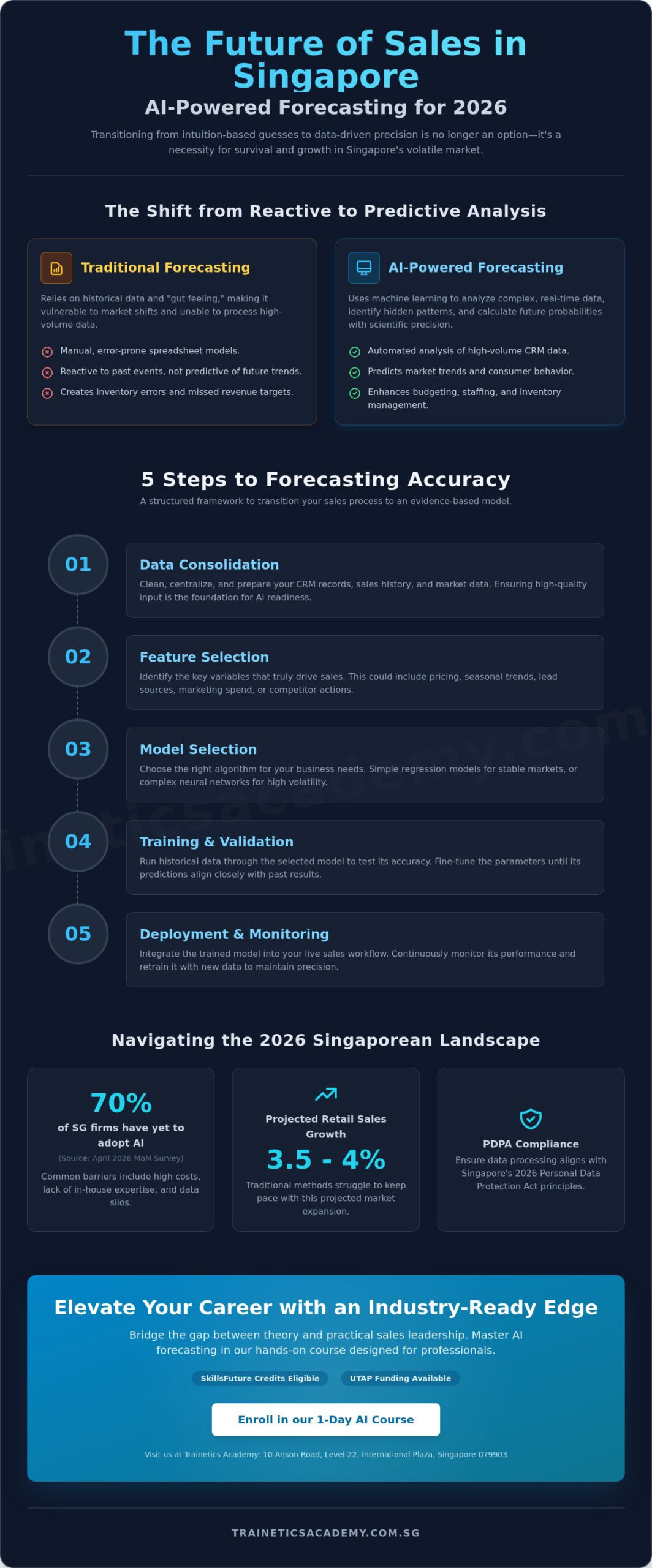
Traditional forecasting methods rely on historical snapshots and intuition. These outdated tools can’t keep pace with the 3.5% to 4% retail sales expansion projected for Singapore in 2026. Relying on gut feeling results in a reactive stance. It leaves sales teams vulnerable to sudden market shifts and regulatory changes like the Personal Data Protection (Amendment) Regulations 2026. Using AI to improve sales forecasting transforms this process into an evidence-based discipline. By utilizing machine learning, professionals can analyze AI in marketing and sales forecasting to identify complex, non-linear patterns that manual spreadsheets often miss.
To better understand how these systems function in a modern business environment, watch this helpful video:
Manual Excel models buckle under the weight of high-volume data generated by modern CRM systems. When your data is stuck in static rows, you lose the ability to see how variables like pricing or seasonal shifts interact in real-time. For Singaporean SMEs, the cost of these inaccuracies is high. Inefficient planning leads to inventory wastage and missed revenue targets. Implementing a system for using AI to improve sales forecasting ensures your business remains competitive, particularly as 80% of local sales professionals already use AI for daily tasks like prospecting and lead scoring.
The Shift from Reactive to Predictive Analysis
Success in 2026 requires moving beyond looking at last year’s KPIs. You must predict next month’s trends. AI tools identify hidden market signals that humans typically overlook. These might include subtle changes in consumer sentiment or shifts in cross-border data flows following the EU-Singapore Digital Trade Agreement. Maintaining an industry-ready strategy means consuming real-time data to pivot before the competition does. It’s about precision and foresight. Machine learning models don’t just look at what happened; they calculate the probability of what will happen by processing thousands of variables simultaneously.
Common Obstacles for Singaporean Sales Teams
Many local corporate structures still suffer from data silos where information is trapped within departments. Managers often face a psychological barrier. They trust their decades of experience over evidence-based models. According to the April 2026 Ministry of Manpower survey, 70% of firms have yet to adopt AI, often citing high implementation costs or a lack of in-house expertise. Overcoming this requires a shift in professional identity. Predictive forecasting serves as a gateway to professional transformation. It allows you to lead with data rather than guesses. Professionals ready to bridge this gap should consider an Artificial Intelligence Course to gain the necessary technical edge. Visit our center at 10 Anson Road, Level 22, International Plaza, Singapore 079903 to learn how to elevate your standards.
5 Steps to Using AI to Improve Sales Forecasting Accuracy
Transitioning to an automated forecasting model requires a disciplined, five-step approach. This methodology ensures your revenue predictions aren’t just guesses, but evidence-based outcomes. Using AI to improve sales forecasting begins with Step 1: Data Consolidation. You must clean and centralize your CRM records to ensure AI readiness. Step 2 is Feature Selection. Here, you identify which specific variables, such as pricing, seasonal trends, or lead sources, actually drive your sales. Step 3 involves Model Selection. Professionals must choose between simple regression models for predictable cycles or complex neural networks for volatile markets. Step 4 focuses on Training and Validation. You run historical data through the model to test its prediction accuracy against known outcomes. Finally, Step 5 is Integration. You feed these AI insights back into your daily sales workflow for real-time adjustments.
Success in this transition is not about the complexity of the software, but the precision of the process. According to a HubSpot study from April 2026, 64% of Singapore businesses are consistently using AI in their daily workflows. However, the 85% of sales professionals who prioritize data cleansing are the ones seeing the highest returns on their investment. By following this structured path, you elevate your professional identity from a traditional manager to a data-driven leader.
Preparing Your Data for Artificial Intelligence Courses and Tools
Data quality is always more important than data quantity. For beginners, the primary goal is removing duplicates and handling missing values in your sales records. Clean data allows machine learning algorithms to identify non-linear patterns without being distracted by "noise." Mastering this documentation process is easier when you use structured frameworks. You can learn to document these new technical processes effectively by exploring business writing with ChatGPT. This ensures your team understands the "why" behind every data entry requirement.
Selecting the Right AI Forecasting Tool for Your Team
Choosing a tool requires balancing technical capability with user accessibility. You might compare built-in CRM AI, like Salesforce Einstein, against standalone predictive platforms that offer deeper customization. Ensure the tool integrates with local Singaporean payment and ERP systems to maintain a seamless data flow. Many professionals now favor "no-code" AI solutions. These allow non-technical sales teams to build powerful models without writing a single line of code. This shift aligns with McKinsey on Singapore’s AI transformation, which emphasizes the need for widespread digital literacy across all sectors. To start your own transformation, consider enrolling in a comprehensive Artificial Intelligence Course to master these tools in a professional setting.
Comparing AI Methods: Which Model Fits Your Business Goal?
Choosing the right mathematical framework is essential for Using AI to improve sales forecasting. Your choice depends on your specific business objectives and the nature of your data. For instance, Time Series Analysis remains the gold standard for seasonal retail and consistent B2B cycles. It focuses on chronological patterns to predict future demand based on historical sequences. Conversely, Regression Models excel when you need to understand how external variables, such as the 2026 tax adjustments or the EU-Singapore Digital Trade Agreement, impact your bottom line. According to Gartner research on AI forecasting, moving to these algorithmic approaches significantly reduces the error rates found in manual "gut-check" methods. By adopting these systems, you align with the visionary leaders who prioritize evidence-based precision over traditional guesswork.
When to Use Time Series vs. Regression
Deciding between these models requires evaluating whether historical patterns or external variables hold more weight in your specific market. A local F&B business in Orchard Road might use Time Series to predict the holiday surge based on the last five years of foot traffic records. However, a Singaporean SaaS firm might prefer Regression Models to predict contract renewals by analyzing customer support tickets and usage frequency. Regression Analysis serves as a rigorous tool for causal understanding, allowing you to isolate specific drivers of growth. Larger firms with over 500 employees often utilize Ensemble Learning to achieve maximum precision across diverse datasets. This advanced technique combines multiple models to neutralize individual biases, ensuring your 2026 revenue predictions are as scientifically grounded as possible.
Predictive Lead Scoring: The Secret to High Conversion
Precision in forecasting isn’t just about total revenue; it’s about knowing which leads will close. AI-driven lead scoring and clustering segment your Singaporean client base by purchase probability. This allows your sales reps to prioritize high-value prospects rather than wasting hours on low-potential inquiries. This proactive approach reduces customer "churn" by identifying behavioral red flags before a client stops buying. When Using AI to improve sales forecasting, the goal is to align your operational resources with the highest possible revenue outcomes. Mastering these nuances is a cornerstone of professional development. To elevate your skills, consider enrolling in our Artificial Intelligence Course. Our experts can guide you through these advanced applications to ensure you remain industry-ready and capable of delivering high-standard results.
Overcoming Local Challenges: Data Privacy and Implementation in SG
Compliance isn’t just a legal hurdle; it’s the foundation of a professional identity in the 2026 digital economy. As of March 2, 2026, the Personal Data Protection (Amendment) Regulations expanded the scope for cross-border data transfers between Singapore and international markets. You must ensure your strategy for Using AI to improve sales forecasting respects these boundaries to avoid financial penalties, which can reach S$1 million or 10% of annual turnover. Precision in data handling is mandatory for any leader aiming to elevate the industry standard and maintain client trust.
Navigating Singapore’s Data Protection Landscape
Organizations must prepare for the December 31, 2026 deadline to cease using NRIC numbers for authentication. When you’re training models, anonymizing customer identifiers is a critical step in maintaining security and regulatory alignment. Localized AI training ensures your systems remain compliant with the EU-Singapore Digital Trade Agreement (EUSDTA), which entered force on February 1, 2026. This agreement introduces binding commitments for data flows, making it essential to audit where your forecasting data is stored and processed.
Startups often worry they lack the massive datasets required for deep learning. You can still succeed by using transfer learning or synthetic data generation to augment your records. Small data doesn’t mean small results; it means you must be more targeted in your approach. The goal is to build models that are "fit for purpose" rather than "one size fits all," ensuring your 2026 budgeting remains grounded in reality even with limited historical inputs. Security in the cloud is often superior to local servers, provided you use encryption standards recognized by the IMDA.
Managing Change Within Your Sales Organization
AI is a powerful tool, but it lacks the ability to interpret local cultural nuances, such as the specific impact of local festive cycles or the "kiasu" sentiment on procurement timelines. This is why a "Human-in-the-loop" approach is vital for Using AI to improve sales forecasting. Your team shouldn’t view AI as an absolute oracle but as a source of high-probability predictions that require professional validation. Trust is built when sales reps see AI as an augmentative partner rather than a replacement for their expertise.
According to the April 2026 MOM survey, 42.4% of firms cite a lack of in-house expertise as a primary barrier to adoption. You can overcome this by fostering a culture that values continuous upskilling and data literacy. Building this internal capability ensures your team remains industry-ready as technology evolves beyond simple automation. Empower your team to lead with confidence and master these technical patterns by enrolling in our Artificial Intelligence Course today. This investment in human capital is what truly drives the ROI of any technological transformation.
Elevate Your Career: Enrolling in a 1 Day AI Course in Singapore
Time is the most valuable asset for any professional in Singapore’s fast-paced economy. A 1 day AI course Singapore offers the most efficient way to acquire high-level technical skills without disrupting your operational commitments. While the April 2026 MOM survey highlights that 42.4% of firms struggle with a lack of in-house expertise, you can position yourself as the solution. Concentrated, high-impact training provides the foundation for Using AI to improve sales forecasting with scientific precision. You aren’t just attending a class; you’re entering a gateway to a more prestigious, data-driven career.
Hands-on, interactive learning is the hallmark of a high-standard education. Working alongside industry leaders at a professional training center allows you to test machine learning models against local market variables in real-time. This practical experience is essential for Using AI to improve sales forecasting and mastering the "Human-in-the-loop" oversight required in 2026. In a single day of training, you will achieve several critical milestones:
- Master the data cleansing techniques required for 85% of AI success stories.
- Understand the functional difference between regression and time-series models.
- Learn to integrate real-time AI insights into your daily sales workflow.
By the end of the session, you’ll have a clear roadmap to automate your forecasting and transform into a visionary mentor within your organization. You’ll gain the confidence to lead your team through the complexities of the 2026 digital landscape.
SkillsFuture AI Courses: Investing in Your Future
Financial barriers shouldn’t hinder your pursuit of excellence. Our Introduction AI Course is eligible for SkillsFuture Credits and UTAP funding, ensuring elite education remains accessible. These SkillsFuture AI courses support the professional evolution of Singaporeans seeking an industry-ready edge. Whether you’re interested in a 1 day AI course SkillsFuture or foundational AI courses for beginners, these subsidies allow you to maximize your 2026 development budget. Eligible learners can leverage these funds to secure their professional identity.
Join Trainetics Academy at International Plaza
Join us at 10 Anson Road, Level 22, International Plaza, Singapore 079903 to begin your journey toward mastery. Our facility provides an environment rooted in academic rigor and professional encouragement. You’ll find that Learning AI Course modules here include mastering practical communication skills using AI tools. This ensures you can translate complex predictive scores into actionable business strategies for your stakeholders. Empower your journey with our Artificial Intelligence Course and elevate your industry standard today.
Master the Science of Predictive Revenue
The transition toward agentic AI is a 2026 reality for the 50% of Singapore sellers already working alongside digital agents. Mastering the art of Using AI to improve sales forecasting allows you to navigate market volatility with the precision of a seasoned industry leader. You’ve learned how to clean CRM data to meet the 85% success threshold and how to select models that align with Singapore’s unique digital trade agreements. This transformation requires more than just new software; it demands a professional identity rooted in continuous improvement and scientific rigor.
Our qualified industry professionals bring sports-science level precision to every session at International Plaza. You don’t have to navigate these technical patterns alone. By prioritizing evidence-based strategies, you ensure your organization remains industry-ready. Our Introduction AI Course is eligible for SkillsFuture Credit and UTAP funding for those ready to begin their journey.
Master the future of sales—Enroll in our Artificial Intelligence Course today
Your journey toward excellence starts with a single, disciplined step. Lead your team with confidence and define the new standard of professional achievement.
Frequently Asked Questions
How accurate is AI in sales forecasting compared to manual methods?
AI is significantly more accurate than manual methods because it eliminates human bias and processes thousands of variables simultaneously. While manual spreadsheets are prone to clerical errors, machine learning models reduce forecasting inaccuracies by approximately 20% to 50%. This evidence-based approach is essential for professionals who value precision in their 2026 revenue predictions and want to avoid costly inventory imbalances.
Do I need to be a coder to use AI for sales forecasting in 2026?
You don’t need to be a coder to leverage these technologies in 2026. The industry has shifted toward "no-code" and "low-code" solutions that prioritize user-friendly interfaces over complex programming. Most sales professionals now interact with AI through their existing CRM platforms, focusing on strategic interpretation and decision-making rather than technical software development or backend scripting.
Which AI tools are best for small businesses in Singapore?
Small businesses in Singapore should prioritize tools that offer seamless integration with local ERP and payment systems. Platforms like HubSpot and Salesforce provide scalable AI features, and specialized providers like HiBotics AI offer automation solutions tailored for firms with fewer than 25 employees. These tools allow smaller teams to compete with larger enterprises by automating prospecting and lead scoring tasks without requiring a massive initial investment.
Can SkillsFuture AI courses help me learn how to implement these tools?
SkillsFuture AI courses are an excellent resource for learning the practical mechanics of implementation. Our Introduction AI Course is eligible for SkillsFuture Credits and UTAP funding, offering a structured path to mastering predictive tools. This training ensures you remain industry-ready by grounding scientific concepts in real-world sales scenarios, helping you bridge the gap between theory and practice.
What kind of data do I need to start using AI for my sales team?
To begin, you require centralized CRM data, including historical transaction records, lead sources, and customer touchpoints. It’s a common misconception that you need massive datasets; instead, focus on data quality and consistency. Cleaning your records is vital, as 85% of Singaporean sales professionals agree that data hygiene is the primary driver of successful AI integration and accurate output.
Is there a 1 day AI course SkillsFuture eligible for professionals?
Yes, a 1 day AI course SkillsFuture eligible opportunity exists for professionals seeking rapid upskilling. Located at 10 Anson Road, Level 22, International Plaza, Singapore 079903, this course covers the essentials of Using AI to improve sales forecasting. It’s designed to provide immediate benefits for your 2026 budgeting and strategic planning, making it ideal for busy executives who require a prestigious edge.
How does AI handle unpredictable market events like global supply chain shifts?
AI handles market volatility by utilizing real-time data streams and ensemble learning to adjust forecasts dynamically. Unlike static manual models, AI can process external signals like shifts in global supply chains or changes in digital trade agreements entered into force in early 2026. This allows your team to pivot strategies before a market shift negatively impacts your bottom line or inventory levels.
What is the ROI of investing in AI training for a sales department?
The ROI of AI training is evidenced by a 70.7% improvement in worker productivity among firms that have adopted these tools as of April 2026. Investing in education reduces the high cost of inventory wastage and missed revenue targets. It empowers your team to identify high-potential leads with scientific precision, elevating your overall industry standard and securing your professional future.
Disclaimer
AI Content Disclaimer: Some articles on this website may be generated or assisted by AI-powered content creation tools. While we strive for accuracy and relevance, readers should independently verify information before relying on it. The content is provided for informational purposes only and does not constitute professional advice.