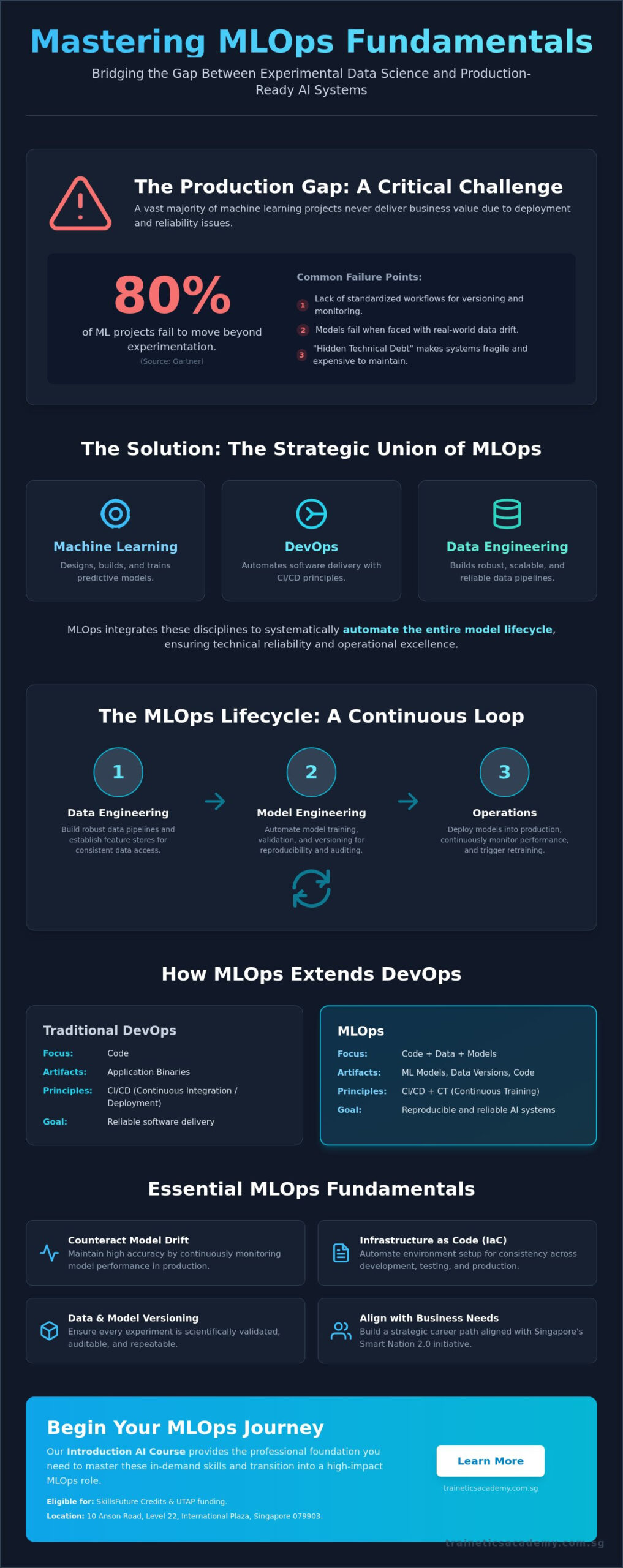
Nearly 80% of machine learning projects fail to move beyond the experimentation phase due to challenges with deployment and model reliability. According to Gartner, this high failure rate often stems from a lack of standardized workflows for versioning and monitoring. You’ve likely felt the frustration of seeing a sophisticated model perform perfectly in a lab setting, only to fail when faced with real world data. Mastering machine learning operations (mlops) fundamentals is the essential step to bridge this gap between experimental data science and production ready AI systems.
This guide empowers you to command the entire MLOps lifecycle and build sustainable workflows that withstand the rigors of the modern industry. We’ll explore the technical skills required to transition into an MLOps role and how to maintain model performance over time. If you’re researching SkillsFuture AI courses or a professional AI course Singapore leaders trust, our Introduction AI Course is eligible for SkillsFuture Credits and UTAP funding. Join us at 10 Anson Road, Level 22, International Plaza, Singapore 079903, as we redefine the benchmarks of excellence in the AI sector.
Key Takeaways
- Understand how the strategic integration of machine learning, DevOps, and data engineering creates a unified framework for production-ready AI.
- Master the machine learning operations (mlops) fundamentals necessary to automate the entire model lifecycle and ensure long-term technical reliability.
- Learn to identify and counteract model drift to maintain high accuracy and performance in real-world business applications.
- Identify the critical shift toward Infrastructure as Code and data versioning tools required for advanced professional mastery in the field.
- Explore the strategic career path for MLOps professionals and how to align your skills with the high-demand benchmarks of Singapore’s Smart Nation 2.0 initiative.
Defining Machine Learning Operations (MLOps) Fundamentals in 2026
MLOps represents the strategic union of machine learning, DevOps, and data engineering. It focuses on the systematic automation of the entire model lifecycle to ensure technical reliability and operational excellence. By mastering machine learning operations (mlops) fundamentals, professionals move beyond the chaotic “lab experiment” phase and into the world of scalable, production ready systems. Unlike traditional software engineering, where the primary focus remains on code, MLOps addresses the dynamic nature of data and the inevitable decay of model performance over time.
To better understand the technical execution of model serving, watch this helpful video:
The discipline was born from a critical need to manage the “Hidden Technical Debt” in machine learning systems, a concept first popularized in a 2015 research paper. This debt occurs because machine learning systems are inherently complex; they’re composed of vast amounts of configuration, data collection, and feature extraction code that surround the actual ML model. Without a rigorous framework, these systems become fragile and expensive to maintain. MLOps provides the structural integrity needed to manage these dependencies at scale.
The Intersection of DevOps and Machine Learning
MLOps inherits the core principles of Continuous Integration and Continuous Deployment (CI/CD) but adds a critical third pillar: Continuous Training (CT). While standard DevOps focuses on versioning code, MLOps requires the simultaneous versioning of code, data, and the resulting model. This ensures reproducibility, allowing engineers to audit exactly which dataset produced a specific model version. By “shifting left,” or integrating testing and validation earlier in the development cycle, organizations significantly reduce long term operational costs and prevent faulty models from reaching end users. Data versioning tools become as fundamental as Git, ensuring every experiment is scientifically validated and repeatable.
Why MLOps is Essential for Business Scalability
Scaling AI requires moving away from manual “Level 0” workflows, where data scientists hand off models to engineers in a fragmented, error prone process. Fully automated pipelines allow for rapid iteration and deployment, which is vital for maintaining a competitive edge. In the Singapore market, companies that adopt these frameworks see a direct impact on ROI by reducing the time to market for new AI features. Singapore’s Smart Nation initiative demands a high level of precision; MLOps provides the guardrails necessary to meet these national benchmarks for innovation. If you’re looking to master these skills, our Artificial Intelligence Course provides the professional foundation you need. The Introduction AI Course is eligible for SkillsFuture Credits and UTAP funding. You can find us at 10 Anson Road, Level 22, International Plaza, Singapore 079903. MLOps is the bridge between model creation and commercial impact.
The MLOps Lifecycle: From Development to Production
The transition from a static model to a dynamic, production ready system requires a disciplined adherence to the MLOps lifecycle. This process isn’t a linear path but a continuous loop consisting of three core pillars: Data Engineering, Model Engineering, and Operations. Within these phases, machine learning operations (mlops) fundamentals dictate that every step must be reproducible and auditable. Establishing rigorous data lineage allows your team to trace a model’s prediction back to the exact version of the dataset and code used during its creation. This level of precision is what separates amateur experiments from professional AI systems.
Data Engineering and Feature Stores
Reliable AI begins with robust data pipelines. These pipelines ensure that the data used for training is identical to the data encountered during real world inference. Feature stores serve as the central repository for these processed data points, acting as the backbone of any mature MLOps architecture. They eliminate “training serving skew,” a common cause of model failure. In Singapore, these pipelines must be designed with the PDPA framework in mind, ensuring that personal data is handled with the highest standards of security and compliance. Professionals who understand this Introduction to MLOps realize that data integrity is non negotiable.
Continuous Integration and Deployment (CI/CD) for ML
Automated testing is the guardian of your production environment. Unlike traditional software, ML systems require testing for both code quality and data validity. If new data arrives that deviates from the training distribution, a trigger mechanism initiates Continuous Training (CT) to refresh the model. This automation prevents “broken” or outdated models from reaching your end users. Those looking to build these skills from the ground up should consider an AI Course to grasp the underlying principles of neural networks and data science. It’s the first step toward technical mastery.
Model Serving and Orchestration
Once a model passes validation, it must be “served” to users. Modern orchestration uses containers like Docker and Kubernetes to ensure the environment remains consistent across development and production. You’ll need to choose between batch processing for high volume, offline tasks or real time inference for immediate responses. Deployment strategies such as A/B testing or Canary releases allow you to roll out updates to a small subset of users first, minimizing risk. Monitoring latency and throughput ensures your system meets professional benchmarks for performance. If you want to accelerate your career, exploring an AI course Singapore professionals recommend is a strategic move for your development.
Overcoming Critical Challenges in Machine Learning Systems
Deploying a model isn’t the finish line; it’s the start of a rigorous maintenance cycle. One of the most significant hurdles in machine learning operations (mlops) fundamentals is “Model Drift.” This occurs when the performance of a deployed model degrades because the real world has changed. Data Drift happens when the statistical properties of the input data shift, such as a sudden change in user demographics or purchasing habits. Concept Drift is more insidious; it occurs when the relationship between inputs and outputs changes, like a fraud detection model failing because criminals adopted new tactics. Without a mature MLOps engineering culture and practice, these shifts go unnoticed until they impact the bottom line.
Another challenge is the “Cold Start” problem, where a system lacks enough historical data to make accurate predictions for new users or products. This phenomenon often occurs in recommendation systems where the lack of interaction data prevents the model from making personalized suggestions. Overcoming this requires a blend of heuristic rules and transfer learning, proving that MLOps is as much about creative problem solving as it is about infrastructure. To mitigate these risks, professional systems often employ a Human-in-the-loop (HITL) approach. This ensures that for critical decision-making, a qualified professional validates the AI’s output, maintaining the high standards expected in regulated industries.
Addressing Model Drift and Performance Decay
Maintaining accuracy requires setting up automated alerts that trigger when model performance falls below a predefined threshold. You must develop strategies for retraining models in the background without disrupting live services, ensuring a seamless transition. This proactive monitoring is vital for technical mastery. For those looking to dive deeper into the societal implications of these failures, our Understanding AI Ethics and Risks Course provides a framework for addressing biased data and ensuring algorithmic fairness.
Managing Technical Debt in AI Workflows
Technical debt in ML is compounded by the unpredictability of data. Quick-fix scripts might solve a problem today, but they lead to fragile, unmaintainable systems in the long run. Professional excellence demands standardized metadata tracking and comprehensive documentation to ensure team continuity. Mastering these workflows is essential for anyone taking an AI course Singapore professionals trust to sharpen their technical edge. By prioritizing long-term stability over short-term fixes, you establish a professional identity rooted in excellence and precision.
Essential Skillsets and Tools for MLOps Beginners
Mastering the machine learning operations (mlops) fundamentals requires a shift in perspective. You aren’t just writing code to solve a mathematical problem; you’re building the factory that produces and maintains those solutions. Beginners often make the mistake of focusing solely on model architecture while neglecting the infrastructure that keeps that model alive. A professional MLOps engineer must balance deep technical proficiency with an understanding of how different systems interact in a high pressure production environment. This transition from “code first” to “infrastructure first” is the hallmark of a mature AI professional.
Programming and Infrastructure as Code
Python proficiency remains the non negotiable baseline for all AI courses for beginners. It’s the language of the AI ecosystem, but it’s no longer enough on its own. You must also command the environments where this code lives. This means gaining a functional understanding of Linux, Bash scripting, and the core services of cloud providers like AWS, Azure, or GCP. To ensure excellence and reproducibility, we use Infrastructure as Code (IaC) tools like Terraform or Pulumi. These tools allow you to define your entire cloud environment through configuration files, making it easy to rebuild or scale your systems with a single command.
Monitoring and Observability Tools
Visibility into your system is the only way to guarantee reliability. Traditional IT monitoring focuses on system health, such as CPU usage and RAM availability. While these are important, MLOps demands a more sophisticated approach. You must track ML specific metrics, including prediction accuracy, latency, and potential bias. Tools like Prometheus and Grafana, which are industry standards for system observability, are now adapted to visualize model health in real time. Building a comprehensive dashboard allows you to spot anomalies before they impact the user experience, ensuring your AI remains a valuable asset rather than a liability.
Beyond the technical stack, your success depends on your ability to bridge the gap between data science and IT operations. Data scientists focus on experimentation, while operations teams prioritize stability. Your role is to facilitate collaboration between these two worlds, ensuring that experimental breakthroughs can be deployed without compromising the integrity of the production environment. Using version control for data (DVC) and experiment tracking tools like MLflow or Weights & Biases ensures that every step of this collaboration is documented and scientifically sound. If you’re ready to elevate your career and master these complex workflows, enroll in our Artificial Intelligence Course today to build your professional identity in this high demand field.
Navigating Your MLOps Career Path in Singapore
The Smart Nation 2.0 initiative has transformed the local employment landscape, placing a premium on those who can navigate machine learning operations (mlops) fundamentals. In Singapore, the average monthly salary for a Machine Learning Engineer now ranges from S$10,750 to S$13,250, reflecting the critical nature of this role. Transitioning from a standard software position into an AI centric career requires more than just learning new libraries; it demands a shift toward operational excellence and system reliability. This professional evolution ensures that you’re not just a developer, but a visionary architect capable of maintaining sophisticated AI ecosystems.
Professional Training and AI Course Opportunities
Upskilling is the primary driver of career mobility in the current market. For busy professionals, a 1 day AI course Singapore provides an intensive introduction to the core concepts needed to pivot into MLOps. You can further enhance your professional identity by exploring SkillsFuture AI courses that align with your career goals. Combining these technical foundations with specialized modules like AI for Process Automation allows you to deliver immediate, measurable impact within your organization. This structured approach to learning ensures you stay ahead of international benchmarks for AI proficiency and operational rigor.
Strategic Growth for Singapore SMEs
Local SMEs must adopt MLOps to remain competitive against larger regional tech firms. Building a lean MLOps stack allows smaller enterprises to deploy and monitor models with high precision without the need for a massive engineering team. This scalability is essential for survival in a data driven economy. By focusing on automated workflows and rigorous machine learning operations (mlops) fundamentals, SMEs can ensure their AI initiatives are both ethical and commercially viable. For organizations looking to build team-wide AI competency from the ground up, an AI workshop for corporate teams in Singapore provides a structured pathway to standardize usage and maximize measurable ROI. This commitment to technical mastery is what will define the next generation of industry leaders in Singapore. Our Artificial Intelligence Course provides the baseline knowledge required to begin this journey and establish a prestigious career path.
Master the Future of AI Deployment
The journey toward AI maturity is no longer a matter of choice but a requirement for professional survival. We’ve explored the lifecycle from data engineering to model serving and identified the technical skillsets needed to overcome model drift. By mastering machine learning operations (mlops) fundamentals, you transform from a developer into a strategic architect of reliable systems. This discipline ensures that your AI contributions are not just experiments, but robust commercial assets that meet the highest standards of engineering excellence and operational rigor.
Trainetics Academy provides expert-led training focused on professional readiness. Our hands-on curriculum prepares you to lead AI initiatives with precision and scientific rigor, ensuring you’re prepared for the complexities of a production environment. Enroll in our Artificial Intelligence Course to build your MLOps foundation today and join an elite community of tech leaders. Your path to technical mastery is clear; it’s time to seize the opportunity and redefine your professional identity in the age of automation.
Frequently Asked Questions
What is the difference between MLOps and DevOps?
DevOps focuses on the continuous integration and delivery of software code to ensure system reliability and speed. MLOps extends these principles by adding the complexities of data versioning and continuous model training. While DevOps manages the lifecycle of code, MLOps must simultaneously manage code, data, and the resulting machine learning models to prevent performance decay in production environments.
Is MLOps only for large tech companies?
No, MLOps is a strategic necessity for organizations of all sizes, including Singaporean SMEs. Implementing a lean MLOps stack allows smaller teams to automate their workflows and compete with larger firms by ensuring their AI systems are reliable and scalable. This approach minimizes technical debt and ensures that AI initiatives deliver measurable commercial value without requiring massive engineering departments.
What programming languages are most important for MLOps?
Python remains the dominant language for MLOps due to its extensive libraries for data science and infrastructure automation. However, a professional must also command Bash for scripting and have a functional understanding of configuration languages like YAML. These tools are essential for managing the containers and orchestration platforms that form the backbone of modern AI systems.
How can a beginner start learning MLOps fundamentals in Singapore?
Beginners should first establish a strong foundation in AI principles before moving into operational frameworks. Enrolling in an AI course Singapore leaders recognize for its academic rigor is a vital first step. You can begin your journey at 10 Anson Road, Level 22, International Plaza, Singapore 079903, where we focus on bridging the gap between theory and professional readiness.
Can I use SkillsFuture Credit for MLOps-related AI courses?
Yes, our Introduction AI Course is eligible for SkillsFuture Credits and UTAP funding. This allows ambitious professionals to leverage SkillsFuture AI courses to upskill in high-demand technical areas without significant financial barriers. Aligning your education with these national frameworks ensures your skills meet the rigorous benchmarks required by Singapore’s Smart Nation 2.0 initiative.
What is model drift and why does it matter?
Model drift refers to the degradation of a model’s predictive accuracy over time as real-world data evolves. It matters because a model that performs well today can quickly become a liability if it fails to adapt to new trends or user behaviors. Mastering machine learning operations (mlops) fundamentals provides the monitoring tools necessary to detect this decay and trigger automated retraining pipelines.
Do I need to be a data scientist to work in MLOps?
No, the MLOps field is highly multidisciplinary and welcomes professionals from software engineering and DevOps backgrounds. While you must understand how models function, your primary responsibility is the infrastructure, automation, and reliability of the AI system. This role is ideal for engineers who value precision and want to transition into a prestigious career at the intersection of AI and operations.
What are the most popular MLOps tools in 2026?
Leading tools for experiment tracking and orchestration include MLflow, Kubeflow, and Weights & Biases. For data versioning, DVC is the industry standard for ensuring scientific reproducibility. Managed platforms such as AWS SageMaker and Google Vertex AI also remain essential for organizations looking to deploy and monitor sophisticated deep learning models with professional-grade efficiency.
Disclaimer
AI Content Disclaimer: Some articles on this website may be generated or assisted by AI-powered content creation tools. While we strive for accuracy and relevance, readers should independently verify information before relying on it. The content is provided for informational purposes only and does not constitute professional advice.