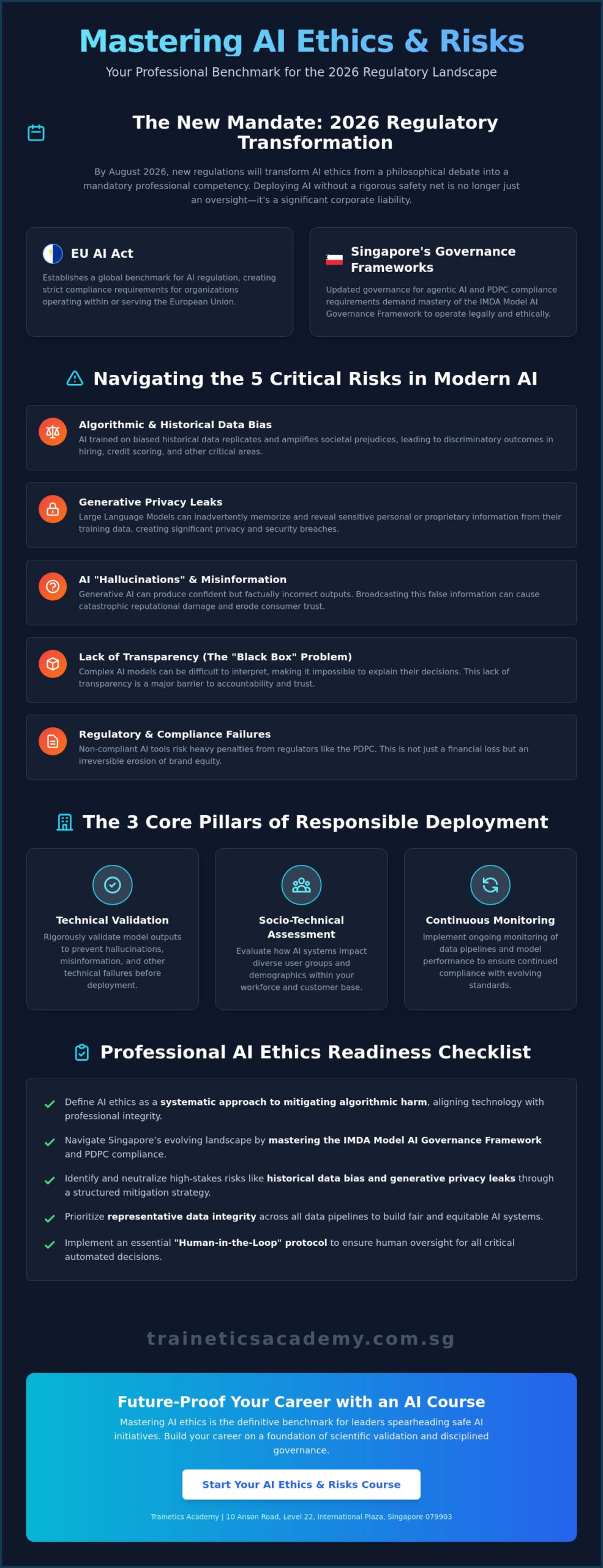
By August 2026, the full enforcement of the EU AI Act and Singapore’s updated governance frameworks for agentic systems will transform AI ethics from a philosophical debate into a mandatory professional competency. You likely recognize that deploying autonomous technology without a rigorous safety net is no longer just a technical oversight; it’s a significant corporate liability. This is why enrolling in a comprehensive understanding ai ethics and risks course has become the definitive benchmark for leaders who refuse to leave their professional reputation to chance.
It’s understandable to feel anxious about the complexities of PDPC compliance or the hidden biases that can compromise your operational integrity. You want to bridge the gap between global standards and local Singaporean requirements while ensuring your team remains at the forefront of innovation. This article promises to provide the professional checklist you need to master risk mitigation and identify a high-caliber AI course that translates ethical theory into actionable business strategies. We’ll preview the critical shifts in the 2026 regulatory landscape and show you how to protect your organization’s future through technical mastery and disciplined governance.
Key Takeaways
- Define AI ethics as a systematic approach to mitigating algorithmic harm, ensuring your technology aligns with professional integrity and international benchmarks.
- Navigate Singapore’s evolving governance landscape by mastering the IMDA Model AI Governance Framework and critical PDPC compliance requirements.
- Identify and neutralize high-stakes risks such as historical data bias and generative privacy leaks through a structured professional mitigation strategy.
- Implement a professional readiness checklist that prioritizes representative data integrity and the essential “Human-in-the-Loop” protocol for critical decisions.
- Recognize why an understanding ai ethics and risks course has become the mandatory benchmark for leaders spearheading safe AI initiatives in 2026.
Why Understanding AI Ethics and Risks is the New Professional Benchmark
Professional mastery in 2026 demands a shift from technical execution to ethical stewardship. We define AI ethics as the systematic mitigation of algorithmic harm and bias. It’s the rigorous framework that ensures machine learning outputs remain aligned with human safety and organizational integrity. For those seeking a comprehensive overview of AI ethics, the focus remains on accountability, fairness, and the prevention of unintended consequences in automated systems.
Enrolling in an understanding ai ethics and risks course provides the intellectual armor required to lead in a volatile market. Any 1 day AI course Singapore professionals attend must prioritize these frameworks over pure coding. The era of “move fast and break things” has ended. In its place, corporate Singapore has adopted a “should we use it” philosophy that values precision over speed. This shift distinguishes a standard technician from a true industry leader who understands the weight of every algorithmic decision.
To better understand the core principles of this field, watch this helpful video from IBM Technology:
Leaders must now evaluate three core pillars of responsible deployment:
- Technical validation of model outputs to prevent hallucinations and misinformation.
- Socio-technical assessments of how AI affects diverse demographics within your workforce.
- Continuous monitoring of data pipelines to ensure ongoing compliance with evolving standards.
The Consequences of Ignoring AI Risks in Business
Neglecting these protocols invites catastrophic reputational damage. Generative “hallucinations” can broadcast false information, while biased outputs in hiring or credit scoring lead to immediate public backlash. Within the Singaporean market, non-compliant AI tools risk heavy penalties from regulators. This isn’t just about financial loss; it’s about the irreversible erosion of consumer trust when transparency fails. A single unvetted automated response can dismantle years of brand equity in minutes.
Ethics as a Competitive Advantage
Ethical leadership acts as a magnet for top-tier tech talent who prioritize purpose-driven work. When you implement a “human-in-the-loop” philosophy, you ensure that AI serves as a tool for augmentation rather than a liability. This disciplined approach drives long-term ROI by preventing costly pivots and legal challenges. Starting with an AI course at our center located at 10 Anson Road, Level 22, International Plaza, Singapore 079903 ensures you build your career on a foundation of scientific validation. Mastery of these benchmarks secures your place as a visionary mentor in your industry.
Navigating the 5 Critical Risks in Modern AI Implementation
Identifying specific critical risks in AI implementation requires more than a casual glance at a dashboard. It demands a rigorous diagnostic approach to the infrastructure supporting your models. Professionals must recognize that these vulnerabilities often exist beneath the surface of seemingly efficient workflows, waiting to compromise organizational integrity.
Deconstructing Algorithmic Bias
Algorithmic bias is perhaps the most insidious threat to modern business operations. Historical data isn’t neutral; it’s a mirror of past societal prejudices. When recruitment tools are trained on a decade of homogenous hiring data, they don’t just find talent; they replicate exclusion. This creates destructive feedback loops where the system confirms its own bias by only recommending candidates who fit a narrow, historically favored profile. Financial services face similar dangers when automated credit scoring relies on proxy variables that unfairly penalize specific demographics. You can neutralize this by conducting regular audits of your tool’s decision-making patterns and using representative synthetic data for stress testing.
Data privacy and sovereignty have also entered a high-stakes era. Every prompt entered into a public generative model risks leaking trade secrets or sensitive customer information. Safeguarding this data requires the technical mastery found in a understanding ai ethics and risks course. Leaders must learn to implement robust data masking and local inference protocols to maintain absolute control over their intellectual property.
The Transparency Challenge for Non-Coders
The accountability gap remains a major concern for corporate governance. When an autonomous system makes a flawed decision, the question of who is responsible often goes unanswered. This ties directly into the transparency challenge. The “Black Box” problem isn’t just for developers; it’s a management crisis. In high-stakes sectors like finance or healthcare, you must demand interpretable models where every decision path is visible to human oversight. You don’t need to be a programmer to demand explainable AI. To gain deeper insights into how these models process information, look into our Natural Language Processing (NLP) Course for Business Analysts. It’s an excellent way to demystify complex outputs and ensure your team remains in control.
Finally, the hidden carbon footprint of large-scale AI cannot be ignored. Training a single massive model can consume vast amounts of energy, often equivalent to the lifetime emissions of multiple vehicles. A professional leader in 2026 considers the ecological utility of their tech stack alongside its financial ROI. Enrolling in a dedicated understanding ai ethics and risks course ensures you don’t just identify these risks but actively build systems to prevent them. If you’re ready to raise your professional benchmarks, consider exploring our comprehensive AI course options.
Singapore’s AI Governance Landscape: Frameworks and Compliance in 2026
Singapore leads the global conversation on responsible automation through the Infocomm Media Development Authority (IMDA) and the Personal Data Protection Commission (PDPC). On January 22, 2026, the IMDA launched the world’s first Model AI Governance Framework for Agentic AI. This pioneering framework addresses the unique challenges of systems capable of autonomous action. It was updated in May 2026 to include real-world case studies and advanced best practices. For any professional, an understanding ai ethics and risks course must center on these local benchmarks to ensure operational compliance and scientific validation.
The PDPC plays a vital role in ensuring that AI deployment respects data privacy. They oversee how personal data is utilized within training sets and generative outputs. Relying solely on global standards is a strategic error. Any AI course Singapore professionals choose must provide deep dives into these regional requirements to protect their organizations from regulatory scrutiny. This localized knowledge transforms a standard practitioner into a visionary mentor capable of navigating complex legal landscapes.
The Four Pillars of Singaporean AI Ethics
Singapore’s framework rests on four essential pillars that guide ethical implementation:
- Internal Governance: Establishing clear roles and responsibilities for AI oversight within the organization.
- Determining AI Decision-Making Model: Defining the level of human involvement based on the risk profile of the decision.
- Operations Management: Managing data lineage and model performance continuously.
- Stakeholder Interaction: Ensuring transparency and effective communication with end-users.
Large corporations often require dedicated ethics boards to manage these pillars. In contrast, SMEs might focus on lean, automated monitoring tools to maintain high standards. AI Verify serves as Singapore’s flagship tool for objective AI testing, providing verifiable evidence of a model’s fairness and safety.
Regulatory Trends to Watch in 2026
The regulatory environment is tightening as we move through the year. We see a distinct shift toward mandatory AI impact assessments for high-stakes industries like finance and healthcare. By August 2026, the full enforcement of international laws like the EU AI Act will also influence how Singaporean firms interact with global markets. Understanding these shifts is part of becoming a disciplined leader who values precision and professional readiness. For a broader perspective on the digital ecosystem, consult our Information Technology in Singapore Guide. This context ensures your ethical framework remains grounded in the wider technological landscape of our region.
The Professional AI Ethics Checklist: Assessing Your Organization’s Readiness
Practicality is the hallmark of a disciplined leader. While understanding the IMDA framework is essential, you must translate those high-level principles into daily operational protocols. A rigorous understanding ai ethics and risks course provides the technical framework to conduct these assessments with precision. At our headquarters at 10 Anson Road, Level 22, International Plaza, Singapore 079903, we emphasize that readiness is not a one-time achievement but a state of continuous improvement.
Your organization must evaluate its current posture against these five critical benchmarks:
- Data Integrity: Verify that your training data is representative and legally sourced. If your datasets are poisoned by historical bias, your outputs will inevitably fail professional benchmarks.
- Human Oversight: Implement a clear “Human-in-the-Loop” protocol for every high-stakes decision. This ensures that machine autonomy never bypasses human accountability.
- Vendor Transparency: Audit the ethical standards of your AI software providers. You are ultimately responsible for the integrity of the tools you integrate into your business stack.
- Bias Monitoring: Establish a recurring schedule for testing algorithmic fairness. Bias is a dynamic threat that requires ongoing scientific validation rather than a single fix.
- Impact Disclosure: Maintain total transparency with your end-users. Individuals must be aware when they are interacting with an AI or being judged by an automated system.
Internal Policy Assessment
A visionary mentor doesn’t leave ethics to chance. You must establish a written AI Ethics Charter that defines your organization’s commitment to responsible innovation. It’s vital to create a clear escalation path for AI errors. This allows your team to neutralize “hallucinations” or biased outputs before they result in significant corporate liability. Mastery of these internal policies distinguishes a top-tier professional from a standard practitioner.
Skills and Training Gap Analysis
Identify which departments require an AI course for beginners most urgently. Often, departments like HR or customer service are the first to deploy generative tools but the last to receive formal ethical training. Your staff must possess the technical literacy to explain AI-driven decisions to both clients and regulators with absolute confidence. Ensuring your models remain reliable in production environments is equally critical; understanding machine learning operations (MLOps) fundamentals equips your team with the standardized workflows needed to keep deployed models performing safely over time. For those looking to optimize efficiency alongside safety, our AI for Process Automation Guide offers a strategic roadmap for productivity in the 2026 market. Take the first step toward professional excellence by exploring our comprehensive Artificial Intelligence Course today.
Future-Proofing Your Career with an AI Course at Trainetics Academy
Trainetics Academy serves as the essential bridge between raw technical execution and visionary professional leadership. We recognize that mastery in the 2026 tech landscape requires more than just technical knowledge; it requires a robust ethical compass and a commitment to excellence. Our understanding ai ethics and risks course curriculum is designed to transform you into a disciplined leader who values precision and scientific validation. We host our intensive training sessions at our centrally located professional hub in the heart of the business district.
Why Learn with Trainetics Academy?
We prioritize practical, career-ready skills over abstract coding theory. Our interactive, professional-led curriculum is meticulously aligned with Singaporean benchmarks, ensuring you stay ahead of regional regulatory shifts. You’ll engage with real-world case studies that mirror the high standards of the industry itself. This rigorous approach ensures your transition into an AI-enhanced role feels both exciting and scientifically grounded. Our Introduction AI Course is Eligible for SkillsFuture Credits and UTAP funding, reflecting our commitment to raising professional benchmarks across the local workforce.
Enrollment and Professional Outcomes
Transitioning from a beginner to an AI-literate leader requires a structured learning path that mirrors the organized nature of our training programs. We offer more than just a certification; we offer a professional identity. By the end of your training, you’ll possess the confidence to lead AI initiatives safely and explain complex ethical decisions to stakeholders. Visit our professional suite to begin your transformation and join a community of elite practitioners. Don’t leave your career trajectory to chance. Enroll in the Artificial Intelligence Course today and secure your place as a leader in the digital economy.
Lead the Next Era of Responsible Innovation
Mastering the ethical dimensions of automation is the most critical investment you’ll make in 2026. You’ve learned that success requires more than technical skill; it demands a deep commitment to the IMDA Model AI Governance Framework and a rigorous approach to bias mitigation. By prioritizing transparency and human oversight, you protect your organization from reputational damage and legal liability while fostering a culture of excellence. These benchmarks aren’t just suggestions; they’re the foundations of a prestigious career in a tech-driven economy.
Enrolling in a comprehensive understanding ai ethics and risks course isn’t just about regulatory compliance. It’s about claiming your identity as a visionary leader who can navigate complex technological challenges with scientific precision. Our academy provides the highest standard of professional development through highly qualified professional trainers and interactive virtual and physical learning platforms. We ensure that subsidies remain available for eligible Singaporeans, making prestigious career advancement accessible to all ambitious professionals ready to raise their benchmarks.
Secure your future and enroll in our Artificial Intelligence Course today. We’re ready to help you master these essential frameworks and lead the next era of innovation with absolute confidence.
Frequently Asked Questions
What are the main ethical concerns in an AI course for beginners?
Algorithmic bias and data privacy are the primary concerns addressed in foundational training. Beginners learn that historical data often contains prejudices that automated systems can amplify. This results in unfair outcomes in recruitment or financial services. Professional education focuses on identifying these flaws and implementing technical controls to protect sensitive information while maintaining model integrity and scientific validation.
Is an understanding ai ethics and risks course necessary for non-technical managers?
Yes, an understanding ai ethics and risks course is a strategic imperative for every modern leader. Managers don’t need to write code, but they are ultimately accountable for the legal and reputational consequences of AI deployment. This training provides the intellectual framework required to oversee technical teams and ensure every initiative aligns with professional benchmarks and rigorous safety standards.
How does Singapore regulate AI ethics compared to the rest of the world?
Singapore prioritizes a practical, innovation-friendly approach through the Model AI Governance Framework, which was updated in May 2026. While the EU AI Act becomes fully enforceable on August 2, 2026, with mandatory requirements, Singapore focuses on voluntary technical controls and accountability. This local framework emphasizes upfront risk assessment and human accountability, especially for agentic systems capable of autonomous action.
Can I use SkillsFuture Credits for an AI course Singapore at Trainetics Academy?
The Introduction AI Course is eligible for specific professional subsidies. We design our AI course Singapore programs to be accessible to ambitious professionals who are dedicated to continuous improvement and technical mastery. You should consult our latest program guides to understand how these financial supports can facilitate your transition into a high-stakes tech career without unnecessary barriers.
What is the most common risk in implementing Generative AI for business?
Hallucinations and the leakage of intellectual property are the most frequent risks. Generative models can produce false information with high confidence, which can dismantle brand trust if not caught by human oversight. Professionals must implement rigorous validation protocols to ensure that every output is scientifically grounded and safe for public consumption, protecting the company from significant corporate liability.
What happens if a company ignores AI ethics in Singapore?
Ignoring these standards results in severe reputational damage and potential regulatory action from the PDPC. Beyond financial penalties, companies risk losing consumer trust and their competitive edge in a market that increasingly values transparency. A disciplined leader understands that ethical stewardship is not optional; it’s a prerequisite for long-term organizational stability and maintaining high professional standards.
How long does a typical 1 day AI course Singapore take to cover ethics?
A standard 1 day AI course Singapore professionals attend usually allocates three to four hours specifically to ethics and risk mitigation. This concentrated focus ensures you walk away with a practical checklist for assessing your organization’s readiness. It bridges the gap between foundational concepts and the advanced applications required to lead AI initiatives safely in a volatile market.
What is AI Verify and why should I care about it?
AI Verify is a flagship governance testing framework that provides objective evidence of your system’s performance. It allows you to validate your AI models against international standards for fairness and explainability. As an industry leader, you should utilize this tool to prove your commitment to professional readiness and build trust with clients and regulators through verifiable, technical evidence.
Disclaimer
AI Content Disclaimer: Some articles on this website may be generated or assisted by AI-powered content creation tools. While we strive for accuracy and relevance, readers should independently verify information before relying on it. The content is provided for informational purposes only and does not constitute professional advice.