With the global AI skills gap projected to cost businesses a staggering S$5.5 trillion in lost productivity, simply attending a course is no longer a viable strategy for Singaporean firms. You’re likely feeling the intense pressure to show immediate efficiency gains while worrying that today’s tools will be obsolete by next quarter. It’s difficult to quantify the impact of technical upskilling when leadership demands hard numbers rather than vague promises of innovation. We understand that you need to bridge the gap between scientific rigor and practical business outcomes.
Master the frameworks needed to turn an Artificial Intelligence Course into data-backed justifications that secure executive approval and long term budget allocation. We’ll show you exactly how to measure roi of corporate ai training by moving beyond completion rates and focusing on the reduction of workflow friction across your organization. This guide provides a repeatable 2026 strategic framework to align your training investments with corporate KPIs. You’ll learn to capture the average S$3.70 return for every dollar spent while ensuring your workforce meets the highest international benchmarks for professional readiness.
Key Takeaways
- Understand why software spending without human upskilling yields zero ROI. We’ll show you how to build a workforce that’s ready for the 2026 business landscape.
- Master the precise metrics for how to measure roi of corporate ai training. This approach transforms soft skills into quantifiable financial outcomes.
- Pinpoint high-impact use cases in operations and marketing. These specific applications deliver immediate efficiency gains and justify your training budget.
- Learn to articulate the value of AI literacy. You’ll calculate both tangible time savings and the intangible reduction of burnout from repetitive tasks.
- Build a data-backed business case that meets international benchmarks. Secure long-term leadership support for your professional development initiatives.
Why AI Training is the Foundation of Your 2026 Business Strategy
Many Singaporean firms fall into the trap of purchasing expensive software licenses without investing in their people. This creates the "AI Productivity Gap," where software investment alone yields 0% ROI. Without a skilled workforce to operate these tools, your digital transformation remains stagnant. Understanding the fundamental Return on Investment (ROI) of any technology requires looking beyond the initial purchase price to the human proficiency driving it. Success isn’t found in the software; it’s found in the mastery of those who wield it.
Learning how to measure roi of corporate ai training starts with acknowledging that your staff are the ultimate catalysts for organizational agility. Hiring external AI specialists in Singapore’s tight labor market is increasingly cost-prohibitive. Salaries for niche AI roles have skyrocketed, making internal upskilling the only logical path to excellence. It’s about building a professional identity that values continuous improvement and scientific rigor. When you invest in your current team, you aren’t just saving on recruitment costs; you’re cultivating a deep institutional knowledge that external hires cannot replicate.
To better understand this concept, watch this helpful video:
The Human Element in Digital Transformation
AI tools are only as effective as the prompts and oversight provided by your staff. Precision matters. We’re seeing a shift where manual tasks are replaced by AI-augmented strategic roles. This transition isn’t just about efficiency; it’s a powerful retention tool. Top-tier professionals want to work for visionary leaders who invest in their technical mastery. By providing an Artificial Intelligence Course, you signal a commitment to professional excellence that keeps your best talent engaged and ready for the challenges of 2026.
Aligning Artificial Intelligence Courses with Corporate Goals
Every training initiative should map directly to your corporate KPIs. Whether it’s reducing turnaround time or increasing lead generation, the curriculum must support your specific innovation benchmarks. Establishing baseline AI literacy across all departments ensures that your entire organization moves in sync. This alignment is critical for those trying to understand how to measure roi of corporate ai training effectively. The cost of inaction is too high; a non-AI-literate workforce puts you at a severe competitive disadvantage in a market that demands scientific validation and professional readiness. If your competitors save 11.4 hours per week per employee while you remain stagnant, your current margins will inevitably evaporate.
Identifying High-Impact Use Cases for AI Upskilling
Identifying the most effective applications for AI within your firm is a matter of strategic precision. In marketing, this involves evolving from simple content generation to sophisticated, data-driven customer insights that shape long term strategy. Operations teams can optimize supply chain communication and internal reporting, converting raw data into strategic intelligence. Finance departments find significant value in predictive modeling and automated auditing; meanwhile, customer service transitions to high-level NLP support that mirrors human empathy. Pinpointing these high-impact areas is essential when you are learning how to measure roi of corporate ai training within a competitive market like Singapore.
Adopting a productivity-first approach to measuring ROI ensures your upskilling initiatives are grounded in business reality. This disciplined focus allows you to see exactly where technical mastery delivers the highest dividends. When you target specific departmental friction points, the transition from investment to measurable profit becomes a logical progression.
Departmental Deep-Dives
Administrative efficiency undergoes a radical transformation when staff complete a specialized AI course Singapore professionals trust. In HR, this mastery enables advanced employee engagement analytics and streamlined resume screening, allowing your team to focus on human-centric strategy. Sales teams benefit from CRM management that anticipates client needs through predictive forecasting. These shifts represent a fundamental change in how your organization functions, moving beyond manual input to strategic oversight. Exploring these practical applications is a core element of our Artificial Intelligence Course.
Mapping Training to Productivity Tools
Effective training must connect directly to the mastery of productivity tools for business. We prioritize mastering the workflow over simply learning the tool. This distinction is vital for those determining how to measure roi of corporate ai training. A mastered workflow becomes a permanent competitive advantage that scales with your business. Within this framework, data privacy training remains a non-negotiable pillar. Ensuring your staff understands the ethical and legal implications of AI usage is critical for maintaining professional benchmarks and adhering to local accreditation standards. This disciplined approach ensures that your upskilling efforts are both scientifically grounded and practically applicable.
Calculating the ROI of AI Literacy vs. Technical Implementation
Quantifying the impact of upskilling requires a dual-lens approach. You must separate the immediate technical implementation from the long-term literacy that sustains it. When you analyze how to measure roi of corporate ai training, start with the tangible gains. Knowledge workers save an average of 11.4 hours per week when properly trained in AI-augmented business writing and data analysis. In a Singaporean context, where labor costs are high, this time recovery translates directly into increased output without expanding headcount. It’s a fundamental shift from manual labor to strategic oversight.
This shift to strategic oversight is most effective when paired with leadership development from Intact Academy, which specializes in the executive coaching and organizational change necessary to sustain these technical transitions.
Intangible benefits are equally vital for organizational health. High-standard education reduces the burnout associated with repetitive, low-value tasks. It empowers your team to focus on strategic leadership and innovation. This shift builds a professional identity rooted in excellence, which is a powerful retention tool. Contrast the cost of a Learning AI Course against the exorbitant fees of external consultants. Internal mastery is a permanent asset; consultants are a recurring expense that leaves no lasting value within your firm.
One of the most overlooked factors is the "Shadow AI" risk. Untrained staff often turn to public, unvetted AI tools to meet productivity demands, inadvertently exposing sensitive corporate data. Training acts as a critical security layer. It ensures that your team uses AI responsibly, adhering to local accreditation standards and data protection laws. By fostering a culture of technical mastery, you transform a potential liability into a disciplined competitive advantage.
The Financial Framework for AI Training
To build a robust business case, you must account for all variables in the equation. A comprehensive framework includes:
- Direct Costs: Professional course fees, infrastructure upgrades, and the opportunity cost of employee time.
- Indirect Benefits: Accelerated project delivery timelines and a significant boost in output quality.
- Long-term Value: Reduced reliance on third-party vendors for routine technical tasks.
Define Training ROI as the ratio of productivity gains to total training expenditure. If an investment of S$1,200 per employee yields a 27% productivity improvement, the financial justification becomes undeniable.
Risk Mitigation through Education
CFOs are rightly concerned about the potential for data leaks and AI hallucinations. Professional training mitigates these risks by instilling a culture of scientific validation. It teaches staff to evaluate AI outputs critically rather than accepting them at face value. When you evaluate how to measure roi of corporate ai training, consider the "Cost of Error." The financial fallout from a single data breach or a legally non-compliant AI-generated report far exceeds the cost of comprehensive education. Precision in training is your best defense against the volatility of the digital landscape.
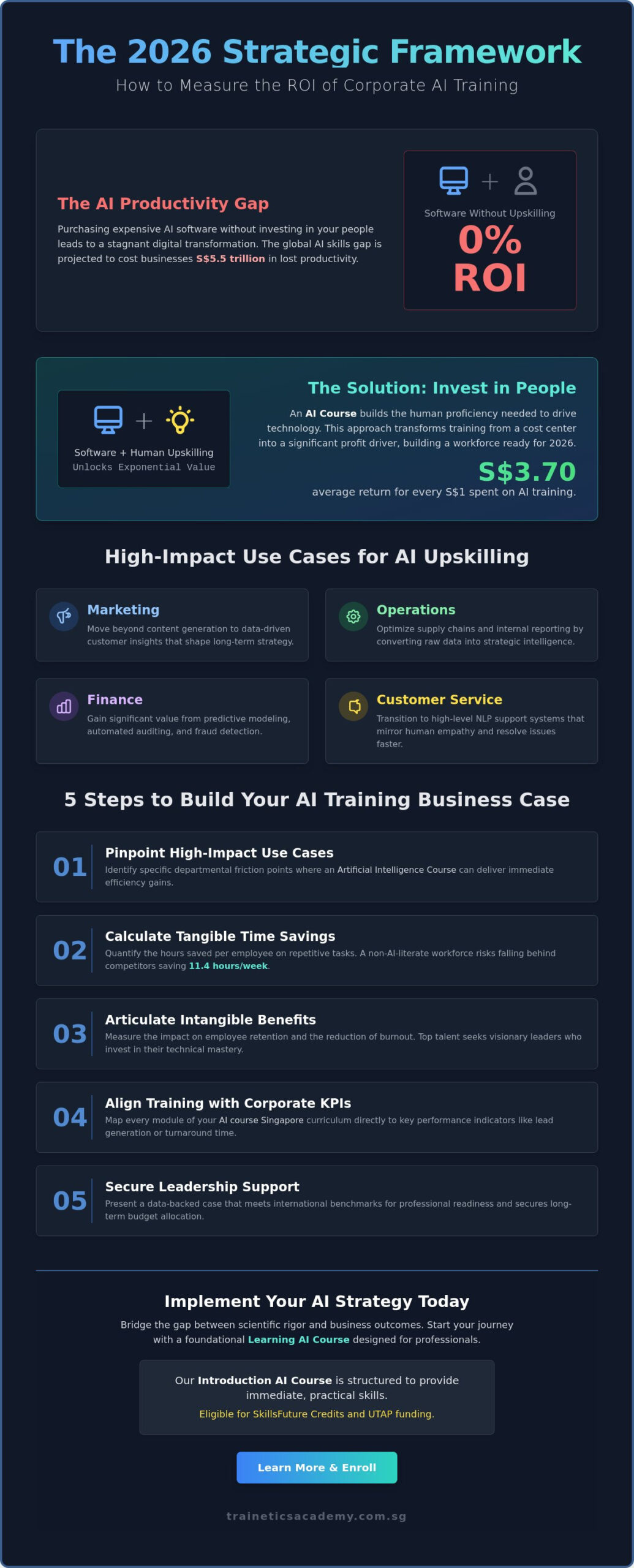
5 Steps to Drafting Your AI Training Business Case
Securing executive buy-in for upskilling requires a proposal as disciplined and precise as the curriculum itself. You aren’t merely asking for a budget; you’re presenting a strategic roadmap for organizational excellence. To effectively communicate how to measure roi of corporate ai training, your business case must lead with an Executive Summary that highlights the "Why Now." In 2026, the competitive landscape in Singapore leaves no room for laggards. Identify the specific productivity bottlenecks and talent gaps within your Problem Statement, then propose a solution centered on high-standard SkillsFuture AI courses. Your financial justification should clearly detail the cost-benefit analysis, referencing "eligible" funding sources to offset initial expenditures. Finally, provide a clear implementation roadmap that outlines the timeline for training and subsequent performance evaluation.
Gathering Stakeholder Support
Each leader in your organization views AI through a different lens. To win over the CFO, focus your pitch on long term cost savings and the availability of "eligible" subsidies that maximize your capital. The CTO requires a different approach; emphasize technical readiness, security, and the mitigation of "Shadow AI" risks. For HR, frame the training as a critical tool for career development and talent retention. By addressing these specific concerns, you demonstrate a visionary understanding of how technical mastery supports every facet of the business. This holistic approach is essential when learning how to measure roi of corporate ai training across departmental silos.
Optimising the Budget with Local Support
Leveraging Singapore’s robust educational framework is a strategic financial move for 2026. Our Introduction AI Course is designed to be eligible for SkillsFuture Credit and UTAP, which significantly lowers the barrier to entry for local firms. These subsidies aren’t just perks; they’re foundational components of a sophisticated budget strategy. Using these credits allows you to reallocate capital toward further innovation while ensuring your team receives the highest standard of professional education. It’s about achieving international benchmarks with local efficiency.
Ready to transform your workforce into a high-performance AI-augmented team? Start by reviewing our comprehensive Artificial Intelligence Course to see how we align technical mastery with your corporate goals.
Implement Your AI Strategy with Trainetics Academy
Excellence in the 2026 business landscape is not achieved by chance; it is the result of disciplined planning and visionary leadership. Choosing the right partner is the final step in securing your organization’s future and ensuring your upskilling efforts yield a definitive return. Trainetics Academy serves as the mentor your firm requires to bridge the gap between theoretical knowledge and professional mastery. We don’t merely offer a curriculum. We provide a professional identity that values precision, hard work, and continuous improvement. Our approach ensures you understand how to measure roi of corporate ai training by providing the performance metrics and scientific validation your leadership demands.
Our curriculum blends academic rigor with the practical, career-ready AI skills that drive immediate impact. Just as we apply scientific validation to the mechanics of human movement, our AI training follows a systematic approach to technical mastery. This methodology ensures that your staff aren’t just learning a tool, but are mastering a workflow that integrates seamlessly into your corporate KPIs. We focus on raising professional benchmarks across Singapore’s competitive market, positioning your team as industry leaders rather than mere participants.
The Trainetics Advantage
Precision is our hallmark. Our location at 10 Anson Road, Level 22, International Plaza, Singapore 079903, provides a prestigious environment for physical workshops. These sessions allow for high-level discourse and hands-on technical mastery in a professional setting. For organizations requiring a different rhythm, our virtual learning platforms offer the same depth of curriculum without geographical constraints. This flexible delivery ensures that your training path is both intellectual and practical, satisfying the curiosity of advanced practitioners while remaining accessible to those at the start of their journey.
Get Started Today
Success requires a commitment to excellence and a willingness to adopt a professional identity rooted in innovation. Invite your leadership team to explore our Introduction AI Course to see how we align technical mastery with your specific corporate goals. This program is the gateway to a prestigious career path for your employees and a competitive advantage for your firm.
Don’t leave your digital transformation to chance. Contact us today for a customized corporate group training quote tailored to your organization’s unique needs. We are ready to help you raise your professional benchmarks and prepare your workforce for the 2026 tech landscape.
Secure Your Competitive Edge in the 2026 AI Economy
Success in today’s digital landscape requires a shift from passive software acquisition to active human mastery. You’ve seen that technical upskilling isn’t just an expense; it’s a strategic asset that recovers an average of 11.4 hours per week for your knowledge workers. By identifying high-impact use cases and mitigating the risks of "Shadow AI," you transform your workforce into a disciplined engine of innovation. Mastering how to measure roi of corporate ai training is the final step in validating your vision and securing long-term leadership approval.
Trainetics Academy is ready to act as your visionary mentor in this transition. Our curriculum is designed by industry leaders for immediate professional mastery, ensuring your team meets the highest international benchmarks. Located at 10 Anson Road, Level 22, International Plaza, Singapore 079903, we provide a prestigious environment for your professional growth. Take advantage of a strategic financial move; our Introduction AI Course is eligible for SkillsFuture Credit and UTAP subsidies, making world-class education highly accessible for local firms.
Empower your team with our Introduction AI Course—Request a Corporate Quote Today. The path to professional excellence is structured, logical, and within your reach. Let’s build your high-performance future together.
Frequently Asked Questions
How do I measure the ROI of an AI course for my employees?
Measure success by tracking specific workflow velocity before and after the training period. Evaluate the reduction in error rates and the time saved on high-frequency tasks like data cleaning or initial draft generation. By comparing these efficiency gains against the total cost of the course, you establish a clear financial benchmark for performance improvement.
What should be included in a business case for AI upskilling?
A robust business case must include a detailed breakdown of current productivity bottlenecks and a projection of "time-to-competency" for the staff. You should explicitly outline how to measure roi of corporate ai training by linking specific learning milestones to your departmental KPIs. Highlighting the mitigation of recruitment costs through internal talent development further strengthens your financial argument.
How long does it take to see results after an AI Course?
Initial productivity gains often manifest within the first two weeks as employees begin applying basic automation to their daily routines. However, the full strategic impact typically matures over three to six months. This period allows the workforce to move beyond individual tool usage and fully integrate AI-augmented workflows into the broader organizational structure.
Why should we choose a Singapore-based training centre like Trainetics Academy?
Choosing a local provider ensures that your training is aligned with Singapore’s specific regulatory frameworks standards. Trainetics Academy offers a unique blend of academic rigor and practical career outcomes that overseas virtual platforms often lack. Our physical presence at International Plaza allows for high-level, face-to-face mentorship that fosters deep professional readiness and institutional trust.
Can I use SkillsFuture Credit for corporate group training?
SkillsFuture Credit is an individual entitlement for Singaporeans to manage their own learning journey. While a company cannot directly claim an employee’s personal credit, you can encourage staff to utilize it for their professional development.
What are the risks of not providing AI training to my staff?
The primary risk is a widening productivity gap that leaves your firm unable to compete on speed or pricing. Without formal education, employees may inadvertently rely on "Shadow AI," which leads to data privacy violations and reliance on inaccurate, "hallucinated" information. This creates a professional liability that can result in significant financial and reputational damage to your firm.
How do I convince my CFO that AI training is a necessity, not a luxury?
Present a cost-benefit analysis that compares the "Cost of Inaction" against the subsidized investment in upskilling. Focus your discussion on how to measure roi of corporate ai training by demonstrating the projected reduction in billable hours lost to manual, repetitive tasks. Emphasize that building internal technical mastery is a permanent asset that yields recurring value far beyond the initial investment.
Disclaimer
AI Content Disclaimer: Some articles on this website may be generated or assisted by AI-powered content creation tools. While we strive for accuracy and relevance, readers should independently verify information before relying on it. The content is provided for informational purposes only and does not constitute professional advice.