AI courses can help people build practical skills while strengthening the judgment needed to assess AI outputs, recognise bias and make sound decisions. The future of work in Singapore will depend on how well people combine these abilities. Learning to use AI is a strong starting point, but knowing when to question its answers matters just as much.
It’s understandable to wonder which AI course to take and what skills to learn next. This article explores AI courses in Singapore, including skills workers can build, transition support available locally and ways AI could reshape jobs and workplace decisions. Productivity gains don’t automatically make human expertise less important: people remain essential for interpreting context, weighing consequences and taking responsibility. Understanding these changes can help you approach AI learning with purpose and contribute confidently as work evolves.
Key Takeaways
- Build practical AI skills through an AI course by learning to write prompts, assess generated work and spot bias or inaccurate outputs.
- Explore how AI courses can help learners develop skills for using AI tools and applying existing knowledge in their work.
- Learn how AI can automate repetitive tasks and how to assess its role in different types of work.
- Prepare for changes in AI by strengthening skills that complement AI tools, rather than assuming every affected role will disappear.
- Practise using human judgment to examine AI-assisted decisions, consider their consequences and take responsibility for the final call.
How can AI courses help workers build skills during the AI transition?
AI courses can help workers develop relevant skills as workplaces adopt new technologies. According to the Ministry of Manpower, employers must notify MOM of retrenchments within 5 working days after they notify any employee. That notification rule concerns retrenchment; it is not an AI-specific workplace rule.
For workers who lose jobs involuntarily, Singapore’s SkillsFuture Jobseeker Support Scheme provides up to S$6,000 in temporary financial relief. The scheme currently has a salary cap of S$5,000. AI courses, job matching and reskilling can help workers build on their existing skills, rather than treating a career transition as a complete restart.
Training support involves employers as well as individuals. For small and medium enterprises, it can cover up to 70 per cent of job redesign costs. NTUC can provide grant funding of up to 70 per cent of qualifying costs for each Company Training Committee project. These mechanisms can help employers redesign roles and strengthen workforce capabilities.
AI courses can build practical literacy. Workers should learn to write prompts, evaluate AI-generated work, and check for bias and hallucinations. People using AI-enabled case management systems also need to understand how those systems reach decisions and what data they use. That knowledge helps workers review, modify or override a recommendation when necessary.
Work design matters, too. As remote work becomes more common, employers can balance computer-based tasks with social activities and non-computer work. For example, a team could use AI to prepare routine case summaries, then set aside staff time for discussions and decisions that require context. AI courses can help workers prepare for changing roles and build skills for purposeful, sustainable work.
AI courses can form part of a broader approach to the AI transition, alongside job redesign, job matching and financial support. The available facts do not establish a direct ranking against other countries.
There is no single 2030 reskilling count to use here. The number of workers who need AI-related training will depend on sector adoption, which tasks change, and how quickly employers redesign jobs.
For workplace AI, privacy and employee monitoring should be governed by clear rules for data use, access and human review. A specific employment requirement is retrenchment notification to MOM. Singaporeans taking selected SkillsFuture AI courses will soon receive six months of free access to premium AI tools. Selected AI-related courses at Institutes of Higher Learning will be offered to alumni at a discounted rate for one year from the second half of 2026.
Workers can build foundational skills through an Artificial Intelligence Course. The Introduction AI Course is eligible for SkillsFuture Credits and UTAP funding. AI courses can help workers strengthen relevant skills, while job matching and reskilling can support transitions into roles that use their existing strengths.
AI productivity tools and business models
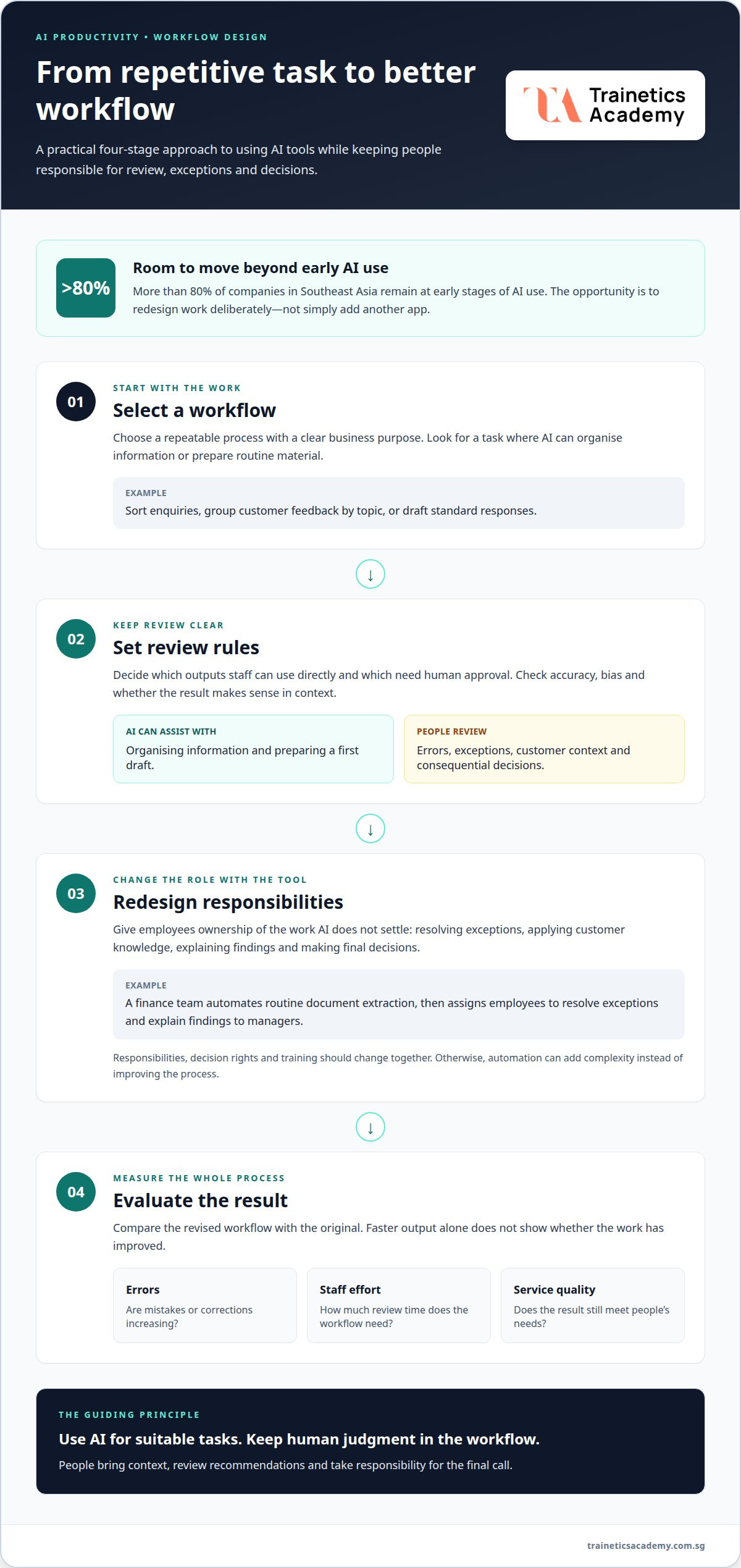
AI courses can help learners understand how productivity tools create value when they improve a workflow, rather than simply add another app. More than 80 per cent of companies in Southeast Asia remain at early stages of AI use, so Singapore businesses still have room to move from trials to deliberate redesign. In an AI course, learners can practise identifying a repetitive task, such as sorting enquiries, and defining how staff should review the result.
For example, a retailer could use AI to group customer feedback by topic. Employees could then investigate recurring complaints and decide which service changes matter. AI courses can teach learners to distinguish between tasks suited to AI tools, such as organising information, and those where staff apply customer knowledge and judgment. Learners can also explore how to assess the full workflow, including review time and corrections, rather than measuring productivity by faster output alone.
Business transformation can also reshape roles, a topic learners can examine in an AI course. A finance team might automate routine document extraction, then assign employees to resolve exceptions and explain findings to managers. Courses can help learners understand why job redesign works best when responsibilities, decision rights and training change together. If software takes over one task while workers retain the same workload and unclear expectations, it can add complexity rather than improve the process.
Hybrid business and technology roles connect operational knowledge with AI implementation. An AI course can help learners explore how a graduate joining a logistics team might map how staff handle delivery exceptions, identify useful automation opportunities and explain requirements to technical colleagues. The role calls for more than familiarity with tools: workers need to understand the business objective, assess output quality and explain when human review is needed.
In an AI course, learners can explore how employers structure an AI productivity project around a few decisions:
- Select a workflow: Choose a repeatable process with a clear business purpose, such as drafting standard responses.
- Set review rules: Decide which outputs staff can use directly and which require human approval.
- Redesign responsibilities: Give employees ownership of exceptions, customer context or final decisions.
- Evaluate the result: Compare the revised workflow with the original, including errors, staff effort and service quality.
This approach can also support new business models, which learners can study through practical examples in AI courses. A professional-services firm, for example, might use AI to prepare a first draft, then give staff more time for tailored analysis and client discussions. The advantage comes from combining scalable production with expertise, not removing human contribution. Graduates who develop both business fluency and AI capability through relevant courses can help teams turn new tools into useful working practices.
Preparing for job changes with AI courses
AI courses can help learners prepare for job changes as employers adopt AI and adjust roles. In an early-2026 poll, 6.2 per cent of firms in Singapore said they had reduced headcount due to AI adoption. Another 8.5 per cent said they had reduced hiring activity due to AI. These figures describe firms’ reported actions, not the share of workers displaced. They point to changes already affecting workforce planning, while leaving room for different outcomes across employers and sectors.
Automation is strongest in repetitive tasks and processes. Software, for example, can draft routine summaries or sort standard documents, reducing the time staff spend on predictable work. An AI course can help learners understand how these tools work and how to use them in relevant tasks. A job may shift towards reviewing exceptions, communicating with customers or making context-dependent decisions. Learning how AI affects a role can help people prepare for its changing responsibilities.
Some occupations face greater exposure because parts of their work involve structured analysis or routine content production. Examples include coders, programmers, software engineers and data analysts, as well as paralegals, legal assistants and market research analysts. Finance roles named in this context include financial analysts, financial advisers, traders and accountants. This does not mean any specific occupation is certain to vanish. Tasks vary within each role, and professional judgment, communication and accountability continue to shape how work gets done. AI courses can help learners build relevant knowledge while strengthening these complementary skills.
Job redesign can turn automation into expanded work rather than immediate job loss. In studied case examples, employers did not reduce headcount after AI-enabled productivity improvements. Instead, existing staff took on more work or a wider range of tasks. A legal team, for instance, could use automation to organise standard documents, then assign staff to investigate unusual cases and prepare for client discussions. AI training can help learners understand how to contribute to such revised responsibilities.
Singapore’s government monitors AI’s workplace impact, aiming to increase cases where workers use AI for more meaningful work and reduce situations where AI replaces workers outright. That makes implementation choices important. Employers can map affected tasks, identify decisions that need human ownership, and train staff for revised duties before introducing a system. For example, a worker whose routine reporting changes may need to interpret trends and explain them to colleagues. AI courses can help learners develop skills for these evolving tasks, while clear role expectations help them understand what is changing and where reskilling can support a move into adjacent work.
For individuals, a practical response is to assess tasks, not just job titles. Identify repetitive activities, learn how relevant AI systems affect them, and consider an AI course to build useful knowledge. Strengthen complementary skills such as analysis, communication and review. This helps workers create a specific development plan while employers make more deliberate decisions about hiring, training and role design.
Can AI courses in Singapore help workers prepare for job changes?
As AI changes some jobs, workers can prepare by learning how to use AI tools in their roles. A role often combines routine tasks with communication, analysis and decision-making. AI may automate parts of that work while creating demand for different capabilities. An AI course can help learners understand which responsibilities are changing and how their expertise can adapt.
In the Microsoft 2023 Work Trend Index, 67% of Singaporeans were concerned that AI would replace their jobs. Concern is understandable, but it is not the same as a forecast of individual job losses. Singapore’s Economic Strategy Review Committee is focused on how AI can support economic growth and create good jobs, rather than simply replace labour. AI courses can support workforce preparation by helping learners build practical skills alongside a focus on job quality.
Some sectors may benefit from wider AI use, while others will see more direct task changes. In Singapore, manufacturing teams could use AI to analyse production information, while healthcare staff could use it to organise administrative work. An AI course can help learners understand how the technology changes the way information is handled. People still provide operational context, respond to exceptions and make decisions that affect service or safety.
Creative work faces a different kind of pressure. Content creation, writing, journalism and advertising are among the media roles identified as more exposed to AI. A communications team might use artificial intelligence to generate draft copy or summarise material. AI courses can help writers and editors practise using these tools while focusing on accuracy, audience needs, original ideas and tone. That shifts the balance of effort, but it doesn’t make every creative task interchangeable.
Risks include job displacement, biased outputs that can lead to unfair decisions, and cybersecurity weaknesses involving sensitive workplace information. AI courses should help workers learn to treat AI-generated results as material for review, especially when decisions affect people or involve confidential data.
For an employee, a focused response starts with mapping tasks. Identify work that is repetitive, work that requires judgment, and work involving relationships or accountability. Then take an AI course to learn tools relevant to those tasks, practise reviewing their outputs, and strengthen skills that support the revised role. A customer-service worker, for example, might shift from drafting routine replies to resolving complex requests and explaining decisions.
Employers can support this transition by explaining which tasks will change, involving staff in workflow redesign, and linking AI course training to revised responsibilities. Each new system should have a clear purpose and defined human oversight. If AI drafts recommendations, managers should decide who reviews them and who owns the final decision. These steps help workers prepare for role changes rather than relying on job titles to indicate what comes next.
Employment outcomes in Singapore will depend on how organisations adopt AI, redesign work and invest in people. Job growth can accompany automation when businesses create new responsibilities and workers develop relevant skills through AI courses. For individuals, adaptability means learning the tools while strengthening the human capabilities that make their contribution valuable.
Human judgment in AI-assisted work
AI can produce a recommendation quickly, but speed alone doesn’t show whether it suits a particular person or situation. In a Singapore workplace, a manager might use an AI summary to prepare for a staff discussion. AI courses can help learners practise using summaries to organise information while considering context the system may not capture, such as a recent change in responsibilities. Sound judgment begins by separating useful analysis from the decision itself.
AI courses can teach human review as an active process, not a final glance. Learners can practise identifying the evidence behind a recommendation, considering whether important context is missing, checking whether the reasoning fits the task, and assessing what could happen if the output is wrong. For example, if an AI tool prioritises customer complaints, a learner can compare its ranking with urgency, customer impact and unresolved service issues before deciding what needs attention.
Analytical thinking helps learners spot gaps and misinformation in generated material. Communication skills help them explain a recommendation clearly, especially when colleagues or customers need to understand its limits. Domain knowledge matters, too: an experienced operations employee can recognise when a proposed process conflicts with how a service actually works. AI courses can help learners practise combining these skills so AI use becomes informed collaboration rather than automatic acceptance.
AI courses can also teach learners how to make responsibilities clear in human-AI collaboration. A team can use AI to prepare an initial report, ask a subject specialist to test its assumptions, and assign a decision-maker to make the final call. The specialist contributes expertise, AI helps organise or draft, and the decision-maker remains accountable for the consequences. This division can improve speed without confusing generated content with a human decision.
AI course learners can build these skills by deliberately practising on everyday tasks. For each AI-assisted output, they can:
- Clarify the purpose: Define the question the tool should help answer.
- Examine the basis: Trace important claims to evidence or workplace records.
- Test the context: Consider exceptions, affected people and relevant constraints.
- Explain the decision: Record why the recommendation was accepted, changed or rejected.
This practice in AI courses applies to roles from administration to communications. For instance, a communications employee can use generated copy as a draft, then check factual accuracy, audience expectations and tone before publication. The final judgment draws on knowledge of the organisation and its readers, not just grammatical fluency.
AI courses can help employers and teams define which tasks AI may support and who owns consequential decisions. Learners can practise making room for questions, escalation and learning when outputs fail. This training develops practical skills and gives employees a clearer role in shaping how technology changes their work.
Managers exploring how AI supports business decisions can learn more about demystifying artificial intelligence for managers, including its uses, limits and decisions.
Strengthen your ability to work confidently with AI through practical AI learning.
Trainetics Academy
Trainetics Academy’s Artificial Intelligence Course is for people who want to strengthen their understanding of AI as work changes. It may be a useful next step if you’re ready to move beyond occasional tool use and build a more considered foundation for learning and workplace decisions.
Treat AI development as an ongoing professional skill. Pair structured learning with reflection on how AI tools relate to your role, where human review matters, and which capabilities you want to build next. This connects course learning with the practical demands of Singapore’s evolving workplaces.
Contact Trainetics Academy to discuss your next step in AI learning.
Build your AI skills with purpose
Learning through an AI course in Singapore can help you understand how AI tools work and where they may be useful in the workplace. Start by identifying a skill to strengthen, applying what you learn to a relevant task, and reflecting on where human judgment adds value. This focused approach can help you choose an AI course that supports your goals.
You don’t need to master every new system at once. Begin with foundational AI knowledge, then deepen your skills as your needs evolve. An AI course can help you build technical understanding alongside thoughtful decision-making, communication and adaptability. Each step can help you use AI more confidently.
Ready to take a deliberate next step? Contact Trainetics Academy to explore AI courses and find a learning path that suits your goals.
Frequently Asked Questions
How can workers build AI skills?
Start with a work task you understand well, then practise applying AI to it. For instance, ask a tool to organise a project brief and compare its structure with the original. Note what it missed, changed or clarified, then refine your instructions. Repeating the exercise with different documents builds practical familiarity and helps you explain where AI adds value in your field.
What does an AI transition with no jobless growth mean?
It means aiming for economic growth without a corresponding rise in unemployment as AI changes work. The phrase describes an overall policy goal, not a guarantee that every person will keep the same position. To assess progress, consider both whether new roles emerge and whether workers affected by changing tasks can access pathways into them.
Will Artificial Intelligence (AI) Take Over My Job?
There’s no reliable yes-or-no answer based on a job title alone. A practical assessment identifies which decisions, relationships and unusual cases your role involves. For example, a project coordinator may spend time arranging information but also resolve shifting priorities between teams. The latter responsibility depends on context and collaboration, so it may change differently from routine administrative tasks.
How will AI affect jobs and industries in Singapore?
AI’s effects will vary across Singapore’s sectors because their processes and service needs differ. Retail and hospitality businesses could use it to organise customer feedback, while agriculture may apply it to analyse operational information. Government services may also use AI to support administrative workflows. Workers can prepare by understanding how their industry creates value and where new tools could change that process.
Which jobs in Singapore are most at risk from AI, and which are likely to grow?
Tasks involving predictable information processing face more automation pressure than work requiring complex coordination or specialist context. Opportunities may emerge in roles that connect business needs with AI implementation, evaluation and oversight. The future of work in Singapore with AI will vary by employer and sector, so assess the responsibilities behind a role instead of relying on a fixed list of “safe” occupations.
What are Singapore’s government plans and funding for AI skills and workforce training?
Singapore’s Tripartite Jobs Council coordinates the Government, employers and unions on responsible AI adoption, job redesign, skills training and worker-support awareness. This gives workforce planning a shared channel across public and private organisations. Funding mechanisms also vary by purpose: some support workplace transformation projects, while other initiatives focus on individual learning. The relevant route depends on whether training supports a personal career move or an employer’s redesign project.
How are Singapore employers adopting AI and changing workplace roles and productivity?
Employers can introduce AI in stages: define the business problem, test a tool on a bounded task, gather staff feedback, then decide whether to expand its use. For example, a service team might trial AI-assisted categorisation of incoming requests before changing its wider workflow. A measured rollout can reveal practical issues, such as unclear handovers or unsuitable categories, before they affect more teams.
What are the salary and hiring trends for AI jobs in Singapore?
AI-related pay and hiring depend on a role’s responsibilities, sector, experience and the mix of technical and business expertise required. A position focused on implementation may have different requirements from one centred on data analysis or governance. To assess opportunities, compare job descriptions for recurring capabilities and scope, then align your development with employers’ sought-after responsibilities rather than a job title alone.
Disclaimer
AI Content Disclaimer: Some articles on this website may be generated or assisted by AI-powered content creation tools. While we strive for accuracy and relevance, readers should independently verify information before relying on it. The content is provided for informational purposes only and does not constitute professional advice.