The strongest employee AI training programs build lasting capability rather than treating learning as a one-off event. Knowing how to develop an internal AI training program starts with business priorities, practical learning, and support employees can apply thoughtfully.
Training should do more than explain how AI tools work. Employees need relevant practice, clear guidance, and learning suited to their roles. Leaders also need to assess whether the training supports meaningful work.
This guide explains how to set aligned objectives, assess training needs, and design learning that can scale. It also covers ways to measure outcomes, develop internal expertise, and use external instruction to help employees apply AI effectively at work.
Key Takeaways
- Connect learning objectives to business priorities, then choose baseline measures that can show whether training is making a difference.
- Give employees a shared foundation in AI before tailoring practice to their roles, existing skills and workplace tasks.
- Design scalable learning around practical exercises, feedback and opportunities to apply new skills on the job.
- Build internal expertise by supporting AI champions and combining their knowledge with structured external learning when needed.
- Use a clear implementation process: assess needs, set guidelines, pilot the program, gather feedback and refine it over time.
Business-aligned learning objectives and success measures
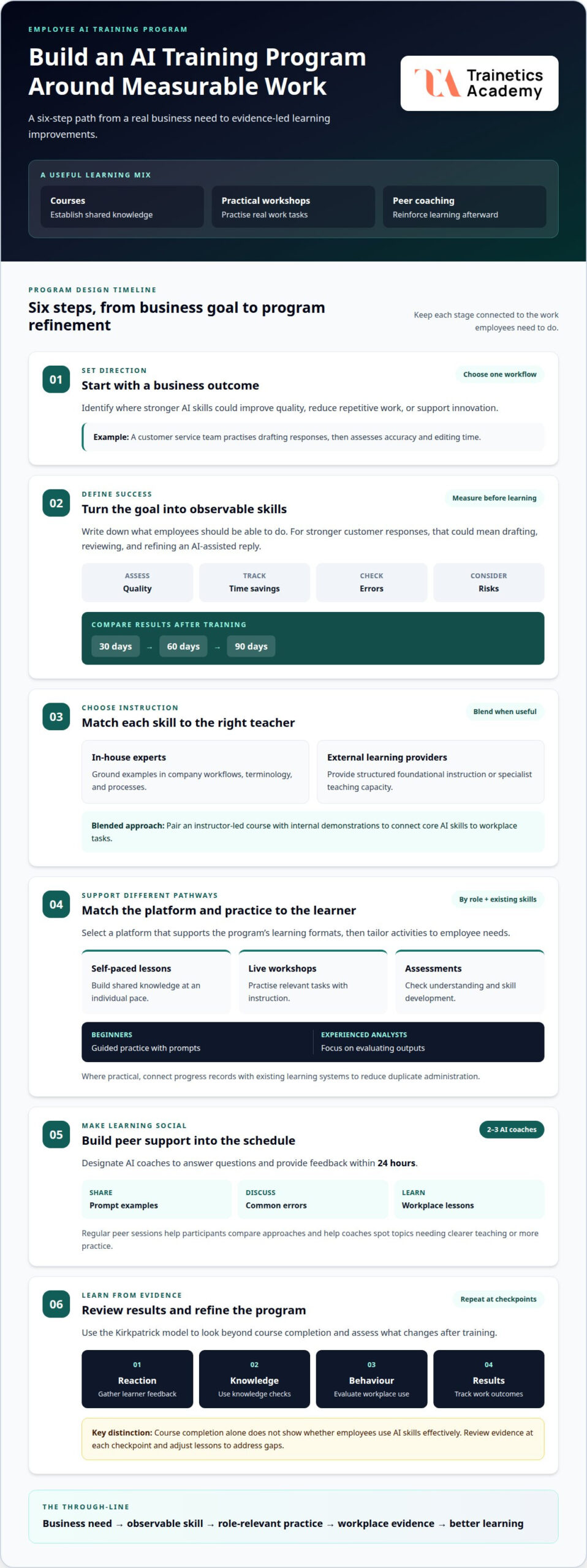
Effective internal AI training combines short courses, practical workshops, and mentoring. Use courses to establish shared knowledge, workshops to practise real tasks, and peer coaching to reinforce learning afterward.
- Start with a business outcome. Choose a workflow where stronger AI skills could improve quality, reduce repetitive work, or support innovation. For example, a customer service team could practise drafting responses, then assess their accuracy and editing time. A clear outcome makes training purposeful and gives the organization a basis for evaluating its value.
- Set measurable learning objectives. Translate the business goal into observable skills. If the goal is stronger customer responses, employees should be able to draft, review, and refine an AI-assisted reply. Record baseline measures before training, then compare results at 30, 60, and 90 days after completion. Consider quality, time savings, errors, and risks together.
- Choose who will teach each skill. Use in-house experts when employees need examples grounded in company workflows, terminology, and processes. Bring in an external learning provider when teams need structured foundational instruction or specialist teaching capacity. A blended approach can pair an instructor-led course with internal demonstrations, helping employees connect core AI skills to their work.
- Match the learning platform to the pathway. Select a platform that supports your program’s formats, such as self-paced lessons, live workshops, and assessments. Personalize learning by role and existing skills: beginners may need guided practice with prompts, while experienced analysts may focus on evaluating outputs. Where practical, connect progress records with existing learning systems to reduce duplicate administration.
- Build peer learning into the schedule. Designate 2-3 AI coaches to answer questions and provide feedback within 24 hours. Give employees a shared collaboration channel for prompt examples, common errors, and lessons from workplace tasks. Regular peer sessions let participants compare approaches and help coaches identify topics that need clearer teaching or additional practice.
- Review evidence and refine the program. Use the Kirkpatrick model to assess learner reaction, knowledge, workplace behaviour, and business results. Gather feedback after training, then use knowledge checks or project evaluations to test learning. Track adoption alongside work outcomes, because course completion alone does not show whether employees use AI skills effectively. Review the evidence at each checkpoint and adjust lessons to address gaps.
What is AI Training for Employees?
In Singapore, workplace AI training should cover relevant data-protection and confidentiality requirements, permitted tools and uses, and human review of outputs. Connect these topics to organizational policies and applicable legal obligations. General AI guidance cannot replace workplace-specific instructions.
- Define reskilling and upskilling by the work involved. Reskilling prepares an employee for tasks changed by AI; upskilling develops capabilities within their current role. For example, a service employee could learn to draft AI-assisted replies and assess them before sending. PwC’s 2025 Global AI Jobs Barometer reports that skills for AI-exposed jobs are changing 66% faster than skills in other roles, making ongoing learning relevant to workforce planning.
- Build a shared foundation, then create tiers. Start with AI literacy, output checking, and safe handling of workplace information. Then tailor learning for general employees, managers, and technical teams. Managers need practice selecting workflows and overseeing use; technical employees need deeper skills in model evaluation, security, testing, and monitoring. The OECD AI skills report highlights both general AI literacy and advanced technical expertise.
- Address anxiety with clear examples. Explain which tasks AI may support, where human judgement remains essential, and how employees can raise concerns. EY research found that 60% of employees are anxious about AI adoption, while 75% worry it could make certain jobs obsolete. Use a familiar task, such as summarising meeting notes, to show what a tool can assist with and what an employee must still review.
- Build confidence through guided practice. Give employees a low-risk exercise before applying AI tools to consequential work. Ask them to compare an AI-generated draft with the source material, identify unsupported statements, and revise the result. JFF research found that 36% of workers say they have the training and resources needed to use AI in their jobs. Structured practice can reveal where confidence, access, or instruction falls short.
- Use feedback to identify adoption barriers. Ask employees to describe obstacles after each learning activity, such as unclear policies, unsuitable tools, or limited practice time. Separate knowledge gaps from workflow barriers, as each needs a different response. If employees understand a tool but cannot access a permitted use case, another tutorial will not solve the problem. Record recurring themes and assign owners to address them.
- Use a framework to guide responsible adoption. Teach employees that generated content is not automatically a reliable source. Ask them to check facts, protect confidential information, and seek human review when decisions carry meaningful consequences. NIST guidance offers a voluntary framework for managing AI risks and supporting trustworthy use. For Singapore teams, pair such principles with company policies and relevant local requirements.
Training should cover relevant data-protection and confidentiality requirements, permitted tools and uses, and when employees must review AI outputs. Connect these topics to organizational policies and applicable legal obligations.
How do you design AI training programs that scale?
Assess employee AI skills through role-based interviews, practical tasks, and manager feedback. HR can use the findings to shape curricula that build relevant capabilities across the workforce.
Assess Employee AI Skills and Training Needs
Interview 2-3 people from each department, then compare their daily tasks and current knowledge. Ask where AI could support work, which tools employees use, and what blocks adoption. HR should combine these interviews with practical exercises, such as reviewing an AI-generated summary. Avoid relying only on self-ratings; observed performance can reveal gaps employees may not recognise.
Define Role-Specific Competency Frameworks
Set clear capability expectations for each role before choosing training content. For customer service, that might mean drafting and checking AI-assisted replies; for analysts, it could mean evaluating outputs against source data. Include shared skills, such as identifying unsupported claims, then add role-specific standards. Leadership should review the framework so expectations align with workflows, oversight, and accountability.
Design Role-Specific Curricula and Workflows
Build each curriculum around a real task, followed by guided practice and feedback. A content team, for example, could practise using AI for research before editing a draft against source material. Budget 5 to 10 hours for basic AI proficiency and 4 to 6 weeks for job-specific application. Avoid generic demonstrations that don’t reflect employees’ actual work.
- Give HR a program-design role. HR can coordinate role interviews, map existing learning, and schedule practice around operational needs. Work with department leaders to identify tasks suitable for training and subject-matter experts to review exercises. Stanford Digital Economy Lab analyzed 51 enterprise AI deployments and found realized value varied with work redesign and role-specific training. Use that insight to connect learning with workflow changes.
- Measure capability and refine the pathway. Choose a practical assessment for each role, such as a reviewed draft, completed analysis, or simulated customer interaction. Record what employees can do before training, then compare their later work against the same competency framework. Gather feedback on confusing lessons, tool access, and workflow friction. HR and leadership can use these findings to update materials as team needs and AI capabilities change.
Developing internal expertise and using external partners
Combine internal ownership with external teaching to build expertise that lasts beyond a course. Internal teams understand local workflows and priorities; an external learning partner can provide structured instruction when subject knowledge or teaching capacity is limited.
- Appoint departmental AI champions. Select employees who understand their team’s workflows and can demonstrate responsible use. For example, a finance champion could help colleagues assess an AI-assisted draft against source records. Give champions clear responsibilities: answer practical questions, collect recurring issues, and share useful examples across departments. Their role is to connect learning with daily work, not replace technical specialists or managers.
- Give champions a structured learning pathway. Build their understanding of core AI concepts, output evaluation, and safe-use practices before they share techniques. Then have each champion practise tasks from their department, such as summarizing a meeting document or improving a first draft. Use common learning materials for consistent guidance, while adapting examples to the language, processes, and information used by Singapore-based teams.
- Set a regular peer-learning rhythm. Run a monthly AI challenge where cross-functional teams spend 2 hours solving a real business problem. A team might map a repetitive workflow, test an AI-assisted approach, and present its findings. Ask participants to document prompts, review steps, limitations, and outcomes. These notes create reusable learning materials and help colleagues assess which methods suit different departments.
- Use external partners to close specific gaps. Identify the capability needed before arranging structured instruction. Foundational AI literacy, role-based practice, and specialist technical skills require different teaching approaches. An external provider can establish shared foundations or teach methods internal experts have not yet developed. Internal leaders should then connect those lessons to the organization’s workflows, tools, and responsibilities.
- Keep work redesign inside the organization. External educators can teach methods, but department leaders decide how those methods fit local processes. For example, a Singapore service team should determine which responses employees review before sending and who makes the final decision. Map responsibilities before changing a workflow, so human expertise remains central to assessing outputs and handling exceptions.
- Build a feedback and refresher cycle. Ask champions to record questions, adoption barriers, and examples of effective practice. Schedule refresher sessions as tools and workflows change, then update internal guidance. MIT CISR research covering 152 enterprises identifies creating AI-ready people, roles, and teams while redesigning work around AI capabilities as a characteristic of organizations achieving above-industry-average financial performance. Treat expertise as an ongoing operating capability, not a one-time course.
What are the steps to develop an internal AI training program?
Use a phased roadmap to move from needs assessment to workplace practice. Assign an owner to each step, then refine the program using employee feedback and outcome measures.
- Form a cross-functional team. Bring together 5-7 people from HR, IT, leadership, and relevant departments. Assign clear ownership for curriculum, tool access, risk guidance, and evaluation. Include employees who understand daily workflows, so training priorities reflect actual tasks rather than assumptions about where AI might help.
- Assess needs before designing content. Use an assessment phase lasting Weeks 1-2 to map roles, existing skills, and workflow challenges. Interview employees and managers, then identify tasks where AI practice could be useful. Record the needs and barriers by role, so the team can prioritize relevant learning rather than create one generic course.
- Set tool and use-case boundaries. Define which AI tools employees can use and which workplace tasks are permitted before training begins. Explain how to handle sensitive information, review generated content, and verify factual claims. Give employees realistic examples of appropriate and unsuitable uses so the guidance connects directly to their work.
- Build a concise learning pathway. Break lessons into 5-10 minute microlearning modules, each focused on one skill. For example, a module could teach employees to write a prompt, review the output, and correct unsupported details. Pair short lessons with practice activities, so knowledge becomes a repeatable workflow.
- Prepare managers and technical teams. Train managers to select suitable workflows, provide oversight, and clarify accountability. Give technical teams instruction in model evaluation, security, testing, and monitoring. Use role-specific exercises: a manager reviewing an AI-assisted process needs different practice from a specialist testing a model.
- Pilot with employees in relevant roles. Run a pilot with 20-50 employees from high-impact roles. Observe whether instructions work during real tasks, where learners struggle, and what questions recur. Gather feedback before broad rollout, then revise confusing examples, practice activities, and guidance to reflect what the pilot reveals.
- Schedule practice and follow-up. Use weekly 45-minute team sessions to work through job-related examples and discuss responsible use. Schedule follow-up practice sessions 2-3 weeks after initial training. Ask employees to apply a new skill to a defined task, then discuss output quality and review steps with their team.
- Review adoption and refine the program. Send employees a 3-question survey every month about AI skills, obstacles, and support needs. Compare their feedback with training participation and workplace usage. Update lessons when recurring barriers appear, and keep the program aligned with permitted tools, evolving workflows, and the outcomes leaders intend to improve.
Strengthen your team’s learning pathway with practical AI course learning.
Trainetics Academy
Trainetics Academy can support your team’s AI learning journey through structured education in artificial intelligence. When employees need a stronger foundation before applying AI skills at work, its Artificial Intelligence Course offers a learning option to consider alongside your internal roadmap.
Use external learning to strengthen core knowledge, then connect it to your organization’s workflows, guidance, and measures of success. This can help teams build a common understanding while internal leaders address role-specific applications and adoption barriers.
Contact Trainetics Academy to discuss how AI learning could support your team.
Make AI Learning Part of Everyday Work
Treat workforce learning as an ongoing capability, not a project that ends when lessons finish. As teams encounter new tasks and tools, create space to revisit how AI fits their work and what responsible use means. This keeps learning connected to practice and gives employees a path to build confidence over time.
Developing an internal AI training program is ultimately about creating a structure your organization can adapt. Start with a learning priority, put it into practice, and use employees’ experience to shape the next stage.
If external learning can help strengthen your team’s AI foundations, contact Trainetics Academy to discuss a suitable next step. With a clear direction and a commitment to continued learning, your team can build capability with purpose.
Frequently Asked Questions
What are the biggest barriers to AI adoption, and how does training solve them?
Unclear use cases, low confidence, limited access, and concerns about unreliable outputs can hinder adoption. Training is most useful when it pairs a tool with a defined task. For example, employees can practise using AI to organize meeting notes, then check the summary against their own notes. If they understand the task but lack tool access, address access separately. Learning alone cannot resolve every operational barrier.
What are the core AI skills every employee needs?
Every employee benefits from knowing how to give an AI tool clear instructions, assess its response, and decide where human judgement is needed. They should recognize that a fluent answer may still be inaccurate and handle workplace information according to company policy. For example, ask learners to identify unsupported claims in a draft and explain what evidence they need before using it.
What does AI training look like across different roles and departments?
Training should reflect each department’s work, not just the tool. An HR team might practise organizing themes in fictional survey comments, while a sales team could refine a sample customer email. Technical staff may need deeper instruction in testing and monitoring. Keep shared expectations consistent, but choose examples that match each team’s decisions, information, and review responsibilities.
Which AI topics and skills should an internal training program cover?
Cover AI fundamentals, prompting, output evaluation, limitations, and responsible workplace use. Add topics based on the tools and tasks employees encounter, such as summarizing documents or drafting content. In a practical exercise, learners can compare an AI-generated summary with its source document, mark missing context, and revise the result. Explain where employees can report errors or raise questions.
How can AI training be tailored to different roles and skill levels?
Use a shared introduction, then vary exercises by role and starting knowledge. Beginners can practise writing and improving simple prompts; experienced users can analyse why an output failed and refine their workflow. A manager might assess a sample AI-assisted process, while a specialist completes a task closer to their daily work. Offer alternative examples so employees can practise without exposing confidential business information.
How can organizations measure the effectiveness and ROI of AI training?
Compare training results with a baseline tied to a specific workflow. For example, a team could assess a sample task for accuracy, completeness, and required editing before and after learning. Track participation and practical skill separately from business impact: better assessment results do not automatically demonstrate operational value. Review the findings with the team responsible for the workflow before expanding training.
What risks and safeguards should AI training cover, including privacy, security, bias, and hallucinations?
Teach employees to follow workplace rules for sensitive information, use permitted tools, and review outputs before relying on them. Use fictional or de-identified examples in practice, and ask learners to check AI-generated claims against trustworthy source material. Discuss bias by examining whether an output makes unsupported assumptions about people. For consequential decisions, define when human review or a non-AI process is appropriate.
How can a company keep AI training current as tools and regulations change?
Assign owners to review training materials when tools, internal policies, or relevant requirements change. Keep examples modular so a changed tool interface does not require rewriting lessons on output review or sound judgement. Invite employees to flag confusing guidance and emerging workflow issues. In Singapore, involve relevant policy or compliance stakeholders when assessing updates, and revise instructions before employees apply changed practices.
Disclaimer
AI Content Disclaimer: Some articles on this website may be generated or assisted by AI-powered content creation tools. While we strive for accuracy and relevance, readers should independently verify information before relying on it. The content is provided for informational purposes only and does not constitute professional advice.