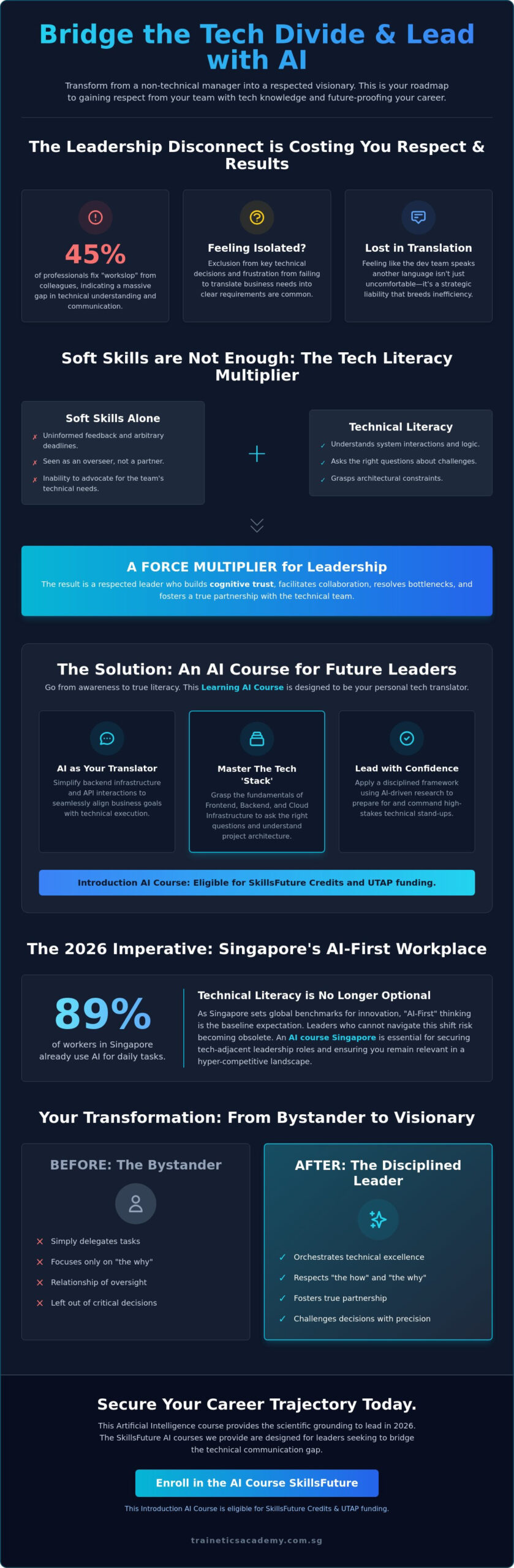
If 45% of professionals are currently fixing “workslop” created by their colleagues, your silence during technical stand-ups isn’t just a personal hurdle; it’s a strategic liability. You likely feel the isolation of being excluded from key decisions or the frustration of failing to translate business needs into technical requirements. It’s common to feel “stupid” when the dev team speaks in a language that seems designed to shut you out. However, you can gain respect from my team with tech knowledge by mastering the language of AI-driven translation rather than learning to code from scratch. This guide explores how a specialized AI Course can transform you into a visionary leader who challenges technical decisions with confidence and precision.
While these programs are ideal for established professionals in Singapore, students in other regions who are navigating their technical degrees can also find specialized academic support; click here to explore educational resources and study guides designed for university learners.
We will examine the path toward bridging the communication gap using AI-driven literacy to secure your professional identity. You’ll discover how the Introduction AI Course, which is eligible for SkillsFuture Credits and UTAP funding, provides the scientific grounding needed to lead in 2026. Prepare to transition from a bystander to a disciplined mentor who orchestrates technical excellence across the entire organization. By the end of this article, you’ll have a clear roadmap to career advancement in tech-adjacent leadership roles.
Key Takeaways
- Redefine your leadership identity by mastering technical literacy, ensuring you understand the architectural foundations that drive your team’s output and innovation.
- Utilize AI as a strategic translator to simplify backend infrastructure and API interactions, allowing for seamless communication between business objectives and technical execution.
- Apply a disciplined framework to gain respect from my team with tech knowledge, using AI-driven research to prepare for high-stakes technical stand-ups with confidence.
- Elevate your professional benchmarks through a specialized AI course Singapore, fostering a rigorous approach to continuous learning and technical mastery in the 2026 landscape.
- Secure your career trajectory with the Introduction AI Course, which is eligible for SkillsFuture Credits and UTAP funding, designed for leaders seeking to bridge the technical communication gap.
The Respect Gap: Why Technical Literacy is the New Leadership Currency
Leadership in the high-stakes environment of 2026 requires more than a visionary outlook; it demands a structural understanding of the tools your team uses daily. Technical teams often feel a disconnect when managers focus solely on business outcomes while ignoring the architectural constraints of the project. To effectively gain respect from my team with tech knowledge, you must move beyond superficial buzzwords and grasp what technological literacy means in an era where AI orchestrates every business function. This literacy is the bridge between a manager who simply delegates and a leader who empowers.
Teams naturally gravitate toward leaders who respect “the how” as much as “the why.” When you understand the complexity of a sprint or the limitations of a specific framework, you build cognitive trust. This trust is the foundation of professional respect. Without it, your deadlines feel arbitrary and your feedback feels uninformed. Technical knowledge allows you to advocate for your team rather than just demanding more from them. It transforms the relationship from one of oversight to one of partnership.
To better understand this concept, watch this helpful video:
We can categorize technical proficiency into three distinct levels: Awareness, Literacy, and Mastery. Awareness is simply knowing that a technology exists. Literacy involves understanding how different systems interact and the logic behind them. Mastery, while not always required for leaders, involves the ability to implement these systems. For most managers, achieving literacy is the strategic goal. The cost of remaining in the “Awareness” stage is high; it leads to slower sprints, missed deadlines, and recurring team friction that erodes productivity.
Soft Skills vs. Hard Knowledge
Being “liked” by your team is a temporary advantage, but it isn’t enough to lead a technical department effectively. Soft skills like empathy and communication are essential, but they require a foundation of hard knowledge to be impactful. Technical literacy acts as a force multiplier for your existing leadership abilities. It allows you to use your soft skills to resolve technical bottlenecks and facilitate better collaboration. This combination creates a professional identity rooted in both emotional intelligence and scientific rigor.
The 2026 Tech Landscape in Singapore
Singapore’s business hubs have shifted toward AI-integrated workplaces where “AI-First” thinking is a baseline expectation. With 89% of workers already utilizing AI for daily tasks, managers can no longer afford a hands-off approach to technology. Local industries are prioritizing leaders who can navigate this shift. Enrolling in an Artificial Intelligence Course is no longer optional for those aiming at tech-adjacent leadership roles. It ensures you remain relevant as Singapore continues to set international benchmarks for innovation and digital readiness.
Essential Tech Concepts Every Non-Technical Leader Must Master
Mastering the fundamental architecture of modern software is a prerequisite for any leader who aims to drive innovation. You cannot expect to gain respect from my team with tech knowledge if you view their work as an impenetrable “black box.” To lead with authority, you must understand the ‘Stack.’ This includes the frontend, which handles user interaction; the backend, where the business logic and server-side processing reside; and the infrastructure, the cloud-based foundation that hosts the entire ecosystem. Recognizing which layer a specific challenge belongs to allows you to ask the right questions during technical reviews.
Communication between these layers often relies on APIs (Application Programming Interfaces). These protocols are the digital glue that allows disparate systems to “talk” to each other. When you understand API basics, you grasp how your product integrates with third-party services or internal microservices. This clarity is essential when you prioritize data skills to ensure your organization remains competitive. High-performing leaders recognize that AI and Large Language Models (LLMs) depend entirely on clean, structured data architecture. Without a solid data foundation, even the most advanced AI tools will produce unreliable results.
Security and compliance form the final pillar of essential knowledge. In Singapore, adhering to the Personal Data Protection Act (PDPA) is a non-negotiable leadership responsibility. Understanding the basics of data encryption, access control, and residency requirements ensures that your strategic decisions don’t compromise the company’s legal standing or user trust.
Understanding the Software Development Life Cycle (SDLC)
Your team likely operates within an Agile or Waterfall framework. Agile focuses on iterative sprints and flexibility, while Waterfall follows a rigid, sequential path. Problems arise when leaders request “just one small change” without realizing it might break complex dependencies in the backend. To gain respect from my team with tech knowledge, you must identify technical debt. This occurs when developers choose a fast, suboptimal solution to meet a deadline, creating a “debt” that must be paid back with future rework. Ignoring this debt eventually stalls project velocity and demoralizes your engineering talent.
Demystifying Artificial Intelligence for Business
Distinguishing between Generative AI and Predictive AI is crucial for strategic planning. Generative AI creates new content, while Predictive AI analyzes historical data to forecast future outcomes. Modern models are trained on massive datasets through a process of pattern recognition. However, these models can experience “hallucinations,” where they generate confident but entirely false information. To manage these risks, forward-thinking managers often enroll in Artificial Intelligence courses to bridge the gap between abstract business strategy and the rigorous reality of algorithmic implementation. If you are ready to elevate your professional benchmark, consider exploring a foundational AI Course to solidify your technical literacy.
Leveraging AI as Your Personal Tech Translator
Leaders often hit a wall when developers present complex architectural diagrams or raw code. Instead of nodding along in silent confusion, you should utilize Generative AI as your personal technical interpreter. This shift allows you to develop the technical skills to earn respect from engineers who value precision and informed inquiry. By feeding a complex code snippet into ChatGPT with an “Explain Like I’m 5” (ELI5) prompt, you strip away the jargon to reveal the underlying logic. This AI-assisted learning path is significantly more efficient than manual research for a busy executive, providing immediate clarity without the need for a computer science degree.
You can also use AI to create a “Tech Glossary” specific to your company’s proprietary product. Ask the AI to define your internal stack components in business terms, mapping technical functions to customer value. This ensures you never feel excluded during a high-stakes stand-up again. When you understand the specific dialect of your engineering team, you bridge the communication gap that often leads to project friction. This proactive approach demonstrates a commitment to excellence that technical teams find deeply reassuring.
To gain respect from my team with tech knowledge, you must be able to challenge assumptions intelligently. AI tools allow you to simulate technical discussions before they happen, giving you a safe space to test your understanding of complex requirements. This preparation transforms you from a passive observer into a visionary mentor who can steer technical strategy with confidence.
Mastering ChatGPT for Technical Translation
Effective leadership requires high-quality inputs to get high-quality outputs. Mastering prompt engineering is the first step toward technical fluency. For example, instead of asking “what is this?”, ask the AI to “explain the business impact of this architectural change and identify potential bottlenecks.” This strategy turns a developer’s flat “no” into a collaborative “how.” You can integrate business writing with ChatGPT to refine your technical requirements, ensuring they are clear, actionable, and technically sound. This precision reduces the “workslop” that often plagues AI-integrated workplaces.
Building an AI-Powered Learning Habit
Consistency is the hallmark of a disciplined professional. Dedicate 15 minutes daily to a “Tech Deep Dive” using AI tools to summarize technical documentation or recent industry benchmarks. You can curate your own AI-driven knowledge base to prepare for weekly team meetings, ensuring your contributions are grounded in scientific reality. Use AI to simulate “Dev-Speak” scenarios and practice your responses to common technical pushbacks. This preparation ensures that you gain respect from my team with tech knowledge that is both current and contextually relevant. As you refine these habits, formalizing your education through structured Artificial Intelligence courses will provide the professional identity your career advancement requires.
5 Steps to Asserting Your Technical Presence in Team Discussions
Asserting your presence in a room full of engineers requires a disciplined framework that moves beyond passive observation. You don’t need to be the most technical person in the room to lead effectively; you need to be the most prepared. To gain respect from my team with tech knowledge, you must demonstrate that you understand the structural implications of their work. This five-step process ensures your contributions are seen as strategic assets rather than administrative overhead.
- Step 1: The Pre-Meeting Research. Use AI tools to analyze the meeting agenda. If the topic is “database migration,” prompt an AI to explain the common bottlenecks and industry benchmarks for 2026. This allows you to enter the room with a foundational grasp of the technical context.
- Step 2: Active Listening and Keyword Extraction. Focus on recurring technical terms like “latency,” “technical debt,” or “scalability.” Identifying these allows you to anchor your questions in the team’s specific reality.
- Step 3: The Informed Inquiry. Instead of asking “why is this taking so long?”, ask about the trade-offs. For example: “How does this architectural choice impact our long-term scalability versus our immediate deployment speed?”
- Step 4: Acknowledging Technical Constraints. Validate the team’s concerns regarding legacy systems or resource limitations. Showing you understand the “cost” of a request prevents you from being viewed as a “pushover” or an unrealistic dreamer.
- Step 5: Synthesizing Tech Reality with Business Goals. Close the loop by explaining how a technical solution directly enables a business outcome. This reinforces your role as the bridge between code and commerce.
The Art of the ‘Informed Inquiry’
A “Bad Question” sounds like micro-management, such as “Can’t you just add a button?” A “Respect-Earning Question” sounds like partnership: “What are the backend dependencies involved in adding this feature to the user interface?” When you challenge a technical estimate, do so by referencing the complexity you’ve identified. Ask, “I noticed we’re prioritizing modularity here; does that account for the extra three weeks in the timeline?” An Informed Inquiry is a precision-targeted leadership tool that demonstrates a structural understanding of technical trade-offs to facilitate strategic alignment.
Handling Pushback from Tech Leads
Architects may occasionally dismiss input from non-technical managers, often due to a perceived lack of “skin in the game.” When your suggestions are met with resistance, use AI-backed research and data to support your position. Presenting a case study or a performance benchmark provides a scientific basis for your inquiry that is difficult to ignore. Build a “Coalition of Technical Respect” by scheduling one-on-one sessions with your leads to discuss their architectural vision. This proactive engagement shows you value their expertise while asserting your own technical literacy. To solidify this professional identity, consider enrolling in an Artificial Intelligence Course to ensure your leadership is grounded in the latest technological standards.
Future-Proofing Your Career with AI Courses in Singapore
The journey toward technical fluency is a strategic investment in your professional identity. While AI tools provide immediate assistance, a structured AI Course offers the scientific validation required to lead with absolute authority. To truly gain respect from my team with tech knowledge, you must move beyond ad-hoc learning and embrace a curriculum designed for the rigorous demands of the 2026 workforce. This formal commitment signals to your engineering peers that you value precision and continuous improvement. It transforms your leadership from a series of management tactics into a disciplined pursuit of excellence.
A 1 day AI course Singapore represents the most efficient pathway for busy executives to bridge the literacy gap. These intensive sessions focus on practical applications rather than abstract theory. You will learn to apply your new skills to real-world business scenarios immediately. High-performing managers recognize that being tech-fluent is no longer a niche advantage; it is a baseline requirement for career advancement into tech-adjacent leadership roles. Choosing the right SkillsFuture AI courses involves looking for providers that prioritize international benchmarks and professional readiness.
Upskilling at International Plaza
Learning in a physical environment fosters a level of technical discourse that digital platforms often struggle to replicate. Trainetics Academy provides this high-standard education at 10 Anson Road, Level 22, International Plaza, Singapore 079903. This central hub allows you to network with other visionary leaders while engaging in face-to-face discussions that clarify complex concepts. Physical learning environments are particularly beneficial for beginners and seniors who value a structured, supportive atmosphere. By attending an AI course Singapore in person, you immerse yourself in a culture of excellence that bridges the gap between AI theory and professional application.
Financing Your Tech Literacy Journey
The Singapore government continues to prioritize digital readiness, making it easier for professionals to access high-level training. The Introduction AI Course is eligible for SkillsFuture Credit and UTAP funding, providing a secure way to invest in your future. You can easily claim your credits for a 1 day AI course Singapore to accelerate your learning journey. 2026 is a critical year for Singaporeans to utilize these training subsidies, as the ambition-capability gap in the workforce continues to widen. Securing your spot in a Learning AI Course today ensures you remain an industry leader who values hard work. Selecting an AI Course SkillsFuture participants can rely on will allow you to gain respect from my team with tech knowledge that is both scientifically grounded and practically applied.
Elevate Your Professional Identity
Bridging the gap between business strategy and technical execution is the definitive challenge for the modern leader. You have explored how to simplify the “Stack,” utilize AI as a technical translator, and assert your presence through informed inquiry. To truly gain respect from my team with tech knowledge, you must move beyond temporary tactics and embrace a rigorous educational framework. This commitment to technical mastery ensures you are no longer a bystander in architectural discussions but a strategic partner in innovation.
Enroll in our Introduction AI Course today to master the tech skills your team respects. Our curriculum is taught by industry professionals with real-world tech experience and is conveniently delivered at our International Plaza campus. By grounding your leadership in scientific validation, you secure a professional identity that is both influential and future-proof. Take the first step toward becoming the visionary mentor your team requires; your transition into a tech-literate leader starts now.
Frequently Asked Questions
How much tech knowledge do I really need to manage a team of developers?
You must move beyond simple awareness toward technical literacy to lead effectively. This involves understanding the logic of your team’s tech stack and the architectural constraints they face daily. While you don’t need to be a master coder, you must be able to evaluate technical trade-offs. This knowledge empowers you to set realistic milestones and advocate for your team during complex project cycles.
Can I really gain respect from my team if I can’t code myself?
You can absolutely gain respect from my team with tech knowledge by mastering the architectural logic behind the code. Developers value a manager who understands the complexity of their workflow and the limitations of their tech stack. By speaking their language and recognizing technical debt, you build the cognitive trust required for a successful and respectful professional relationship.
Is the Introduction AI Course at Trainetics Academy eligible for SkillsFuture Credit?
The Introduction AI Course is a cornerstone of our professional development curriculum, designed to meet the high standards of Singapore’s educational frameworks. This program focuses on providing you with a rigorous understanding of machine learning and data ethics. By completing this training, you establish a professional identity that is recognized by technical teams and industry leaders alike for its scientific grounding.
How can I use ChatGPT to understand my team’s technical documentation?
You should use ChatGPT as a technical interpreter by pasting complex documentation into the tool and requesting a summary in business terms. Use specific prompts like “Identify the primary architectural dependencies in this document” or “Explain the security implications of this protocol.” This AI-assisted learning habit allows you to stay informed without spending hours on manual research, providing immediate clarity for strategic decision-making.
What are the most important tech terms for a non-technical manager to know in 2026?
Managers must master terms like Technical Debt, API Integration, and LLM Hallucinations. Understanding the difference between Generative and Predictive AI is also critical for strategic planning. These terms allow you to navigate technical discussions with precision and authority. By speaking the language of your developers, you ensure that your business goals are translated into sound technical requirements.
How do I deal with a developer who is condescending about my lack of tech knowledge?
Address condescending behavior by maintaining a disciplined, professional stance and asking precision-targeted questions. When you gain respect from my team with tech knowledge, you shift the dynamic from one of superiority to one of mutual collaboration. Demonstrating that you understand technical trade-offs and resource constraints effectively neutralizes dismissal and establishes your authority as a visionary mentor.
What is the best way to prepare for a technical meeting as a non-tech leader?
Prepare by using AI tools to research the meeting topics and identify potential technical trade-offs in advance. Review previous sprint notes to extract key technical terms and recurring bottlenecks. This proactive approach ensures you enter the room with the confidence to challenge decisions. It allows you to synthesize technical reality with broader business objectives, proving you are a visionary mentor rather than a passive observer.
Where is the Trainetics Academy training center located in Singapore?
Trainetics Academy is located at 10 Anson Road, Level 22, International Plaza, Singapore 079903. This centrally located facility provides a professional and academic environment for mastering complex technical skills. Learning in this high-standard setting allows you to network with industry leaders and engage in the rigorous training required to advance your career in tech-adjacent leadership roles.
Disclaimer
AI Content Disclaimer: Some articles on this website may be generated or assisted by AI-powered content creation tools. While we strive for accuracy and relevance, readers should independently verify information before relying on it. The content is provided for informational purposes only and does not constitute professional advice.