What if generative AI could help you develop not just campaign copy, but also images, videos and landing-page concepts? A generative AI for marketing course in Singapore can build practical skills for applying these tools to campaign work. The programme runs for 24 hours and includes a complimentary AI subscription for six months, starting with the first class.
It’s reasonable to weigh the fee and funding options before choosing a course, and to want more than a tour of popular tools. This guide explains how course costs and learner offsets work, what to look for in the tools and certification, and how to use AI responsibly in marketing campaigns. It also explores ways to apply generative AI to visual content and digital experiences, while keeping human judgement central to accuracy, brand voice and audience trust.
Key Takeaways
- Understand how course fees, funding eligibility and learner offsets can affect your out-of-pocket cost in Singapore.
- See how assessment requirements and certification fit into the learning journey, and what to consider when evaluating the AI tools included.
- Learn practical ways to use AI in advertising and campaign optimisation while keeping human review central to decisions.
- Explore responsible approaches to copyright and ethical use, plus how to plan AI-generated images, videos, websites and landing pages for campaigns.
- Identify when an Artificial Intelligence Course may be a useful next step for building practical generative AI skills.
Singapore course fees, funding and learner offsets
Singapore offers generative AI marketing courses with different practical focuses, formats, and funding arrangements. A generative AI for marketing course in Singapore may cover campaign creation, social media content, or broader AI applications. Compare the learning outcomes and assessment approach, not just the course title. Providers in Singapore offer programmes for marketers, but their course details and funding categories vary.
Before enrolling, review the full course fee, GST treatment, and any funding that applies to the specific programme and learner category. For a generative AI for marketing course in Singapore, this helps you understand the amount payable without assuming that every course has the same support.
SkillsFuture Credit is a learner funding mechanism, not an automatic discount across all courses. Singapore Citizens aged 25 and above may use SkillsFuture Credit for eligible course fees, but that general rule does not mean every marketing programme qualifies. Confirm the specific course’s stated funding category before including credit in your budget.
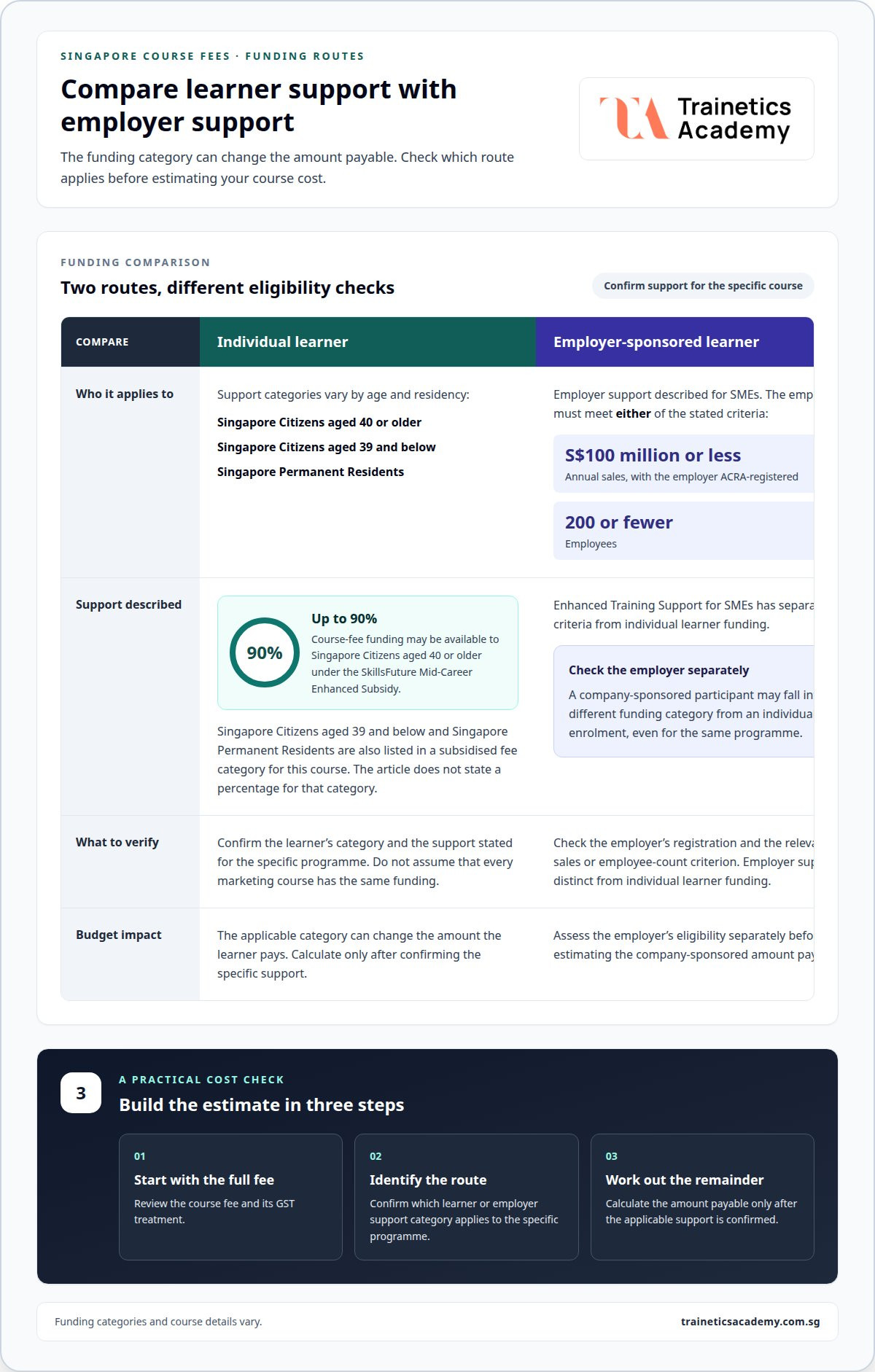
Age and residency can affect course-fee support. Singapore Citizens aged 40 or older may receive up to 90% course-fee funding under the SkillsFuture Mid-Career Enhanced Subsidy. Singapore Citizens aged 39 and below and Singapore Permanent Residents are also listed in a subsidised fee category for this course. These categories can change the amount a learner pays.
Employer funding follows separate criteria. For Enhanced Training Support for SMEs, an employer must be ACRA-registered with annual sales of S$100 million or less, or have 200 employees or fewer. This support is distinct from individual learner funding, so a company-sponsored participant should assess the employer’s eligibility separately.
Use a practical comparison: identify the full course fee and GST treatment, determine which learner or employer support applies, then calculate the remaining amount. An individual enrolment and a company-sponsored place may fall into different funding categories, even for the same programme.
Generative AI marketing courses in Singapore can cover campaign tools, content creation, or broader AI knowledge. Match the course focus to your work needs, then review its fee and any applicable funding. This keeps your decision grounded in professional relevance and the amount payable.
Available courses may focus on campaign creation, social media content, or broader AI applications. Compare their learning outcomes and assessment approaches to find a course suited to your work needs.
Course schedule, certification and AI tools
For beginners and working professionals, the best fit is a course with structured practice, clear assessment requirements, and tools relevant to marketing. A 24-hour programme offers a defined learning commitment; compare its schedule and applied focus with your career needs.
Course Schedule and AI Tools
The programme runs on weekdays from 9am to 6pm. A full-day classroom cohort is scheduled for 9-11 December 2026, giving learners dedicated time to work through the material. Before enrolling, consider whether those dates suit your work commitments and whether classroom learning supports your preferred pace.
Participants receive a complimentary AI subscription for six months, starting at the beginning of their first class. That access gives learners time to practise with AI tools during and after training. For digital marketing work, focus on how each tool supports a specific task, such as drafting campaign content or developing visual concepts.
A practical way to assess fit is to connect each technology to a work goal. For example, a marketer developing social content may prioritise content creation, while a communications professional may focus on adapting messages for different audiences. This makes the course’s applied value clearer than a list of tools alone.
Assessments and Certification
Entry begins with a pre-enrolment assessment that takes under five minutes. It gives prospective learners an initial step before class. Assessment requirements also matter at completion: participants who pass the course assessments receive a Statement of Attainment for competency standard RET-ICT-3001-1.1 Emerging Technology-3.
Before choosing a programme, understand what learners must complete and what credential follows successful assessment. Distinguish an award tied to passing assessments from a certificate issued for attendance. This helps beginners and experienced marketers align training with a career development goal.
Plan the learning process in three steps: complete the short pre-enrolment assessment, attend the scheduled training, then meet the assessment requirements. The six-month AI subscription provides a defined period for further practice. Together, these details help learners judge the time commitment, tool access, and outcome without assuming that course attendance alone earns the Statement of Attainment.
AI-powered advertising and campaign optimisation
A generative AI for marketing course in Singapore can help marketers practise connecting campaign content with measurable objectives. Projects might include drafting sponsored social posts, planning creative variations, and reviewing campaign data. For example, participants could prepare alternate messages for a Meta Ads campaign, then match each version to an audience and a clear objective.
AI can support the workflow, but professionals still set the strategy and review outputs. Start with a brief that identifies the audience, channel, offer, and desired action. Then use a generative AI tool to draft social headlines or suggest creative directions. Edit each draft for accuracy, brand voice, and relevance before preparing it for publication.
For paid social, make each variation purposeful. A marketer could compare two headlines while keeping the image and audience consistent. Changing one element at a time makes results easier to interpret. In Meta Ads, assess performance against the campaign objective rather than treating clicks alone as evidence of success.
Measurement should be planned before launch. In GA4, identify the website interaction that signals progress, such as a completed enquiry form. After the campaign begins, review that event alongside traffic sources and paid-social results. If a sponsored post attracts visits but few enquiries, examine whether the landing-page message matches the ad.
- Brief: Define the audience, offer, channel, and campaign objective.
- Create: Draft content variations and review each one before use.
- Measure: Track the chosen GA4 event and relevant Meta Ads results.
- Refine: Use the findings to guide the next campaign version.
A generative AI for marketing course in Singapore can also help participants practise turning reports into decisions. A concise report might state the objective, summarise the selected GA4 event, and recommend one adjustment. For instance, weak enquiry completion could prompt a review of the landing-page call to action before revising the ad creative.
For an employer or enterprise team, clarify who drafts, reviews, and signs off on campaign materials. A marketing professional can prepare AI-assisted options, while the campaign owner checks claims and brand alignment. This keeps implementation organised and preserves human accountability.
The practical value lies in linking generated content to a defined objective, then using measured outcomes to inform the next step. This connects content creation, paid social, analytics, and campaign optimisation without treating AI output as a finished decision.
Copyright issues and ethical use of generative AI
Generative AI can speed up campaign work, but polished output still needs human review. A ChatGPT draft, for example, may contain a factual claim, phrase, or visual element that needs checking before publication. Treat the tool as support for marketing judgement, not a replacement for it.
Copyright questions can arise with both prompts and outputs. A prompt containing a competitor’s campaign copy or a creator’s image raises different concerns from one based on an original product brief. Before using generated material, review the tool’s current terms and your organisation’s content policies. Keep records of prompts, edits, and final reviews for campaign assets.
Use a simple review sequence before publishing:
- Check names, product details, figures, and claims against reliable internal information.
- Review text and visuals for close resemblance to material supplied in the prompt.
- Confirm the intended use fits the tool’s terms and the organisation’s policies.
- Record who reviewed the final campaign asset.
These steps apply to social posts, email copy, and generated images. For instance, a marketer can use AI to improve a product description, then verify every feature against verified product information. The final review should also consider whether the content could mislead audiences or present a sensitive topic without appropriate context.
Ethical use also shapes strategy. Before generating content, a team planning a campaign should define its audience, objective, and review responsibilities. If an AI-generated message targets a specific audience segment, assess whether its wording is respectful and relevant. Human oversight helps align AI use with brand values and audience expectations.
Protect confidential information during training and daily work. Use fictional customer details in sample prompts rather than real names, contact information, or private business data. Funding decisions are separate from content rights: financial support for training does not determine whether a generated asset is suitable for publication.
Finally, set clear rules for transparency and accountability. Decide which outputs require specialist review, who owns the final review, and how corrections are handled. Documenting these steps helps campaign teams use generative AI with discipline while keeping responsibility for published content with people.
AI-generated images, videos, websites and landing pages
A marketing programme can apply generative AI beyond text, using visual assets and page concepts in campaigns. For example, a retailer promoting a seasonal product could draft an image concept, a short video storyboard, and landing-page copy from one campaign brief. The marketer’s ability to refine each output determines whether the assets fit the audience and brand.
Start with the image’s purpose. A social campaign might need a product-focused visual, while an educational post may need a simple explanatory graphic. Give the tool a clear subject, setting, style, and placement. Then check the result for accurate product details, legible text, and consistency with verified campaign materials.
For video, define the audience, write a scene outline, and create a draft storyboard. A café introducing a new menu item could plan an opening shot, a preparation scene, and a closing invitation. Review the sequence for clear messaging before producing or publishing a final asset.
Generative AI can also help organise a website or landing-page draft. Turn a campaign brief into a proposed page structure with a headline, product explanation, visual direction, and action button. For example, a course campaign might place its learning outcomes before an enrolment prompt. Check each statement against accurate programme details.
- Image: Match the visual concept to the campaign’s audience and placement.
- Video: Review the storyboard’s message and sequence before production.
- Landing page: Align the headline, supporting copy, and action.
- Review: Check generated materials against brand and product information.
Engage audiences with connected assets rather than isolated outputs. A social post, video, and landing page for one campaign should share the same offer and message. If a post promotes a product demonstration, for instance, the landing page should explain that demonstration clearly. Consistency makes the next step easier to understand.
Access to a particular AI tool does not make every output suitable for publication. Keep a human review step for factual claims, visual accuracy, and audience fit. This is especially important when generated images could suggest product features the real item does not have.
The practical takeaway is to treat AI as a visual and structural drafting aid. Use a brief to create a first version, review each asset against its campaign purpose, and revise before release. This approach connects images, videos, websites, and landing pages to one coherent marketing objective.
Trainetics Academy: Artificial Intelligence Course
Trainetics Academy offers an Artificial Intelligence Course for learners seeking structured study in AI. Consider it if your goal extends beyond a single marketing application and includes building a broader understanding of artificial intelligence. A focused marketing programme and a general AI course can serve different learning needs.
If your priority is campaign execution, identify the skills you want to strengthen, such as evaluating generative outputs or planning responsible use. Then consider whether you also want a broader foundation in AI concepts. This helps you judge how an Artificial Intelligence Course fits your role, learning goals, and intended applications.
Trainetics Academy delivers programmes through in-person and virtual learning, with interactive elements and qualified professionals. Consider which setting supports your concentration and participation, and how you will apply new knowledge to tasks such as reviewing AI-generated content.
Begin with your work objective. A marketer may want to use AI for campaign drafts, while a manager may need a stronger grasp of how teams can apply AI responsibly. Write down the outcome you want, then decide whether broader AI learning or focused marketing practice better matches it.
Keep expectations precise. Training can build knowledge and provide a structured learning experience, but applying AI in campaigns also requires judgement about audience, brand voice, and content accuracy. A learner can use course concepts to assess a generated draft, then decide what needs revision before publication.
The Artificial Intelligence Course is relevant when you want to develop a broader understanding of AI as part of your professional learning. If your immediate need is a specialised marketing skill, define it clearly as you consider your next step. This keeps your choice grounded in the work you intend to do, rather than the appeal of a tool alone.
For details about the course, contact Trainetics Academy at a time that suits you.
Frequently Asked Questions
WHY TAKE THIS COURSE?
A generative AI marketing course can help you practise applying AI to real campaign tasks, not just learn tool names. A marketing team, for example, can use a generated concept to plan social content, then refine it for its audience and brand. Structured learning can help connect creative work with evaluation, responsible use, and business goals, especially when you need a repeatable process for assessing AI-generated material.
What topics and tools do generative AI marketing courses in Singapore cover?
Course content can include prompt writing, marketing copy, campaign planning, visual concepts, and ways to review AI outputs. Tools and applications vary by programme. A practical exercise might use ChatGPT to draft alternate product descriptions, then ask learners to refine the tone and check factual details. Some training also explores images, video concepts, website structures, or campaign analysis, so compare activities with the work you want to perform.
How much do generative AI marketing courses in Singapore cost?
Course fees depend on the programme, fee category, learner eligibility, sponsorship arrangement, and GST treatment. A published figure may represent a fee before or after GST, or a subsidised amount for a particular group. For budgeting, distinguish the full course fee from any support that may apply to you. Compare the programme’s content and learning format as well as the final payable amount.
Which generative AI marketing courses in Singapore are eligible for SkillsFuture Credit or subsidies?
Under the stated course eligibility guidance, only the Introduction AI Course is identified as eligible for SkillsFuture Credit and UTAP funding. Don’t assume those funding options apply to a generative AI marketing course. Other course subsidies depend on the relevant programme and learner or employer category. Separate SkillsFuture Credit from course fee subsidies, then assess each option against the course and participant details.
What are the entry requirements, duration, and formats of these courses?
Requirements and formats differ by programme. The course discussed here includes a pre-enrolment assessment that takes under five minutes, and its duration is 24 hours. Delivery is scheduled on weekdays from 9am to 6pm, with a full-day classroom cohort listed for 9-11 December 2026. Before enrolling, consider whether the schedule suits your work commitments and whether the course’s assessment approach matches your learning needs.
Do Singapore generative AI marketing courses provide certificates or recognised credentials?
Some courses describe a credential tied to successful assessment rather than attendance alone. For the programme discussed here, participants who pass assessments receive a Statement of Attainment for competency standard RET-ICT-3001-1.1 Emerging Technology-3. That is a specific course outcome; it shouldn’t be treated as proof of every employer’s recognition or as a general marketing qualification. Review the credential’s exact name and assessment basis when weighing its relevance to your goals.
What privacy, copyright, and AI governance rules should Singapore marketers learn?
Marketers should protect confidential information, review tool terms, and check generated content before publication. Use fictional customer details in prompts rather than private records, for example, and verify claims against reliable business information. Establish who reviews text and visuals, who gives the final review, and how corrections are handled. These practices help teams manage sensitive inputs and copyright questions while keeping human accountability clear in every campaign.
Which Singapore providers offer generative AI courses for marketers?
Trainetics Academy offers an Artificial Intelligence Course.
Disclaimer
AI Content Disclaimer: Some articles on this website may be generated or assisted by AI-powered content creation tools. While we strive for accuracy and relevance, readers should independently verify information before relying on it. The content is provided for informational purposes only and does not constitute professional advice.