What if your next ChatGPT prompt accidentally triggers a breach of Singapore’s Personal Data Protection Act, leading to a financial penalty of up to S$1 million? You’ve probably felt the frustration of trying to distinguish between European GDPR and local data protection principles while your team demands faster AI integration. It’s a common anxiety for professionals who want to innovate without risking a catastrophic data leak or damaging their professional reputation. We understand that the transition into an AI-driven role feels both exciting and scientifically complex, requiring a disciplined approach to compliance.
This guide provides the academic rigor you need to move from confusion to absolute confidence in the 2026 regulatory environment. We’ll deliver a rigorous breakdown of the 11 PDPA obligations and practical, evidence-based protocols for safe AI usage. Whether you’re researching an AI course singapore skillsfuture or evaluating various SkillsFuture AI courses, mastering these standards is a prerequisite for any prestigious career. You’ll gain a definitive checklist to secure your workflow and a roadmap to a 1 day ai course SkillsFuture that validates your expertise as an industry-ready professional.
Key Takeaways
- Master the distinction between Singapore’s 11 PDPA obligations and global frameworks to ensure your organization remains compliant within the local regulatory landscape.
- Navigate the complexities of innovation by applying core data protection principles to Generative AI workflows, focusing specifically on data minimization within LLM prompts.
- Empower your department with actionable implementation strategies, including the development of a Data Protection Management Programme (DPMP) and the execution of rigorous impact assessments.
- Secure your position as a visionary leader by integrating evidence-based data literacy into your professional repertoire through an elite AI course Singapore SkillsFuture professionals utilize for career transformation.
Understanding Data Protection Principles in the Singapore PDPA Context
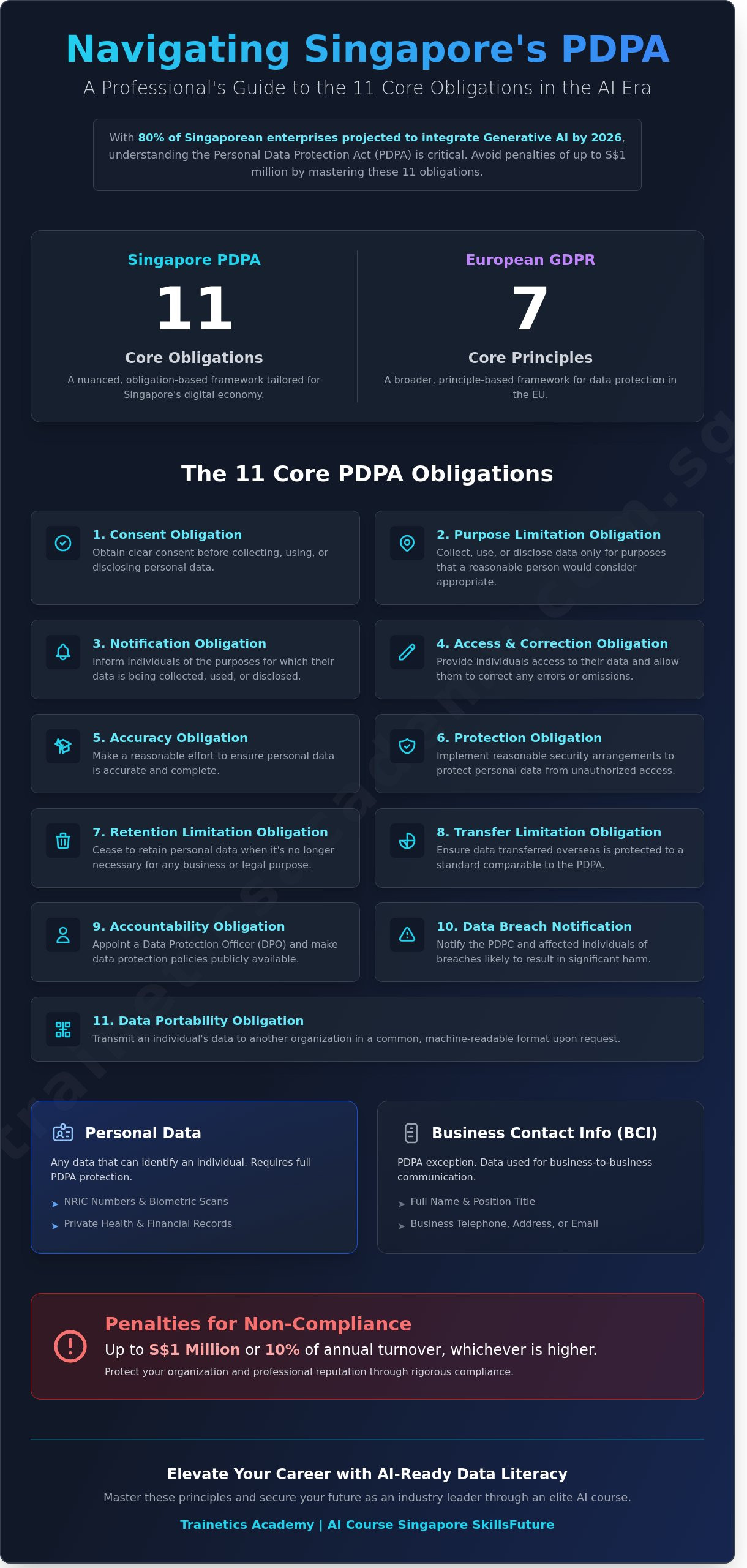
Establishing a professional identity in Singapore’s competitive market requires more than just technical expertise; it demands an unwavering commitment to ethical integrity. This integrity is legally codified through Singapore’s Personal Data Protection Act (PDPA). The Act serves as the primary framework governing the collection, use, and disclosure of personal data by organizations. While international standards like the European GDPR rely on 7 core principles, Singapore’s framework is uniquely structured around 11 distinct obligations. This nuanced approach ensures that businesses remain accountable while fostering an environment of innovation. The Personal Data Protection Commission (PDPC) actively enforces these standards, ensuring every professional entity operates with transparency and precision.
By 2026, projections suggest that 80% of Singaporean enterprises will have integrated generative AI into their core operations. This rapid technological shift makes a deep understanding of data protection principles non-negotiable for the modern professional. Mastering these regulations is essential for those enrolled in an AI course singapore skillsfuture to ensure their technical implementation remains legally sound. It’s about building a foundation of security that supports ambitious career goals. Professionals who invest time in SkillsFuture AI courses gain the specific knowledge needed to manage complex data sets without compromising individual privacy. This level of competence is what differentiates a standard practitioner from an industry leader.
The Evolution of Data Privacy in Singapore
Singapore’s digital economy thrives on a robust “Trust-as-a-Service” model. This strategy positions the nation as a secure hub for global data flows. Between 2025 and 2026, the PDPC introduced refreshed guidelines that specifically address the challenges of biometric data and automated decision-making. We’ve seen a definitive shift from reactive compliance to proactive data ethics. Organizations no longer just aim to avoid fines; they seek to elevate the industry standard by treating data protection as a core pillar of their professional identity. This proactive stance ensures that as AI adoption accelerates, the trust between businesses and consumers remains unbreakable.
Personal Data vs. Business Contact Information
Precision is vital when defining what information falls under the Act’s jurisdiction. Personal data refers to any data about an individual who can be identified from that data, such as NRIC numbers, private health records, or financial history. However, the PDPA provides a significant exception for Business Contact Information (BCI). BCI includes an individual’s name, position, business telephone number, and office address when used for business communications. This distinction is crucial for operational efficiency. It prevents administrative bottlenecks in professional environments, allowing for seamless networking. Still, when handling sensitive physiological profiles or biometric scans, the highest level of protection must be applied. For those attending a 1 day ai course SkillsFuture, distinguishing between these data types is often the first step toward achieving compliance excellence. If you require further guidance, our experts at 10 Anson Road, Level 22, International Plaza, Singapore 079903, can provide clarity on these complex legal requirements.
Adhering to data protection principles isn’t merely a legal hurdle; it’s a gateway to professional prestige. It reflects a disciplined approach to management and a visionary outlook on the future of work. As the landscape continues to evolve, staying informed on PDPC updates remains a critical component of career longevity and institutional success.
The 11 Core Obligations of Data Protection in Singapore
Upholding the integrity of personal information requires the same precision as mastering human biomechanics. In Singapore, the Personal Data Protection Act (PDPA) mandates a rigorous framework consisting of 11 core obligations. These data protection principles serve as the evidence-based foundation for any professional organization. Failing to meet these standards doesn’t just invite legal scrutiny; it erodes the trust necessary to build a prestigious career in any industry. Since the 2020 amendments, the PDPC has intensified its enforcement, with financial penalties reaching up to S$1 million or 10% of an organization’s annual turnover in Singapore.
The core triad of Consent, Purpose Limitation, and Notification forms the first line of defense. Organizations must obtain clear permission before collecting data. They must specify why they need it and limit usage to that exact reason. This systematic approach ensures that client information remains a tool for service excellence rather than a liability. Adhering to the PDPA data protection obligations ensures your business remains resilient against the evolving threats of the digital economy.
Managing Consent and Purpose in a Digital-First Economy
Obtaining consent isn’t always about a physical signature. In professional interactions, “Deemed Consent” applies when a client voluntarily provides data for a specific, obvious purpose. For instance, when a student registers for an AI course singapore skillsfuture, they reasonably expect their contact details to be used for course updates. However, “Purpose Limitation” dictates that this data cannot be sold to third-party marketers without fresh authorization. Best practices involve writing notification notices that are transparent and jargon-free. Clear communication reflects a brand’s commitment to excellence, ensuring users feel secure and valued from their first interaction.
The Security and Accountability Mandate
The “Protection Obligation” requires organizations to implement robust security measures to prevent unauthorized access or leaks. This isn’t a suggestion; it’s a technical necessity. For digital security, the “Retention Limitation” obligation ensures that personal data is purged once the business or legal purpose is served. Keeping data indefinitely is a high-risk strategy that offers no professional benefit. Practitioners enrolled in SkillsFuture AI courses often learn that data hygiene is just as critical as the algorithms themselves. Precision in data disposal is a hallmark of a disciplined mentor.
By 2026, the “Accountability Obligation” will stand as the overarching requirement for all Singaporean entities. This shift moves the focus from reactive compliance to proactive governance. Every organization must appoint a Data Protection Officer (DPO) to oversee these data protection principles. For Singaporean SMEs, the “Data Breach Notification Obligation” is a critical protocol. If a breach occurs that results in significant harm, the organization must notify the PDPC within 72 hours. This transparency is vital for maintaining industry standards.
At Trainetics Academy, located at 10 Anson Road, Level 22, International Plaza, Singapore 079903, we believe that professional identity is built on a foundation of scientific rigor and ethical responsibility. Whether you’re exploring a 1 day ai course SkillsFuture or a long-term certification, understanding these legal frameworks is essential. You can empower your professional journey by integrating these high-level standards into your daily practice, ensuring you’re industry-ready for the challenges of tomorrow.
Data Protection in the Age of AI: Bridging Compliance and Innovation
AI technologies are reshaping the professional landscape in Singapore, but they also introduce complex risks to data protection principles. When you use Generative AI, you’re often feeding proprietary or personal information into a digital system that operates beyond your immediate control. This creates a tension between the need for rapid innovation and the legal requirements of Singapore’s Personal Data Protection Act (PDPA). Professionals must bridge this gap by treating every AI prompt as a data handling event that requires the same scrutiny as a physical filing system. Empower your professional standing by recognizing that compliance isn’t a hurdle; it’s a hallmark of a sophisticated practitioner.
Data minimization is a core pillar of modern compliance. In the context of Large Language Models (LLMs), this means you shouldn’t upload entire databases to generate a single summary. If a fitness manager inputs the medical histories of 100 gym members to identify trends, they’ve likely breached the purpose limitation and data minimization clauses if those members didn’t consent to AI processing. Organizations also face a growing threat from “shadow AI,” where employees use personal accounts to process work data. A 2023 study by Salesforce revealed that 15% of employees regularly paste sensitive corporate data into AI tools without official oversight. To gain technical mastery over these tools while staying compliant, professionals should consider an Artificial Intelligence Course that balances performance with privacy.
AI Governance and the PDPA
The PDPC’s Advisory Guidelines on the use of Personal Data in AI Systems, updated in March 2024, provide a roadmap for ethical implementation. Professionals must prioritize algorithmic transparency, which ensures that AI-driven decisions, like health risk assessments or client profiling, are explainable to the individual. If you use AI to build customer profiles, the “Accuracy” principle remains your responsibility. You’re legally liable if an AI hallucination creates a false and damaging profile of a client. Many seekers of a 1 day ai course SkillsFuture or other SkillsFuture AI courses often overlook this liability aspect in favor of speed. Master the science of data integrity to ensure your AI outputs remain evidence-based and legally sound.
Safe AI Prompting for Professionals
Safe prompting starts with clear boundaries. Never enter NRIC numbers, home addresses, or specific physiological data into public AI tools. Instead, use anonymization techniques. Replace “John Tan, 52, recovering from a myocardial infarction” with “Male, 50s, post-cardiac event.” This preserves the utility of the AI for generating a training program while protecting the individual’s identity. Those enrolled in an AI course singapore skillsfuture program learn that privacy isn’t a barrier to creativity; it’s a framework for professional excellence. By mastering these boundaries at our training center at 10 Anson Road, Level 22, International Plaza, Singapore 079903, you protect your career and your clients’ trust simultaneously. You don’t just use AI; you lead with it responsibly.
Practical Implementation Strategies for Singaporean Professionals
Singaporean professionals must bridge the gap between regulatory theory and daily operations to remain competitive. Implementing robust data protection principles isn’t a one-time event; it’s a rigorous commitment to operational excellence. Start by establishing a Data Protection Management Programme (DPMP). This framework governs how your department collects, uses, and discloses personal data. It requires a clear governance structure, typically led by a Data Protection Officer, to ensure 100% compliance with the PDPA. A DPMP serves as your organization’s blueprint for accountability, providing a structured way to manage data throughout its entire lifecycle.
Before you deploy any new software or marketing tool, perform a Data Protection Impact Assessment (DPIA). This systematic process identifies potential privacy risks early in the development phase. For instance, if your team adopts a new CRM in 2024, the DPIA helps you assess if the data flow aligns with the purpose limitation obligation. You’ll need to document these findings to satisfy PDPC audits. By identifying vulnerabilities before they become breaches, you protect both your clients and your professional reputation. Evidence-based risk management is the hallmark of a sophisticated professional environment.
Develop internal Standard Operating Procedures (SOPs) that dictate exactly how data moves through your office. This includes everything from secure shredding of physical documents to the use of password-protected files for external transfers. A privacy-by-design culture only succeeds when every team member views data security as a core competency rather than an administrative hurdle. Continuous upskilling ensures that your staff remains industry-ready as cyber threats evolve. Professionals who prioritize these standards contribute to a more secure and trustworthy business ecosystem in Singapore.
The Professional Workflow Audit
Professional accountability begins with a granular look at your daily tasks. Conduct an audit to ensure your application of data protection principles remains consistent across all digital platforms. This process helps you visualize the movement of sensitive information and identify where security might be compromised.
- Step 1: Map every data touchpoint. Identify where personal data enters your workflow, whether through email, web forms, or physical business cards.
- Step 2: Locate high-risk areas. If you store client phone numbers in an unencrypted spreadsheet, you’ve identified a critical vulnerability that requires immediate remediation.
- Step 3: Lockdown your assets. Use AES-256 encryption for shared documents and implement role-based access controls to ensure only authorized personnel view sensitive files.
Leveraging AI for Privacy Compliance
Modern professionals use technology to protect technology. AI tools now exist to automatically detect and redact PII within large datasets, which can reduce human error by up to 95%. You can also automate data retention schedules to ensure you meet the Retention Limitation obligation. This mandates that data shouldn’t be kept longer than necessary for legal or business purposes. In 2023, the PDPC issued several financial penalties to firms that neglected these retention habits, proving that automation is no longer optional for high-performing teams.
Communication is the most frequent point of failure in data security. You can learn to draft privacy-compliant professional emails using our Business Writing with ChatGPT techniques. This training helps you use AI to scrub sensitive details before hitting send. If you’re exploring an AI course singapore skillsfuture or searching for high-impact SkillsFuture AI courses, mastering these tools is essential for modern compliance. A focused 1 day ai course SkillsFuture option can provide the immediate skills needed to automate your compliance tasks without compromising professional standards. Take the next step to elevate your professional standards at Trainetics Academy and secure your future in the digital economy.
Elevating Your Career with AI-Ready Data Literacy at Trainetics Academy
Mastery of data governance has evolved into a mandatory competency for Singaporean executives. As the Personal Data Protection Commission (PDPC) continues to refine enforcement, leaders must move beyond passive compliance. They need to integrate core data protection principles into their strategic decision making. At Trainetics Academy, we view data literacy as a physiological extension of professional fitness. Our evidence-based curriculum prepares you for an era where 73% of Singaporean enterprises prioritize AI adoption. Data protection isn’t a hurdle. It’s a foundation.
Our methodology is scientifically grounded and industry-ready. We don’t just teach theory; we build professional identities. Every module reflects the rigor expected in high-stakes environments. You’ll engage with an AI course singapore skillsfuture that transforms abstract concepts into actionable workflows. By mastering these tools, you secure a competitive advantage in a market that rewards precision and ethical foresight. Our trainers act as visionary mentors, guiding you through the complexities of modern data ethics with a disciplined approach. We prioritize the science of movement and the science of data with equal intensity.
Investing in your professional development budget is a strategic move for 2025. A 1 day ai course SkillsFuture provides an intensive, high-impact immersion into modern data protection principles. This fast-track format is designed for busy professionals who demand immediate results without sacrificing depth. You’ll walk away with a toolkit that is both intellectual and practical. We’ve structured our learning paths to mirror the organized nature of professional fitness training, moving from foundational concepts to advanced applications. This systematic approach ensures that you don’t just learn; you excel.
- Develop a sophisticated understanding of data governance as a leadership soft skill.
- Apply evidence-based strategies to mitigate organizational risk.
- Enhance your professional identity through industry-recognized certifications.
- Utilize your development budget to stay ahead of the 2026 technological curve.
Professional Certification and Industry Recognition
By 2026, the Singaporean job market will treat AI literacy as a baseline requirement rather than a luxury. Our programs bridge the gap between technical science and practical application. We remain committed to delivering the highest standard of professional education, ensuring our graduates are recognized as pioneers in their fields. You aren’t just attending a class; you’re joining a community dedicated to elevating industry standards. Visit our consultants at 10 Anson Road, Level 22, International Plaza, Singapore 079903 to map your trajectory toward excellence. We provide personalized consultations to align your training with your specific career ambitions.
Next Steps: Enrolling in SkillsFuture AI courses
Selecting the right SkillsFuture AI courses requires a clear understanding of your career trajectory. Whether you’re aiming for a role in data privacy or looking to lead an AI-driven team, our curriculum adapts to your goals. Prepare for your session by reviewing current PDPA guidelines; we provide all other interactive materials on-site. Expect a curriculum that demands active participation and rewards intellectual curiosity. Don’t settle for mediocre training. Transform your professional identity with Trainetics Academy today and lead the next wave of Singaporean innovation with confidence and scientific precision.
Future-Proof Your Professional Identity in Singapore’s Digital Economy
Navigating the complexities of Singapore’s 2026 regulatory landscape requires more than just awareness; it demands a sophisticated mastery of the 11 core obligations. Professionals who internalize these data protection principles position themselves as vital assets in an economy where data is the most valuable currency. By integrating ethical AI frameworks with practical PDPA compliance, you’re not just protecting information; you’re building a foundation for sustainable innovation.
Trainetics Academy provides the academic rigor needed to excel. Our evidence-based curriculum is delivered by expert trainers at 10 Anson Road, Level 22, International Plaza, Singapore 079903. If you’re searching for a 1 day ai course SkillsFuture or comprehensive SkillsFuture AI courses, our industry-ready certifications ensure you meet global standards. We’ve meticulously designed our AI course singapore skillsfuture to transform practitioners into disciplined leaders who understand the science of secure data management.
Master AI and Data Protection with Trainetics Academy
Take the lead in your industry today. Your journey toward professional excellence starts with a commitment to precision and continuous growth.
Frequently Asked Questions
What are the 11 obligations of the PDPA in Singapore?
The PDPA outlines 11 specific obligations that organizations must follow to uphold data protection principles. These include Consent, Purpose Limitation, Notification, Access and Correction, Accuracy, Protection, Retention Limitation, Transfer Limitation, Data Breach Notification, Accountability, and Data Portability. Since the 2020 amendment, the Data Breach Notification obligation requires firms to notify the PDPC within 3 calendar days if a breach causes significant harm to 500 or more individuals.
How do data protection principles apply to ChatGPT and other AI tools?
Organizations must ensure that any personal data processed via ChatGPT or AI tools adheres to established data protection principles. This means firms shouldn’t input sensitive client information into public AI models without explicit consent. The PDPC Advisory Guidelines on Use of Personal Data in AI Systems, published on 1 March 2024, clarify that businesses remain responsible for data accuracy and security during AI integration. You’ve got to maintain transparency about how AI processes personal data.
Is it a legal requirement for every Singaporean company to have a Data Protection Officer?
Every organization in Singapore is legally required to appoint at least one Data Protection Officer (DPO) under Section 11 of the PDPA. Failure to designate a DPO is a direct violation of the Accountability Obligation. You’ve got to register your DPO’s contact details via the ACRA BizFile+ portal to ensure the PDPC can reach your organization. This role is vital for maintaining industry-ready standards and ensuring your team follows evidence-based compliance protocols.
What is the penalty for breaching data protection principles in Singapore?
Organizations that breach the PDPA face financial penalties of up to S$1 million or 10% of their annual turnover in Singapore, whichever is higher. These revised maximum fines took effect on 1 October 2022. Beyond financial costs, the PDPC often issues directions to stop data processing or destroy collected data. This can severely disrupt your business operations and damage the professional identity you’ve built within the local market.
Can I use my SkillsFuture Credit for data protection and AI courses?
You can utilize your credits for an AI course singapore skillsfuture to master both technical skills and compliance. Enrolling in SkillsFuture AI courses allows professionals to understand the intersection of machine learning and legal frameworks. Whether you choose a 1 day ai course SkillsFuture or a longer certification, these programs ensure you’re industry-ready for the digital economy at our center at 10 Anson Road, Level 22, International Plaza, Singapore 079903.
How long should a company retain personal data under Singapore law?
Singapore law doesn’t specify a fixed number of years for data retention; instead, the Retention Limitation Obligation requires data destruction once the original purpose is gone. Most firms adopt a 7 year policy to align with the Inland Revenue Authority of Singapore (IRAS) tax record requirements. You shouldn’t keep personal data indefinitely just because storage is cheap. It’s a liability that increases your risk of a breach and violates the pursuit of operational excellence.
What is the difference between data protection and data privacy?
Data protection refers to the technical mechanisms and security measures used to safeguard information from unauthorized access. Data privacy focuses on the individual’s right to control how their personal information is collected and used. While protection involves firewalls and encryption, privacy involves consent forms and transparency. Both are essential components of a robust compliance framework in any professional setting. Mastering these concepts is a hallmark of a disciplined and visionary mentor.
How do I report a data protection breach to the PDPC?
You should report a data breach through the PDPC’s official e-service portal within 3 calendar days of discovery. This is mandatory if the breach affects 500 or more individuals or is likely to cause significant harm to affected parties. Organizations must provide a detailed account of the incident, the types of data involved, and the immediate remedial actions taken. Prompt reporting reflects a commitment to global standards and helps mitigate potential regulatory actions against your firm.
Disclaimer
AI Content Disclaimer: Some articles on this website may be generated or assisted by AI-powered content creation tools. While we strive for accuracy and relevance, readers should independently verify information before relying on it. The content is provided for informational purposes only and does not constitute professional advice.