While 77% of companies are actively exploring artificial intelligence, simply typing casual queries into a chatbot won’t secure your competitive edge. True professional impact comes from systematically applying AI skills in the workplace to eliminate operational bottlenecks, enforce output quality, and solve tangible business challenges.
If you’ve completed an introductory course or experimented with modern tools, you’ve likely realized that bridging the gap to daily execution isn’t simple. Unclear corporate boundaries around data confidentiality, worries over factual accuracy, and abstract technical jargon often leave professionals wondering how to safely handle routine duties without risking sensitive intellectual property.
You don’t need a technical background to drive meaningful transformation. This 2026 guide shows you how to translate artificial intelligence training into immediate productivity gains, streamlined workflows, and measurable business value. You’ll master a repeatable methodology for automating repetitive tasks like drafting and data synthesis, alongside the precise prompting frameworks needed to champion practical adoption across your team.
Key Takeaways
- Pinpoint high-value operational tasks through personal time audits, focusing on systematic augmentation rather than complete workflow replacement.
- Master a structured five-step methodology for applying AI skills in the workplace to reliably draft correspondence, synthesize reports, and accelerate departmental projects.
- Implement strict governance boundaries to safeguard proprietary company data and maintain regulatory compliance while querying external language models.
- Bridge the divide between abstract technical theory and everyday execution through structured, interactive professional training.
Identifying High-Impact Workplace Use Cases for AI Integration
Successful execution begins by viewing artificial intelligence as cognitive scaffolding rather than an outright workforce replacement. High-performing professionals don’t surrender ownership of their deliverables. Instead, they isolate discrete cognitive friction points within daily routines to systematically expand operational capacity.
To evaluate the core capabilities required alongside modern automated tools, watch this helpful overview:
Mapping Repetitive Daily Tasks to AI Capabilities
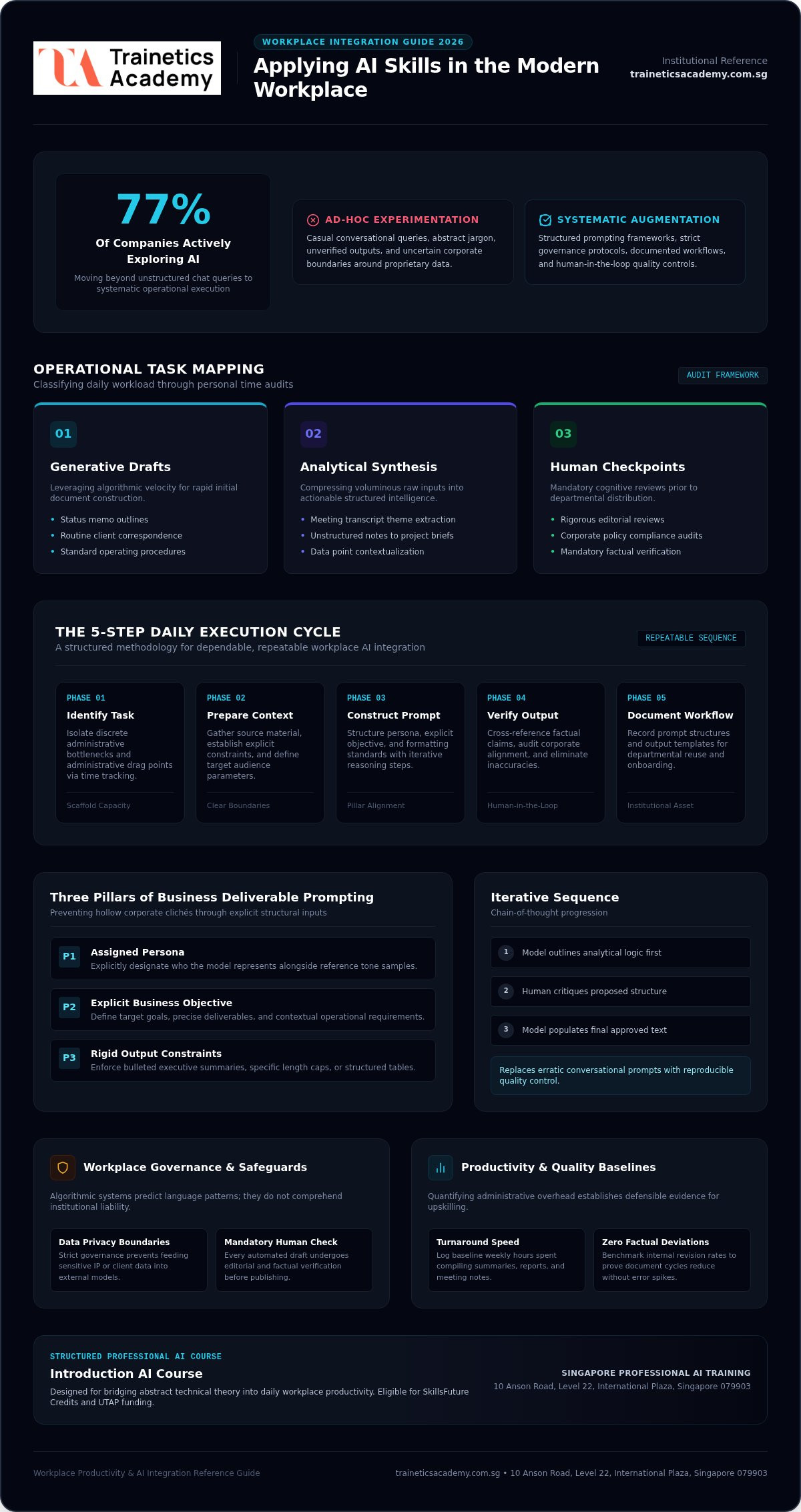
A rigorous personal time audit reveals precisely where administrative drag drains your workweek. Group your recurring responsibilities into three distinct operational buckets: generative drafting, analytical synthesis, and administrative coordination. Successfully applying AI skills in the workplace depends on knowing which responsibilities benefit from algorithmic speed and which demand strict human oversight.
- Generative drafts: Producing initial outlines for status memos, client communications, and standard operational procedures.
- Analytical synthesis: Extracting core themes from voluminous meeting transcripts and converting unstructured notes into structured project briefs.
- Human checkpoints: Mandatory editorial reviews, policy compliance audits, and factual verification before publishing any external deliverable.
Establishing Measurable Productivity and Quality Baselines
You can’t optimize what you don’t benchmark. Before deploying automated assistants across your daily responsibilities, log the baseline hours you spend each week compiling routine summaries, formatting reports, and reconciling meeting notes. Quantifying this administrative overhead establishes clear evidence of performance improvements.
Document both turnaround speed and internal revision rates. When you demonstrate that structured prompting cuts document production cycles while maintaining zero factual deviations, applying AI skills in the workplace transforms from an ad-hoc personal experiment into an indisputable business asset that justifies departmental upskilling.
A Step-by-Step Framework for Applying AI Skills in Daily Workflows
Moving beyond erratic chat queries requires an operational cadence. Applying AI skills in the workplace functions best when anchored by a structured five-step cycle: identify the task, prepare the raw context, construct the prompt, verify the factual output, and document the resulting workflow template for internal reuse. This repeatable sequence prevents disjointed experimentation and establishes dependable execution across your daily duties.
Before querying any language model, gather all required source material and establish explicit operational parameters. Define the boundaries of the assignment clearly. Specifying target audiences, formatting constraints, and data limitations in advance ensures the generated output aligns with practical organizational requirements from the outset.
Engineering Context-Rich Prompts for Business Deliverables
Vague inputs generate hollow corporate clichés. To extract actionable value, structure your instructions around three core pillars: assigned persona, explicit business objective, and rigid output constraints. Tell the model who it represents, provide reference tone samples, and enforce specific formatting such as bulleted executive summaries or structured markdown tables.
Instead of relying on single, unstructured conversational queries, deploy iterative chain-of-thought sequences. Ask the model to outline its analytical logic first, critique its proposed structure, and then populate the final text. Pairing these techniques with the top AI productivity tools for business ensures your cross-platform workflows remain fast, sharp, and consistent.
Human-in-the-Loop Quality Control and Verification Protocols
Algorithmic systems predict language patterns; they don’t comprehend institutional liability. Every automated draft demands human-in-the-loop validation before reaching leadership or external clients. Always cross-reference quantitative claims against your original spreadsheet source data, since language models can introduce subtle computational distortions when handling numbers.
Check dates, market benchmarks, and statutory citations against authoritative primary documentation. Once facts are confirmed, refine phrasing to ensure authentic brand alignment. Building this verification discipline is a core focus of structured professional training, such as enrolling in a dedicated AI course to master systematic daily execution.
Practical AI Competencies Across Functional Business Departments
Modern professionals must understand how to leverage language models to synthesize unstructured data sets, draft complex communications, and extract rapid qualitative insights across both client-facing and internal back-office roles. Testing prompts on multi-model platforms such as N33 AI can help teams compare outputs and determine which systems best address specific operational needs.
Communications, Marketing, and Sales Enablement
Commercial teams leverage generative models to accelerate business development cycles and refine messaging strategy. Instead of spending hours staring at a blank page, marketing and sales practitioners use structured frameworks to execute high-impact communication tasks quickly:
- Targeted commercial outreach: Drafting multi-touch sales sequences adapted to distinct buyer personas, pain points, and company sizes.
- Content repurposing: Condensing 40-page technical white papers into sharp executive briefs, email nurture streams, and presentation slide structures.
- Customer sentiment extraction: Ingesting unstructured qualitative feedback from customer survey transcripts to surface recurring objections and feature requests.
Operations, Human Resources, and Administration
Internal corporate teams use language models to standardize governance and reduce administrative drag. HR and operations specialists frequently handle extensive documentation that benefits from rigorous semantic structuring and objective synthesis.
For talent acquisition, teams synthesize multi-interviewer candidate notes against standardized evaluation rubrics, ensuring objective assessments while eliminating personal administrative fatigue. In daily administration, managers draft comprehensive standard operating procedures (SOPs) simply by feeding raw, step-by-step voice transcripts into structured documentation prompts.
Workplace Governance: Data Privacy, Accuracy, and Risk Mitigation
Speed without safety creates severe enterprise liabilities. True mastery when applying AI skills in the workplace requires balancing productivity acceleration with strict data confidentiality, output validation, and compliance with statutory frameworks. High-performing teams treat risk management as a non-negotiable operational standard rather than an afterthought.
Employees frequently struggle to balance the convenience of public generative tools with corporate information security standards. Establishing clear behavioral protocols around input hygiene and model verification protects both organizational intellectual property and individual professional standing.
Protecting Sensitive Corporate Information and Customer Data
Never input proprietary source code, internal financial ledgers, or customer personal details into unvetted consumer-tier interfaces. Public models often utilize prompt histories to retrain foundational algorithms, turning your casual query into a potential data breach.
Practice thorough data sanitization before initiating any operational query:
- Strip identifiable markers: Replace client names, employee titles, and trade identifiers with generic placeholders like “Company A” or “Stakeholder 1.”
- Isolate internal workspaces: Confirm whether your employer utilizes enterprise instances with zero-retention data policies before uploading confidential documentation.
- Enforce boundary discipline: Restrict external prompts to procedural structuring, stylistic refinement, and public research queries.
Managing Hallucinations, Bias, and Reputational Risk
Modern models output articulate falsehoods with authoritative cadence. When synthesizing market reports or forecasting operational trajectories, algorithmic assistants can fabricate plausible-sounding dates, legal references, or statistical trends. Failing to catch these distortions undermines team trust and introduces major business risks.
Cultivate an unyielding audit discipline. Maintain explicit audit trails for any AI-assisted business proposals, and treat every machine-generated assertion as an unverified draft requiring independent sign-off. Applying AI skills in the workplace responsibly demands that human domain specialists retain final accountability for strategic decisions.
If you want your department to master compliant prompt protocols, explore a structured AI course Singapore professionals trust for comprehensive governance training.
Scaling Impact Through Structured Professional AI Training
Benefits of Instructor-Led Interactive Learning
Passive video modules rarely teach professionals how to navigate dirty data, conflicting stakeholder inputs, or hallucinations under strict commercial deadlines. Interactive workshops immerse participants in realistic corporate environments where they receive immediate feedback on prompt construction, workflow chaining, and output verification.
Hands-on practice ensures participants build muscle memory across practical operational tasks. Completing a structured AI Course in Singapore equips non-coders with the skills needed to design multi-turn prompt templates, conduct reliable document syntheses, and deploy compliant AI routines directly into daily business operations.
Leveraging Government Subsidies for Professional Upskilling
Singaporean professionals have exceptional access to national workforce development schemes designed to accelerate technological readiness. When selecting executive training, verify the financial assistance pathways available to offset corporate and individual expenditures.
For individuals taking their foundational steps, the Introduction AI Course is eligible for SkillsFuture Credits and UTAP funding. This financial support enables local professionals and enterprise teams to maximize annual development budgets while acquiring essential technological competencies.
Review our comprehensive AI course Singapore professional guide to explore curriculum pathways and funding criteria. To review customized corporate cohorts or speak directly with certified instructors, visit the Trainetics Academy training facility at 10 Anson Road, Level 22, International Plaza, Singapore 079903. Systematic, hands-on training ensures you lead your team in applying AI skills in the workplace with confidence, precision, and measurable strategic impact.
Transform Your Daily Workflow with Practical AI Execution
Mastering modern corporate efficiency requires more than casual experimentation. By isolating repetitive administrative friction, engineering structured prompt sequences, and maintaining disciplined verification protocols, you convert raw algorithmic speed into tangible business results. Upholding rigorous data hygiene while enforcing high output standards ensures your workflow enhancements protect company assets while elevating your professional standing.
The professionals shaping tomorrow’s industries aren’t necessarily technical programmers. Instead, they’re disciplined operators who understand how to augment their analytical and generative capabilities safely. When you commit to applying AI skills in the workplace with deliberate focus, you establish yourself as an indispensable driver of operational excellence across your organization.
Take charge of your professional trajectory today. Master practical workplace AI tools with Trainetics Academy and build the practical confidence to lead your team into a productive, automated future.
Frequently Asked Questions
How do I start applying AI skills in the workplace if my company lacks official AI software?
What are the most common mistakes professionals make when implementing AI at work?
The biggest mistake is treating generative models as search engines rather than reasoning assistants. Many professionals paste raw queries without background context, leading to generic outputs. Another major error is skipping manual verification, which risks publishing hallucinations or flawed calculations. Failing to build standardized prompt templates also means employees waste valuable time rediscovering how to prompt the model effectively for recurring tasks.
Can I apply generative AI tools to sensitive financial or client data safely?
You can safely handle sensitive workflows only by following strict data anonymization protocols or operating within secure enterprise environments. Before pasting data into external models, strip out client names, exact financial figures, and trade secrets, replacing them with generic placeholders. If your organization doesn’t provide an enterprise workspace with zero-data-retention terms, keep raw confidential files entirely offline and use AI solely for layout structures or conceptual formulas.
How do I demonstrate the measurable value of my AI skills to senior management?
Track time savings and deliverable velocity before and after adopting automated workflows. Show how applying AI skills in the workplace reduced a recurring multi-hour task, like drafting weekly status digests or client summaries, down to minutes without quality degradation. Present clear metrics covering hours reclaimed, document turnaround speed, and reduced revision cycles to build an indisputable business case for broader team adoption.
Do I need programming knowledge to apply AI tools effectively in an office role?
Are short professional AI courses sufficient to gain practical workplace competence?
Yes, targeted short-format workshops provide immediate operational value when they focus on hands-on application rather than abstract computer science theory. A well-designed 1 day AI course Singapore professionals attend teaches tactical prompt engineering, workflow chaining, and output auditing. By practicing directly with realistic workplace business scenarios, learners gain immediate confidence to automate routine drafting and administrative processes right away.
Is the Introduction AI Course eligible for government training support in Singapore?
Yes, the Introduction AI Course is eligible for SkillsFuture Credits and UTAP funding for qualifying Singaporean learners. This financial support enables individual working professionals and corporate teams to lower out-of-pocket upskilling expenses while gaining practical AI capabilities. Always check your individual credit balance and current eligibility guidelines with the respective administrative portals before submitting an enrollment claim.
Disclaimer
AI Content Disclaimer: Some articles on this website may be generated or assisted by AI-powered content creation tools. While we strive for accuracy and relevance, readers should independently verify information before relying on it. The content is provided for informational purposes only and does not constitute professional advice.