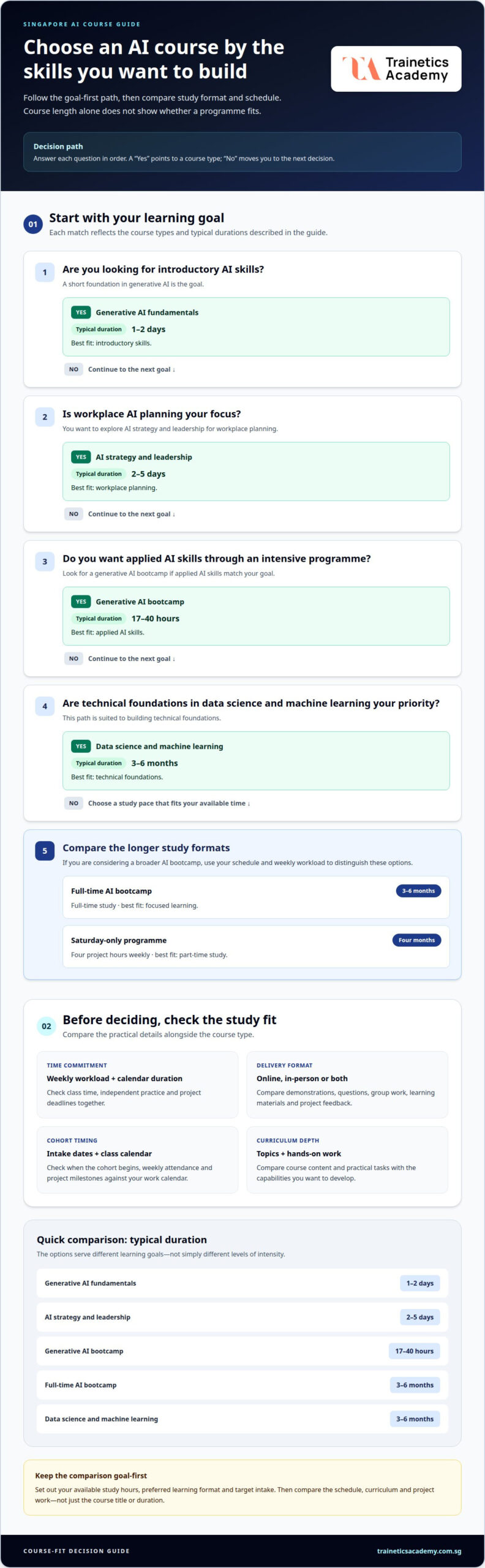
The longest AI bootcamp isn’t automatically the strongest choice: the right fit depends on the skills and career path you want to pursue. A comparison of AI bootcamps in Singapore should start with course type: generative AI fundamentals courses typically run for 1-2 days, while full-time AI bootcamps and data science and machine learning programmes typically last 3-6 months.
It’s reasonable to expect a bootcamp to combine practical learning with a clear route towards your goals. But course length alone won’t show whether a programme suits you. Compare delivery format, intake dates, curriculum depth and the technical pathway each option supports, from applying AI tools at work to developing machine learning expertise.
This guide compares six types of AI course options in Singapore by those decision points. You’ll see how to weigh hands-on work, study commitment and career fit, so you can focus on a programme that builds relevant capability rather than choosing by duration or title alone.
Key Takeaways
- Match the course format and intake schedule to the time you can commit and the way you learn best.
- Look beyond course titles: compare curriculum depth and how much practical work supports each learning path.
- Choose between AI applications, machine learning and data science based on the capabilities your target role requires.
- Assess whether a programme develops technical foundations or focuses on applying AI in workplace tasks.
- Use a side-by-side comparison of curriculum, delivery, career fit and technical pathway to narrow your options.
Course duration, delivery format, and intake dates
Singapore AI courses range from short workshops to extended programmes, so duration alone cannot show which format fits. Compare weekly commitment, teaching mode and cohort start dates alongside the skills each course develops.
Full-Time and Part-Time Formats
Full-time AI bootcamps in Singapore typically last 3-6 months, concentrating lessons and projects into a more intensive study period. Part-time formats spread learning around work or other commitments; one Saturday-only programme involves four hours of project-based work each week over four months. For a fair comparison, consider calendar duration and weekly workload together.
A full-time schedule may suit learners who can prioritise a structured block of study, while part-time learning offers a different pace. Find out how live sessions, independent practice and project deadlines fit together. For example, a course with regular machine-learning assignments calls for study between classes, even if its delivery is flexible.
Online and In-Person Learning
Online learning removes the need to attend a classroom, while in-person teaching brings learners together for lessons. Some providers offer both formats. Compare how each option handles demonstrations, questions, group work and learning materials, rather than treating “online” or “in-person” as a measure of curriculum quality.
For online learning, look at scheduled sessions and how learners collaborate on practical tasks. In-person classes can make real-time discussion easier, while online delivery can suit learners who prefer to study remotely. In either format, check how the course includes project feedback and instructor interaction.
Course Durations and Cohort Schedules
Generative AI fundamentals courses in Singapore typically last 1-2 days. AI strategy and leadership programmes typically run 2-5 days, while data science and machine learning programmes typically last 3-6 months. Across the AI courses compared in this guide, durations range from a three-hour workshop to programmes of up to three years. These options serve different learning goals, not simply different levels of intensity.
Cohort schedules add another comparison point. A fixed intake gives learners a shared start and sequence of sessions; other schedules may suit independent pacing. Providers’ published intake dates show when a cohort begins, while class calendars clarify weekly attendance and project milestones. Compare these details with your work calendar before choosing.
| Option | Typical duration | Format or schedule | Best fit |
|---|---|---|---|
| Generative AI fundamentals | 1-2 days | Short course | Introductory skills |
| AI strategy and leadership | 2-5 days | Short programme | Workplace planning |
| Generative AI bootcamp | 17 to 40 hours | Intensive sessions | Applied AI skills |
| Full-time AI bootcamp | 3-6 months | Full-time study | Focused learning |
| Saturday-only programme | Four months | Four project hours weekly | Part-time study |
| Data science and machine learning | 3-6 months | Extended programme | Technical foundations |
Before comparing providers, set out your available study hours, preferred learning format and target intake. Then match each course’s duration to its weekly schedule and curriculum. Funding may also affect a learner’s final decision, but it should not replace a review of course content, project work and cohort timing.
Choose the option whose schedule makes consistent practice possible and develops the skills you want.
AI, machine learning, and data science curricula
Course titles can overlap, but curricula may prepare learners for different tasks. Compare the concepts taught, practical work, entry expectations and learning format before deciding which path matches your goals.
AI, Machine Learning, and Data Science Courses
An AI course may focus on generative tools, automation and applying AI concepts to workplace tasks. Machine-learning study is more technical, exploring how models learn from data and make predictions. Data science courses place greater emphasis on preparing, analysing and interpreting data, which can support machine-learning projects.
Read the curriculum topic by topic. For example, check whether a machine-learning course teaches Python, data preparation and model evaluation, rather than only discussing AI applications. A data science course may instead prioritise analysis and communicating findings. These distinctions help connect course content with the work you want to do.
Course categories also differ by learner goal. A beginner seeking practical familiarity may prioritise AI tools and guided examples. Someone building technical foundations may prefer Python, statistics and model development. A professional focused on workplace change may value automation use cases and responsible implementation. Compare the stated outcomes with the skills you want to demonstrate.
Entry prerequisites shape eligibility and the learning experience. Check whether a course expects coding experience, comfort with data, or only general digital skills. If Python is new to you, a programme that assumes coding knowledge may require extra preparation. If you already analyse datasets, a course covering basic data concepts may spend less time on your next learning need.
Self-Learning Materials and Hands-On Tasks
Self-learning materials, such as recorded lessons and readings, let learners revisit concepts at their own pace. Hands-on tasks require learners to apply them, for example by testing an AI prompt, cleaning a dataset or comparing model outputs. A useful curriculum benchmark is at least 60% hands-on exercises.
This helps distinguish a course built around active practice from one centred mainly on consuming content. Examine how exercises connect to the syllabus: a Python lesson should include coding practice, while an automation topic should use a workflow example. Look for details about feedback or assessment to understand how learners review their work.
Online, in-person and part-time formats can all support practical learning, but the activities matter. An online course might use shared datasets and guided exercises; an in-person class might work through the same task with instructor discussion. Part-time learners can benefit from materials they can revisit between sessions. Compare the practice tasks with your career goal, then choose the course that builds the skills you need.
Choosing courses based on career and workplace goals
Choose an AI course by matching its applications to your current role or target career. A non-technical professional may need generative AI for research, drafting or workflow automation, while a technical learner may need coding practice and model development. Start with the work you want to do, then compare course topics, entry requirements and activities against that goal.
For workplace use, focus on tasks rather than broad promises. A marketing professional might practise refining prompts and reviewing generated content; an operations specialist might explore how automation fits an existing process. These goals call for applied generative AI skills, not necessarily a coding curriculum. If you want to build or evaluate models, technical instruction and programming become more relevant.
Course labels such as GA100 and GA200 need a syllabus-based comparison. The code alone doesn’t establish a course’s subject, depth or prerequisites. Compare the published learning outcomes, required prior knowledge and practical assignments for each. For example, identify whether either course expects coding experience, teaches prompt design, or focuses on workplace applications. That approach helps learners judge eligibility without assuming the codes indicate a particular sequence.
Cohort bootcamps and self-paced courses organise learning differently. A cohort follows a shared schedule, which can structure lessons, peer discussion and project deadlines. Self-paced study gives learners more control over when they work through materials. Compare how each format supports practice and feedback. A learner balancing work may value flexibility, while someone building a portfolio may prefer set milestones and collaborative projects.
Career support, internships and job-placement assistance are distinct features to assess separately from curriculum. Singapore’s formal tech programmes have upskilled more than 340,000 individuals and placed more than 21,000 in local tech roles. Those figures describe programmes overall, not the outcome of each AI bootcamp. Treat them as market context, not a prediction of an individual learner’s result.
Use these decision points to compare options:
- Workplace application: Match generative AI and prompt practice to tasks you perform regularly.
- Technical direction: Prioritise coding and model-related learning for more technical goals.
- Entry requirements: Align prerequisites with your existing skills and experience.
- Learning structure: Weigh cohort deadlines against the flexibility of self-paced study.
- Career support: Separate teaching, internship opportunities and placement assistance when reviewing outcomes.
For government-related training pathways, distinguish programme-level placement figures from a course’s own career support. A careful comparison of AI bootcamps in Singapore should connect each curriculum to a defined goal, whether that means improving workplace processes or developing technical capability. Select the learning structure that makes consistent practice possible, then assess whether its outcomes match the next step in your career.
Technical AI training and engineering pathways
Technical AI training should connect core concepts with practical work. Compare project activities, trainer expertise, workplace relevance and any applicable funding support before choosing a pathway.
Hands-On Training and Practical Work Products
Hands-on training asks learners to apply methods, not just study concepts. In an engineering pathway, a practical task might involve preparing data, testing a model and documenting its performance. These work products show how learners approach technical problems and explain their decisions.
Compare projects with the skills you want to develop. A business-focused task might map an AI-assisted workflow, while a technical project might involve code and model evaluation. Check how instructors guide each stage, from defining the task to reviewing results. This structure makes practical work more relevant to workplace needs.
Trainer Experience and Credentials
Trainer experience matters most when it connects directly to the curriculum. For machine learning, relevant expertise could include building or evaluating models; for workplace automation, it could include applying AI to operational processes. Compare the trainer’s stated background and teaching experience with the course topics.
Credentials and industry experience serve different purposes. Formal education can demonstrate subject preparation, while project experience can show applied knowledge. Consider whether the trainer can explain both the underlying methods and their practical limits. For example, a discussion of model evaluation should connect metrics to the decisions learners make.
Trainer access also shapes the learning experience. Compare scheduled Q&A sessions, feedback on practical tasks and opportunities to discuss technical challenges. A useful session might unpack why a model produced an unexpected result, then guide learners through possible causes. Clear access arrangements help learners connect questions to course content.
For corporate AI training, begin with the organisation’s intended outcome. A small business seeking workflow improvements using AI may need applied exercises, while an engineering team may require deeper technical practice. Compare whether the course can address the organisation’s use cases, learner backgrounds and practical goals. Assess funding separately from curriculum fit.
In Singapore, distinguish employer sponsorship from SkillsFuture Credit when reviewing funding. Only the Introduction AI Course is eligible for SkillsFuture Credits and UTAP funding, so don’t assume eligibility applies to every AI training option. For SME subsidies or other support, compare the relevant course, learner and employer conditions before including funding in the training plan.
A sound pathway builds from foundations towards more technical work. Learners might progress from handling data to evaluating models, then apply those skills to an engineering project. Compare each course’s entry requirements, practice tasks and trainer support against that progression. This helps employers select training that develops relevant skills, rather than relying on a course title alone.
Singapore AI bootcamp programme comparison
Compare programmes by learning evidence, learner feedback and career outcomes, not labels alone. A useful comparison separates short applied courses, technical bootcamps and longer academic pathways.
Student Reviews
Student reviews can reveal how learners experience teaching, workload and practical exercises. Compare comments about specific parts of a programme, such as machine-learning projects or instructor explanations. A detailed review of a coding task offers more useful context than a general rating. Look for recurring themes, while separating feedback about course delivery from claims about career outcomes.
Graduate Outcomes
Graduate outcomes describe what learners do after completing a programme, but measures can differ. One institute may highlight new roles, while another reports portfolio projects or further study. Compare the outcome measure, the learner group it covers and its connection to the curriculum. A certificate shows course completion; it doesn’t establish a particular job result.
Student reviews and graduate outcomes vary by programme and learner goal, so those measures alone cannot produce a reliable ranking. Compare like with like: feedback about teaching against teaching, and graduate outcomes against the same clearly defined career measure.
Use a consistent scorecard to compare programme types. For each option, record the evidence provided and the learner goal it serves. This keeps marketing language separate from practical measures of learning and career relevance.
| Programme type | Review themes to compare | Outcome evidence to assess | Typical fit |
|---|---|---|---|
| Generative AI course | Prompt practice and workplace examples | Applied tasks or workflow examples | Using AI tools at work |
| Machine learning bootcamp | Technical explanations and coding support | Model or data project work | Building technical skills |
| Data science programme | Data exercises and analytical feedback | Analysis projects and communication | Working with data |
| University pathway | Academic structure and subject depth | Programme requirements and progression | Extended formal study |
| Short applied programme | Practical examples and lesson clarity | Demonstrated workplace application | Focused skills development |
| Self-paced course | Materials, task guidance and flexibility | Completed exercises or portfolio pieces | Independent learning |
Read reviews for concrete details. Comments about whether instructors explain a machine-learning concept clearly can help you assess teaching quality. Feedback about project instructions can indicate how well a programme supports practical work. Treat isolated praise or criticism as one person’s experience, not a complete measure of an institute.
For graduates, distinguish course outputs from employment outcomes. A portfolio project can demonstrate applied learning; a new role is a separate career outcome. Compare the programme’s stated learning goals with the evidence it presents, then decide whether that evidence matches your next step. This puts graduates’ experiences in context without treating a certificate or programme as a promise of employment.
Trainetics Academy
Trainetics Academy offers an Artificial Intelligence Course for learners who want to build practical AI knowledge for workplace use. Consider this option when your comparison points towards applied AI learning rather than a lengthy academic pathway or specialised machine-learning engineering programme.
Use your goals to assess fit: identify the tasks you want to improve, the concepts you need to understand and the learning format that suits you. Trainetics Academy offers interactive courses through both in-person and online learning, giving learners different ways to engage with AI education. This is a relevant next step if you want structured instruction while developing your artificial intelligence skills.
Contact Trainetics Academy to discuss your AI learning goals.
Turn your learning choice into a career plan
Treat your next course as one stage in a broader professional development plan. A careful comparison of AI bootcamps in Singapore can help you choose a direction, but progress also depends on how you apply what you learn. Identify a workplace challenge, technical problem or process you want to understand better, then use it to guide your practice after training.
Before committing, write down the skills you want to build and how you’ll recognise progress. That might mean explaining an AI concept clearly, applying a tool thoughtfully or developing stronger technical judgement. Keep the goal specific enough to guide your learning, but open enough to evolve as your experience grows. This gives each learning decision a purpose beyond completing a course.
When you’re ready to explore a structured next step, contact Trainetics Academy to discuss your AI learning goals. Approach the next stage with curiosity, focus and the confidence to keep building your expertise.
Frequently Asked Questions
What Are the 5 Best AI Bootcamps in Singapore?
There isn’t one set of five best AI bootcamps for every learner. Build a shortlist by excluding programmes that don’t match your study commitment or intended work, then compare the remaining options using evidence that matters to you. A career changer may prioritise assessed projects, while a team lead may value organisational use cases. Treat “best” as a question of fit, not a universal ranking.
Do I need to already know how to code to join?
No, coding is not a universal entry requirement for AI learning. If you aim to use AI tools in your current role, focus on whether the course teaches you to assess outputs, use tools responsibly and design tasks. Coding becomes relevant when your planned work involves implementing models or building data workflows. Match the course’s stated entry level to the work you expect to do after training.
How Are These Ranked as the Best AI Bootcamps?
Rankings are useful only when programmes are compared using clear, consistent criteria. Check whether a list explains how options were selected, distinguishes learner feedback from promotional testimonials, and compares outcomes for similar learner groups. A university programme and a short professional course are different offerings. If a ranking doesn’t explain its basis, use it as a starting point rather than a final decision.
Which AI and machine learning bootcamps are available in Singapore?
Learners in Singapore can find applied AI courses, generative AI training, machine-learning and data science programmes, and strategy-focused study. These labels describe broad pathways, not identical course content. Someone exploring AI in a business team may seek application-focused lessons, while a learner targeting model work needs technical study. Check each programme’s learning outcomes to see which pathway it follows.
How do Singapore AI bootcamps compare by curriculum, duration, and learning format?
Compare each programme using the same details: guided learning hours, calendar span, live attendance requirements, assessment method and access to learning materials. This can reveal different demands even when courses have similar durations. Also note whether assignments are individual or collaborative. These details help distinguish flexible study from cohort-led learning without relying on a provider’s headline description.
What are the tuition fees for AI bootcamps in Singapore?
Fees vary by programme and provider, so there isn’t one standard fee for Singapore AI bootcamps. Compare what the quoted amount covers, such as teaching, materials, assessment and project support, then consider eligible funding separately. The total depends on course scope, delivery format and learner requirements. Don’t treat the lowest headline fee as best value if the included learning components differ.
Which Singapore AI bootcamps qualify for SkillsFuture or other government subsidies?
The Introduction AI Course is eligible for SkillsFuture Credits and UTAP funding. This eligibility applies to that named course only; don’t assume it extends to other AI courses or bootcamps. For a funding decision, distinguish course eligibility from your own ability to claim support, and identify the exact course you intend to take. Funding eligibility alone doesn’t establish whether the curriculum fits your learning goals.
What prerequisites and admissions requirements do AI bootcamps in Singapore have?
Each programme sets its own admission requirements, so review the entry information before choosing an intake. Note any stated prior study, technical background, application documents, assessment steps and enrolment deadlines. If a course uses a screening task, its subject can indicate the preparation expected. Keep a record of each programme’s requirements to distinguish application conditions from the skills you aim to develop during training.
Disclaimer
AI Content Disclaimer: Some articles on this website may be generated or assisted by AI-powered content creation tools. While we strive for accuracy and relevance, readers should independently verify information before relying on it. The content is provided for informational purposes only and does not constitute professional advice.