What makes a SkillsFuture AI course the right fit? In Singapore, course titles can sound similar while the learning goals differ. To choose well, match the course content to your current knowledge and the tasks you want to understand or improve at work.
An AI course may focus on foundational concepts, particular tools or practical workplace applications. The title alone won’t tell you how much time learners spend practising, or how they learn to assess AI-generated results. Before choosing, look for specific learning outcomes and activities that suit your experience level.
This guide explains how to compare SkillsFuture AI courses by what they teach and how they support learning. You’ll find practical ways to assess workplace relevance, distinguish application from theory or tool-specific instruction, and verify course and funding details through official sources. Use these checks to choose a suitable next step, whether you’re exploring AI for the first time or building on existing knowledge.
Key Takeaways
- Start with a workplace task or learning goal, such as building AI foundations or exploring a practical application.
- Look beyond tool lists. Check whether the course includes demonstrations, guided practice and realistic tasks.
- Compare each SkillsFuture AI course using the same criteria: learning goals, practice, delivery mode and work relevance.
- Assess course suitability first, then verify current funding details for that specific course through official sources.
- Trainetics Academy offers interactive AI learning led by qualified professionals, delivered in physical and virtual formats.
What does a SkillsFuture AI course help you learn in Singapore?
An AI course provides structured learning in artificial intelligence concepts, tools or practical applications. It can help learners understand how AI works or explore how it may support relevant tasks. This differs from a general digital skills class, which may cover a wider range of technologies without focusing on AI.
Course titles can point to very different learning goals. One course may introduce foundational concepts; another may focus on generative AI or prompt-writing. To judge the difference, look for details about course content, practice and workplace examples rather than relying on the title or tool names. For an overview of the broader field, explore Artificial Intelligence.
For context on AI learning and professional development in Singapore, watch this report:
Which AI learning goals might a course address?
First identify the capability you want to develop. Then check whether the course content supports it. Common goals include:
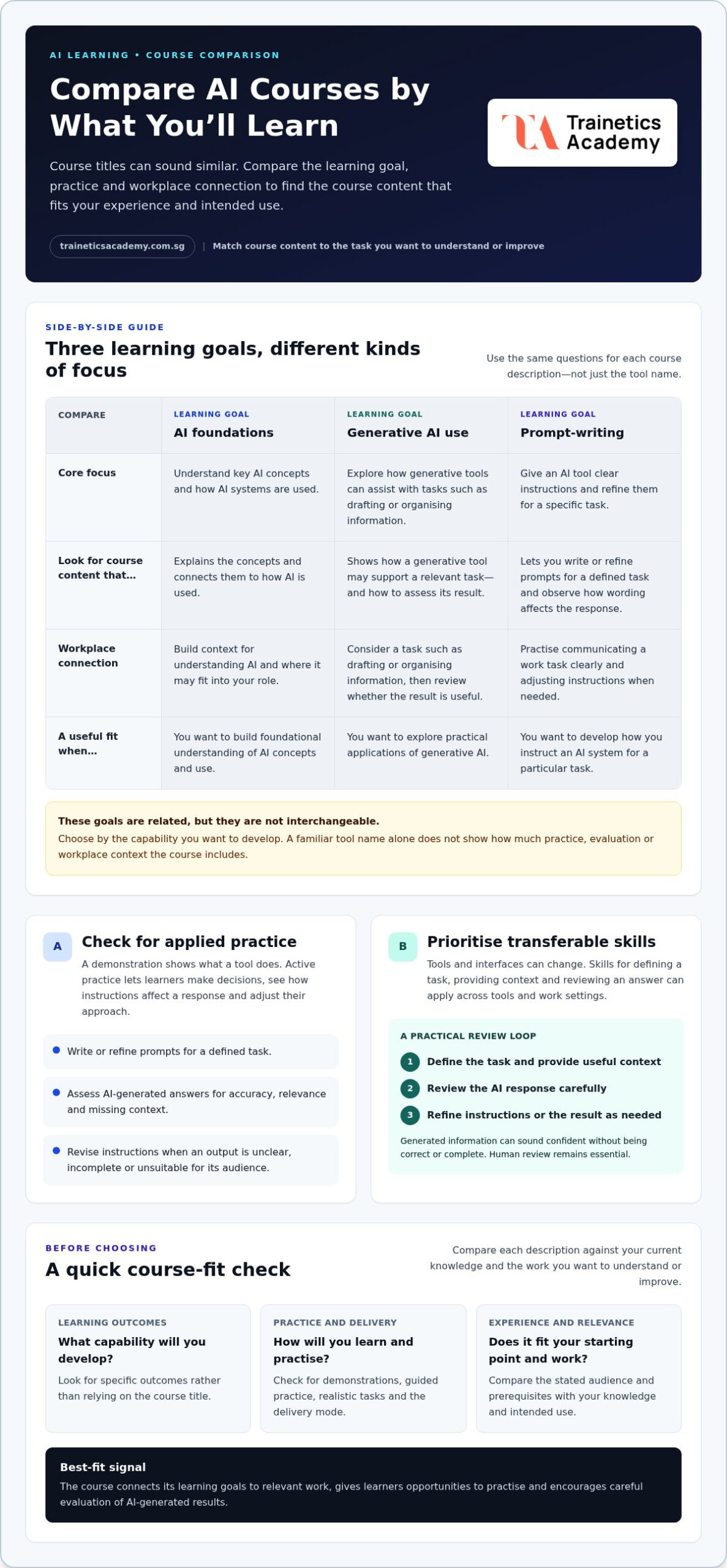
- AI foundations: Understand key concepts and how AI systems are used.
- Generative AI use: Explore how generative tools can assist with tasks such as drafting or organising information.
- Prompt-writing: Practise giving an AI tool clear instructions and refining them for a specific task.
These goals are related, but they aren’t interchangeable. Learning AI concepts builds context; using a particular generative AI tool focuses on applying it. For example, if you prepare meeting notes, you might want to learn how AI could help summarise information and how to assess whether the output is relevant and complete.
Let your responsibilities guide your choice. A SkillsFuture AI course is a stronger fit when its learning goals connect to the work you want to understand or improve, rather than simply featuring a familiar tool name.
Who might benefit from structured AI learning?
Working professionals can use structured learning to build confidence, strengthen their foundations and think more deliberately about where AI may fit into their roles. AI courses for beginners can also suit non-technical learners who want to understand applications without starting with programming. Course depth and entry requirements differ, so compare the stated audience and prerequisites with your current knowledge and intended use.
Trainetics Academy provides interactive AI learning led by qualified professionals, with physical and virtual delivery. Explore the Artificial Intelligence course to see how structured learning can support your next step.
What should SkillsFuture AI courses teach for practical workplace use?
Practical value comes from capabilities you can apply to a task, not just familiarity with a collection of tools. A course may introduce a tool, but its learning value depends on whether you practise using it, evaluate the result and understand when it may not suit the task. Practical AI learning connects concepts, hands-on practice and careful evaluation so learners can apply their understanding to real work.
This distinction matters in Singapore, where AI development and adoption are part of the national conversation. Singapore’s National AI Strategy provides context for the country’s focus on AI. For learners, the practical question is whether course activities develop sound judgement alongside tool fluency.
How can learners recognise applied AI practice?
Look for a learning sequence that goes beyond watching an instructor demonstrate a feature. A demonstration can show what a tool does; active practice lets you make decisions, see how instructions affect a response and adjust your approach. Check for specific activities in the course description rather than relying on a broad promise of “hands-on” learning.
Useful signs of applied practice include opportunities to:
- Write or refine prompts for a defined task and observe how wording changes the response.
- Assess an AI-generated answer for accuracy, relevance and missing context rather than treating it as ready to use.
- Revise instructions when an output is unclear, incomplete or unsuitable for its intended audience.
Connect each exercise to a familiar responsibility, such as drafting an internal update or organising information for a presentation. Consider where AI might assist, what human review is needed and whether the result meets the task’s requirements. A SkillsFuture AI course with guided practice can help you work through that process more concretely than a tool demonstration alone.
Why should transferable skills matter more than a tool list?
Interfaces and popular tools can change. Skills such as defining a task, providing useful context and reviewing an answer can apply across tools and work settings. That’s why course descriptions deserve a closer look than their software names: transferable skills help you adapt instead of relying on steps tied to one interface.
Responsible judgement is part of that capability. Look for learning that encourages you to check generated information against reliable sources, remove irrelevant material and consider whether the result is appropriate to share or use. AI output can sound confident without being correct or complete, so human review remains essential.
Prompt-focused learning can also strengthen how you communicate tasks to AI systems. Explore Trainetics Academy’s Artificial Intelligence course for a structured way to develop practical AI understanding.
How can you compare SkillsFuture AI courses for fit?
Use the same criteria to compare course descriptions. A title may sound relevant while the activities focus on a different goal, and a long list of tools doesn’t tell you how much learners practise. Write down what you want to learn, then assess each option for its learning goal, practice, delivery mode and connection to your work.
Use the table below as a practical comparison framework. The questions are prompts for reviewing course information, not claims about specific courses.
| Learning goal | Practice | Delivery mode | Work relevance |
|---|---|---|---|
| Understand AI foundations | Does the description explain concepts or include activities to apply them? | Is the format physical, virtual or a combination? | Will this knowledge help you make sense of AI’s role in your work? |
| Explore AI for a work task | Can learners practise applying ideas to a realistic task? | Does the stated format suit how you prefer to learn? | Does the example relate to a responsibility you actually have? |
| Learn a particular tool or approach | Are learners guided to practise, or mainly shown a demonstration? | Can you participate effectively in the described format? | Is the tool focus relevant to your needs, or is a broader capability more useful? |
Which course details deserve a side-by-side comparison?
Record each course’s stated outcomes in your own words, then compare them with a task you’d like to approach differently. Look for evidence of guided practice, such as activities where learners work through a task, rather than relying only on explanations or demonstrations. Consider delivery mode too: a physical or virtual format may suit you differently depending on how you focus, participate and learn.
Keep foundation learning distinct from task-specific or tool-focused learning. A foundations course may build general understanding, while a task-centred course may explore applying AI to a particular kind of work. Neither is automatically better. The right fit depends on your goal and what the course says about practice.
If you’re searching for a 1 day AI course Singapore, check the actual course duration and learning outcomes against your goal. A short format may focus on an introduction or a specific application, so don’t assume that the duration alone tells you how much practice or depth the course includes.
How should beginners and experienced users assess course fit?
If you’re new to AI, look for clear explanations and supported opportunities to practise. If you’ve already used AI tools, check whether the course goes beyond introductory demonstrations and addresses applications that matter to you. Don’t infer your level from your job title or brief experience with one tool. Your understanding of concepts, confidence in evaluating results and intended use may each differ.
The right course is the one whose learning goals match your work. Use that test before weighing the tool list or title. A SkillsFuture AI course is easier to assess when its outcomes, practice and delivery connect to a specific learning need. Trainetics Academy offers interactive AI learning in physical and virtual formats. Explore its Artificial Intelligence course after defining your priorities.
How do you check course suitability and SkillsFuture funding information?
Assess an AI course in a clear sequence: define what you want to learn, read the course details, compare them with your needs, then verify current funding information. Keeping course suitability and funding as separate checks helps you avoid making a choice based on a funding assumption alone.
- Define your goal. Identify a skill gap or work task you want to understand better.
- Read the course details. Review the learning objectives, intended audience, activities and delivery information.
- Compare the fit. Check whether the stated focus and learning approach align with your goal and experience.
- Verify funding. Look up current, course-specific information through the relevant official SkillsFuture listing.
What should you review before deciding on a course?
Look for concrete descriptions rather than relying on a broad course title. Note what learners are expected to study, who the course is intended for and how learning is delivered. Then compare those details with the skill gap you identified. A course about AI foundations, for example, may address a different need from one centred on a particular application.
Make a short list of questions about the content. Does the course describe activities or mainly explain topics? Which capabilities does it cover? How does the delivery format fit your learning preferences? These checks keep your assessment grounded in the course information instead of assuming that a title guarantees a particular outcome.
How should you approach course-specific funding details?
Check funding information for the specific course you’re considering. Don’t assume that funding associated with one AI course applies to other SkillsFuture AI courses. Course details and funding information can change, so verify the current information on the relevant official listing before deciding.
The Introduction AI Course is eligible for SkillsFuture Credit and UTAP. This applies to that named course and is not a general claim about AI courses. For more context, read this SkillsFuture Credit guide for AI courses, then verify the latest course-specific details through the official listing.
A clear process supports a better-informed choice: match the learning objectives to your needs first, then assess funding separately. When you’ve clarified what you want from structured AI learning, explore Trainetics Academy’s Artificial Intelligence course.
How can Trainetics Academy support your next step in AI learning?
Building AI knowledge starts with a clear learning purpose. Decide whether you want to strengthen your foundations or understand practical applications, then use the course information to judge how well it matches that goal. A considered choice is more useful than enrolling based on a broad title alone.
Trainetics Academy provides AI learning through interactive programmes led by qualified professionals, with physical and virtual delivery. Compare the course focus with the questions you want to explore and the knowledge you hope to build.
What can learners expect from Trainetics Academy’s approach?
Trainetics Academy’s Artificial Intelligence course offers structured learning about artificial intelligence. Review its course details in light of your goals and experience, and focus on whether the subject matter is relevant to what you want to understand. Choose based on learning fit, not an assumed career outcome.
What is a useful next step after choosing your learning goal?
Use your goal as a reference point when reviewing the course page. Look for a clear connection between the subject matter and what you want to understand, then use the course details to decide whether it’s a suitable next step.
- Keep your learning purpose in view as you review the course.
- Compare its focus with the knowledge you want to build.
- Use current course information to guide your decision.
If the course aligns with your direction, review the Artificial Intelligence Course details and take your next step in AI learning with purpose.
Turn your AI learning goal into a considered next step
A course can help you take a more deliberate approach to AI at work. Decide what you want to understand or explore, then use that goal to guide your review of course details. A SkillsFuture AI course should suit your priorities today and support learning you can continue to build on as tools and responsibilities evolve.
Consider what would make learning worthwhile for you: a clearer grasp of AI concepts, more confidence exploring applications or a stronger basis for judging when AI may be useful. With that direction in mind, review Trainetics Academy’s course information and see how it aligns with your learning needs.
Explore the AI course at Trainetics Academy and take your next step with purpose.
Frequently Asked Questions
Is a SkillsFuture AI course useful if I do not work in technology?
Yes. An AI course can be relevant to non-technical roles when its content connects to your responsibilities. An administrator might explore how AI could help organise routine information, while a manager may want to learn how to assess AI-generated summaries before sharing them. You don’t need to work in software or data to learn how AI tools function and where human review matters.
Can I learn AI without a technical background?
Yes. Start with a course that explains core ideas in accessible language and introduces applications without making programming the starting point. Review the course description for expected prior knowledge. If technical terms are unfamiliar, check whether the course explains them step by step or assumes existing expertise.
What is the difference between an AI course and a generative AI course?
An AI course may cover a broad range of artificial intelligence concepts and applications. A generative AI course focuses more specifically on systems that produce content, such as written responses or images, based on prompts or other inputs. Some courses cover both. Check the stated scope to see whether the focus is general AI concepts, generative applications or a particular use case.
How can I tell whether an AI course includes hands-on learning?
Look for explicit descriptions of learner activities, such as completing exercises, working through scenarios or practising a task. The word “practical” can be broad, so focus on what participants actually do. Course details that explain how learners apply and review their understanding give you a clearer picture than a description focused only on instructor demonstrations.
Can I use workplace information in AI course exercises?
Use workplace information only if your employer’s policies allow it and the exercise is suitable for that material. Avoid entering confidential business details or identifiable customer and colleague information into an AI tool unless you have clear permission to do so. When in doubt, use fictional or anonymised examples. You can practise a workflow with a realistic scenario without exposing sensitive workplace content.
What should I compare when choosing an online or in-person AI course?
Compare how each format supports your participation, not just where learning takes place. Consider whether you can ask questions comfortably, stay focused, access the required technology and complete the stated activities. For in-person learning, account for travel and the classroom setting. For online learning, consider your workspace and internet access. Choose the format that makes it easiest for you to participate consistently.
Disclaimer
AI Content Disclaimer: Some articles on this website may be generated or assisted by AI-powered content creation tools. While we strive for accuracy and relevance, readers should independently verify information before relying on it. The content is provided for informational purposes only and does not constitute professional advice.