An AI course can help you build practical workplace skills, including how to use ChatGPT for research and writing. You can learn to give it a clear task, useful context and firm limits, then review the result before using it. Treat ChatGPT as an assistant for research and drafting, not as an unchecked source of facts. It can help summarise lengthy material, shape workplace writing, generate ideas and proofread text, while you remain responsible for accuracy and judgement.
AI courses can also help you learn to use workplace tools carefully, without exposing sensitive information or breaching workplace AI rules. Choose suitable tasks, give precise instructions and keep private or confidential details out of prompts. This guide covers practical ChatGPT skills for research, emails and other work documents, brainstorming and proofreading, along with ways to review responses and use AI carefully in a Singapore workplace.
Key Takeaways
- AI courses can teach you to summarise non-sensitive material by defining the audience, purpose and key points to retain.
- Learn to use ChatGPT to shape workplace emails and reports by providing context, intended reader and tone, then reviewing the draft.
- Practise generating ideas with clear constraints, such as length and style, and clarifying an unclear brief before drafting.
- Build proofreading skills to spot wording and structure issues, while checking factual claims separately.
- Learn to protect workplace information by following your organisation’s AI rules and keeping sensitive or private details out of prompts.
1. Research assistance and summarising information
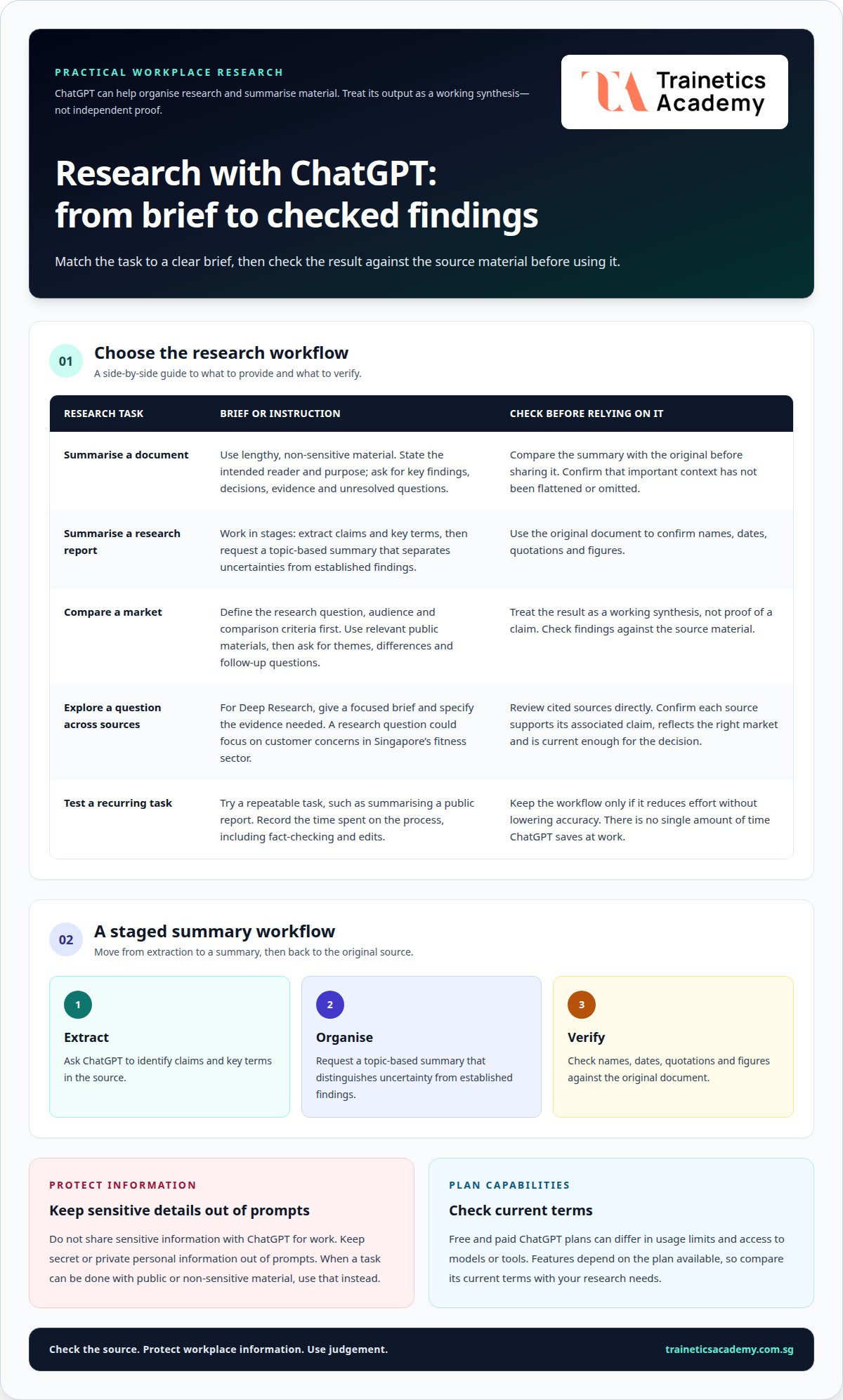
In an AI course, learners can practise using ChatGPT to summarise lengthy, non-sensitive documents and identify their main points. For a meeting pack, they might ask it to identify key findings, decisions, evidence and unresolved questions. Course exercises can show how to specify the intended reader, such as a manager who needs a short briefing, and request language suited to that audience. Learners should compare summaries with the original before sharing them.
AI courses can teach a staged approach to summarising research reports. Learners can first ask ChatGPT to extract claims and key terms, then request a topic-based summary that separates uncertainties from established findings. Finally, they can use the original document to confirm names, dates, quotations and figures. This helps preserve context that a short summary might otherwise flatten or omit.
Research-focused AI course exercises can also teach learners to structure workplace research. For example, they can create a comparison framework for Singapore’s public transport, retail or food-service markets. Define the research question, audience and comparison criteria first. Use relevant public materials as inputs, then ask for themes, differences and follow-up questions. Treat the result as a working synthesis, not independent proof of a claim.
AI courses can cover how Deep Research supports market research by investigating a question across sources and organising findings into a report. Learners can practise giving it a focused brief, such as identifying customer concerns in Singapore’s fitness sector, and specifying the evidence needed. They should review cited sources directly: confirm that each supports its associated claim, reflects the right market and is current enough for the decision.
As part of an AI course, learners can compare free and paid ChatGPT plans, which can differ in usage limits and access to models or tools. Features depend on the plan available, so compare its current terms with research needs before relying on a particular capability.
AI courses can introduce studies of productivity that compare task completion time and output quality between people using AI and a control group. There is no single amount of time ChatGPT saves at work. Results depend on the task, the user’s experience and the quality standard applied.
A practical exercise in an AI course is to test ChatGPT on a repeatable task, such as summarising a public report. Learners can record how long the process takes, including fact-checking and edits. Keep the workflow only if it reduces effort without lowering accuracy.
AI courses can also teach privacy considerations when preparing material for research. Workers should not share sensitive information with ChatGPT for work. Do not enter secret or private personal information, and check ChatGPT’s outputs before using them. When a task can be completed with public or non-sensitive material, use that instead of exposing confidential details. Compare generated summaries and research findings with the original sources before relying on them, especially if they may inform a workplace decision.
For recurring research tasks, AI courses can show how ChatGPT can be set up as an assistant to handle repetitive tasks on a schedule. Connecting work apps can also reduce copying and pasting between tools. For example, ChatGPT can connect with calendar apps for scheduling and data APIs for more detailed information. These connections may streamline a workflow, but they do not replace checking the resulting information. If you use a ChatGPT Project to keep relevant material together, audit it monthly and remove outdated files and information so future work does not rely on stale context.
2. AI courses for workplace writing and communications
An AI Course can teach you to shape workplace writing from a clear brief rather than a vague instruction. Practise giving an AI tool the purpose, recipient, essential facts and desired next step for a supplier email. Learn to request a concise, professional draft in a specific tone, then replace placeholders and check names, dates and commitments.
In AI courses for beginners, exercises can cover routine replies using sanitised messages and clear response goals. For example, practise prompting for a polite reply that acknowledges a delivery delay and requests an updated schedule. Learn to set boundaries such as “keep the meaning,” “avoid blame” or “use plain English,” and review drafts for invented promises or details.
How can an AI course teach you to draft and improve work emails? Practise providing the audience, purpose, key points and preferred tone, then requesting a draft or revision. Compare the result with your intended meaning, especially around deadlines, decisions and commitments.
AI courses can also teach you to turn meeting notes into useful follow-up emails. Practise organising notes into decisions, action owners and pending questions before drafting a message for attendees. For a project meeting, the email might recap the agreed launch task and identify who will provide the next update. Check every owner and action against the notes.
For reports, learn to request a structure before drafting: executive summary, findings, evidence and recommended next steps. Practise providing verified source material and explaining the reader’s needs, such as a concise update for a department head. Check each claim against the inputs, then adjust the language to match your organisation’s terminology.
How can an AI course cover spreadsheets, data analysis and reports? If your plan supports working with spreadsheet files, practise asking a clear question about the data, such as identifying duplicate entries or summarising monthly categories. Check formulas, assumptions and totals against the spreadsheet before using the analysis in a report.
AI courses can teach planning with a defined brief, too. Practise sharing a meeting objective and agenda topics, then asking for an order, preparation questions and decisions to capture. For a busy day, provide tasks and deadlines to create a draft priority plan. Review dependencies and adjust the schedule to reflect real commitments.
How can an AI course develop planning, prioritisation and meeting preparation skills? Practise grouping tasks by deadline and importance, or turning an agenda into preparation prompts. Structured AI learning can help you build stronger prompting and review habits.
3. Learning to generate ideas and content drafts
AI courses can teach learners how to use ChatGPT to develop starting points for a campaign, presentation or internal project. A useful exercise is to name the task, audience, purpose and desired outcome before requesting ideas. For example, practise generating concepts for a Singapore fitness studio’s staff wellness newsletter aimed at office workers. This context helps steer suggestions toward the brief instead of generic themes.
In an AI course, learners can practise building prompts with four elements: background, audience, format and constraints. Add relevant facts, the reader’s needs, the output type and what to avoid. For example, request six newsletter themes for new employees, in plain language, without medical claims. If the task remains unclear, prompt ChatGPT to ask questions before drafting.
A staged process is another skill to develop through AI training. First, request a range of possible angles, then select one and ask for an outline. For a product announcement, compare options by audience relevance, evidence required and fit with the company’s tone. Separating idea generation from final copy makes it easier to identify unsuitable suggestions.
AI courses can also show learners how to prompt for content drafts by specifying length, voice and structure instead of asking for “a good article.” Practise requesting an introduction, three sections and a concise conclusion for a Singapore audience. Include phrases that must appear naturally and topics to exclude. Clear limits help align the draft with editorial requirements.
As part of an AI course, learners can practise using ChatGPT to review a draft against a supplied SEO brief. Ask it to identify missing subtopics, repeated points, unclear headings and unanswered reader questions. For example, provide a page brief about workplace fitness and check whether the draft covers exercise breaks, accessibility and practical implementation. Treat its comments as editorial suggestions, not ranking guarantees.
Another skill covered in AI training is giving feedback in targeted rounds. Ask ChatGPT to shorten a paragraph, improve a transition or suggest alternative headlines. You can also request versions with different tones, then compare their accuracy, clarity and audience fit before revising.
AI courses can teach a review process for generated drafts: check that each claim matches the source material and that the language reflects the organisation. Ask for a final pass to flag unsupported statements or unintended repetition. Keep the final editorial decision with the writer, especially for public-facing content, campaign promises and sensitive topics.
Learning to write clear prompts and provide context can help you get more useful ChatGPT responses. Treat the prompt as part of the work: explain the intended use and provide relevant details before requesting a draft. For recurring business tasks, review the output against the actual workflow and adapt it, rather than treating generated material as finished copy.
An AI course exercise could involve generating 20 CRM templates with ChatGPT, as suggested in a startup operations post. Request template concepts for customer-management tasks, then assess which are relevant and revise them to match actual processes. When a prompt is unclear, instruct ChatGPT to ask questions before proceeding. Use those questions to clarify what the drafts should cover, and check the result against the intended use before adopting it.
4. Drafting and proofreading documents
In an AI course, learn to guide ChatGPT through a first draft by providing the document’s purpose, audience, source material and required format. A project update, for example, might need a brief overview, completed work, outstanding issues and next steps. Practise requesting those sections directly, then replacing generic wording with details from the project record.
Course exercises can teach you to proofread with a defined focus. Ask ChatGPT to review a policy memo for grammar, repetition and unclear sentences while preserving its meaning. Request suggested edits separately from the revised version. This makes it easier to assess each change and retain terminology your team uses.
As part of learning to review AI-assisted documents, check ChatGPT’s work for errors, bias and made-up facts. Compare factual answers with reliable source material, verify names and figures, and check whether the wording treats groups fairly. Ask it to identify unsupported claims, but use that review as a prompt for your own checks, not proof of accuracy.
For documents with several requirements, practise turning the brief into a review sequence. First, ask ChatGPT to list the required sections and claims. Next, request a draft based only on supplied information. Finally, ask it to flag missing points, contradictions and sentences that need evidence. This helps expose gaps before approval.
Course activities can also help you recognise bias in examples, assumptions or uneven descriptions. For instance, review a hiring guide for language that implies one career path suits only a particular group. Ask ChatGPT to identify loaded terms and suggest neutral alternatives, then assess each suggestion against the role’s actual requirements.
Learn to use ChatGPT to improve readability without giving up authorship. Ask it to shorten a dense paragraph, explain technical terms for new staff or rewrite instructions as direct steps. Compare the revision with the original to ensure no exceptions, conditions or important details disappeared during editing.
For a final review exercise, request a table with each flagged sentence, the issue and a proposed correction. Check every answer against the relevant document, especially claims about deadlines, responsibilities or procedures. Use only edits that preserve the intended meaning and meet your organisation’s standards.
5. AI courses: privacy, confidentiality, and workplace rules
AI courses can teach learners to classify information before using an AI tool for a workplace task. A public product description differs from a customer complaint containing names and account details. Training should emphasise keeping sensitive information out of prompts and never entering secret or private personal information. If a task requires confidential details, learners should use an authorised workplace process instead.
Responsible-use lessons can help learners follow their organisation’s security guidelines when selecting an AI tool. A team policy may explain which tools are allowed, what information can be shared and whether outputs need approval. AI course content can encourage learners to read relevant guidance before entering a draft contract, staff record or internal strategy document.
Courses can explain how removing identifiers may reduce exposure when a prompt needs only general context. For example, replace a customer’s name, phone number and account reference with neutral labels. Keep only the details needed to explain the task, such as “a customer requests a delivery update.” Training should also clarify that anonymising text does not make every confidential detail safe to share.
AI courses can demonstrate how to choose prompts that disclose less. Instead of uploading a full employee review, describe the writing goal and provide a short, sanitised excerpt. Ask ChatGPT to improve clarity or tone, not to decide an employment outcome. Keep the final decision with the responsible person and follow internal review procedures.
Training should also cover checking AI responses before using them in workplace decisions or communications. Compare dates, figures, names and claims with trusted source material. A polished answer can still contain errors. For example, confirm a proposed deadline against the project record before sending it to a customer or colleague.
AI course lessons can help learners consider how an output will be used. A draft for internal brainstorming has different consequences from text sent to a client or used in a formal report. Review its tone, factual claims and any unintended disclosure. Remove confidential material that ChatGPT has repeated from the prompt before sharing the response.
As a practical safeguard, courses can teach a short pre-use check: Is this tool permitted? Does the prompt contain sensitive information? Is the task suitable for AI assistance? After generation, check accuracy and remove private details. These steps help staff apply workplace rules consistently across research, writing and document review.
AI courses for Singapore workplaces can highlight the need for care with local customer, employee and business information. When a policy is unclear, learners should pause before entering the information and use an internal channel permitted by their organisation’s policy to resolve the question. Convenience is never permission to share confidential material with an AI tool.
Trainetics Academy
Trainetics Academy is a natural next step when using ChatGPT at work raises broader questions about AI. You may know how to ask for a draft, summary or list of ideas, yet still want a stronger foundation for choosing tasks and assessing outputs. Learning structured principles can help turn isolated experiments into more considered workplace practice.
Trainetics Academy’s Artificial Intelligence Course offers a way to develop your understanding of AI and its practical role. It can suit people exploring AI for the first time, as well as those who already use ChatGPT and want to approach workplace applications with greater clarity. The focus is learning, not treating an AI response as a substitute for professional judgement.
Consider formal learning when self-directed experimentation leaves important gaps. You might be unsure how to frame prompts for different tasks, where human review remains essential, or how to discuss AI use with colleagues. A course can provide a guided learning context for exploring these questions and building a deliberate approach.
A solid foundation extends beyond one email or report. Understanding AI concepts can help you assess where tools may fit into research, drafting and routine workflows. It also supports thoughtful decisions about accuracy, privacy and the limits of generated answers. Apply that understanding alongside your organisation’s workplace rules.
Trainetics Academy’s Artificial Intelligence Course is relevant if you want to deepen your AI knowledge and connect it with practical use. It is also a suitable next step when you need more than a collection of prompts and want to build confidence through structured learning. Choose this path when developing your understanding matters as much as completing an immediate task.
As you continue using ChatGPT, keep your standards consistent: define the task, provide appropriate context and review the output before relying on it. Learning about AI can help you make informed choices, but workplace decisions still require your expertise and attention. Contact Trainetics Academy to discuss its Artificial Intelligence Course.
Build your next step with AI
Make your next move deliberate. Choose a recurring work task and decide what better performance means to you: clearer thinking, stronger judgement or a more disciplined approach to AI. The aim is not to hand over responsibility, but to strengthen how you apply your expertise.
A practical way to learn how to use ChatGPT to save time at work is to build your AI knowledge alongside regular practice. Trainetics Academy offers an Artificial Intelligence Course for people who want to develop a stronger understanding of AI and its relevance to work. That foundation can help you approach new tools with purpose and make considered choices as your responsibilities evolve.
If you’re ready to take that step, begin a conversation with Trainetics Academy about its Artificial Intelligence Course. Keep learning, stay thoughtful and bring high standards to every application of AI.
Disclaimer
AI Content Disclaimer: Some articles on this website may be generated or assisted by AI-powered content creation tools. While we strive for accuracy and relevance, readers should independently verify information before relying on it. The content is provided for informational purposes only and does not constitute professional advice.