Skill change is real, but it doesn’t mean your experience has lost its value. To stop worrying that your skills are becoming obsolete, focus on what you can build next: keep learning, apply AI thoughtfully, and strengthen capabilities that complement technology. The World Economic Forum’s Future of Jobs Report 2023 projected that 44% of workers’ core skills would change by 2027, a reason to adapt deliberately rather than assume your career has reached a dead end.
It’s understandable to feel unsettled when tools and expectations change, especially if you’re unsure which skills will matter next. This article explains why that worry arises and how to respond: assess your transferable strengths, learn relevant AI skills, use automation to make room for higher-value work, and consider career directions that fit your interests and changing demand. The goal isn’t to predict every change, but to stay ready to learn and contribute. You’ll find a practical way to turn uncertainty into purposeful development, without treating every new technology as a threat or chasing every trend.
Key Takeaways
- Separate genuine changes in your role from the fear that every new technology makes your experience irrelevant.
- Identify transferable strengths, then choose a focused learning goal that builds on what you already know.
- Explore how AI can take on repetitive tasks and create more room for work that relies on human judgement and creativity.
- Use your interests, skills and awareness of sector trends to guide career decisions instead of reacting to every new tool.
- Consider an Artificial Intelligence Course when structured learning can help you build practical understanding of AI.
1. Technological change and skill obsolescence
Technology often changes tasks before it changes job titles. A spreadsheet can automate routine calculations, while a generative AI tool can draft a report. These shifts may create new responsibilities and reduce demand for some repetitive work. The concern is understandable, but a changing task doesn’t mean your whole skill set has lost value.
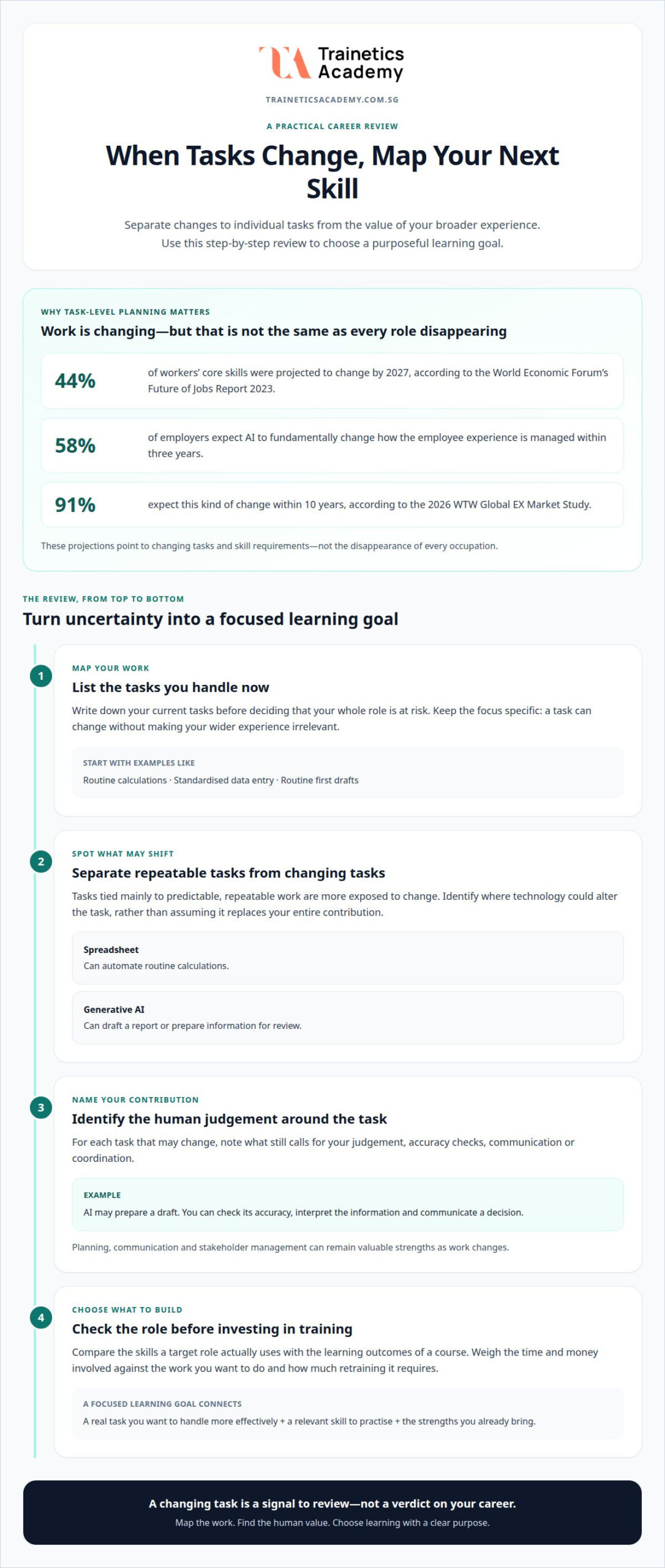
Which skills are most likely to become obsolete in the next 5 to 10 years? Skills tied mainly to predictable, repeatable tasks are more exposed, such as entering standardised data or producing routine first drafts. The World Economic Forum’s Future of Jobs Report 2023 projected that 44% of workers’ core skills would change by 2027. That points to changing skill requirements, not the disappearance of every occupation.
AI may also reshape the employee experience, including how people complete tasks and collaborate. In the 2026 WTW Global EX Market Study, 58% of employers expect AI to fundamentally change how the employee experience is managed within three years. The study reports that 91% expect this within 10 years. For example, an employee might use AI to organise information, then apply judgement to interpret it and communicate a decision.
Career changes are another part of this adjustment. The Department of Labor predicts that professionals will change careers, not just jobs, an average of 5-7 times during their working lives. Retraining can help connect existing strengths to new work, rather than requiring a complete restart. A project coordinator, for instance, could build data skills while retaining planning, communication, and stakeholder management experience.
What risks should I consider before changing careers or investing in training? Weigh the time and money involved against the skills a target role actually uses, and consider how much retraining it requires. A course can teach useful concepts, but it cannot by itself establish whether a role suits your interests or whether employers value every skill equally. Compare the learning outcomes with the tasks you want to perform.
Use a simple review before making a move: list your current tasks, identify which technology could change, then note the human judgement or communication each still requires. For example, automation may prepare a draft, while you check its accuracy and explain the result. This separates a task-level shift from your broader contribution and gives your next learning goal a clearer purpose.
2. Understanding the causes of fear about becoming obsolete
Fear of becoming obsolete, often called FOBO, describes the worry that your skills or role may lose relevance as work changes. AI can intensify that concern because its capabilities are visible: a tool can draft text, summarise documents, or sort information quickly. Seeing a task automated can feel like a judgement on your whole career, even when the change affects only part of your work.
Uncertainty is a major source of AI anxiety. You may hear that a new tool is transforming an industry without knowing which tasks will change, what skills employers will value, or how quickly expectations may shift. For example, an administrator who sees software prepare routine reports might wonder whether their position will disappear. That unanswered question can make a technical change feel more threatening than a specific, manageable skills gap.
Comparison adds another layer. An experienced professional may see a younger colleague using new tools confidently and conclude that years of experience no longer count. But speed with an interface is only one capability. A team still needs people who understand client context, catch errors, explain decisions, and coordinate work. Look beyond the visible new skill: write down a task you do well and the judgement it requires.
FOBO can also weaken your sense of agency. If every technology announcement feels like a verdict, it becomes harder to distinguish a real development need from speculation. Try describing the concern precisely: “I’m worried that routine reporting may change,” rather than “My career is over.” This identifies a task and gives you something practical to investigate, such as which parts require interpretation or communication.
A structured routine can stop worry from taking over every workday. Set a daily worry period at the same time and place; 5:00 to 5:20 p.m. is one example. Note the concern, the evidence behind it, and one next action, such as asking your manager how reporting responsibilities are changing. Outside that period, return attention to the task in front of you.
Mindfulness can offer another way to notice anxious thoughts without treating each one as a fact. A practical starting point is a 10-minute meditation, repeated 3 or 4 times per week. Pair it with a concrete career review: identify one skill you want to strengthen and one trusted colleague who can discuss changes in your field. These steps won’t predict every workplace shift, but they can turn vague fear into focused attention and a deliberate learning choice.
3. Upskilling through online learning, webinars and workshops
Begin with a work task you want to handle more effectively, then choose learning that addresses it. For example, a professional who reviews customer feedback could look for a webinar on using AI to group comments and identify themes. After the session, practise on a suitable sample and assess whether the results help with the actual task. This makes learning purposeful instead of collecting course completions without a clear application.
Online lessons, webinars, and workshops each serve different learning needs. A webinar can introduce a new concept, while a workshop may offer guided practice with a specific method. An AI course can provide a structured starting point for foundational concepts. Choose by examining the stated learning outcomes and practical exercises, then connect the material to a task in your field.
For workers comparing SkillsFuture AI courses, focus on whether the subject and learning outcomes fit your intended use. Funding eligibility applies to specific courses, not every course described as an AI course. The Introduction AI Course is eligible for SkillsFuture Credits and UTAP funding. Match the course content to a capability you plan to practise, such as evaluating AI-generated material or using prompts effectively.
Turn learning into a regular professional habit. LinkedIn’s Workplace Learning Report found that 59% of professionals spent more time learning in 2023 than in previous years. Set a recurring study slot, complete one focused lesson, and apply a concept to a real task. For instance, after learning about prompt structure, refine a prompt for a routine workplace draft and review the output.
Adaptability develops through practice and feedback. Harvard Business Review research stated that adaptable professionals are 46% more likely to succeed in their careers. Apply a new method to a work problem, ask a colleague for specific feedback, and adjust your approach. A colleague might point out that an AI-generated summary needs clearer context, helping you improve both your review process and communication.
Shared learning brings different strengths together. Arrange a mentoring conversation around a practical challenge, or join peers discussing how tools affect your sector. Seeking perspective from executive advisors and coaches like Jani Havunen can also help professionals align high-impact skills with evolving business needs. An experienced colleague can explain a process, while a teammate familiar with a new tool can demonstrate its use. This exchange connects established knowledge with new methods and gives both people a chance to develop their skills.
For self-directed learning, keep a short record of the skill studied, where you applied it, and what you want to learn next. Review it regularly. If the same gap appears across several tasks, choose an online lesson or workshop focused on that capability. A structured AI course in Singapore can also suit learners seeking guided study, provided the content aligns with a relevant professional goal.
Beginner AI courses, webinars, and workshops can help workers build practical skills. The Introduction AI Course is eligible for SkillsFuture Credits and UTAP funding; check that a course’s learning outcomes and exercises match the skill you want to develop.
4. Using AI and automation to handle repetitive tasks
Start with a task that follows a consistent pattern, such as sorting enquiries or summarising meeting notes. AI and automation can help with repeatable steps, leaving people more time for interpretation, planning, and communication. The aim isn’t to automate everything. Identify where a tool can assist without removing the human review the task needs.
The scale of change is visible in work forecasts. The share of work handled through automation and digital tools is expected to rise from 14% to 31% in the next three years. Eurostat estimates that digital technology could create nearly 15 million jobs, while automation will eliminate 6 million jobs over the same period. These figures describe change in both directions, not a simple swap of every worker for a machine.
Apply a structured workflow to one suitable task. First, describe the desired outcome and the steps required. Next, identify a repetitive step, such as extracting key points from a standard report. Then test an AI tool on a sample, review its output, and correct errors before using the result. Keep a person responsible for decisions involving context, tone, or consequences.
For example, a project team could use AI to create an initial meeting summary. A team member can then correct names, distinguish decisions from suggestions, and assign follow-up actions. This separates drafting from accountability. The same approach can support routine research or document organisation, while professionals contribute subject knowledge and decide what the information means.
Automation may also change the skills employers need. If a tool handles a routine first draft, workers may spend more time refining content, coordinating stakeholders, or explaining recommendations. New tasks can emerge around using and evaluating digital tools. Eurostat’s estimates point to potential job creation alongside job displacement, so observe how duties change in your own role and sector.
Choose a low-risk, repeatable task for your first test. Record the original steps, the tool’s output, and the corrections needed. Compare the result with the intended outcome, then decide whether the tool genuinely reduces routine effort. If errors repeatedly require extensive repair, revise the prompt or choose another task. This review helps distinguish useful assistance from automation that adds extra work.
Keep the human contribution visible. Communication, empathy, creativity, and teamwork can complement technical ability as tasks shift. For instance, a tool may organise customer feedback, but a person can interpret its context and respond with care. Treat AI as part of a workflow, not a substitute for professional judgement. This approach can help improve how work gets done.
Re-evaluating career interests and market demand
A career review works best when it weighs personal fit against changing work, not job titles alone. List tasks you enjoy, tasks you do well, and tasks you want to reduce. For example, an operations specialist who enjoys solving workflow problems may find that process analysis fits better than a role focused mainly on routine data entry.
Which skills are growing in demand in Singapore’s job market? Skills worth investigating include AI literacy, data interpretation, adaptability, communication, and problem-solving. Their relevance varies by sector and role, so compare them with the tasks employers describe in the field you’re considering.
Look beyond broad labels such as “AI skills.” A job may require evaluating AI-generated content, interpreting data, or communicating findings to colleagues. Read role descriptions in your target sector and note recurring tasks and capabilities. If several roles mention data interpretation, for instance, that may be a useful learning direction to explore.
How can I assess whether my current skills are at risk of becoming obsolete? Map your regular tasks and mark which depend on predictable steps, specialist judgement, or human interaction. Then consider whether digital tools could change the predictable tasks, and whether your judgement or communication remains essential. This task-level review gives a clearer signal than worrying about your job title.
Next, review your transferable skills and values. Write down examples of adapting to a new process, resolving a difficult issue, or helping a team reach a decision. A retail supervisor, for example, might bring customer insight, scheduling experience, and conflict resolution into a different service role. Specific examples show how experience can carry across industries.
Use Singapore’s employment context as a prompt to investigate, not as a reason to chase every trend. Follow changes in your sector through professional discussions, relevant online communities, and conversations with people doing the work. Compare their observations with role descriptions. If a capability appears repeatedly, decide whether it matches your interests and whether you can practise it in your current position.
Then choose a small, evidence-based next step. You might take on a project involving data, volunteer to test an AI-assisted workflow, or ask a colleague about a role’s daily responsibilities. Track what the experience teaches you. If the work energises you and strengthens a useful capability, continue exploring. If not, adjust your direction before making a larger career move.
Finally, present adaptability alongside technical ability. In a CV or interview, describe a specific change you handled, the action you took, and what you learned. Curiosity is more credible when paired with an example, such as learning a new system and using it to improve a team process. This evidence helps employers see how you respond as work evolves.
Trainetics Academy
Trainetics Academy offers an Artificial Intelligence course for professionals who want to build their understanding of AI as work changes. Consider structured learning when you’ve identified a practical skills gap, such as understanding how AI relates to tasks in your current role or exploring a new direction.
Use your career review to define what you want to learn before choosing your next step. A clear goal, such as gaining foundational AI knowledge for workplace use, helps focus your learning and connect it to your professional development. An AI course can support that learning. Apply new knowledge thoughtfully to relevant tasks and keep developing your wider professional strengths.
If you’d like to explore whether Trainetics Academy’s Artificial Intelligence course fits your learning goals, contact the academy.
Choose your next move with intention
Your next career step doesn’t need to be a dramatic reinvention. Choose a small experiment to test a direction: take on a new responsibility, practise a relevant tool, or discuss a possible role with someone who understands its day-to-day demands. Set a clear outcome, such as identifying whether the work fits your strengths or what knowledge you still need. Evidence from action can make your next decision more grounded than speculation alone.
You can stop worrying that your skills are becoming obsolete by treating change as a prompt to make deliberate choices, not as a verdict on your value. Your experience remains part of how you learn, adapt, and contribute. Decide which capability you want to develop and how it supports the work you want to do.
If structured AI learning fits that goal, contact Trainetics Academy to explore learning options. Move forward with curiosity, a clear purpose, and confidence in your ability to keep growing.
Frequently Asked Questions
Breaking Free from FOBO: Can You Future-Proof Your Professional Life?
You can future-proof your professional life by building skills that transfer across roles and staying ready to learn. Start by choosing a work challenge you expect to face, then identify the knowledge and judgement it requires. For example, a sales professional could strengthen client communication while learning how digital tools support customer research, or consult resources like AI Powered Network Marketing to see how automation can assist outreach. You can stop worrying that your skills are becoming obsolete by focusing on deliberate development rather than trying to predict every change.
Don’t you have to specialise in a particular profession to understand and embrace change?
No, you don’t need to master every profession or technology to respond constructively to change. A useful balance is deep knowledge in your field combined with curiosity about tools and methods that affect your work. A finance specialist, for example, can learn how AI supports document review without becoming a software engineer. Ask knowledgeable colleagues focused questions, follow relevant developments, and practise capabilities that connect to your responsibilities or goals.
Why do people worry their skills are becoming obsolete because of AI and automation?
People worry because AI makes changes to familiar work visible, while the consequences for their roles can feel uncertain. An employee who sees a tool draft routine emails may wonder whether their wider contribution is at risk. Anxiety can grow when announcements focus on technology rather than explaining how responsibilities are changing. Separating a specific task from your whole profession makes the concern more precise and easier to address.
What are the best ways to future-proof my career and develop transferable skills?
Choose learning that strengthens both role-specific expertise and capabilities useful in different settings. For instance, a team leader could develop data interpretation while practising clear communication and decision-making. Apply each new skill to a real task, then record the outcome as evidence for future projects or interviews. Conversations with colleagues in related roles can also reveal where your experience transfers and which practical capabilities could make a transition smoother.
How much time and money does it typically take to reskill for a new career?
The time and financial commitment depend on the target role, your starting knowledge, and the depth of training required. Moving into related work may involve building a focused capability, while a major career shift can require broader study and practical experience. Account for course fees, learning materials, and time spent studying or practising. Compare these commitments with the specific tasks you want to perform, rather than choosing training based on a job title alone.
How can I use AI tools to augment my skills rather than compete with them?
Use AI as an assistant for a defined part of your workflow, then contribute the expertise the tool lacks. For example, an HR professional might use AI to organise themes from employee feedback, then interpret sensitive context and decide how to respond. Protect confidential information, review outputs for errors, and retain responsibility for final decisions. This makes your professional judgement part of the process instead of treating the tool as an independent authority.
What practical steps can I take this month to make my skills more relevant?
Select a work task you want to improve and identify the capability behind it. Ask a colleague what strong performance looks like, then find a focused learning activity that addresses the gap. Apply an idea to a suitable task and write down what you learned, including any errors or unanswered questions. Choose your next step based on that experience, such as further practice, a new project, or a conversation about changing responsibilities.
Which free or low-cost courses can help Singapore workers build in-demand skills?
Workers in Singapore can consider Trainetics Academy’s Artificial Intelligence course, which is eligible for SkillsFuture Credits and UTAP funding. Webinars and workshops are other ways to learn practical, in-demand skills.
Disclaimer
AI Content Disclaimer: Some articles on this website may be generated or assisted by AI-powered content creation tools. While we strive for accuracy and relevance, readers should independently verify information before relying on it. The content is provided for informational purposes only and does not constitute professional advice.