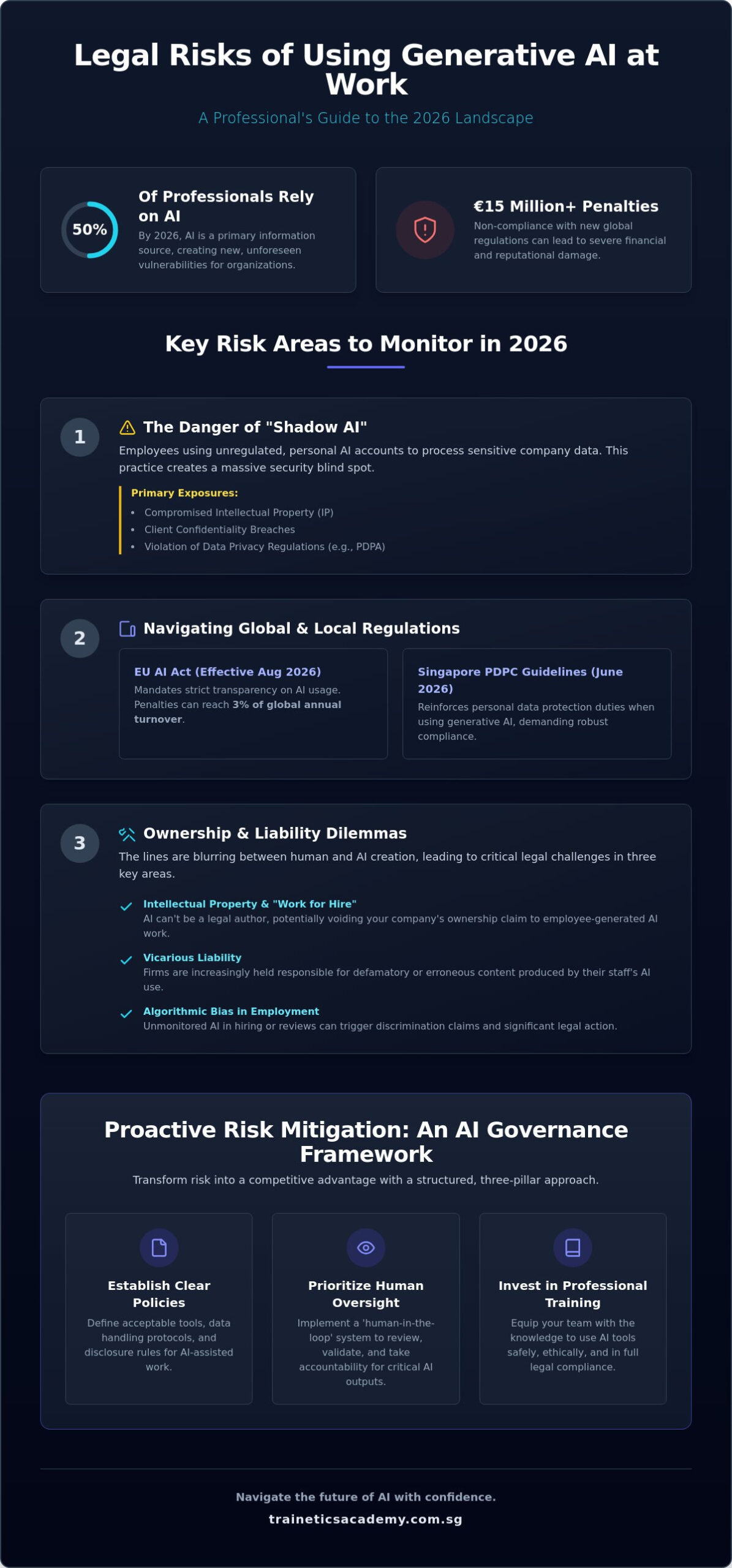
As of early 2026, up to 50% of professionals rely on AI as their primary information source, yet many don’t realize their next prompt could lead to a €15 million penalty under the latest global regulations. You’re likely feeling the tension between the need for speed and the fear of accidentally leaking sensitive corporate data or violating Singapore PDPA regulations. Understanding what are the legal risks of using generative ai at work is no longer optional; it’s a core competency for any disciplined professional aiming for leadership in this new era of digital transformation.
We agree that the rapid shift toward unregulated “Shadow AI” creates a precarious environment for your organization’s intellectual property. This guide promises to demystify the 2026 legal landscape, from the EU AI Act’s transparency duties to the PDPC’s latest advisory guidelines. You’ll gain a clear checklist of pitfalls to avoid and see how our Introduction AI Course, which is eligible for SkillsFuture Credits and UTAP funding, provides the rigorous training needed to implement these tools safely. We’ll preview the essential governance frameworks that protect your professional identity while ensuring your team remains at the forefront of innovation at 10 Anson Road, Level 22, International Plaza, Singapore 079903.
Key Takeaways
- Identify the hidden dangers of “Shadow AI” and learn how unmonitored tool usage can compromise corporate security and professional standards.
- Navigate the complexities of the “Work for Hire” doctrine to ensure your organization maintains clear ownership of all AI-generated outputs.
- Strengthen your compliance with Singapore’s PDPA regulations by implementing strict protocols to prevent sensitive data leakage into public models.
- Master a professional checklist of what are the legal risks of using generative ai at work, focusing on mitigating algorithmic bias in hiring and performance reviews.
- Build a visionary corporate AI governance framework that prioritizes human oversight and continuous professional development to safeguard your career.
Understanding the Shifting Landscape of Generative AI in the Workplace
By mid-2026, the professional landscape has fundamentally transformed. Generative AI is no longer a peripheral tool for early adopters; it’s the engine driving core business functions across Singapore and the global market. While this shift offers unprecedented efficiency, it also introduces the phenomenon of “Shadow AI.” This occurs when employees utilize unregulated, personal AI accounts to process proprietary company data. This lack of oversight creates a vacuum where corporate secrets and client confidentiality are at constant risk. Without a structured governance framework, your organization remains vulnerable to data breaches that can derail years of professional progress.
To better understand this concept, watch this helpful video:
Mastering what are the legal risks of using generative ai at work is now a prerequisite for professional survival. In August 2026, the EU AI Act’s transparency obligations took full effect, setting a global precedent for how businesses must disclose AI involvement. Coupled with the Singapore PDPC’s June 2026 advisory guidelines on personal data in generative AI, the legal stakes have never been higher. Professionals who fail to meet these technical benchmarks risk not only their reputation but also significant financial penalties that could reach 3% of global annual turnover.
The Evolution of AI Liability in 2026
Legal accountability has shifted from the developer to the end-user and their employer. Under the principle of vicarious liability, Singaporean firms are increasingly held responsible for AI-generated errors or defamatory outputs produced by their staff. We’ve moved past the “experimental” phase where mistakes were excused as technical glitches. Today, accurate AI management is a standard professional expectation. Engaging in a comprehensive AI course Singapore professionals trust is the most direct path to ensuring your team operates within these new legal boundaries while maintaining a competitive edge.
Why Legal Compliance is a Professional Benchmark
There’s a clear divide between hobbyist usage and professional AI application. While a hobbyist might ignore the nuances of AI and copyright law, a disciplined professional understands that every prompt carries legal weight. Ignorance of how these models process data is no longer a valid defense in court. To bridge this gap, our Introduction AI Course is designed to elevate your technical mastery. This AI Course is Eligible for SkillsFuture Credits and UTAP funding. Whether you’re searching for SkillsFuture AI courses, AI courses for beginners, or an intensive 1 day AI course Singapore professionals can complete quickly, our curriculum at 10 Anson Road, Level 22, International Plaza, Singapore 079903, ensures you meet international benchmarks. For a deeper dive, read our AI Course Singapore: The Ultimate 2026 Guide for Professionals to master the latest regulatory standards.
Intellectual Property Infringement and Ownership Dilemmas
The traditional “Work for Hire” doctrine is facing its greatest challenge since the inception of digital copyright law. Historically, an employer owned any work created by an employee within the scope of their employment. However, as of March 2026, the legal consensus has shifted toward a “human-centric” authorship model. The U.S. Supreme Court recently declined to hear challenges to the Copyright Office’s 2025 position, firmly establishing that an AI system cannot be recognized as a legal author. This creates a precarious situation for businesses: if a report or code snippet is generated entirely by AI without sufficient human intervention, it may fall into the public domain, leaving your company with no legal recourse to protect its proprietary assets.
When assessing what are the legal risks of using generative ai at work, the distinction between “AI-assisted” and “AI-generated” is critical. To claim ownership, professionals must demonstrate a high level of human authorship through complex prompt engineering and iterative refinement. This “human-in-the-loop” requirement serves as a professional benchmark for 2026. Without documented human oversight, your company’s newest software or marketing strategy could be legally unprotectable. Refine your technical mastery through our Artificial Intelligence Course to ensure every output meets these rigorous legal benchmarks for ownership.
Can You Copyright AI-Generated Content?
Copyright eligibility in 2026 hinges on the degree of human creativity involved in the prompting process. Simple, one-line prompts rarely meet the threshold for protection. Professionals must now master advanced methodologies to secure intellectual property rights. A 1 day AI course Singapore leaders attend provides the technical framework needed to transform raw AI outputs into protectable corporate assets. By learning these prompt standards, you move from being a passive user to an active creator, securing your professional identity and your firm’s competitive edge.
Navigating Third-Party Infringement Claims
The risk of infringing on existing trademarks or copyrighted material remains high, especially as AI models occasionally “hallucinate” or replicate training data too closely. In March 2026, more than 50 copyright infringement cases were pending in U.S. federal courts, highlighting the volatility of this space. Even unintentional replication can lead to massive liabilities; consider the $1.5 billion settlement by Anthropic in August 2025 following disputes over training data. For smaller firms, these risks are even more acute. We recommend reviewing our guide on AI Strategy for SMEs in Singapore to implement safe usage protocols that shield your organization from third-party claims. Protecting your business requires a disciplined approach to how data is ingested and how outputs are verified at 10 Anson Road, Level 22, International Plaza, Singapore 079903.
Data Privacy, Confidentiality, and PDPA Compliance in Singapore
In the Singaporean business context, data is a high-stakes asset that requires disciplined protection. One of the most pressing answers to what are the legal risks of using generative ai at work involves the unintentional “data leakage” that occurs when employees interact with public AI models. Every prompt sent to a standard consumer-grade AI tool can be ingested into its training set, potentially exposing your firm’s trade secrets or proprietary strategies to the public. This isn’t just a technical oversight; it’s a fundamental breach of professional standards that can compromise your organization’s integrity and competitive standing.
The Personal Data Protection Commission (PDPC) has solidified its stance on these issues. On June 2, 2026, the PDPC released proposed advisory guidelines specifically targeting the use of personal data in generative AI. These guidelines clarify that businesses must maintain transparency and obtain meaningful consent before processing personal data through AI systems. Failing to adhere to these evolving standards doesn’t just invite reputational damage. It triggers significant legal liabilities under the Personal Data Protection Act (PDPA), which remains the cornerstone of Singapore’s data governance. Professionals must treat AI inputs with the same scientific precision they apply to every other facet of their career. For a comprehensive step-by-step approach to safeguarding sensitive information, review our detailed guide on how to ensure data privacy when using AI tools, which covers the latest PDPC advisory guidelines and configuration steps for maximum security.
Protecting Sensitive Business Information
Securing your data requires a clear understanding of the infrastructure behind the tools you use. Open AI models generally reserve the right to use your inputs for future training, whereas “Enterprise” instances are designed to keep your data siloed and secure. To maintain professional benchmarks, your team should follow this essential privacy checklist:
- Anonymization: Strip all personally identifiable information (PII) before inputting data into any AI system.
- Enterprise Guardrails: Only process sensitive corporate data through enterprise-grade instances that guarantee data privacy.
- Audit Trails: Maintain a rigorous log of all AI interactions to ensure accountability and traceability.
Ensuring Adherence to Local Governance Standards
Singapore’s Model AI Governance Framework 2.0+ emphasizes that human oversight is mandatory for high-stakes AI applications. The PDPC expects professionals to not only understand these regulations but to actively implement them within their daily workflows. Mastering these nuances is a hallmark of leadership. Our Introduction AI Course provides the technical foundation needed to navigate these complex frameworks with confidence. This artificial intelligence course is Eligible for SkillsFuture Credits and UTAP funding, ensuring that cost isn’t a barrier to your professional excellence. We invite you to join our community of visionary professionals at 10 Anson Road, Level 22, International Plaza, Singapore 079903, where we bridge the gap between high-level theory and practical, compliant implementation.
Employment Law, Algorithmic Bias, and Ethical Accountability
In the evolving workplace of 2026, the intersection of human resource management and automated intelligence has created a new frontier of liability. When organizations delegate hiring or performance evaluations to AI systems, they often inherit the systemic biases embedded within the training data. This leads to what legal experts call “automated discrimination.” For a leader, understanding what are the legal risks of using generative ai at work involves recognizing that an algorithm’s output is your legal responsibility. If an AI tool disproportionately filters out candidates based on age, gender, or ethnicity, the organization faces severe repercussions under Singapore’s Tripartite Guidelines on Fair Employment Practices (TGFEP).
Ethical accountability is the hallmark of a disciplined mentor. You cannot hide behind a “black box” algorithm when professional standards are at stake. As of late 2025, audits of automated employment decision tools have become more rigorous, following global trends like New York City’s Local Law 144, where penalties can reach $1,500 per violation per day. Singaporean firms are expected to follow similar paths of rigorous bias auditing. To lead with confidence, you must master the mechanics of these tools through professional training. Enroll in our Artificial Intelligence Course to gain the technical mastery required to audit these systems effectively and protect your organization from discriminatory pitfalls.
Mitigating Bias in AI-Assisted Decision Making
Systemic inequality is often perpetuated when AI models are trained on historical data that reflects past societal biases. High-stakes applications, such as identifying high-potential employees or determining salary increments, require a human-in-the-loop to verify that the AI’s logic aligns with ethical benchmarks. This is not just about fairness; it’s about legal protection. Professionals who invest in their education are better equipped to spot these discrepancies before they escalate into lawsuits. Learn more about your options in our guide on Maximizing Your SkillsFuture Credit for AI Courses.
Employee Monitoring and Transparency
The rise of digital workspaces has intensified the use of AI for productivity tracking. However, Singapore’s PDPA and international standards require a delicate balance between operational visibility and the employee’s right to privacy. Transparency is paramount. Stakeholders must be informed when their data is being processed by AI for monitoring purposes. Failure to disclose these processes can lead to a total breakdown of trust and potential litigation. By mastering these governance standards, you position yourself as a visionary leader who values both precision and human dignity. Our curriculum provides the path to this professional identity, ensuring you remain compliant while driving innovation in your specific market.
Proactive Risk Mitigation: Establishing Corporate AI Governance
Moving from the reactive fear of what are the legal risks of using generative ai at work to a proactive stance of governance requires a fundamental shift in corporate culture. In the 2026 regulatory environment, a static document hidden in an employee handbook is insufficient protection. True risk mitigation is found in the disciplined transition from “Shadow AI” to “Governed AI,” where every team member understands the technical and ethical parameters of the tools they employ. This transformation is achieved through a combination of clear internal policy and rigorous, standardized training that reflects the highest professional benchmarks.
The roadmap to a governed environment begins with a comprehensive inventory of how AI is currently being used across your organization. Most firms discover that their staff is already utilizing personal accounts to process corporate data, creating a vacuum of accountability. By bringing these practices into a structured framework, you replace individual guesswork with corporate precision. This ensures that every prompt and every output aligns with your firm’s professional identity and legal obligations, effectively shielding the organization from the volatility of the current legal landscape.
Developing a Robust Internal AI Usage Policy
A robust internal AI usage policy serves as the operational blueprint for your firm. It must move beyond vague suggestions and establish clear, mandatory clauses that define how AI interacts with your business ecosystem. To maintain professional excellence, your policy should include:
- Data Usage Boundaries: Explicitly state which categories of data, such as client PII or trade secrets, are strictly prohibited from being processed via public AI models.
- Attribution and Verification: Define the standard for human authorship, requiring that all AI-generated content be reviewed and “signed off” by a qualified professional to ensure accuracy and IP ownership.
- Approved Tool Registry: Maintain a dynamic list of vetted AI applications that meet your firm’s security and privacy benchmarks, while banning unapproved “Shadow AI” tools.
Regular audits of these AI workflows are essential. These checks ensure that your team remains disciplined as new models emerge and regulations, like the Singapore PDPA advisory guidelines, continue to evolve. This systematic approach mirrors the organized nature of top-tier professional training and builds a predictable environment of trust.
For organizations looking to move beyond off-the-shelf tools, partnering with an AI-native build studio can provide the infrastructure needed for secure, custom workflows. You can learn more about creating bespoke web applications and IT management solutions that ensure your automations are both powerful and legally compliant.
Bridging the Gap with Professional AI Training
Static policies often fail because they lack the educational depth required for real-world application. This is why SkillsFuture AI courses have become the gold standard for workforce alignment in Singapore. Training is the most effective form of legal risk mitigation because it empowers your staff to identify hallucinations, bias, and privacy risks before they manifest as costly litigation. When an entire department undergoes corporate group training, it standardizes compliance and ensures everyone is operating from the same playbook of excellence.
Investing in an AI course for beginners or a more intensive AI course Singapore leaders trust provides the technical literacy needed to navigate 2026’s complex legal landscape. These programs move your team beyond hobbyist usage and into a space of professional mastery. Securing your professional future requires more than just awareness; it demands a commitment to continuous improvement and scientific validation. Enroll in our Artificial Intelligence Course to bridge the gap between technical potential and legal security, ensuring your organization sets the professional benchmarks of tomorrow.
Elevate Your Professional Standards for the AI Era
The transition from unregulated usage to a structured governance framework is the defining challenge for today’s visionary leader. We’ve analyzed how human oversight secures your intellectual property and why local PDPA compliance is the only way to anchor your firm’s integrity in 2026. Mastering what are the legal risks of using generative ai at work transforms technical hurdles into a profound competitive advantage. It’s the hallmark of a professional who values precision and scientific validation, whether they are auditing corporate algorithms or using AI tools like Day90 to visualize the long-term impact of their fitness discipline.
Solidify your professional identity and ensure your team meets the highest international benchmarks. Our Introduction AI Course is Eligible for SkillsFuture Credits and UTAP funding, featuring a curriculum designed by industry-leading professionals at our campus in International Plaza, Singapore. Secure Your Career with our Professional AI Course and lead your organization with the confidence that only rigorous training can provide.
Take the lead in this digital transformation. Your commitment to excellence starts here.
Frequently Asked Questions
Is it illegal to use ChatGPT for work without telling my boss?
While not a criminal offense, using ChatGPT without authorization constitutes a significant breach of employment trust and corporate policy. This “Shadow AI” usage exposes your firm to data leakage risks that can lead to litigation or termination. Professionals must understand that every interaction with a public model is a potential corporate liability. Our AI Course emphasizes the importance of transparency and human oversight to prevent these career-damaging oversights.
Who owns the copyright of a report written by an AI tool?
Current 2026 legal standards dictate that AI cannot be recognized as a legal author. If a report is generated entirely by a tool without significant human intervention, it likely falls into the public domain and cannot be copyrighted. To secure ownership, you must demonstrate substantial human authorship through iterative prompting and refinement. This technical benchmark is a core component of the AI course Singapore leaders attend to protect proprietary assets.
Does the Singapore PDPA apply to data I put into a Generative AI prompt?
Yes, the Personal Data Protection Act (PDPA) strictly applies to any personal data processed through AI systems. The PDPC’s June 2026 guidelines clarify that businesses remain responsible for ensuring data privacy and obtaining consent for AI-driven processing. Inputting client PII into a public prompt without safeguards is a direct violation. Understanding these nuances is essential for any disciplined professional operating in the Singaporean market today.
Can my company be sued for bias if we use AI for hiring?
Your company can be held liable for “automated discrimination” if AI hiring tools perpetuate systemic bias. Singapore’s Tripartite Guidelines on Fair Employment Practices require that all hiring decisions remain fair and merit-based. If an algorithm disproportionately excludes candidates based on protected characteristics, the legal and reputational fallout is severe. Professionals must learn to audit these systems to maintain the highest ethical and professional benchmarks in corporate leadership.
What happens if an AI tool generates incorrect or defamatory information?
The legal responsibility for defamatory or incorrect AI outputs falls squarely on the user and their organization under vicarious liability. If your firm publishes AI-generated content that damages a third party’s reputation, you face the same legal consequences as if a human had written it. This highlights what are the legal risks of using generative ai at work when human verification is bypassed. Scientific precision and rigorous fact-checking are non-negotiable.
Are there specific AI laws in Singapore I need to follow in 2026?
While Singapore focuses on a pro-innovation regulatory stance, you must adhere to the PDPA and the Model AI Governance Framework 2.0+. These frameworks mandate human-centric oversight and transparency in high-stakes AI applications. The 2026 advisory guidelines on generative AI provide the technical benchmarks for compliance. Staying informed through SkillsFuture AI courses ensures your organization operates within these evolving legal boundaries while pursuing excellence in digital transformation.
Can I use SkillsFuture Credits for a course on AI legal risks?
Yes, our Introduction AI Course is Eligible for SkillsFuture Credits and UTAP funding. This program covers the critical intersection of technical mastery and legal compliance, helping you navigate the complexities of workplace AI. We provide the professional identity needed to lead with confidence at 10 Anson Road, Level 22, International Plaza, Singapore 079903. These AI courses for beginners are essential for mitigating the legal pitfalls of modern automation.
How do I create an AI usage policy for my small business?
Creating an effective policy begins with a thorough inventory of current AI usage and defining clear data boundaries. You must explicitly prohibit the input of sensitive data into public models and mandate human review for all AI-generated outputs. Standardizing these processes through a 1 day AI course Singapore professionals trust allows your small business to scale safely. This structured path moves your firm from unregulated usage to a visionary governance model.
Disclaimer
AI Content Disclaimer: Some articles on this website may be generated or assisted by AI-powered content creation tools. While we strive for accuracy and relevance, readers should independently verify information before relying on it. The content is provided for informational purposes only and does not constitute professional advice.