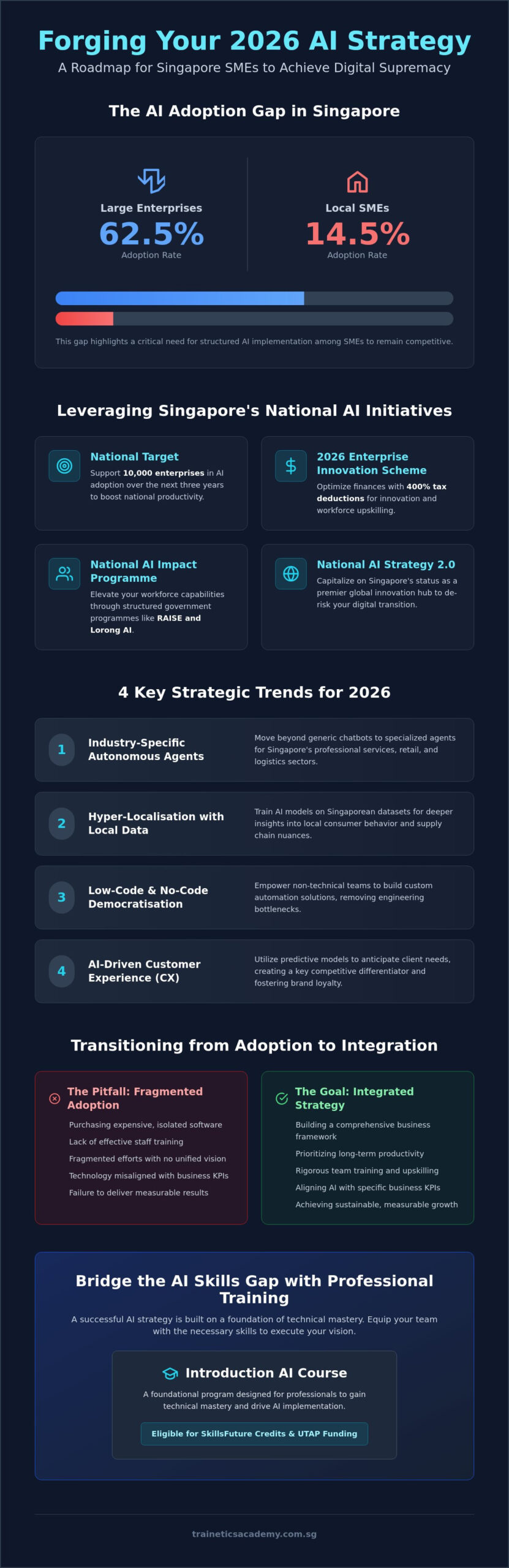
With the Singapore government aiming to support 10,000 enterprises in AI adoption over the next three years, the race for digital supremacy has officially moved from the boardroom to the operational front lines. Developing a robust ai strategy for smes in singapore is no longer an elective pursuit; it’s a fundamental requirement for professional excellence. Scale requires strategy. You likely recognize that fragmented digital efforts often fail to deliver results, especially when addressing the high cost of technical talent in our local market.
This guide provides a definitive roadmap to ensure your transition into an AI-driven future is both scientifically grounded and financially optimized. You’ll discover how to leverage the 2026 Enterprise Innovation Scheme for 400% tax deductions and utilize the National AI Impact Programme to elevate your workforce. We’ll explore practical implementation frameworks and the Introduction AI Course, which is eligible for SkillsFuture Credits and UTAP funding, to ensure your team achieves technical mastery. From our headquarters at 10 Anson Road, Level 22, International Plaza, Singapore 079903, we aim to equip you with the disciplined leadership necessary to exceed international benchmarks.
Key Takeaways
- Master the 2026 digital landscape by moving beyond tactical tool adoption toward a comprehensive, integrated business framework.
- Discover how localized Generative AI agents and hyper-local data insights provide a unique competitive edge in the Singaporean market.
- Build a sustainable ai strategy for smes in singapore that prioritizes long-term productivity over fragmented software implementation.
- Navigate the complex 2026 funding landscape to secure tax deductions and subsidies for essential workforce upskilling.
- Establish a professional identity through rigorous training programs that bridge the existing AI skills gap in your organization.
The 2026 AI Landscape for Singapore SMEs
Singapore’s status as a global hub depends entirely on its ability to integrate emerging technologies into its foundational structures. By mid-2026, Singapore’s technology-driven economy has evolved to a point where artificial intelligence serves as the primary engine for growth. Small and medium enterprises (SMEs) that previously viewed AI as an experimental luxury now find it essential for survival. This transition marks a critical shift from basic digitization to a sophisticated ai strategy for smes in singapore that prioritizes operational excellence and workforce productivity.
Current data reveals a stark contrast between corporate ambition and execution. While large enterprises boast an adoption rate of 62.5%, local SMEs lag at just 14.5%. This gap stems from a lack of structured implementation rather than a lack of interest. Businesses are moving away from surface-level experimentation. They’re now embedding AI into core inventory forecasting, automated customer service, and predictive analytics to drive measurable growth.
To better understand how these national initiatives provide a roadmap for your firm, watch this helpful video:
Current Adoption Gaps in Raffles Place and Beyond
Technical hurdles often stall growth in the competitive districts of Raffles Place and Tanjong Pagar. Many firms suffer from fragmented AI efforts; they purchase expensive software without training their staff to use it effectively. The cost of inaction is high. By 2026, companies failing to automate routine tasks face a significant competitive disadvantage, particularly as labor costs for technical talent remain elevated. Success requires moving beyond isolated tools to a unified corporate vision that aligns technology with specific business KPIs.
Opportunities in the Smart Nation Ecosystem
The National AI Strategy 2.0 has transformed Singapore into a premier “location of choice” for global innovation. SMEs now possess the unique opportunity to leverage initiatives like Lorong AI and the RAISE program to de-risk their digital transition. These frameworks offer more than just funding; they provide a gateway to market-proven solutions and elite industry collaboration. To bridge the existing skills gap, visionary leaders are enrolling their teams in a professional Artificial Intelligence Course. This ensures that your ai strategy for smes in singapore is built on a foundation of technical mastery and scientific validation.
Key Strategic Trends: Generative AI and Localised Automation
Precision and hyper-localisation define the 2026 strategic environment. As Singapore’s digital economy growth continues to accelerate, the standard for operational efficiency has shifted. A successful ai strategy for smes in singapore now requires moving beyond general-purpose tools toward specialized applications. Four dominant trends have emerged to reshape how local firms compete:
- Industry-Specific Agents: Generic chatbots have been replaced by autonomous agents tailored for Singaporean professional services, retail, and logistics.
- Hyper-Localisation: AI models are now trained on local datasets, allowing for deeper insights into Singaporean consumer behavior and regional supply chain nuances.
- Low-Code Democratisation: The barrier to entry has vanished. No-code platforms allow non-technical department heads to build custom automation without a software engineering background.
- AI-Driven CX: Customer experience is the primary differentiator. Predictive service models now anticipate client needs before they’re articulated, fostering unprecedented brand loyalty.
These trends represent a fundamental shift in how value is created. Adopting these technologies isn’t just about speed; it’s about accuracy and the pursuit of professional excellence in a crowded market.
Generative AI for Operational Excellence
The evolution of Generative AI has transformed “ChatGPT for professionals” into sophisticated departmental assistants. In Singaporean retail, these agents manage inventory forecasting with 98% accuracy. In logistics, they optimize last-mile delivery routes in real-time. By integrating an AI Course into your corporate training, you empower non-technical staff to build these workflows themselves. This internal capability reduces reliance on expensive external consultants and ensures your ai strategy for smes in singapore remains agile and sustainable. You might consider how a structured learning path could advance your professional identity and organizational resilience.
Data Privacy and Ethics in 2026
Trust is the currency of the digital age. Maintaining PDPA compliance is mandatory when training internal AI models on proprietary data. SMEs must implement ethical AI frameworks to reassure clients that their information is handled with academic rigor and absolute security. Adopting a “Growth with Ethics” mindset isn’t just a legal requirement; it’s a core brand value that distinguishes leaders from followers. Understanding what are the legal risks of using generative AI at work is essential to ensuring that your technological advancements don’t compromise your professional integrity or customer trust. Equally important is knowing how to ensure data privacy when using AI tools, so that your adoption of automation is protected by the disciplined safeguards your clients and stakeholders expect.
Adoption vs. Integration: Comparing SME Success Frameworks
Success in the digital era isn’t measured by the number of software subscriptions your firm maintains. Many local businesses fall into the trap of tactical adoption, which involves purchasing tools without a corresponding plan for workforce development. This approach inevitably leads to “AI fatigue,” where employees feel overwhelmed by redundant systems that don’t actually simplify their workflows. A sophisticated ai strategy for smes in singapore focuses instead on strategic integration, ensuring that every technological investment aligns directly with long-term business KPIs and operational benchmarks.
To evaluate your current position, we utilize a four-stage maturity framework designed for the local market:
- Awareness: Identifying specific business challenges where automation can provide a competitive edge.
- Adoption: Implementing pilot programs and initial toolsets to test functional viability.
- Integration: Synchronizing AI capabilities across departments to create a unified data ecosystem.
- Mastery: Achieving a state where AI is a core component of the professional identity and innovation cycle.
Measuring ROI must extend beyond simple time-savings. True integration facilitates revenue growth through enhanced lead conversion and improves talent retention by removing the drudgery of repetitive administrative tasks. When your team sees AI as a partner in excellence, productivity naturally follows.
The “People-First” Implementation Model
Upgrading your digital infrastructure without upskling your workforce is a recipe for obsolescence. Sustainable gains require a people-first approach where internal teams are empowered to lead the transition. While outsourcing development might seem efficient, it often creates a dependency that stalls long-term innovation. Investing in a professional artificial intelligence course for your core team ensures that your ai strategy for smes in singapore is executed by those who understand your unique business nuances. This internal technical mastery is the only way to maintain a high standard of professional readiness in 2026.
Case Studies: SME Triumphs in Singapore
We’ve observed remarkable transformations within the local landscape. A boutique professional services firm recently utilized localized automation to triple their service output without increasing their headcount. They avoided the “fragmentation trap” by establishing a centralized leadership role responsible for AI oversight. This contrasts sharply with early 2025 failures, where firms rushed into implementation without proper data governance, leading to costly errors and loss of client trust. These lessons highlight a fundamental truth: precision in planning is just as critical as the technology itself. Achieving these results starts with foundational knowledge, which you can gain through our comprehensive Artificial Intelligence Course.
Overcoming Barriers: Navigating Funding and AI Skills Training
The primary obstacle to a successful ai strategy for smes in singapore is not the technology itself, but the widening skills gap within the local workforce. While the 2026 Singapore Budget allocates resources to train 100,000 workers through the expanded TechSkills Accelerator (TeSA), many firms struggle to translate these national goals into departmental reality. Bridging this gap requires a disciplined approach to talent development. Leaders must prioritize professional readiness over mere software acquisition to ensure their digital transition remains scientifically grounded and sustainable.
Streamlining the grant application process is essential to reducing the administrative burden that often stalls SME growth. By leveraging pre-approved solutions under the Productivity Solutions Grant (PSG), which offers up to 50% co-funding in 2026, businesses can accelerate their deployment without exhausting internal resources. For rapid corporate deployment, the “1 day AI course Singapore” format has emerged as a high-impact solution. These intensive sessions allow teams to absorb foundational concepts and immediate practical applications without significant downtime, making them ideal for the fast-paced Singaporean market.
Maximising Local Training Subsidies
Financial optimization is a hallmark of visionary leadership. The Introduction AI Course is Eligible for SkillsFuture Credits and UTAP funding, providing a clear pathway for firms to subsidize their professional development. Utilizing these subsidies allows SMEs to access elite training while maintaining lean operational budgets. Specifically, NTUC members can leverage UTAP to offset training costs, ensuring that high-level education remains accessible to all tiers of the organization. This methodical approach to funding ensures that your ai strategy for smes in singapore is both ambitious and fiscally responsible.
Building an AI-Ready Culture
Technology alone cannot drive innovation; it requires a culture of “AI curiosity” that permeates every level of the firm. Senior employees and non-technical staff must be encouraged to view automation as a tool for personal growth rather than a threat to their professional identity. You can maximize your SkillsFuture credits to provide your team with the technical mastery required in this rapidly shifting 2026 landscape. Continuous learning is no longer a choice; it’s a fundamental requirement for maintaining professional benchmarks in a competitive global economy.
Our mentors at 10 Anson Road, Level 22, International Plaza, Singapore 079903 are dedicated to helping you navigate these complex training frameworks. Ready to transform your workforce? Enroll your team in our comprehensive Artificial Intelligence Course to begin your journey toward technical excellence.
Executing Your Strategy with Trainetics Academy
Realizing a visionary ai strategy for smes in singapore demands more than just software; it requires a professional identity rooted in technical excellence. Trainetics Academy serves as the gateway for local firms to bridge the gap between theoretical potential and operational mastery. We don’t merely offer instruction. We provide a disciplined path toward raising professional benchmarks, ensuring your organization is prepared to lead in the 2026 digital economy. Our flow is highly structured and logical, moving from foundational concepts to advanced applications to ensure a predictable pace that builds trust among your staff.
Transitioning into an AI-driven future feels both exciting and scientifically grounded when you have the right mentor. We speak with the voice of an industry leader that values precision, hard work, and continuous improvement. This persona is supportive yet demanding of high standards, mirroring the expectations of the Singaporean business environment itself. By choosing a path of academic rigor, you reassure your team that they’re receiving the highest standard of education available in our market.
Our Professional AI Training Pathway
Our curriculum is built on a foundation of academic rigor and practical, industry-aligned application. The AI Course at Trainetics Academy is specifically designed to meet the immediate needs of Singaporean business leaders who value precision. By focusing on international benchmarks in AI competency, we prepare your team to navigate complex technological shifts with confidence. This ensures your workforce doesn’t just use tools but understands the professional logic behind every automated workflow. We prioritize technical mastery to help your staff move beyond basic literacy toward true expertise.
Contact Us for Corporate Training Solutions
Every SME faces unique operational challenges that require customized training solutions. Our mentors take a systematic approach to education, mirroring the organized nature of the industry’s highest standards. We offer flexible learning platforms that bridge the gap between physical and virtual training, allowing your team to learn at a pace that suits your operational requirements. We invite you to connect with our team to discuss your digital roadmap and workforce strategy. Our presence in the heart of the business district reflects our commitment to being at the center of Singapore’s professional evolution.
Achieving AI mastery is a journey of continuous improvement. Join a community of visionary professionals who prioritize precision and hard work. Take the next leap toward securing your firm’s future by choosing a partner dedicated to producing top-tier professionals. Your professional identity in the 2026 tech landscape begins with the right foundation. We’re ready to help you raise your professional benchmarks and secure a prestigious career path for your entire team.
Securing Your Competitive Edge in the 2026 Digital Economy
Mastering the 2026 landscape requires a transition from fragmented tool adoption to a unified corporate vision. You’ve seen that the most successful firms prioritize strategic integration and workforce mastery over mere software acquisition. A robust ai strategy for smes in singapore is fundamentally a talent-first endeavor. By aligning your team’s technical capabilities with long-term business KPIs, you ensure that your digital transition is both scalable and scientifically grounded. Precision in planning is the hallmark of an industry leader.
Trainetics Academy offers the academic rigor and professional mentorship needed to lead this transformation. Our curriculum is designed by highly qualified industry professionals and delivered at our training centre at 10 Anson Road, Level 22, International Plaza, Singapore 079903. To support your team’s growth, our Introduction AI Course is Eligible for SkillsFuture Credits and UTAP funding. This ensures your pursuit of excellence is financially optimized and professionally recognized. It’s time to move beyond experimentation and establish a definitive professional identity.
Future-proof your business with our professional AI Course and begin your journey toward technical mastery today. Your commitment to precision and continuous improvement starts here.
Frequently Asked Questions
How can a small business in Singapore start an AI strategy with a limited budget?
Small businesses can initiate an ai strategy for smes in singapore by conducting a rigorous audit of high-frequency, low-complexity tasks. Prioritizing “low-hanging fruit”—such as automated scheduling or basic data synthesis—allows for immediate wins without a massive capital outlay. This methodical approach ensures that your digital transition is self-funding, as initial efficiency gains can be reinvested into more advanced integration projects and technical mastery.
Is the Introduction AI Course at Trainetics Academy eligible for SkillsFuture Credits?
Training subsidy eligibility is subject to individual and corporate profiles as determined by prevailing government frameworks. We encourage prospective students to contact our advisors for a personalized assessment of which modules currently qualify for local offsets. This ensures you can plan your professional development path with full financial clarity and maximize your available resources for an AI course Singapore that meets international benchmarks.
What are the most common mistakes SMEs make when implementing AI tools?
The most pervasive error is failing to establish a centralized data governance policy. When departments adopt tools in isolation, it creates fragmented ecosystems that are difficult to scale. Success requires a disciplined, top-down approach that ensures all technological advancements are interoperable and aligned with the firm’s broader innovation benchmarks. Moving beyond tactical tool adoption toward strategic integration is essential for long-term operational excellence.
Can I use UTAP to fund AI training for my employees in Singapore?
Singapore offers several robust mechanisms to support professional development and workforce upskilling. Our corporate team can guide you through the process of identifying which regional frameworks and union-led initiatives can be leveraged to offset training costs for your employees. This disciplined approach to funding allows your firm to maintain a high standard for an AI Course while optimizing your operational budget and enhancing your team’s professional identity.
How long does it typically take to see ROI from an AI strategy in an SME?
While initial productivity spikes can appear within months, a sustainable ROI from an ai strategy for smes in singapore typically stabilizes after one full business cycle. This period allows your team to move past the learning curve and fully integrate automated workflows into their professional identity. Beyond direct financial returns, SMEs often report improved employee retention as staff are liberated from repetitive administrative burdens to focus on higher-value strategic initiatives.
What AI skills are most in demand for non-technical SME employees in 2026?
In 2026, the market demands “Workflow Orchestration” and advanced prompt engineering skills. This involves the ability to link multiple AI agents to perform complex, multi-step operations efficiently. Professionals who can architect these automated sequences provide immense value, as they bridge the gap between technical potential and practical business outcomes. This mastery is a core component of a modern professional identity and is essential for maintaining a competitive edge.
Does my SME need to hire a data scientist to implement an AI strategy?
Hiring a full-time data scientist is rarely necessary for the initial stages of SME integration. Most operational improvements can be achieved by empowering “Citizen Developers” within your existing team. By providing your staff with the technical mastery to manage pre-built AI frameworks, you create a more agile and sustainable innovation model. This approach ensures that your technological evolution is deeply rooted in your specific industry context and operational needs.
Is it safe to use Generative AI tools with sensitive company data in Singapore?
Security is a matter of professional discipline and technical rigor. It is safe to use Generative AI provided you utilize enterprise-grade sandboxes that prevent your data from being used to train public models. Adhering to PDPA standards and implementing clear internal usage protocols ensures that your firm can leverage cutting-edge automation without compromising its professional integrity or client confidentiality. For a comprehensive overview of the regulatory landscape, we recommend reviewing the legal risks of using generative AI at work to ensure your implementation meets all 2026 compliance requirements. Additionally, following a structured professional checklist on how to ensure data privacy when using AI tools will help your firm maintain the rigorous safeguards necessary to protect sensitive company and client information. This protection is a fundamental requirement for any serious corporate AI implementation.
Disclaimer
AI Content Disclaimer: Some articles on this website may be generated or assisted by AI-powered content creation tools. While we strive for accuracy and relevance, readers should independently verify information before relying on it. The content is provided for informational purposes only and does not constitute professional advice.