Did you know that Singapore’s AI diffusion rate reached 63.4% of the working-age population by March 2026? This rapid adoption means your leadership is likely already looking for a roadmap that moves beyond experimentation toward disciplined execution. You probably feel the weight of this transition, worrying that technical jargon might obscure the value you know exists. If you’re currently wondering how to discuss AI strategy with my CEO, you’re facing the common challenge of aligning technical mastery with core business models.
This guide will show you how to translate technical potential into strategic business growth. You’ll master the art of executive communication, ensuring your presentation reflects the precision and excellence expected at the highest professional levels. We’ll provide a structured meeting framework and a list of specific metrics that resonate with a visionary leader’s goals. You’ll walk away with the confidence to lead your organization’s AI transition and set new professional benchmarks in your industry. For those seeking foundational mastery, our Introduction AI Course is eligible for SkillsFuture Credits and UTAP funding, offering a gateway to this prestigious professional identity.
Key Takeaways
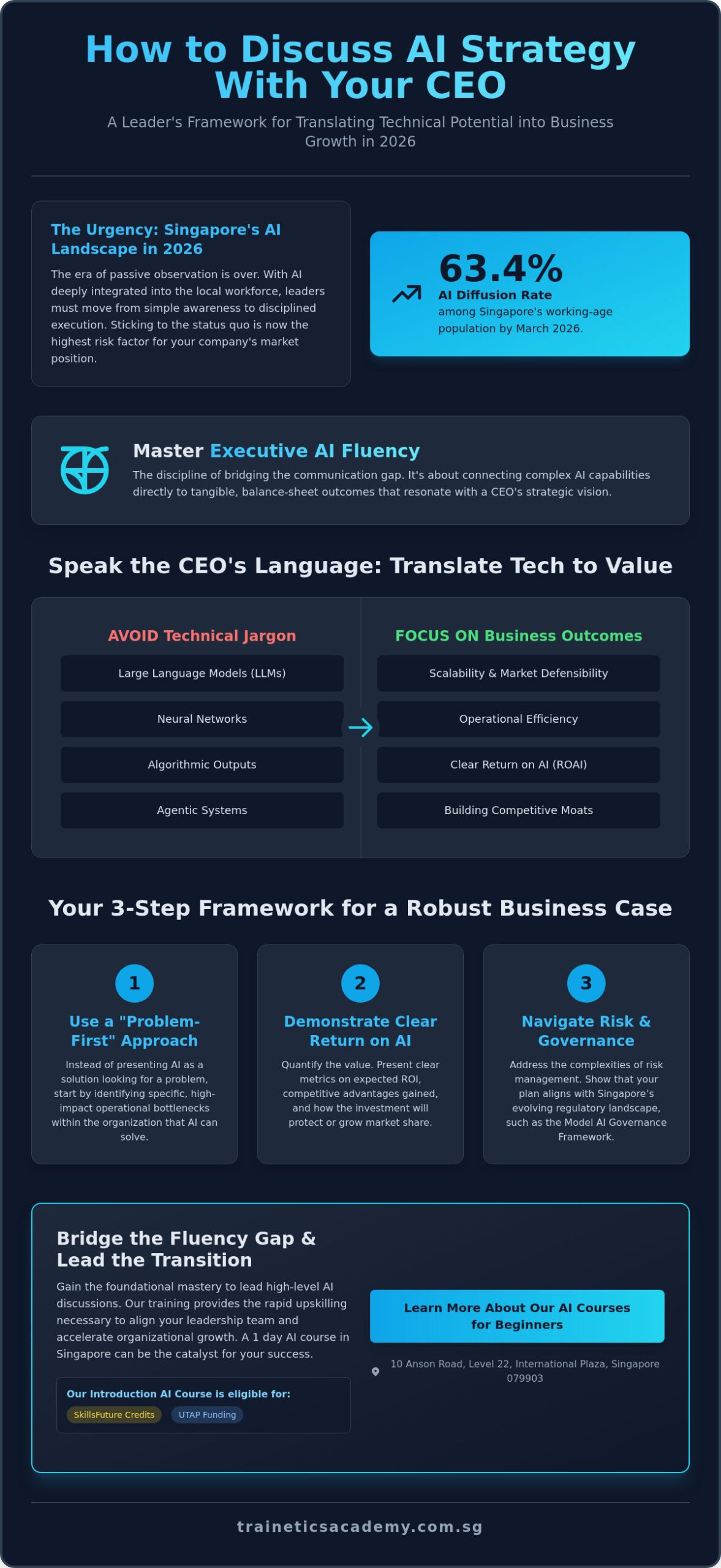
- Master the concept of Executive AI Fluency to bridge the communication gap between technical potential and tangible balance sheet outcomes.
- Learn exactly how to discuss AI strategy with my CEO by replacing technical jargon with business-centric terms like scalability, efficiency, and competitive moats.
- Develop a robust business case using a “problem-first” framework that identifies specific operational bottlenecks and demonstrates a clear Return on AI.
- Navigate the complexities of risk management and governance to ensure your implementation aligns with professional benchmarks and Singapore’s evolving regulatory landscape.
- Discover how a 1 day AI course Singapore can provide the rapid upskilling necessary to align your leadership team and accelerate organizational growth.
Table of Contents
Translating AI Capabilities into the CEO’s Language of Business Value
Building the Business Case: ROI, Competitive Advantage, and Risk Management
Step-by-Step: How to Lead a Strategic AI Discussion with Your Executive Team
Bridging the Fluency Gap: Professional AI Training for Singapore Leaders
Why Your CEO is Suddenly Asking About AI Strategy in 2026
By May 2026, the era of passive observation has ended. Singapore’s AI diffusion rate has surged to 63.4% of the working-age population, signaling a deep integration of these technologies into the local workforce. Your CEO is likely feeling the pressure of this shift. They don’t want to hear that AI is "coming"; they want to know how it’s being executed to protect the bottom line. This requires a transition from simple awareness to true AI fluency, where leaders move beyond basic prompts to architecting end-to-end workflows.
Mastering this dialogue involves viewing AI not as a siloed IT project, but as a core component within your organization’s framework for strategic management. When you consider how to discuss AI strategy with my CEO, focus on how these tools align with high-level objectives and resource allocation. It’s about moving from curiosity to a disciplined, professional roadmap. You must demonstrate that you aren’t just chasing a trend, but are instead proposing a scientifically grounded evolution of the business model.
To better understand this concept, watch this helpful video:
The 2026 Competitive Landscape in Singapore
Regional peers aren’t waiting. With 63% of APAC organizations actively using AI as of March 2026, the competitive window is closing fast. Singaporean firms are operating under the National AI Strategy 2.0, which emphasizes rapid adoption to maintain global benchmarks. The government’s introduction of the Model AI Governance Framework for Agentic AI in January 2026 further proves that the regulatory environment is ready for autonomous systems. In this high-stakes environment, sticking to the status quo represents the highest risk factor for your company’s market position and long-term viability.
From Personal Tools to Strategic Infrastructure
Your CEO likely sees staff using basic chatbots for emails, but that isn’t an enterprise strategy. True AI integration involves building strategic infrastructure that optimizes organizational assets. We’re seeing a shift toward "AI workers" or agentic systems that manage complex processes independently. This shift impacts everything from data-driven decision-making to talent retention. Professionals who can bridge this gap are the ones who define the next generation of industry leadership. If you’re looking for a structured start, our Introduction AI Course is eligible for SkillsFuture Credits and UTAP funding, providing the technical foundation needed to lead these high-level discussions. It’s about moving from individual productivity to creating a "moat" that competitors cannot easily replicate.
Translating AI Capabilities into the CEO’s Language of Business Value
Precision in communication is the hallmark of an industry leader. When you consider how to discuss AI strategy with my CEO, you must pivot from technical specifications to strategic outcomes. This transition defines Executive AI Fluency: the discipline of connecting algorithmic outputs directly to balance sheet results. Instead of discussing Large Language Models (LLMs) or neural networks, your narrative should focus on operational moats, scalability, and market defensibility. CEOs don’t buy software; they buy certainty.
Mastering this shift is essential for Building an AI Business Strategy that survives executive scrutiny. You’re no longer selling a tool; you’re proposing a fundamental enhancement of the organization’s competitive mechanics. This requires a high level of professional communication to ensure your vision isn’t lost in translation. Framing the narrative correctly allows you to move from requesting a budget to proposing a high-yield investment.
The Three Pillars of CEO Interest: Revenue, Cost, and Risk
Revenue Growth: Focus on how AI creates new products or improves customer acquisition. Demonstrate how predictive models can identify high-value leads before your competitors do.
Operational Efficiency: Highlight the reduction in the cost of doing business. Automation should be framed as a way to liberate human capital for high-impact, creative tasks rather than just cutting headcount.
Risk Mitigation: Use AI as a shield. Explain how agentic systems can predict market shifts or ensure compliance with evolving regulatory frameworks, protecting the firm’s long-term interests.
Case Study: Turning a Technical Project into a Strategic Win
Consider a Singaporean firm in the logistics sector that implemented AI for predictive maintenance. Initially, the project was framed as a sensor data upgrade and struggled to gain traction. Once the team reframed it as a 20% reduction in fleet downtime and a safeguard against supply chain volatility, the CEO immediately prioritized the rollout. They stopped viewing it as a technical expense and started seeing it as a workforce investment.
At our training center at 10 Anson Road, Level 22, International Plaza, Singapore 079903, we emphasize that technical mastery must be paired with leadership. Enrolling in a comprehensive Artificial Intelligence Course allows your team to develop these high-level capabilities. Investing in your people creates a permanent capability that no subscription service can replace, ensuring your organization can raise its professional benchmarks without unnecessary friction.
Building the Business Case: ROI, Competitive Advantage, and Risk Management
Building a business case for AI requires more than just a list of potential efficiencies. It demands a rigorous analysis of how these technologies will redefine your market position. When you prepare how to discuss AI strategy with my CEO, you must present a vision that includes a defensible "AI Moat." This isn’t just about using a tool; it’s about proprietary data loops and process integration that competitors cannot easily replicate. You’re building a structural advantage, not just checking a box. This methodical approach reflects the organized nature of top-tier professional training and positions you as an industry leader.
A recent report from the Boston Consulting Group on AI strategy suggests that many leaders aren’t thinking broadly enough about the transformative power of these systems. To counter this, your proposal should highlight the "Cost of Inaction." In a market where 86% of organizations plan to increase AI budgets in 2026, falling behind on maturity is a systemic risk to your firm’s survival. You must also address ethical AI governance and data security. A robust business case includes a plan for de-risking these initiatives through frameworks like the NIST AI Risk Management Framework, ensuring your strategy is both ambitious and secure.
Quantifying ROI for AI Initiatives
Quantifying the Return on AI (ROAI) starts with moving past simple time-saving metrics. While saving hours is beneficial, the real value lies in the reallocation of that human capital toward higher-value strategic tasks. You can use specific productivity tools for business to establish baseline performance data. This allows you to track improvements in output quality and decision-making speed. These are the true engines of long-term value creation. Short-term wins provide momentum, but long-term value is found in the optimization of organizational assets. You want to show that AI isn’t just a cost center, but a catalyst for professional excellence and technical mastery.
Identifying High-Impact Use Cases
Mastering how to discuss AI strategy with my CEO depends on selecting the right battles. High-impact use cases should be mapped on a matrix of feasibility and strategic alignment. Focus on core operations like supply chain or customer lifecycle management rather than peripheral experiments. This ensures that every dollar spent aligns with the company’s three-year strategic plan. By prioritizing core business bottlenecks, you prove that AI is a solution to existing problems, not a solution looking for a problem. This disciplined flow builds the executive trust required for larger, transformative investments. It positions you as a visionary mentor within the organization, leading the charge toward a more efficient, scientifically grounded future.
Step-by-Step: How to Lead a Strategic AI Discussion with Your Executive Team
Leading an AI transition requires more than technical knowledge; it demands a disciplined approach to organizational change. When you’re preparing how to discuss AI strategy with my CEO, you must act as a visionary mentor who bridges the gap between current operations and future potential. This isn’t a casual conversation. It’s a professional presentation of a high-standard roadmap that aligns with international benchmarks. Follow these five steps to ensure your proposal is received with the seriousness it deserves.
Step 1: Audit internal AI "pockets." Conduct a systematic review of where your team is already using AI tools. Demonstrating existing organic momentum proves that adoption isn’t just a theory; it’s a reality that needs a professional framework.
Step 2: Draft a "Problem-First" brief. Avoid starting with the technology. Instead, identify a specific business bottleneck, such as supply chain friction or customer churn, and frame AI as the scientifically grounded solution.
Step 3: Propose a pilot program. Lower the perceived risk by suggesting a short-term trial. Define rigorous success and failure criteria to manage executive expectations and prove your commitment to precision.
Step 4: Secure executive sponsorship. Connect your proposal to the organization’s long-term growth. Highlight the training ROI by showing how upskilling the workforce creates a permanent, scalable asset.
Step 5: Finalize the logistics. Identify a dedicated training window for your leadership team and schedule a formal session to discuss the specific curriculum and implementation timeline.
The Pre-Meeting Checklist
Success is found in the preparation. Before entering the boardroom, gather data on competitor AI moves to emphasize the urgency of action. Identify internal "AI Champions" who can vouch for the technology’s efficacy. Most importantly, prepare a governance plan that addresses data privacy and security. This proactive approach neutralizes the common "But is it safe?" objection before it can derail your narrative.
A Sample 30-Minute CEO Briefing Agenda
Executive time is a finite resource. Structure your briefing to maximize impact within a short window:
00-05 mins: The Market Reality. Use current regional adoption trends to explain why the status quo is the highest risk factor.
05-15 mins: The Strategic Opportunity. Present your Problem-First brief and the specific ROI expected from the pilot.
15-25 mins: The Implementation & Training Roadmap. Detail how the team will achieve technical mastery through professional development.
25-30 mins: Request for Sponsorship. Secure a clear commitment for the pilot program and define the next steps.
To lead this transition with absolute confidence, consider enrolling in our Artificial Intelligence Course. This program is designed to provide the professional identity and technical fluency required to navigate these high-level strategic discussions successfully.
Bridging the Fluency Gap: Professional AI Training for Singapore Leaders
The divide between technical potential and executive execution is often a matter of shared vocabulary. When technical teams speak of parameters and leaders speak of profit, the strategy stalls. Mastering how to discuss AI strategy with my CEO requires a shift toward professional readiness that only structured education provides. By engaging in a Learning AI Course, you gain the ability to navigate complex governance and implementation scenarios with the precision of an industry veteran. This ensures your proposals are viewed as rigorous business investments rather than speculative technical experiments.
A 1 day AI course Singapore leaders can attend provides the rapid upskilling necessary to close this gap. It provides the scientific foundation to move beyond surface-level chatbot usage toward architecting end-to-end organizational assets. This professional certification builds the internal confidence required for high-stakes boardroom discussions, allowing you to set new benchmarks for excellence within your specific market.
Choosing the Right AI Course for Beginners
Success in leadership doesn’t require you to write code. Instead, you should focus on AI courses for beginners that emphasize practical application and strategic oversight. The best learning environments are interactive and professional-led, allowing you to simulate executive scenarios. Our curriculum is specifically designed for managers who need to understand the "why" and "how" of AI integration without getting lost in theoretical abstractions. This approach ensures you gain technical mastery that is immediately applicable to your core business operations.
Maximizing Support for Training
To further explore how these professional benchmarks can be integrated into your firm’s growth plan, visit our facility at 10 Anson Road, Level 22, International Plaza, Singapore 079903. While many search for a 1 day AI course Singapore offers, few provide the depth of curriculum required for true executive fluency. You can learn more about SkillsFuture credit options to support your corporate training initiatives. Our Artificial Intelligence courses ensure that you leave with a professional identity that allows you to lead the AI transition with absolute confidence. This commitment to continuous improvement is what defines top-tier professionals in the 2026 economy.
Lead Your Organization’s AI Evolution
Success in the boardroom depends on your ability to pivot from technical complexity to strategic clarity. You’ve now mastered the framework for translating algorithmic potential into tangible business moats and operational efficiency. By following a structured briefing agenda and focusing on high-impact use cases, you position yourself as a disciplined leader capable of navigating the 2026 market. Mastering how to discuss AI strategy with my CEO isn’t just about a single meeting; it’s about establishing a professional identity rooted in technical mastery and visionary leadership.
Empower your team with our eligible Introduction AI Course to solidify this transition. Our curriculum is designed for professional excellence, ensuring you and your staff remain at the forefront of the industry’s rapid evolution. Take this opportunity to set a new benchmark for your career and your organization’s future. You have the tools and the framework; now it’s time to execute with confidence.
Frequently Asked Questions
How do I start an AI strategy conversation if I am not in a technical role?
You should initiate the dialogue by focusing on business outcomes rather than underlying algorithms. CEOs prioritize growth, efficiency, and market defensibility. By identifying a specific operational bottleneck and proposing AI as a scientifically grounded solution, you demonstrate leadership and professional readiness. This approach ensures the conversation remains rooted in strategic value rather than technical complexity.
What are the top AI-related risks my CEO will be worried about?
Your leadership will likely focus on data privacy, security, and regulatory compliance. You should reference Singapore’s Model AI Governance Framework for Agentic AI, introduced in January 2026, to show you’re aware of the latest standards. Proactively addressing how the company will manage autonomous systems and data integrity will reassure your CEO that your strategy is both ambitious and secure.
How much budget should I ask for when starting an AI pilot program?
You shouldn’t lead with a fixed dollar amount but rather a percentage of the operational budget for the specific department you’re optimizing. Focus on a low-risk initial investment for a pilot program that has clear success criteria. This allows the organization to test technical potential without overextending resources, building the necessary momentum for larger, enterprise-wide deployments later.
Which AI courses for beginners are most respected by Singaporean employers?
Employers value programs that emphasize professional mastery and immediate practical application over theoretical coding. Highly respected AI courses for beginners focus on bridging the gap between technical potential and business execution. Training that aligns with regional educational frameworks and local accreditation standards ensures that your team is prepared to meet the rigorous expectations of the Singaporean market.
How do I prove the ROI of an AI training course for my team?
Proving ROI involves tracking productivity benchmarks and the reallocation of human capital toward high-value strategic tasks. When you consider how to discuss AI strategy with my CEO, show how training reduces error rates and accelerates decision-making cycles. Proving that your team has achieved technical mastery through a structured learning path provides the scientific validation required to justify the initial investment.
What is the "Cost of Inaction" and how do I calculate it for my company?
The cost of inaction is the competitive disadvantage your firm faces as peers adopt AI at faster rates. With Singapore’s AI diffusion rate reaching 63.4% by March 2026, the risk of falling behind is a systemic threat to market share. You can calculate this by estimating lost efficiency gains and the potential erosion of your customer base to AI-enabled competitors over a three-year period.
Is there an eligible 1 day AI course Singapore professionals can take?
Yes, short-term training options are available for busy professionals who need to achieve rapid upskilling. A 1 day AI course Singapore can provide the essential foundation needed to lead strategic discussions and implement basic AI workflows. These intensive sessions are designed to fit into a professional schedule while delivering high-level insights that are immediately applicable to your organizational goals.
Can I use SkillsFuture credits for AI strategy training?
You can certainly use your credits to offset the costs of specific professional development programs. Our Introduction AI Course is eligible for SkillsFuture Credits and UTAP funding, making it a cost-effective way to build technical fluency. You can visit us at 10 Anson Road, Level 22, International Plaza, Singapore 079903 to discuss how these SkillsFuture AI courses can be integrated into your company’s broader professional identity roadmap.
Disclaimer
AI Content Disclaimer: Some articles on this website may be generated or assisted by AI-powered content creation tools. While we strive for accuracy and relevance, readers should independently verify information before relying on it. The content is provided for informational purposes only and does not constitute professional advice.