By April 2026, 75% of employees reported deep concerns that AI would render their roles obsolete. This fear isn’t just a hurdle; it’s a productivity killer that stalls innovation at the finish line. Managing employee anxiety about AI automation has become the defining challenge for leaders who want to see a real return on their technology investments. If your team feels threatened, they won’t adopt the tools you’ve provided, leaving your digital transformation stagnant.
You likely recognize that a workforce operating in survival mode cannot reach peak performance. We understand that bridging the gap between technical implementation and human psychological safety is essential for professional excellence. This guide provides proven psychological frameworks and strategic upskilling pathways to transform AI-related fear into professional empowerment. You’ll discover a clear roadmap for integration that fosters higher buy-in and masters human-AI collaboration. For those ready to lead this transition at 10 Anson Road, Level 22, International Plaza, Singapore 079903, an AI course Singapore professionals trust, such as our Introduction to Artificial Intelligence, offers the foundational mastery needed to excel. This 1-day AI course Singapore leaders attend is eligible for SkillsFuture Credits and UTAP funding.
Key Takeaways
- Decode the psychological triggers behind automation stress to replace professional uncertainty with a sense of technical mastery and job security.
- Implement strategic communication frameworks for managing employee anxiety about AI automation, ensuring your team views technology as a partner rather than a threat.
- Adopt a role allocation framework that preserves the “Human Edge” by focusing your staff on high-value tasks requiring complex ethics and strategic vision.
- Execute a two-step action plan involving readiness assessments and high-impact training to bridge skill gaps and build immediate organizational confidence.
- Discover how an Introduction AI Course eligible for SkillsFuture Credits and UTAP funding can empower your workforce with the essential AI literacy needed for 2026.
Table of Contents
The Psychology of AI Anxiety: Why Automation Triggers Workplace Stress
Strategic Communication: Transparency as the Antidote to Fear
Human-Centric Automation: Strategic Role Allocation Frameworks
The Psychology of AI Anxiety: Why Automation Triggers Workplace Stress
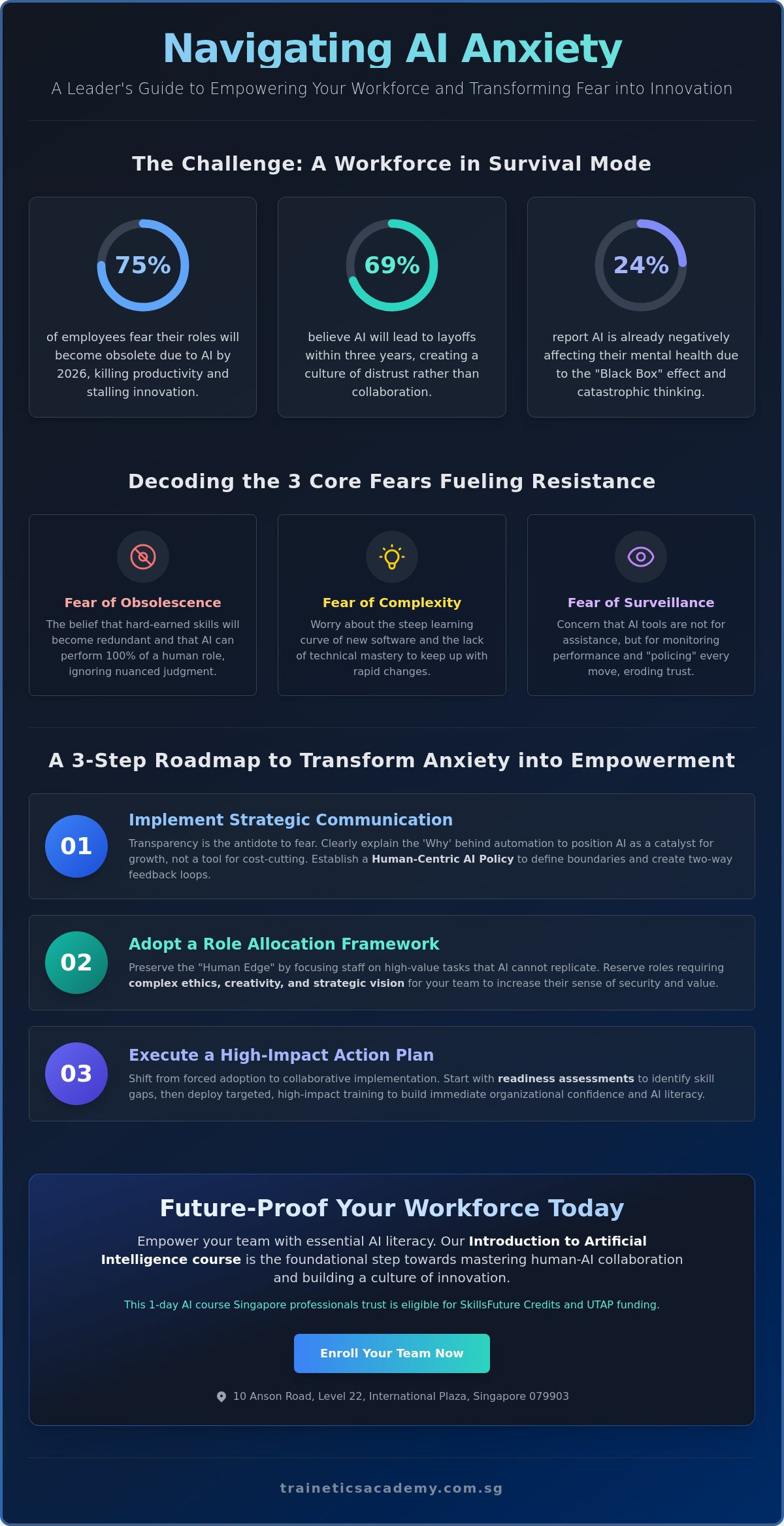
AI anxiety isn’t merely a resistance to change. It’s a persistent psychological state where professionals believe their hard-earned skills will become redundant. In Singapore’s fast-moving 2026 economy, the rapid integration of Generative AI has created a "Black Box" effect. When employees don’t understand how an algorithm makes decisions, they fill that knowledge gap with catastrophic thinking. This mental strain has measurable consequences; data from April 2026 reveals that 24% of employees report AI is already negatively affecting their mental health.
Managing employee anxiety about AI automation requires leaders to look past the technical specs and address the human shadow of automation. Without psychological safety, productivity drops because anxious teams won’t experiment or innovate with the very tools meant to help them. This lack of engagement often leads to a cycle of underperformance and increased stress. To better understand this concept, watch this helpful video:
The Three Core Fears of AI Displacement
Research from April 2026 shows that 69% of employees believe AI will lead to layoffs within three years. This fear of obsolescence stems from the belief that AI can perform 100% of a human role, ignoring the nuanced judgment humans provide. Secondly, many feel a fear of complexity. They worry about the steep learning curve required by new software and fear they lack the technical mastery to keep up. Finally, there is the fear of surveillance. Many staff members worry that AI tools are not there to help, but to monitor performance and "police" their every move; this creates a culture of distrust rather than collaboration.
Recognizing Symptoms of Resistance in Your Team
Leaders must identify the subtle markers of resistance before they harden into cultural roadblocks. Passive-aggressive avoidance is common; employees might "forget" to use new AI-driven workflows or stick to legacy systems under the guise of reliability. You may also encounter "Pilot Paralysis," where projects stall at the implementation stage because the team is too fearful of making mistakes with unfamiliar technology. Using emotional intelligence to address these concerns early is vital. By acknowledging the validity of their stress, you can begin the process of managing employee anxiety about AI automation and transition your team toward a mindset of professional empowerment.
Strategic Communication: Transparency as the Antidote to Fear
Transparency serves as the primary antidote to workplace fear. When leaders fail to explain the ‘Why’ behind automation, employees often assume the worst. To succeed in managing employee anxiety about AI automation, you must position these tools as catalysts for growth rather than instruments for cost-reduction. If your team thinks the goal is simply to cut headcount, they’ll naturally resist every new integration. Clear, honest communication prevents the rumor mill from undermining your digital strategy and ensures everyone is pulling in the same direction.
Establishing a Human-Centric AI Policy provides the guardrails your team needs. This document should explicitly outline where AI will be used and, more importantly, where human intervention remains mandatory. When workers see that ethical judgment and high-level strategy are reserved for them, their sense of security increases. Couple this with two-way feedback loops where staff can voice technical frustrations without judgment. Highlighting success stories from local Singaporean workflows helps ground these concepts in reality. Show how AI removes the drudgery from daily tasks, such as automated scheduling or data entry, which creates space for more creative and impactful output.
Building a Culture of AI Literacy
Shift your strategy from forced adoption to collaborative implementation. It’s not enough to buy the software; you must democratize access so every staff level feels comfortable with basic AI exposure. Identify internal ‘AI Champions’, employees who are naturally tech-curious, to mentor their peers. This peer-to-peer support often feels less threatening than top-down mandates. Encouraging your team to take an Artificial Intelligence Course can provide the foundational literacy needed to turn fear into professional curiosity. When knowledge is shared horizontally, the ‘Black Box’ effect begins to dissolve.
Leadership’s Role in Modeling Adaptability
Managers must demonstrate their own learning journey. If you aren’t using the tools, your team won’t either. Frame AI as a ‘Co-pilot’ in all professional communication, emphasizing that the human is always the one in the pilot’s seat. This distinction is vital for maintaining professional identity and pride. Encourage experimentation and allow for a ‘fail-forward’ environment where minor errors during the learning phase aren’t penalized. When employees see that their leaders value the effort of learning new systems over immediate, flawless execution, the pressure to be perfect with new tech subsides. This vulnerability from leadership builds trust and encourages the entire organization to embrace the future.
Human-Centric Automation: Strategic Role Allocation Frameworks
Effective leadership in 2026 requires a surgical approach to task delegation. Managing employee anxiety about AI automation starts with identifying the "Automation Sweet Spot." This involves isolating high-volume, repetitive, and data-heavy tasks that consume your team’s time without utilizing their professional expertise. When you automate these manual bottlenecks, you aren’t removing the person; you’re removing the drudgery. This shift allows your staff to reclaim their "Human Edge," focusing on responsibilities that require empathy, complex ethics, and strategic vision. AI lacks the nuanced understanding of organizational culture and interpersonal dynamics that your long-term staff possess.
The most successful organizations utilize a "Human-in-the-loop" model. This framework acknowledges that while AI can generate outputs at scale, it requires expert oversight to ensure accuracy and alignment with brand standards. For example, our course on business writing with ChatGPT demonstrates how AI acts as a sophisticated drafting tool. It enhances rather than replaces professional writers by handling initial structures, allowing the human author to focus on tone, persuasion, and high-level messaging. This collaborative approach reinforces the idea that the professional remains the final authority.
Task Mapping for Your Department
Audit your current workflows to identify specific manual bottlenecks suitable for automation. Categorize every skill within your department into "AI-Enhanced" or "Human-Exclusive" domains. This clarity helps employees understand that their value isn’t tied to data entry, but to the interpretation of that data. AI provides the computational speed, while human judgment provides the necessary direction and context.
The ROI of Upskilling vs. Replacement
Replacing experienced staff is a costly endeavor that erodes institutional memory. Data from April 2026 shows that 77% of employers plan to reskill their workers, yet only 13% of employees have received any formal training. Investing in your current team is your best strategic move. Your staff already understands your clients and internal processes. By providing training, you foster long-term loyalty and transform your existing workforce into your most valuable AI assets. This investment in professional development is the most direct path to raising your professional benchmarks and ensuring long-term competitiveness in the Singapore market.
Actionable Strategies for Building a Culture of AI Literacy
Managing employee anxiety about AI automation involves more than just reassurance; it requires a systematic educational intervention. Leaders must move beyond philosophical discussions and provide concrete tools that build technical mastery. By providing a structured learning path, you remove the ambiguity that fuels workplace stress. Confidence follows competence. When your team understands the mechanics of the tools they use, the "Black Box" effect dissolves, replaced by a sense of professional agency.
Execution begins with a five-step framework designed for the 2026 business environment:
Step 1: Conduct an AI Readiness Assessment. Audit your team’s current technical baseline to identify specific skill gaps. This data-driven approach ensures your training efforts are targeted and effective.
Step 2: Implement short-term, high-impact training. Focus on immediate wins. Short, intensive sessions build confidence faster than long, theoretical programs.
Step 3: Leverage local support. At 10 Anson Road, Level 22, International Plaza, Singapore 079903, we provide professional-led instruction. Our Introduction AI Course is eligible for SkillsFuture Credits and UTAP funding, making it a cost-effective solution for workforce upskilling.
Step 4: Integrate AI tools with low-stakes ‘play’ sessions. Create a safe environment for employees to experiment with Generative AI without the pressure of formal deadlines. This encourages curiosity over fear.
Step 5: Review and iterate. Use employee feedback to refine your automation strategy. A collaborative approach to managing employee anxiety about AI automation ensures that the transition feels like a shared journey rather than a top-down mandate.
Choosing the Right Training Partner in Singapore
Selecting a training provider is a strategic decision that impacts your team’s professional readiness. Look for an AI course Singapore professionals can rely on, featuring interactive, professional-led curriculums that mirror real-world needs. A 1 day AI course Singapore leaders choose often provides the best balance of depth and efficiency. This format ensures minimal business disruption while delivering the technical mastery required to meet international benchmarks and regional standards.
Maximizing Training Subsidies for Your Team
Your organization can significantly offset corporate training costs by utilizing available local support. Identify programs that are "Eligible" for SkillsFuture AI courses and UTAP support. These subsidies are designed to help beginners and professionals alike achieve practical artificial intelligence course mastery. For a deeper look at how to fund your team’s development, read our guide on Maximizing Your SkillsFuture Credit for AI Courses. Taking this proactive step demonstrates a clear investment in your staff’s professional identity and long-term security. Ready to future-proof your department? Explore our Artificial Intelligence Course today to begin your team’s transformation.
Future-Proofing Your Workforce with Trainetics Academy
Trainetics Academy empowers Singaporean professionals through a unique blend of academic rigor and practical application. We don’t just teach tools; we build a professional identity that’s resilient to technological shifts. Managing employee anxiety about AI automation requires a partner that values precision and continuous improvement. By choosing an industry leader, you provide your team with the confidence that they’re receiving the highest standard of education available in the market. Our curriculum is designed to move students from foundational understanding to technical mastery in a single day, ensuring they’re ready to excel in the 2026 economy.
Our instructors are qualified professionals who understand the nuances of the local business landscape. We focus on professional readiness, ensuring that every participant leaves with a scientifically grounded understanding of how to leverage automation. This commitment to excellence is what makes our 1 day AI course Singapore leaders’ preferred choice for rapid upskilling. We prioritize clear, purposeful instruction that highlights immediate benefits, allowing your staff to see AI as a gateway to a more prestigious career rather than a threat to their current roles.
Why Trainetics Academy is the Gateway to AI Mastery
We provide interactive learning platforms that cater to both physical and virtual needs, ensuring accessibility without compromising on depth. Our sophisticated curriculum is specifically crafted to raise professional benchmarks across Singapore’s diverse sectors. For a comprehensive look at the training landscape, explore our AI Course Singapore: The Ultimate 2026 Guide. This resource helps leaders align their training investments with international benchmarks and regional educational frameworks.
Take the Next Step in Workforce Transformation
Success in managing employee anxiety about AI automation depends on a structured, logical learning path. We offer customized corporate group training solutions tailored to the specific needs of your organization. Whether you’re a small team or a large enterprise, we ensure your staff is professionally ready for the 2026 tech landscape. Our training programs are methodical and deliberate, giving your employees the time they need to absorb critical concepts. Visit us at International Plaza to discuss a tailored upskilling path that secures your team’s future. Investing in Artificial Intelligence courses today is the most effective way to transform fear into a collective pursuit of excellence.
Leading the Future of Human-AI Collaboration
Successful leadership in 2026 hinges on your ability to bridge the gap between technical innovation and psychological safety. You’ve learned that transparency acts as the antidote to fear, while strategic role allocation ensures your team’s unique human judgment remains central to your operations. Managing employee anxiety about AI automation isn’t just about software; it’s about providing a professional identity that’s ready for the next decade of growth.
By transforming technical uncertainty into professional mastery, you secure your organization’s position at the forefront of the Singaporean market. Your current team is your most valuable asset, and their institutional knowledge is the foundation of your AI success. Take the decisive step to raise your professional benchmarks and foster a culture of innovation. Enroll your team in our professional Artificial Intelligence Course today to begin this transformation. The transition to an automated future is an opportunity to redefine what it means to be a leader in an age of precision and excellence.
Frequently Asked Questions
How do I explain to employees that AI won’t take their jobs?
Explain that AI is a tool for augmentation, not replacement. Frame automation as a way to eliminate repetitive drudgery, allowing staff to focus on high-value strategic work. By April 2026, research shows that human oversight remains the critical factor for technology success. Emphasize that their institutional knowledge and ethical judgment are irreplaceable assets that an algorithm simply cannot replicate.
What are the first signs of AI-related burnout or anxiety in a team?
Look for "Pilot Paralysis" or passive avoidance of new digital workflows. When employees feel threatened, they often stick to legacy systems or show decreased engagement in innovation. Data from April 2026 indicates that 24% of workers already feel AI is impacting their mental health. Early intervention through transparent communication and supportive training can prevent these symptoms from becoming deep cultural roadblocks.
Can older employees successfully transition to using AI tools?
Older professionals often transition more successfully because they possess deep institutional context. While younger staff might grasp the technical interface quickly, senior employees excel at the logic and strategic oversight required for effective AI prompts. Their years of experience allow them to interpret AI outputs with a level of critical thinking that beginners often lack, making them valuable AI mentors.
Is there government support in Singapore for AI staff training?
Singapore offers significant support for workforce upskilling through various local funding schemes. These initiatives help organizations offset the costs of technical training, ensuring the local workforce remains competitive and professionally ready for the 2026 tech landscape. You can check for eligible programs that focus on practical mastery to maximize your training budget and raise your team’s professional benchmarks.
How long does it take for a team to become proficient in basic AI automation?
Foundational proficiency can be achieved through a 1 day AI course Singapore leaders trust. While complete mastery is a continuous journey, an intensive workshop provides the immediate confidence needed to start using tools like ChatGPT effectively. Within a few weeks of daily application, most teams report a significant reduction in time spent on repetitive administrative or data-heavy tasks.
What happens if employees refuse to use new AI productivity tools?
Resistance is usually a symptom of fear or a lack of technical mastery. Managing employee anxiety about AI automation involves identifying these root causes through open dialogue rather than top-down mandates. If refusal persists, it’s often because the learning curve feels too steep. Providing targeted, short-term training replaces this uncertainty with the practical skills needed for a successful transition.
Which AI skills are currently in highest demand for Singaporean businesses?
Prompt engineering and data interpretation are currently the most sought-after skills in the local market. Businesses need professionals who can effectively communicate with AI models to generate high-quality, accurate outputs. Additionally, a strong understanding of ethical AI oversight and digital literacy is essential. These skills ensure that automation is used responsibly and aligns with broader organizational goals and international benchmarks.
How can I measure the success of an AI upskilling program?
Track time saved on automated tasks and the quality of AI-generated work against your previous benchmarks. Successful programs also result in higher employee sentiment scores and a noticeable increase in team innovation. If your staff is actively suggesting new ways to integrate AI into their workflows, it’s a clear sign they’ve moved from a state of anxiety to one of professional empowerment.
Disclaimer
AI Content Disclaimer: Some articles on this website may be generated or assisted by AI-powered content creation tools. While we strive for accuracy and relevance, readers should independently verify information before relying on it. The content is provided for informational purposes only and does not constitute professional advice.