AI courses can help learners understand how to implement AI by teaching them to start with a clear business problem, reliable and well-governed data, and a realistic way to measure success. A capable model alone is not enough if it does not fit everyday workflows or employees are not prepared to use its outputs.
It is understandable to expect AI to deliver faster, better results, but ambitious promises can obscure the practical work involved. This guide explains how AI courses can help learners set measurable goals, manage expectations, prepare data and operations, and involve people in decisions. An iterative approach is essential: begin with one process, assess how it works in practice, and use what you learn to refine the next step. This disciplined method helps you evaluate AI’s value, spot problems early, and base implementation on real business needs rather than technology alone.
Key Takeaways
- Learn how AI courses cover data quality, information silos, and sharing usable data across relevant systems.
- Study how to set a baseline, measure success, and decide what to do if AI underperforms.
- Learn to set realistic expectations and interpret AI outputs for appropriate use.
- Explore operational fit, ongoing monitoring, and clear accountability alongside model accuracy.
- Learn how to start with one department or process, assess results, and guide wider adoption.
1. Data quality and governance
Artificial intelligence can amplify mistakes already present in business data. If a support system contains outdated product guidance, it may repeat that information confidently. Start with a data inventory: identify each source, its owner, update schedule, access rules, and intended use. Then assess accuracy, completeness, consistency, relevance, and freshness for the task. For example, a customer record without service history may not be suitable for a support recommendation.
Availability matters as much as quality. Map where useful information is stored, including separate databases, shared files, and operational systems. Confirm that these sources can communicate and that teams can access current, relevant records. Assign an owner to each important dataset. That person can resolve conflicting definitions, approve corrections, and decide when to archive outdated content. Treat information as a shared organisational asset, not departmental territory.
- Check completeness: identify missing fields that affect the task, such as product category or customer status.
- Check consistency: standardise duplicate labels, dates, and formats before combining records.
- Check freshness: mark the current version of policies and archive superseded guidance.
- Check access: limit datasets to people and systems that need them for the defined purpose.
Bias can enter through historical decisions, uneven data coverage, or labels that reflect past practices. For example, a loan model trained on unrepresentative records may make unfair recommendations for groups poorly represented in its training data. Use diverse, representative datasets, examine performance across relevant groups, and document how records were selected. Retain human oversight when AI informs consequential decisions. Regular fairness testing and bias audits can reveal patterns that overall accuracy alone may conceal.
Infrastructure also affects reliability. Before development, test whether source systems share data in compatible formats and whether updates reach the model’s information supply. A sales team and a service team might use different labels for the same customer issue. Agreeing on definitions helps prevent fragmented records from producing inconsistent outputs. Establish a process for correcting source data, recording changes, and reviewing model inputs when business information changes.
Protect personal information through clear data-use policies, consent, encryption, anonymisation, and access controls. Collect only information needed for the defined purpose, and record who can use it. The European Union requires businesses operating there to comply with GDPR when handling personal data. For Singapore projects, establish applicable privacy and security requirements before data is collected or used. Cambridge Analytica illustrates why consent and purpose matter: Facebook user data was harvested without consent for political profiling and election targeting. AI courses help learners assess data quality, recognise bias, and apply governance practices in AI projects.
2. Defining clear objectives and measurable outcomes for AI courses
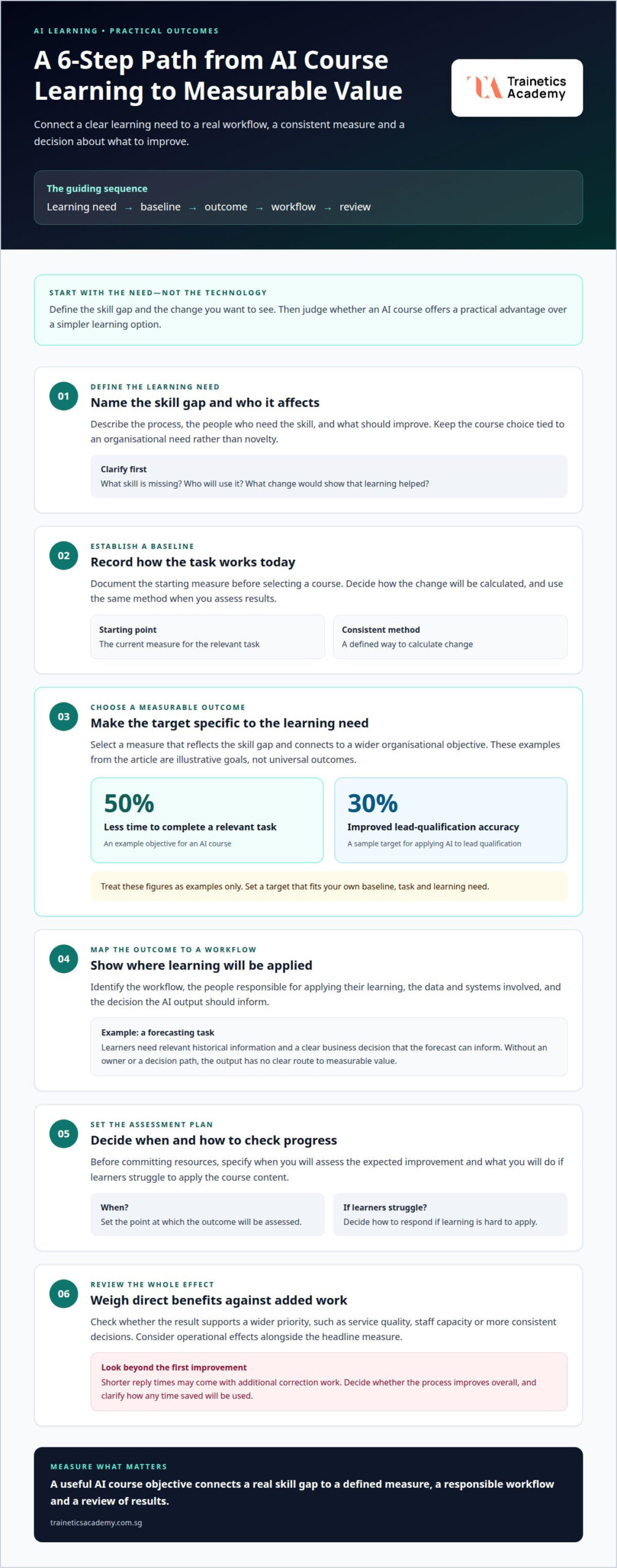
Start with the learning need, not the technology. A team might want to improve its use of AI, but “take an AI course” does not define a result. Specify the skill gap, who needs to address it, and what should improve. Then decide whether an AI course offers a practical advantage over a simpler learning option. This keeps course choices tied to organisational goals rather than novelty.
Translate the learning need into a measurable objective before selecting a course. For an AI course, one example is reducing the time needed to complete a relevant task by 50%. For applying AI to lead qualification, a sample target is improving accuracy by 30%. These are illustrative goals, not universal outcomes. Choose a measure that reflects the learning need, then document its starting baseline and the method used to calculate change.
A clear objective should also identify the affected workflow and the people responsible for applying their learning. If support staff handle incoming questions, measure response times in the same queue before and after AI course training. If sales teams review qualified leads, define what counts as an accurate qualification. Consistent definitions prevent teams from reporting progress against different criteria.
Set expectations about learning value before committing resources. Identify the expected improvement, when you will assess it, and what you will do if learners struggle to apply the course content. Consider direct benefits, such as shorter handling time, alongside operational effects, such as additional review work. An AI course that helps speed up replies but creates more correction tasks may not improve the process overall.
Connect the learning measure to the organisation’s wider priorities. An AI course may support service quality, staff capacity, or more consistent decisions. Make the link explicit: explain how the selected measure reflects that priority and who will act on the results. If the objective is to shorten response time, for example, clarify whether staff will use the time saved for complex cases or to handle more requests.
Before choosing an AI course, map its learning outcomes to the task. Identify the data learners need to understand, where it is stored, which systems the workflow uses, and how employees will apply AI outputs. A forecasting task requires relevant historical information and a clear business decision that forecasts can inform. If no one owns the output or it does not influence a decision, the course lacks a path to measurable value.
- Define the learning need: describe the process and the people affected.
- Set the baseline: record the current measure using a consistent method.
- Choose an outcome: connect one or more indicators to a strategic objective.
- Plan the review: set an assessment timeframe and a response to underperformance.
This sequence helps teams distinguish a useful AI course from an expensive experiment. Clearly defined learning outcomes give each course a purpose, a way to assess progress, and a basis for deciding whether to continue, adjust, or stop.
3. Managing expectations about AI capabilities
Treat AI as one tool in an organisation’s toolkit, not as the outcome of an AI course. An AI system can generate recommendations, classify information, or automate a defined task, but it still needs people and processes around it. AI courses can help learners understand how off-the-shelf tools may suit standard automation, generic document processing, customer-support chat, or basic forecasting. A specialised workflow may require more testing and human review.
Set realistic expectations before a demonstration becomes a promise. Claims such as “99% accuracy” or “50% cost reduction” need context, including the task, data, operating conditions, and measurement method. Replacing 30% of operations within a year is also a bold commitment, not a default planning assumption. A cautious 10-15% improvement can serve as an illustrative estimate under current assumptions, but teams should explain those assumptions clearly. AI courses can help learners assess such claims and understand the assumptions behind them.
Employees need to understand what will change in their work and what remains their responsibility. For example, a customer-support AI may suggest draft replies, while staff handle sensitive complaints and verify responses. An AI course can explain how the system works in practical terms, where it may make mistakes, and how employees can flag unreliable outputs. Without this understanding, uncertainty can weaken adoption even when the tool performs its assigned task.
Change management should involve the people who build, use, oversee, and fund the system. Executive leaders set priorities, IT teams manage integration, operational teams understand daily workflows, and legal or risk functions consider relevant controls. Bring these groups into planning early. Their input can reveal a mismatch between the technical design and the decisions employees actually need to make, helping shape relevant AI course content.
Training should be relevant to each role. In manufacturing, technicians using predictive-maintenance alerts need to interpret the signal, understand the equipment data, and know what action to take. In a financial institution, employees evaluating credit should learn how AI outputs complement, rather than replace, their judgement. These examples show why general awareness is not enough: AI courses need to provide task-specific practice and clear escalation routes.
- Explain the limits: identify where an AI output needs human review.
- Prepare users: practise realistic tasks, including handling incorrect or unclear results.
- Integrate feedback: give employees a way to report workflow problems and recurring errors.
- Align stakeholders: agree on roles, expected benefits, and what evidence will support a wider rollout.
A project can lose support if leaders expect immediate transformation while employees face extra work. A vendor demonstration followed by abandonment six months later illustrates the cost of separating excitement from operational preparation. AI courses can help set expectations in plain language and prepare people for their actual responsibilities. Review adoption alongside system performance.
4. Operational readiness versus model accuracy
AI courses can help teams assess readiness by mapping the workflow, tools, data access, staff responsibilities, and response to failures before starting. For example, confirm who reviews the AI model’s output, where it appears, and how employees will continue if the system fails.
A high laboratory score doesn’t guarantee a successful operation. A model might reach 99% accuracy in a controlled setting, yet prove difficult to integrate with daily tools. For production, a smoothly integrated model with 90% accuracy may be more useful than a 99%-accurate model that employees can’t operate. AI course learning can help teams assess performance in the real workflow, including response times, handoffs, and the effect of incorrect outputs.
AI courses can also help teams check technical and operational readiness together. Identify the systems the AI must connect to, who maintains those connections, and which team owns ongoing monitoring. Then test the entire process with representative tasks. A customer-service system, for instance, should be assessed from the moment a query arrives through employee review and the final response. This can reveal integration gaps that a model-only test would miss.
Data limitations do not always mean you need to build a model from scratch. If an organisation lacks data for a particular use case, it can consider a pre-trained AI model. AI course learning can help teams assess whether the model fits the task, available information, and operating environment. Validate its outputs against representative examples before employees rely on them. Keep a human review step where errors could affect customers or important decisions.
Production readiness also requires continuous monitoring. AI courses can teach teams how data, user behaviour, and business processes can change, causing model drift and weaker results. Establish real-time performance dashboards, drift alerts, scheduled retraining, and a named owner responsible for responding. Define what happens when an alert appears: investigate the affected inputs, assess recent outputs, and decide whether to adjust, retrain, or pause the model.
Testing should continue after launch. AI course learning can help teams validate the system against current tasks, monitor performance, and maintain clear accountability and fail-safes. For example, if a forecasting model starts producing results that conflict with current operating conditions, employees need a defined way to flag the issue. A designated team can review the evidence and determine what to do next.
- Map the workflow: identify users, tools, handoffs, and points requiring human review.
- Test the whole process: assess integration and output quality using realistic tasks.
- Prepare ongoing controls: assign monitoring ownership and establish drift alerts, retraining, and fail-safes.
Operational readiness turns model performance into useful work. AI courses can help teams measure accuracy alongside integration, employee use, monitoring, and recovery procedures. These capabilities support learning after deployment and help teams maintain performance as conditions change.
5. Iterative learning through AI courses
Build AI capability through structured learning and practical evidence, not a single launch decision. An AI course can help teams understand how to assess a tool in real use and apply their findings to the next stage. For example, a customer-service team could learn to test an AI tool on a defined query type before expanding its role. This approach helps learners spot workflow issues early and ground implementation decisions in actual results. Treating a pilot as a learning stage, rather than a miniature rollout, is a useful principle to explore in an AI course.
Choose AI courses that support a clear learning cycle. Learners can define a task and success measures, consider how to run a system in a controlled workflow, collect feedback, and decide what to adjust. If an algorithm repeatedly misclassifies a request, they can examine the examples and process behind the errors. Reviewing a relevant change and assessing whether the system performs better gives teams a practical basis for deciding what to refine next.
Look for AI courses that address the role of employees who use or oversee a process. They can identify confusing outputs, missing handoffs, and exceptions that a design team may overlook. Service staff, for instance, may find suggested replies helpful for routine queries but unsuitable for complaints. Course learning can help teams record this feedback, assign responsibility for reviewing it, and update a workflow before extending a system. These observations help show whether a change works in daily operations.
AI courses can also help teams define decision points before each expansion. Learners can review output quality, employee use, operational fit, and unresolved risks against project objectives. If results fall short, they can consider refining the use case, workflow, or model inputs. If the system meets agreed measures, teams can move to another process or team and repeat the evaluation. This makes each expansion an evidence-based decision, rather than an automatic next step.
When choosing an AI course, consider how its learning relates to project scope and total ownership needs, including infrastructure, staffing, governance, retraining, depreciation, and opportunity cost. Timelines depend on data readiness, integration, testing, and operational changes. A contained pilot and a complex organisation-wide deployment require different work, so course learning can help teams plan around these factors rather than assume a standard budget or schedule.
An AI course can help learners define a business problem, identify required data and workflow changes, and prepare people and safeguards. They can then pilot one process, measure performance, address findings, and expand only when the evidence supports it. For Singapore teams building this capability, an AI course can establish a shared foundation for informed implementation decisions. Trainetics Academy’s Artificial Intelligence Course is a learning option for developing that foundation.
- Keep learning focused: choose a process with a clear owner and observable results to explore in an AI course.
- Capture learning: record errors, exceptions, employee feedback, and corrective actions.
- Expand deliberately: use agreed evidence to decide whether to refine, pause, or extend the system.
Structured AI courses support sounder implementation decisions. Teams can use each pilot to build a practical understanding of where algorithms help, where review is needed, and what evidence should guide the next decision.
Trainetics Academy
Trainetics Academy is a practical next step for professionals who want a stronger foundation before applying AI at work. Its Artificial Intelligence Course introduces AI concepts and helps learners consider how they relate to business processes, data, and implementation decisions.
This learning is relevant when teams are evaluating use cases, preparing employees for new tools, or deciding how to assess AI outputs. A stronger understanding of the technology can help participants contribute more clearly to discussions about expectations, human oversight, and responsible adoption. It complements the practical steps in this guide, but does not replace project-specific planning or operational controls.
Contact Trainetics Academy to discuss learning about artificial intelligence.
Build AI course knowledge into your next decision
AI readiness is not a one-time milestone. As tools and business needs change, learners need the knowledge to assess new opportunities with sound judgement, ask precise questions, and understand where human responsibility remains essential. An AI course can help learners build that capability, making future AI decisions more deliberate, from choosing a suitable use case to deciding whether a system should expand.
The goal is not to adopt AI everywhere. It is to develop the confidence to recognise where AI can serve a real purpose and where another approach may be better. That judgement helps reduce the risk of a failed AI implementation while keeping technology connected to meaningful work.
For a structured way to strengthen your understanding of artificial intelligence, contact Trainetics Academy today. An AI course can help you build the knowledge to make thoughtful, well-grounded decisions as your needs evolve.
Frequently Asked Questions
What are the most common reasons AI implementations fail?
AI projects often falter when teams deploy a tool without a clear operational owner or a plan for exceptions. For example, an automated response system may produce a plausible but incorrect answer, while staff have no agreed way to correct it. Other warning signs include unresolved security risks, poor integration with daily work, and leadership expectations that exceed what the system can reliably deliver.
How should businesses choose an AI use case with measurable value and manageable risk?
Choose a contained task where success can be observed and mistakes reviewed before they affect customers. For example, an internal tool that drafts meeting summaries may be easier to assess than a system making consequential decisions. Compare potential value with the sensitivity of the information, the impact of errors, and the availability of human fallback. Start where the organisation can learn safely.
How can organisations evaluate AI vendors, models, and implementation partners?
Assess how well a proposed solution fits the actual task, not just how it performs in a presentation. Request a demonstration using representative scenarios, including unusual inputs and failure cases. Examine how the system handles data, explains outputs, integrates with existing tools, and supports human review. Clarify responsibilities for maintenance, incidents, and changes, as well as how the organisation can retrieve its data if the arrangement ends.
What data quality, privacy, and security checks are needed before deploying AI?
Trace sample records from their source through to the AI output, checking that each field is relevant, accurate, and used for its intended purpose. Remove unnecessary personal or confidential details from test prompts. Confirm access permissions, logging, encryption, retention practices, and data deletion procedures. Test whether users can see information outside their role. These checks can expose risks that a review of written policies alone may miss.
How can AI systems be tested, monitored, and governed after deployment?
Keep records of model versions, documented changes, test results, incidents, and decisions to pause or restore an earlier version. Review real outputs for recurring errors, not just average performance. For a document-classification system, sample mislabelled files and assess whether a new document type caused the problem. Assign an accountable owner to review findings and record corrective actions so governance remains active after launch.
How can organisations manage employee adoption, training, and resistance to AI?
Give employees a practical way to try the system and raise concerns before relying on it in live work. Use role-based exercises: a frontline employee might practise reviewing a generated reply, while a manager assesses when escalation is needed. Explain how feedback will be handled and which decisions remain with people. This makes training relevant to actual responsibilities and helps surface workflow concerns early.
What metrics can measure the ROI and success of an AI implementation?
Measure business outcomes alongside the work required to achieve them. A service team could track resolution quality and repeat contacts alongside response time, since faster replies alone may hide unresolved cases. Include operating costs such as staffing, infrastructure, governance, and retraining when assessing value. Compare results with a consistent pre-deployment baseline, and review employee use and error rates to understand whether the benefits are sustainable.
Disclaimer
AI Content Disclaimer: Some articles on this website may be generated or assisted by AI-powered content creation tools. While we strive for accuracy and relevance, readers should independently verify information before relying on it. The content is provided for informational purposes only and does not constitute professional advice.