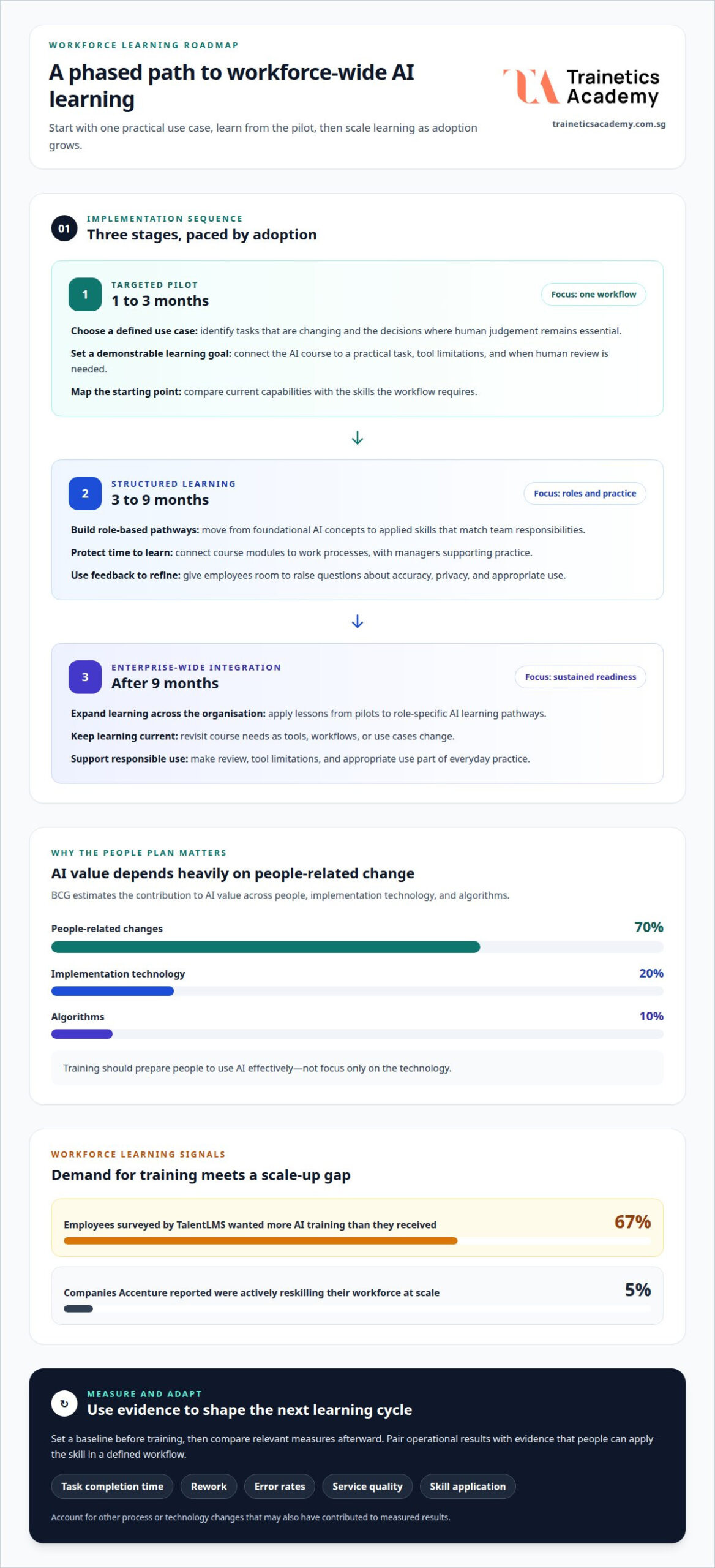
AI transformation calls for deliberate workforce preparation, and AI courses can help employees build relevant skills over time. Start with a targeted 1-to-3-month pilot, expand structured learning over 3-to-9 months, then begin enterprise-wide integration after 9 months.
It’s understandable to worry that automation could change roles faster than employees can adapt. AI courses can support a clear plan: identify the AI skills each role needs, explain how new tools may affect day-to-day work, and give people practical opportunities to learn.
This guide explains how to use AI courses to map current capabilities against future needs, communicate transparently, promote responsible AI use, and phase training to keep pace with adoption. Start with foundational skills, use pilot programmes to shape broader learning, and build organisation-wide readiness without assuming every employee has the same needs.
Key Takeaways
- Choose an AI course by identifying which tasks are changing and where human judgement remains essential.
- Set role-specific learning goals so learners can connect AI concepts to their daily work.
- Make space for learners to raise concerns and understand how AI may reshape their responsibilities.
- Build instructor participation and responsible-use practices into AI course delivery, not as afterthoughts.
- Use learner feedback to refine AI courses and guide their wider application.
1. AI courses and workforce skills
Choosing an AI course starts with the tasks you want to improve, rather than a generic course catalogue. Consider where AI could change tasks, decisions, or service delivery in your role. For example, a Singapore retailer might examine demand forecasting, customer enquiries, and stock planning separately. Each workflow calls for different skills, oversight, and collaboration. Mapping these tasks helps learners identify relevant course content and connect training to practical needs.
BCG estimates that people-related changes account for 70% of AI value, compared with 20% from implementation technology and 10% from algorithms. This highlights why AI courses should help learners prepare to use AI effectively, rather than focus only on technology. PwC’s CEO Survey found that, over the following three years, 47% of companies expected to integrate AI into technology platforms, 31% into workforce and skills, and 41% into core business processes. These figures can help learners understand the range of skills they may want to develop through training.
Before selecting a course, compare your current capabilities with the demands of the AI workflows relevant to your work. List the tasks you perform, the tools you may use, and the decisions that require human judgement. A data analyst adopting machine-learning tools may need skills in data preparation, model evaluation, and critical interpretation. A customer-service worker using AI-generated responses may need prompt skills, fact-checking, escalation judgement, and clear communication. These examples can help learners distinguish technical and analytical abilities from interpersonal skills.
Use a skills-gap analysis to identify which AI course best fits your learning needs. For each task, record your current proficiency, the capability required, and the learning method that can close the gap. Separate foundational AI literacy from applied skills, such as evaluating outputs or handling structured data. Then identify transferable strengths, including subject expertise and client communication. This helps learners recognise where existing experience remains valuable as processes change.
Consider both near-term and longer-term skills when choosing an AI course. Someone learning about automated document review may first need to assess output quality. Wider use of AI may also call for workflow design, data governance, and cross-team collaboration. Revisit your learning needs when the use case, process, or tool changes. This keeps course choices aligned with practical applications rather than assumptions about which roles will disappear.
How can learners measure the impact and ROI of AI training? Set a baseline before training, then compare relevant measures afterward, such as task completion time, rework, error rates, or service quality. Pair these operational measures with evidence of skill application, such as completing a defined workflow with appropriate review. Compare training costs with measured changes, while accounting for other process or technology changes that may have contributed. For additional guidance, explore AI for business process improvement through tools, KPIs and forecasts.
Include practical skills and readiness in your AI learning plan. Ask team leaders to identify changing tasks, workers to surface workflow challenges, and technical specialists to explain tool limitations. Use these discussions to prioritise training and understand where human review is needed for decisions with significant consequences. In Singapore, this role-based approach helps learners connect AI courses with their responsibilities, available skills, and service requirements.
2. Strategic workforce planning and learning and development
Small businesses can start with an AI course focused on one workflow, while large enterprises can use role-based AI learning pathways across teams. For example, a small firm could explore GenAI for drafting routine customer replies; a large organisation might create separate AI learning paths for analysts, managers, and customer-facing workers.
Start with a defined use case and a learning objective employees can demonstrate. An AI course for a marketing team might cover writing prompts, checking factual claims, and editing outputs to meet brand requirements. Keep the first experiment focused: employees should understand the task, the tool’s limitations, and when human review is needed. This makes AI learning a repeatable process rather than informal tool use.
Structured AI training matters. TalentLMS research found that 67% of employees surveyed wanted more AI training than they received. Accenture reported that only 5% of companies were actively reskilling their workforce at scale. These findings point to a gap between employees’ AI learning needs and organisational action. Assign protected learning time, connect each course module to a work process, and give managers a clear role in supporting practice.
Make AI learning continuous, not a one-off event. A structured course pathway can move from foundational AI concepts to role-specific application, then to refreshers as processes change. Future-built companies plan to upskill more than 50% of employees on AI, while AI laggards plan to upskill 20%. These figures suggest that workforce coverage is a strategic choice. Track participation and practical application to see whether AI learning reaches beyond a small group of specialists.
Online AI courses can fit more easily around work, especially when modules focus on specific abilities. A worker might complete a short lesson on prompt design, apply it to a real task, then discuss the result with a manager. Pair self-paced course content with guided practice and team collaboration. This supports independent thinking while giving employees a way to raise questions about accuracy, privacy, or appropriate use.
When choosing AI courses in Singapore, match course outcomes to employees’ roles and planned workplace processes. The practical question is whether a course builds abilities the organisation needs, such as interpreting AI outputs, improving a workflow, or using GenAI responsibly. Let learning relevance guide the choice of courses and the training strategy.
Plan a structured expansion over 3-to-9 months. Begin with foundational AI learning, gather feedback from participating workers, and adapt later course modules to their experience. This staged approach helps organisations develop talent while preserving time for experimentation and collaboration. Review learning goals when tools or work processes change, so the programme remains driven by real operational needs. For guidance on how to develop an internal AI training program, align learning objectives with business priorities and build practical, role-specific learning that can scale.
3. How AI courses support employees amid automation concerns
AI courses can help address automation concerns with direct answers, not silence. TalentLMS research found that 71% of employees surveyed wanted to better understand AI’s impact on their roles. Course discussions can explain which tasks may change, which decisions remain human-led, and how workers can contribute. For example, a service team could discuss whether AI drafts routine replies while employees handle complex or sensitive cases.
AI courses can also help employees prepare for job changes, which may involve displacement but also create opportunities to develop new capabilities. The McKinsey Global Institute estimates that as many as 375 million workers globally may need to switch occupational categories because of automation and AI adoption by 2030. This is a global estimate, not a prediction for a specific Singapore workplace. Use it in course discussions to prompt role-level planning, not to announce that a particular job will disappear.
Include employees in AI training and implementation before a digital tool becomes part of everyday work. Invite the people who perform a process to identify exceptions, test outputs, and flag tasks requiring human judgement. For example, payroll staff can review an AI-assisted process against unusual cases before wider use. Their feedback can surface practical issues a technology team might miss and give employees a meaningful role in shaping workplace changes.
AI courses can cover risks such as inaccurate outputs, unclear accountability, mishandled data, and unfair outcomes that can undermine trust. Teach clear boundaries for use, human review, transparent decisions, and responsible data handling. In PwC’s EMEA Workforce Hopes & Fears Survey, a quarter of respondents said their employer had not given them access to GenAI or they were unsure how to use the tools. Explain both access and safe use.
Protect learning time for AI courses as part of implementation instead of leaving employees to practise after hours. BCG research found that future-built companies are four times more likely than AI laggards to have structured AI-learning programmes and set aside protected time. A team could schedule sessions to practise established workflows, compare outputs, and discuss errors. Managers should take part and make questions a normal part of work.
Leaders should also use AI course discussions to communicate workforce plans with care. Globally, 17% of CEOs expected their organisations to decrease employee numbers in the following 12 months, but that figure does not establish what any Singapore employer will do. Explain changes using role-specific examples, describe learning opportunities, and invite employees to raise concerns through regular team discussions. Clear communication helps workers distinguish confirmed process changes from speculation.
Support from AI courses becomes credible when employees can see action. Set a review point after each AI pilot, share what changed, and explain how feedback shaped the next step. If a tool takes over routine document sorting, for instance, discuss whether affected employees can learn exception handling or quality review. Transparent decisions and protected learning give workers a clearer path through change.
4. Leadership and AI course learning
AI courses can help leaders and employees build the skills needed to use AI, evaluate its outputs, and apply human judgement. Leaders can turn course learning into clear responsibilities, practical opportunities to practise, and support for teams as AI tools are introduced into workflows.
Workforce attitudes can include optimism and uncertainty at the same time. In PwC’s EMEA Workforce Hopes & Fears Survey, 56% of workers surveyed believed GenAI would boost their efficiency. In the same survey, 70% felt optimistic that emerging technology would create opportunities to learn new skills. Leaders can use these findings as prompts to discuss how AI courses could support learning, not as assumptions about every Singapore employee.
Connect AI course learning to the work employees do. For each AI-enabled workflow, define who operates the tool, reviews its output, resolves exceptions, and owns the final decision. For example, if a finance team uses an AI agent to prepare routine report drafts, analysts may shift towards validation and interpretation. AI courses can help employees build relevant skills, alongside clear role expectations and learning paths.
AI agents may also change how work moves between people and systems. Use AI courses to help learners map a current process, identify where an agent may act, and specify when a person must intervene. In an invoice workflow, the agent might sort documents while an employee handles discrepancies and supplier questions. This clarifies handoffs, accountability, and the capabilities each role needs to develop.
Leadership behaviour shapes whether employees embrace new ways of working. BCG research found that 88% of managers at future-built companies role-model AI use and incorporate it into decisions and daily operations. At AI laggards, the figure was 25%. Managers can demonstrate appropriate use in team discussions, explain their review process, and openly correct errors. AI courses can give leaders and teams a shared foundation for putting these practices into action.
Choose AI courses that connect learning to practical application. TalentLMS research found that 64% of 309 HR managers surveyed said AI was changing in-demand skills; 63% felt upskilling would matter for their organisations, and 62% said the same about reskilling. These findings support planning AI course learning for both deeper skills in existing roles and preparation for different responsibilities.
Accenture reported that 94% of people were willing to learn new skills to work with AI. Leadership can turn that willingness into a structured learning plan: explain role changes, provide time for AI courses, and define how new capabilities will be recognised. Review responsibilities after each workflow change, then adjust course content and support. This gives employees a clearer route from current work to emerging opportunities.
5. Phased implementation of AI-course learning
A phased AI-course learning plan connects lessons to real adoption, rather than treating learning as a launch-day event. Start with a 1-to-3-month period for targeted piloting. Select one AI use case, define its users, and choose an AI course for the employees directly involved. For example, a team could pilot AI-assisted document summaries, then review accuracy, time saved, and human oversight needs before expanding.
During the pilot, establish a baseline and a review routine. Record how the task works before AI, then compare the same measures during use. Track output quality, rework, completion time, and employee feedback. These measures help leaders decide whether the tool and AI-course learning suit the task. If workers struggle to identify unsupported claims, add verification practice to the course before expanding the pilot.
Use the next 3-to-9-month period for structured expansion. Build AI-course learning around roles and workflows, rather than giving every employee identical exercises. A pilot team can share lessons with related departments, while managers adapt course examples to their processes. Include foundational AI understanding, applied practice, and responsible-use guidance. This creates a consistent learning culture while allowing teams to address different operational challenges.
At each expansion stage, assign clear ownership. Managers can schedule learning time, process owners can update workflows, and employees can report recurring errors or useful applications. Review those inputs before adding another use case or course module. For instance, if an AI assistant drafts internal summaries, teams should agree who checks sensitive details and how corrections inform future practice. These steps make AI-course learning measurable and strengthen human oversight.
Begin enterprise integration after 9 months, using pilot evidence to guide wider deployment of AI courses. This stage connects course plans across departments and embeds learning into onboarding, role development, and workflow updates. Keep a central record of use cases, capability needs, and review responsibilities. Local teams can then adapt course examples without losing shared standards for quality, privacy, and accountability.
Sequence matters: pilot, refine, expand, then integrate. Moving too quickly can spread weak practices, while waiting for perfect certainty can stall useful learning. Use decision gates between phases, based on demonstrated task performance, employee readiness, and responsible use. The goal is not simply to introduce artificial intelligence, but to use AI courses to develop a workforce able to apply it with sound judgement.
For employees building foundational knowledge alongside workplace learning, practical AI courses can help develop confidence with AI concepts and applications.
BCG’s case work involving hundreds of companies found about 10% of AI value comes from algorithms, 20% from implementation technology and 70% from rethinking the people component. Ensure fairness, transparency, responsible data handling and prioritise data privacy.
Trainetics Academy
Trainetics Academy offers an Artificial Intelligence Course for professionals building foundational knowledge as workplace AI adoption develops. It can help employees understand AI concepts before applying role-specific learning within their organisation. Leaders can consider it alongside internal plans for workflow training, employee participation, and responsible use. The course is most relevant when individuals or teams need structured AI learning to complement a phased transformation, rather than replace organisation-specific change management. Align course learning with employees’ tasks and the capabilities their roles require. To discuss your AI learning needs, contact Trainetics Academy.
Choose your next AI course
Choose an AI course that supports your learning goals. Identify the AI skills you want to strengthen first, then match them to a practical course. A clear starting point helps you build your knowledge at a pace that suits your needs.
Taking an AI course is an investment in your ability to contribute as AI changes the way we work. Treat learning as part of your professional development, not a response reserved for moments of disruption. Steady learning helps you make informed decisions about how AI fits your role.
For individuals or teams seeking structured learning in artificial intelligence, take the next step at a pace that suits your goals. Contact Trainetics Academy to discuss AI courses and explore a focused path towards stronger AI capability.
Frequently Asked Questions
Which AI skills should employees in Singapore develop?
Employees in Singapore should build AI literacy, prompt design, output checking, data awareness, and sound judgement. Priorities depend on the work: a coordinator may need to summarise and verify text, while an analyst may need to interpret model outputs and recognise data limitations. Communication matters too. Workers should be able to explain AI-assisted recommendations clearly and escalate uncertain results instead of treating generated content as fact.
What are the best AI training programmes for Singapore businesses and workers?
Choose a programme based on the capability employees need to demonstrate, not a broad “AI” label. Foundational learning can introduce core concepts and practical tool use; teams can then add supervised exercises based on realistic work tasks. Trainetics Academy offers an Artificial Intelligence Course. For workplace adoption, combine course learning with internal practice so employees can apply new concepts to their processes.
How can employers assess workforce AI skills gaps and prioritize training?
Assess gaps through a short, role-based task rather than relying only on self-ratings. For example, ask employees to review an AI-generated draft, identify unsupported claims, and explain what information should remain private. Use a simple rubric covering tool use, accuracy checks, domain judgement, and escalation. Prioritise roles with frequent AI interaction or consequential decisions, then focus learning on the weakest demonstrated capability.
What are effective steps for implementing an AI upskilling programme at work?
Set a named owner, a defined use case, and a learning outcome before rollout. Give a small employee group guided practice, then use their questions and reported errors to improve instructions. Explain what the tool may assist with, which tasks need human review, and how employees can raise concerns. After launch, managers can review actual use and output quality, then refresh training as workflows or tools change.
Disclaimer
AI Content Disclaimer: Some articles on this website may be generated or assisted by AI-powered content creation tools. While we strive for accuracy and relevance, readers should independently verify information before relying on it. The content is provided for informational purposes only and does not constitute professional advice.