The strongest skill set for 2026 is not AI alone; it combines practical AI use with data analysis, privacy awareness and clear collaboration. If you’re deciding what skills to learn in Singapore in 2026, prioritise using generative AI effectively, checking data and AI outputs, handling personal information responsibly, and communicating your reasoning.
Focusing on AI makes sense: it is changing how people approach tasks across many kinds of work. But knowing how to use a tool is only part of being effective. You also need to judge whether its output is reliable, protect sensitive information and work well with colleagues who have different levels of technical knowledge.
This guide explains how these skills fit together, how to apply them in different professional roles, and where to begin if you are new to AI. You will also see why prompt writing is most valuable when paired with sound judgement, data skills and responsible information handling, helping you build capabilities for everyday work.
Key Takeaways
- Build confidence analysing data with AI through course-based practice, and validate outputs before using them to guide decisions.
- Learn privacy and governance principles in an AI course so you can handle personal information responsibly at work.
- Strengthen communication skills through AI course activities that help you explain AI-assisted insights and collaborate across teams.
- Practise writing clear prompts with context, goals and constraints, then review AI responses critically.
- Choose an AI course that develops role-specific skills for everyday tasks, so you can apply what you learn with a practical purpose.
1. AI-assisted data analysis and validation
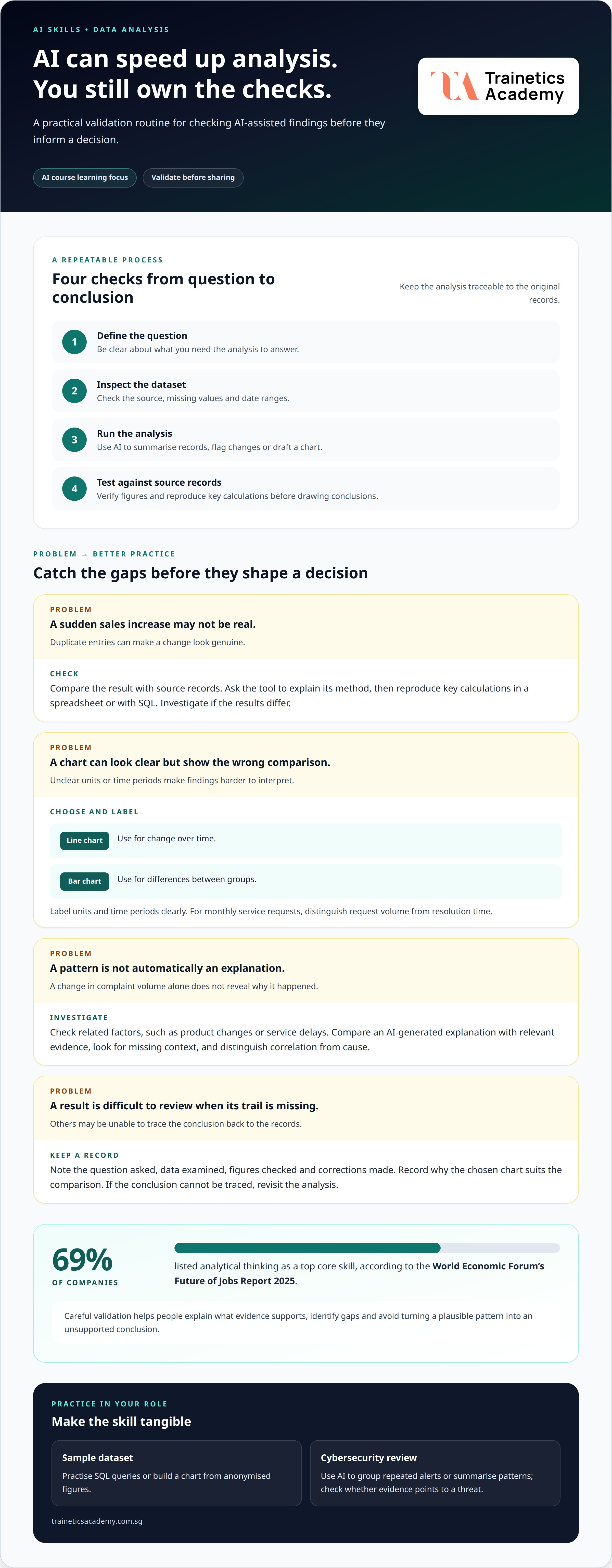
AI can speed up data analysis, but the analyst remains responsible for checking the work. In an AI course, learners might use a tool to summarise sales records, flag unusual changes or draft a chart. Before sharing the result, verify the underlying figures. Check the data source, missing values and date ranges, and confirm that the summary matches the original records.
Use a repeatable validation process when learning to analyse data with AI: define the question, inspect the dataset, run the analysis, then test the output against source records. A sudden sales increase, for example, could reflect a genuine change or duplicate entries. Ask the tool to explain its method, then reproduce key calculations in a spreadsheet or with SQL. If the results differ, investigate before drawing conclusions.
AI course content on data analytics and visualisation can help learners interpret findings. Choose a chart that suits the comparison: a line chart for change over time, or a bar chart for differences between groups. Label units and time periods clearly. A chart of monthly service requests, for example, should distinguish request volume from resolution time.
For cybersecurity analysts, AI course exercises in data analysis can support the review of access logs, alerts and unusual network activity. AI can help group repeated alerts or summarise patterns, while the analyst checks whether the evidence points to a threat. Coding fundamentals, such as reading a simple Python script or writing a SQL query, help analysts examine records and understand how results were produced.
AI courses can also develop analytical thinking by teaching learners to test assumptions. Compare an AI-generated explanation with the relevant evidence, look for missing context, and distinguish correlation from cause. In a role involving customer data, for example, a change in complaint volume alone does not explain why it happened. Check related factors, such as product changes or service delays, before recommending action.
Salary expectations for in-demand roles in Singapore vary by job scope, experience, sector and technical depth. Compare equivalent roles, such as data analyst and cybersecurity analyst, rather than treating analytics skills as a single salary category.
Singapore residents can explore AI courses that teach data analysis and digital skills. The Introduction AI Course is eligible for SkillsFuture Credits and UTAP funding.
To learn while working, choose a task from your current role and practise a relevant skill on it. For example, use a sample dataset to practise SQL queries, or build a chart from anonymised figures. Set a regular study block and apply each technique to a work problem when appropriate.
The World Economic Forum’s Future of Jobs Report 2025 says 69% of companies listed analytical thinking as a top core skill. That emphasis makes careful validation useful beyond specialist analytics work: it helps people explain what the evidence supports, identify gaps, and avoid turning a plausible pattern into an unsupported conclusion.
When using an AI-generated chart or summary, keep a record of the question asked, the data examined and any corrections made. Note which figures you checked and why the chosen view suits the comparison. If another person cannot trace the conclusion back to the records, revisit the analysis before using it to guide a decision. This habit makes AI assistance easier to review while keeping judgement with the analyst.
2. AI governance, ethics and data privacy
Using AI responsibly starts with knowing what information enters a tool and why, an important topic covered in AI courses. Singapore’s PDPA is the Personal Data Protection Act 2012, according to Attorney-General’s Chambers of Singapore. In practical AI course exercises, learners can explore a workplace example: before using an AI system to summarise customer feedback, a team should check whether its files contain names, email addresses, or other sensitive details.
AI courses can teach learners to build a simple review process around each AI task. First, define the intended use, such as drafting a summary of customer comments. Next, identify the data involved and remove details that are not needed for that purpose. Then assess the output before sharing or acting on it. Practising this sequence helps employees make privacy and accountability part of their everyday workflow.
Governance also means documenting decisions, a process learners can practise in an AI course. Record the task, data category, tool used and reviewer. For example, a human resources team using AI to organise application materials should set a clear purpose and check summaries for errors or unfair assumptions. These records help employers understand how a decision was reached and where human judgement remains essential.
AI course exercises can show that ethical review involves more than checking whether an answer sounds convincing. Test whether the output treats comparable cases consistently, omits relevant context or relies on assumptions unsupported by the input. If an AI summary describes two customer complaints differently, compare both summaries with the original text. Correct unsupported conclusions before they influence a decision.
Singapore’s Model AI Governance Framework for Generative AI was released on 30 May 2024. Its existence makes AI governance a practical learning topic for teams adopting generative tools and for learners taking AI courses. Learners can practise checking intended use, data exposure, output quality, and human oversight. These checks help turn broad ethical principles into repeatable actions during everyday work.
Privacy awareness should also shape how teams collaborate, and AI courses can help learners practise this approach. Share only the information colleagues need for a task, and use anonymised examples for practice where possible. For instance, a training exercise can use fictional customer records instead of real names. Clear access boundaries and careful handling reduce unnecessary exposure while preserving the learning objective.
As an AI course exercise, map one AI-assisted task in your role. Note its purpose, inputs, likely risks, reviewer and final decision-maker. Then revise the process when the tool or task changes. A concise checklist helps teams apply consistent standards to recurring work without treating every AI output as reliable by default.
3. Communication and workplace collaboration
SkillsFuture Singapore’s report on skills demand for the future economy highlighted communication as a core critical skill. In an AI course, learners can practise explaining what an AI tool produced, what evidence supports it and which decisions still need human judgement. A clear explanation helps colleagues use an AI-assisted result appropriately.
Start with the audience’s needs. A manager may need the decision and its key evidence, while a technical colleague may need assumptions and limitations. In an AI course exercise, learners could present a customer-service summary by stating the main pattern, the records reviewed and the next action. This structure keeps a report focused without hiding important context.
Listening matters as much as presenting. During an AI course project discussion, clarify what a colleague needs before proposing an AI solution. If a finance team wants to speed up invoice review, confirm whether its main concern is duplicate entries, missing fields or reporting delays. That distinction helps learners define a useful AI task.
Written communication should make AI-supported work traceable. In a shared AI course project note, distinguish source information from generated suggestions, then identify who will review the final version. For example, label an AI-drafted customer response as a draft until a learner checks its tone, accuracy and relevance.
Collaboration improves when roles are clear. An AI course project team might assign one person to define the business problem, another to assess the output and a decision-maker to approve the next step. These responsibilities reduce confusion when an AI-generated recommendation conflicts with a colleague’s experience or source records.
Disagreement can reveal useful gaps. If a marketing colleague reads a trend differently from an analyst during an AI course exercise, compare the definitions, time periods and evidence behind both interpretations. Ask each person to explain their reasoning before agreeing on a conclusion. This approach turns discussion into a quality check, not a contest.
Practise these habits in AI course activities based on routine workplace tasks. Before a project meeting, prepare a short summary of the objective, supporting evidence and decision required. During the discussion, invite questions and record agreed actions. Afterward, send a concise follow-up naming each owner and deliverable, so the team can act on the decision.
AI courses can help learners practise applying AI concepts to workplace communication, from framing a task to reviewing generated material. A structured Artificial Intelligence Course can suit workers who want guided learning alongside practical collaboration skills.
These AI course learning habits also help teams respond to urgent capability needs. In major industries including IT, healthcare, logistics, communications, consumer services, financials and real estate, around 70-90% of skill gaps need to be addressed immediately. Learners can use regular project check-ins to identify where communication breaks down, whether in defining a request, interpreting an output, or handing work to another person. A shared vocabulary makes those gaps easier to address.
When learners explain what they know and what they still need to verify, others can contribute more effectively. AI course activities can make space for questions, clarify unfamiliar terms and share useful examples from everyday tasks. These practices support trust and help people learn from one another while keeping responsibility for decisions clear. Over time, open communication can make collaboration on AI-supported work more consistent and effective.
4. Generative AI and prompt engineering
Generative AI skills matter across Singapore’s job market, not only for software developers. About 82% of AI-related job postings in Singapore were for AI user roles in 2025. AI-related roles made up 5.3% of job postings that year, up from 3.3% in 2024. These figures point to practical learning outcomes for an AI course: using AI tools effectively within an existing sector.
In an AI course, prompt engineering starts with a defined task. State the role the tool should take, the purpose, relevant context and the format you need. For example, ask it to turn meeting notes into a client update with sections for decisions, open questions and next steps. Then refine the prompt if the result misses an important detail.
Useful prompts set boundaries. As an AI course exercise, a retail worker could request product descriptions in a consistent tone while specifying the audience and approved product information. A finance employee might ask for a plain-language explanation of a report and instruct the tool to use only the supplied figures. Clear limits reduce irrelevant output and make review more focused.
Build a short revision cycle, a practical skill to develop through AI course activities. First, check whether the response answers the task. Next, identify missing facts, unsupported statements or unsuitable wording. Then add precise instructions and run the prompt again. For example, if a draft email invents a delivery date, remove the claim and request a version based only on confirmed details.
Prompt quality also depends on context. Instead of writing “summarise this,” specify the reader, the document’s purpose and the desired length or structure. A human resources employee could request a neutral summary of a policy draft for new staff, with unfamiliar terms explained. Reviewing the response against the original is an important AI course learning outcome before sharing it.
Choose a tool to suit the work. Generative AI can help draft, summarise, classify or brainstorm, but each task needs different instructions and review criteria. For brainstorming, variety may matter most. For a customer-facing message, accuracy, tone and consistency carry more weight. Define success before prompting so you have a clear basis for evaluation, a useful practice in an AI course.
Use AI output as a working draft, not an automatic decision. A Singapore job posting may seek AI skills for user tasks without requiring model development. That makes practical fluency useful: describe the task, provide relevant context, improve the prompt, and assess the answer. Advertised pay premiums for roles requiring AI skills started at 32% and reached 107% in Government and Public Sector roles. An AI course can help learners practise these skills in relevant workplace tasks.
Develop these habits through repeatable practice. Choose a routine task, write a prompt, compare the response with your intended result and record which instruction improved it. A customer-service worker can assess a response draft against tone and accuracy criteria. This kind of structured practice in an AI course builds prompt judgement that transfers across tools and workplace tasks.
5. AI skills by professional role
AI courses can help Singapore learners build skills for AI-related tasks in their roles. Workers choosing what to learn in 2026 can start with a recurring work challenge: a finance analyst may need to interpret forecasts, while a healthcare administrator could use AI to organise routine information. An AI course can provide structured practice with these role-specific applications.
In finance, an AI course can help learners practise interpreting spreadsheet data and checking AI-generated summaries against source figures. A finance professional preparing a performance briefing, for example, can learn to use AI to draft an explanation, then confirm each claim against the underlying records. Course exercises can also help learners distinguish a useful summary from a recommendation that needs further analysis.
Technology roles may call for greater technical depth. AI courses can help learners build familiarity with SQL queries, data workflows and testing AI-generated code. An employee supporting an internal chatbot could practise comparing its answers with company reference material and identifying questions that need a human response. This combines technical understanding with careful evaluation.
For healthcare administration, an AI course can help learners practise clear information handling and accurate communication. An administrator might use AI to draft a plain-language explanation of an appointment process, then compare it with the source instructions. Course activities can develop context awareness, error detection and sound judgement about which decisions remain with people.
Manufacturing workers can use AI course content to connect AI skills with production information. A planner might review maintenance records or inventory patterns, then discuss possible implications with staff who understand the process. Learning about data literacy can help identify unusual results; operational knowledge helps determine whether a pattern calls for action or further investigation.
Across Singapore industries, AI courses can help learners choose skills based on the problems they need to solve. In logistics, an employee might organise shipment information; in communications, a colleague might use AI to prepare a first draft. Both roles benefit from course practice in defining tasks clearly and checking whether outputs serve their intended purpose.
AI course exercises can also help professionals practise explaining how they reached a recommendation. A finance worker can show which records informed a briefing, while a production planner can describe the operational context behind a proposed schedule. In each case, domain knowledge helps connect AI use with responsible workplace decisions.
A practical way to choose AI course content for work in Singapore in 2026 is to identify a recurring task and the capability that could improve it. Set a focused learning objective, such as interpreting a dataset, reviewing AI-generated material, or explaining a finding to colleagues. Practise with a relevant example, then assess whether the skill supports a clear work outcome.
Trainetics Academy
Trainetics Academy offers an Artificial Intelligence Course for learners who want structured AI learning. It can be a useful next step once you have identified a workplace task where AI skills could support your role and want to build a foundation before applying them.
Use the course to develop your understanding of artificial intelligence, then connect that knowledge to the work you do. For example, consider how AI could assist with drafting, summarising, or organising information, and where human review remains important. Explore the Artificial Intelligence Course to see how it fits your learning goals.
To take the next step in your AI learning, contact Trainetics Academy.
Turn Your AI Course Learning into Practice
Choose an AI course based on the work you want to do, then connect what you learn to a task you can practise. If you’re considering an AI course in Singapore in 2026, focus on course content that supports your career direction and build from there. A clear learning goal makes it easier to identify what you need to understand, practise, and apply.
Start small: choose a workplace challenge, define what better performance would look like and set aside time to apply what you learn in an AI course. Review your progress through a practical outcome, such as a clearer report, a more efficient workflow or a well-reasoned recommendation. Consistent practice can help you apply AI course learning at work.
If structured AI learning would help you take that next step, contact Trainetics Academy to explore training. Choose an AI course that fits your goals, practise with purpose, and apply what you learn to the work you want to do.
Frequently Asked Questions
What skills are most in demand in Singapore in 2026?
AI fluency, analytical thinking, data literacy, privacy awareness, and communication are useful priorities for Singapore workers. The World Economic Forum’s Future of Jobs Report 2025 identified analytical thinking among sought-after core skills. To make that capability practical, practise evaluating an AI-generated recommendation against the evidence behind it. Then explain what the evidence supports, what remains uncertain, and what action the result can inform.
What technical and human skills do Singapore employers value most in 2026?
Technical skills include using AI tools effectively and interpreting data; human skills include analytical thinking and communication. SkillsFuture Singapore’s report on skills demand for the future economy highlighted communication as a core critical skill. For example, a project analyst can pair a clear chart with a concise briefing that explains the decision needed. That combination helps colleagues understand both the technical finding and its practical significance.
Which SkillsFuture courses and subsidies can Singapore residents use to learn in-demand skills?
Singapore residents can look for SkillsFuture courses in AI, data analytics and digital skills. Singaporeans and permanent residents may receive subsidies of up to 70% on course fees; eligible Singapore Citizens aged 40 and above may qualify for up to 90% coverage through the Mid-Career Enhanced Subsidy for eligible programmes.
Disclaimer
AI Content Disclaimer: Some articles on this website may be generated or assisted by AI-powered content creation tools. While we strive for accuracy and relevance, readers should independently verify information before relying on it. The content is provided for informational purposes only and does not constitute professional advice.