AI courses can help professionals understand how enterprise adoption is changing. Learning about agentic AI offers insight into how people, systems and safeguards work together. The most important trends point to a shift from standalone assistants to agents that coordinate tasks, retain conversational context and act within clear boundaries.
It’s natural to focus first on what these systems can automate. But for Singapore organisations, practical adoption also depends on how agents connect to business tools, when people review their decisions and which models suit each task. AI course learning can help teams assess these choices carefully instead of treating autonomy as an end in itself.
This article explains how multiagent systems work in enterprise settings and how context-aware conversations, human oversight and model selection are shaping adoption. It offers a structured view of the changes to watch, the decisions they raise and how AI courses can help professionals engage with these trends confidently.
Key Takeaways
- Learn in an AI course how task-specific agents coordinate across enterprise workflows, and why clear roles and communication matter.
- Explore how specialized agents can adapt AI to the needs of distinct industries and business functions.
- Study how conversational context helps agents deliver responses that better reflect users’ needs and earlier interactions.
- Compare model choices by weighing task requirements, control and the trade-offs between open-source and proprietary options.
- Examine where AI adoption is emerging in Singapore and worldwide, and how responsible human oversight contributes.
How do multiagent systems work in enterprise environments?
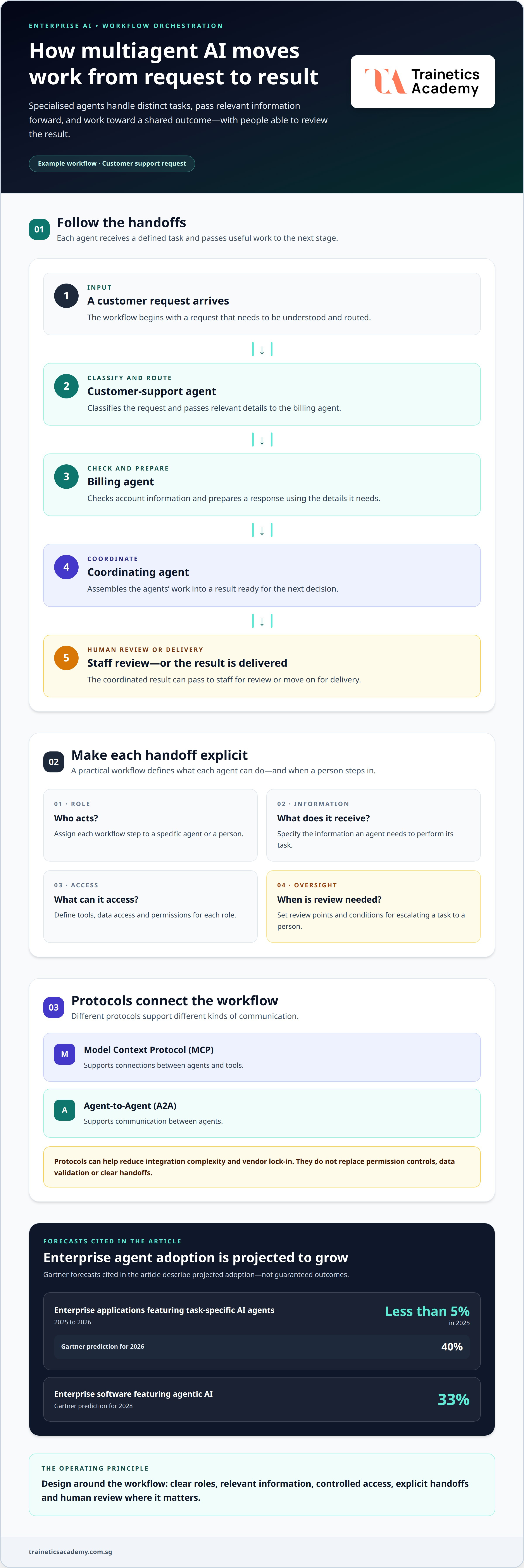
A multiagent system assigns distinct tasks to specialised AI agents and coordinates their work towards a shared outcome. In an AI course, learners can explore how an enterprise workflow might use a data engineering agent to prepare information while a data science agent builds a predictive model. Studying orchestration helps learners understand which agent acts, what information it receives and when its output passes to another agent.
Dividing the work matters because one agent rarely needs every tool or piece of information. A customer-support agent, for example, can classify a request and pass relevant details to a billing agent. That agent checks account information and prepares a response. A coordinating agent can then assemble the result for staff review or delivery. Learning to map these roles is a practical outcome of AI courses for beginners studying multiagent systems.
Communication protocols help agents exchange instructions and results across systems. The Model Context Protocol (MCP) supports connections between agents and tools, while Agent-to-Agent (A2A) supports communication between agents. In an AI course, examining these protocols can help learners understand how standardisation may reduce integration complexity and help prevent vendor lock-in. Protocols don’t remove the need to control permissions, validate data or define clear handoffs.
Gartner predicted that 40% of enterprise applications would feature task-specific AI agents by 2026, up from less than 5% in 2025. Gartner also predicted that 33% of enterprise software would feature agentic AI by 2028. These forecasts point to expanding automation, but successful transformation depends on workflow design. AI course learners can practise defining each agent’s role, the data it can access, and the conditions for escalating a task.
How much does it cost to build and deploy agentic AI systems? The cost depends on the number of agents, model choices, data preparation, integrations, security controls and ongoing evaluation. An AI course can help learners assess how a workflow that connects existing tools differs from one involving several specialised agents and complex data.
What are the latest market size and growth forecasts for agentic AI? Gartner’s forecasts describe adoption across enterprise applications and software, rather than a dollar-denominated market size. The figures of 40% by 2026 and 33% by 2028 indicate projected expansion in enterprise use. These figures can provide context for learners exploring multiagent systems in an AI course.
What skills and jobs are emerging as agentic AI adoption grows? Multiagent workflows increase the need for people who can map processes, prepare data, coordinate integrations and evaluate model outputs. Data engineering and data science skills, for instance, support the preparation and modelling stages. AI courses can help learners build these skills, while governance and security expertise helps teams set access controls and review agent actions.
To assess a proposed workflow, map each step from input to outcome. Assign each step to an agent or a person, specify the information and permissions required, then set review points for consequential actions. Practising this process in an AI course helps learners make orchestration measurable and identify where human judgement remains essential.
What are the top 15 agentic AI trends to watch in 2026?
In 2026, enterprise adoption is moving from broad AI experiments towards more specialised applications. Capgemini reports that approximately 80% of surveyed organisations plan to integrate AI agents within one to three years. The trend to watch is not simply greater automation. It’s the growing ability to apply agents to defined industry tasks, with suitable oversight and frameworks, topics learners can explore in an AI course.
Vertical agents are designed around the language, data and workflows of a particular field. For Singapore organisations, that may mean adapting an agent to local business processes rather than expecting a general-purpose assistant to handle every task. An AI course can help learners understand these applications and the considerations involved. The following 15 developments show where adoption is taking shape and what each could mean in practice.
- Industry-specific agents: An AI course can show how a finance agent supports a defined financial workflow, while staff retain responsibility for consequential decisions.
- Medical imaging support: Learners can examine how NVIDIA and GE HealthCare are working together on agentic robotic systems for X-ray and ultrasound imaging.
- Financial actions: AI courses can explore how financial institutions and technology companies are developing agents for financial tasks, placing control and review at the centre.
- E-commerce workflows: An AI course can cover how agents support product discovery or service requests; 20% of e-commerce tasks were expected to be handled by agents in 2025.
- Personalised customer interactions: Learners can study Gartner’s projection that 60% of brands will use agentic AI for one-to-one interactions at scale by 2028.
- Independent service resolution: AI courses can discuss Gartner’s prediction that 80% of customer service problems will be solved independently by 2029.
- Task-specific systems: An AI course can teach how organisations shape an agent around a narrow business process instead of asking one system to serve every department.
- Human-reviewed decisions: Learners can consider how a claims workflow routes unusual cases to a person rather than letting an agent complete every action.
- Specialised data operations: An AI course can cover how an agent profiles and prepares information from different sources before analysts use it.
- Predictive maintenance: Learners can explore how a manufacturing workflow uses equipment data to flag maintenance needs for technicians.
- Context-aware service: AI courses can explain how a support agent uses earlier conversation details to make its next response more relevant.
- Smaller task-focused models: An AI course can show how teams match a compact model to routine classification instead of using a frontier model for every query.
- Model choice by task: Learners can study how an organisation selects different models for summarising, reasoning or specialised analysis.
- Security-led deployment: AI courses can cover how role-based access controls restrict which systems and information an agent can use.
- Measured adoption: An AI course can explain how teams evaluate each agent against workflow outcomes before expanding its role across the organisation.
These trends respond to practical industry needs, not autonomy alone. An AI course can help learners understand why a healthcare workflow may prioritise imaging support, while a retailer may focus on customer interactions. Matching an agent’s capabilities to a specific task helps organisations make purposeful adoption decisions. Define the intended outcome, assign appropriate human review and assess results within the relevant business framework.
Context-aware conversational agents
In an AI course, learners can explore how a conversational agent interprets a current request alongside relevant earlier information. For example, a service agent handling a delivery query can use the customer’s previous message and order details instead of asking for them again. Context gives a response continuity, but it does not mean the system should retain or use every detail indefinitely.
AI courses can also help learners understand how personalisation may influence business outcomes. Salesforce data cited in the research shows that AI-driven personalisation increases customer engagement by 40% and conversion rates by 25-35%. These figures describe reported effects of personalisation, not guaranteed results for every organisation. A retailer, for instance, could tailor product suggestions using the customer’s stated preferences and current browsing context.
Two techniques help agents use information effectively. A context window holds the text and details available during an interaction. Retrieval-augmented generation, or RAG, retrieves relevant material from a connected knowledge base before the agent responds. In an AI course, learners can practise applying these techniques: a policy-support agent might retrieve the current policy passage and explain it in light of an employee’s question.
Context engineering is the deliberate design of the information an agent receives. In an AI course, learners can practise defining which conversation history matters, which records the system may retrieve and how the agent should handle missing or conflicting details. In a Singapore customer-service workflow, that could mean providing the current request and relevant account information while excluding unrelated records. Clear context helps the agent focus on the task instead of treating all available data as equally relevant.
A practical design sequence has three steps. First, identify the user’s task and the facts needed to complete it. Second, specify trusted sources and retrieval rules. Third, test the agent with examples involving incomplete requests, corrections and changes of intent. These steps are useful learning outcomes for an AI course. A customer who asks about a refund, then clarifies the purchase date, tests whether the conversation system can update its understanding.
Scaling across industries requires different context boundaries. A retailer may use product and service details; a healthcare organisation may need carefully controlled access to relevant case information. In an AI course, learners can examine how retrieval permissions can be kept separate from conversational instructions so that a fluent answer cannot expose information the agent should not use.
Autonomous responses also need clear limits. An agent can summarise retrieved information and draft a next step, while a person reviews sensitive or consequential actions. For example, a service agent might prepare a response but route an unusual account change to staff for review. This gives AI course learners a practical example of balancing conversational speed with organisational controls.
Evaluate context-aware systems against task-specific measures: whether an answer reflects the latest user correction, uses relevant source material and avoids unnecessary repetition. Testing realistic conversations can reveal where context retrieval or instructions need refinement before the system expands into other workflows, an important skill for learners applying AI course concepts.
Open-source versus proprietary models
Choosing models for agentic systems means matching capability, control and deployment needs. AI courses can teach learners how to assess these factors and select models for different tasks. Open-source models can offer greater flexibility to teams that want to inspect, adapt or host model components. Proprietary models are typically accessed through a provider’s platform, which can simplify access and managed operations. The right choice depends on the task and the organisation’s technical capacity.
“Open source” can describe different levels of access. Some model releases provide weights for local deployment, while others also share code or training details. Licences set the conditions for use and modification. In an AI course, learners can practise assessing licences and deployment requirements before building a workflow around a model.
Proprietary models may suit tasks that require advanced reasoning or managed platform features. For example, an enterprise could use one to interpret complex requests, then send routine classification to a smaller model. This can balance capability with operational demands, rather than assigning every task to the same model. Learning to make these trade-offs is a practical outcome of studying model selection in an AI course.
Small language models are another important option. IBM Institute for Business Value research found that 72% of executives expect small language models to surpass large language models. Smaller models can handle simple tasks while reducing energy consumption and compute costs compared with using a massive frontier model for every query. This makes task selection an important part of AI course lessons on deployment decisions.
A useful model strategy starts with the workflow. First, define the task, such as extracting fields from a standard form. Next, test candidate models against representative examples. Then assess answer quality, consistency, integration needs and human review requirements. An AI course can guide learners through this evaluation process: a model that performs well on routine forms may not suit complex financial analysis.
Teams should also assess where a model runs and how it connects to tools. A locally hosted model can give an organisation more control over its deployment environment, while a provider-hosted model may reduce infrastructure work. Neither option removes the need to secure API access, manage permissions and monitor agent behaviour, considerations learners can explore in an applied AI course.
For a multiagent workflow, assign models by function rather than brand preference. A small model might classify incoming requests, while a more capable model drafts a response for staff review. The orchestration layer can route work according to task requirements and escalation rules. Practising this approach in an AI course helps learners connect model selection to measurable business needs.
Before scaling, record a baseline for each task and compare model outputs against it. Review errors, latency, integration effort and ongoing operating needs. Then deploy a model that meets the workflow’s requirements, with a fallback or human-review path for uncertain results. This disciplined evaluation helps Singapore organisations build AI strategies around evidence, not model reputation, and gives learners a practical framework to apply after an AI course.
Which industries are adopting agentic AI in Singapore and worldwide?
Agentic AI applications are emerging across industries where work involves repeatable decisions, large information flows or coordinated actions. Healthcare, manufacturing, financial services and customer operations offer distinct examples to explore in an AI course. For Singapore organisations, the relevant question is how an agent fits a specific workflow, not whether an entire industry can be automated.
In healthcare, AI-assisted care coordination has been reported to reduce hospital readmissions by 23% and improve chronic disease management outcomes by 31%, citing research in the New England Journal of Medicine. These results illustrate the potential value of coordinating information across care activities. In an AI course, learners can examine a practical workflow that helps organise records and follow-up tasks, while clinicians retain responsibility for care decisions.
Manufacturing offers a different application. Industry benchmarks report that predictive maintenance can reduce unplanned downtime by 40-50%. An AI course can use an agentic maintenance workflow to explore how a system could review equipment data, identify a developing issue and prepare a work order for technician review. Its value depends on reliable sensor information and a clear handoff between the system and the people responsible for repairs.
Financial institutions and technology companies are developing agentic AI systems for financial actions, according to the Office of the Superintendent of Financial Institutions Canada. In a Singapore finance workflow, learners in an AI course might explore how an organisation could use an agent to organise transaction information or prepare a case summary. Controls can define what the agent may access, which actions need human approval and how decisions are recorded.
Customer operations span sectors rather than belonging to one industry. A telecommunications provider, insurer or retailer could use an agent to interpret a service request, retrieve relevant account details and draft a response. Gartner projects that 60% of brands will use agentic AI for one-to-one customer interactions at scale by 2028. An AI course can help learners assess this projection as a signal of growing interest, not proof that every deployment will suit every customer journey.
Across these examples, industry-specific agents work best when their responsibilities reflect the process they support. A hospital prioritises clinical review; a factory prioritises equipment continuity; a financial team prioritises controlled actions. AI course content can help learners understand how these differences shape data access, escalation rules and evaluation criteria. Map the workflow first, identify decisions requiring human judgement, then test the agent against representative cases.
Singapore businesses can use the same sequence to assess opportunities without assuming overseas results will transfer directly. Start with a defined task, such as sorting maintenance alerts or preparing service summaries. AI course learning can help teams set permissions and review points, then measure whether the agent completes that task accurately and consistently. This disciplined approach helps teams compare use cases across industries and build adoption around operational evidence.
Trainetics Academy
Trainetics Academy offers an Artificial Intelligence Course for professionals building practical AI knowledge. If you’re comparing an AI course in Singapore, consider how the learning fits your goals, whether you’re exploring AI courses for beginners or looking for focused professional development. Searches for SkillsFuture AI courses or a 1 day AI course Singapore may reflect specific funding or schedule priorities, so assess those details for each course.
Contact Trainetics Academy to discuss your AI learning goals and the next step in your professional development.
Build judgement through an AI course
An AI course can help you develop professional judgement alongside technical understanding. Learn how to frame a task, assess an AI-generated result and recognise when human review matters, so you can contribute thoughtfully as organisations adopt new systems.
Choose an AI course learning goal tied to your work. You might want to understand how AI supports decisions, identify useful applications in your field or build confidence discussing AI projects with colleagues. A clear objective gives your learning direction and helps turn interest into practical capability.
For structured AI course learning in Singapore, contact Trainetics Academy to discuss AI learning. Take the next step with curiosity, discipline and a commitment to developing your expertise.
Frequently Asked Questions
How can an AI course prepare people for workplace changes?
An AI course can help learners understand how AI may affect workplace responsibilities. Before introducing an AI tool, identify who handles exceptions, supports affected staff and shares feedback with the project team. For example, learners could practise documenting which requests need employee attention and how to report confusing AI behaviour. This clarifies training needs and helps employees understand how AI tools may fit their roles.
What is agentic AI, and how can a course explain it?
Agentic AI is designed to pursue a goal using delegated authority, rather than simply return a prediction or generated response. An AI course can compare a conventional classifier that labels a calendar request as a meeting change with an agent tasked with arranging that change through connected tools. Learners can explore how far delegation extends by defining permitted actions, stopping conditions and what the system must return to the user.
Can an AI course teach learners to assess ROI?
An AI course can teach learners to assess ROI by considering the value created and resources required to sustain a system. They can distinguish capacity released from costs actually avoided: time saved may let employees handle more complex work without reducing headcount. Learners can also assess service quality, rework and customer outcomes. For a pilot, compare these measures with the current process and include implementation, maintenance and staff adaptation before deciding whether to expand.
What can learners study about AI agent architecture and design?
AI courses can introduce architecture that makes each action explicit and recoverable. Learners can examine the information passed between components, the expected format of tool responses and how a system behaves after a failed request. For example, a payment-related workflow should avoid repeating an action when a connection times out. Course exercises can cover interruptions and duplicate requests, as well as records showing which actions succeeded and which still need attention.
How can an AI course cover risks and governance?
An AI course can cover information retention, vendor dependency and incident response. Learners can consider how long interaction records are kept, who can review them and how teams respond to unexpected AI results. They can also map external service dependencies so a service change does not silently disrupt a critical process. A documented escalation route helps staff report incidents and supports timely investigation.
What AI agent use cases can learners explore?
AI courses can explore applications such as preparing software test cases, extracting clauses for contract review and tracking follow-up actions from internal meetings. These tasks produce structured drafts or summaries that professionals can inspect before use. For instance, an agent could identify renewal language in a contract and point a reviewer to the relevant passage. A useful course exercise has a clear output that a subject-matter expert can assess.
How can an AI course help learners choose an approach?
An AI course can help learners consider an organisation’s readiness to delegate work. A staged approach can begin with recommendations, progress to employee-approved actions and later allow limited execution within defined boundaries. At each stage, learners can assess staff confidence, exception handling and the quality of completed work. This helps teams understand where delegation adds value before making a broader operational change.
What AI course topics are relevant to agentic AI trends in 2026?
One relevant topic is how to assess whether AI projects deliver dependable business value. Gartner predicted that over 40% of agentic AI projects would be cancelled by the end of 2027. For learners studying agentic AI trends in 2026, that forecast highlights the importance of defining success criteria before expansion. Course discussions can explore how pilot reviews identify weak assumptions, refine intended uses and help teams stop work that does not meet its purpose.
Disclaimer
AI Content Disclaimer: Some articles on this website may be generated or assisted by AI-powered content creation tools. While we strive for accuracy and relevance, readers should independently verify information before relying on it. The content is provided for informational purposes only and does not constitute professional advice.