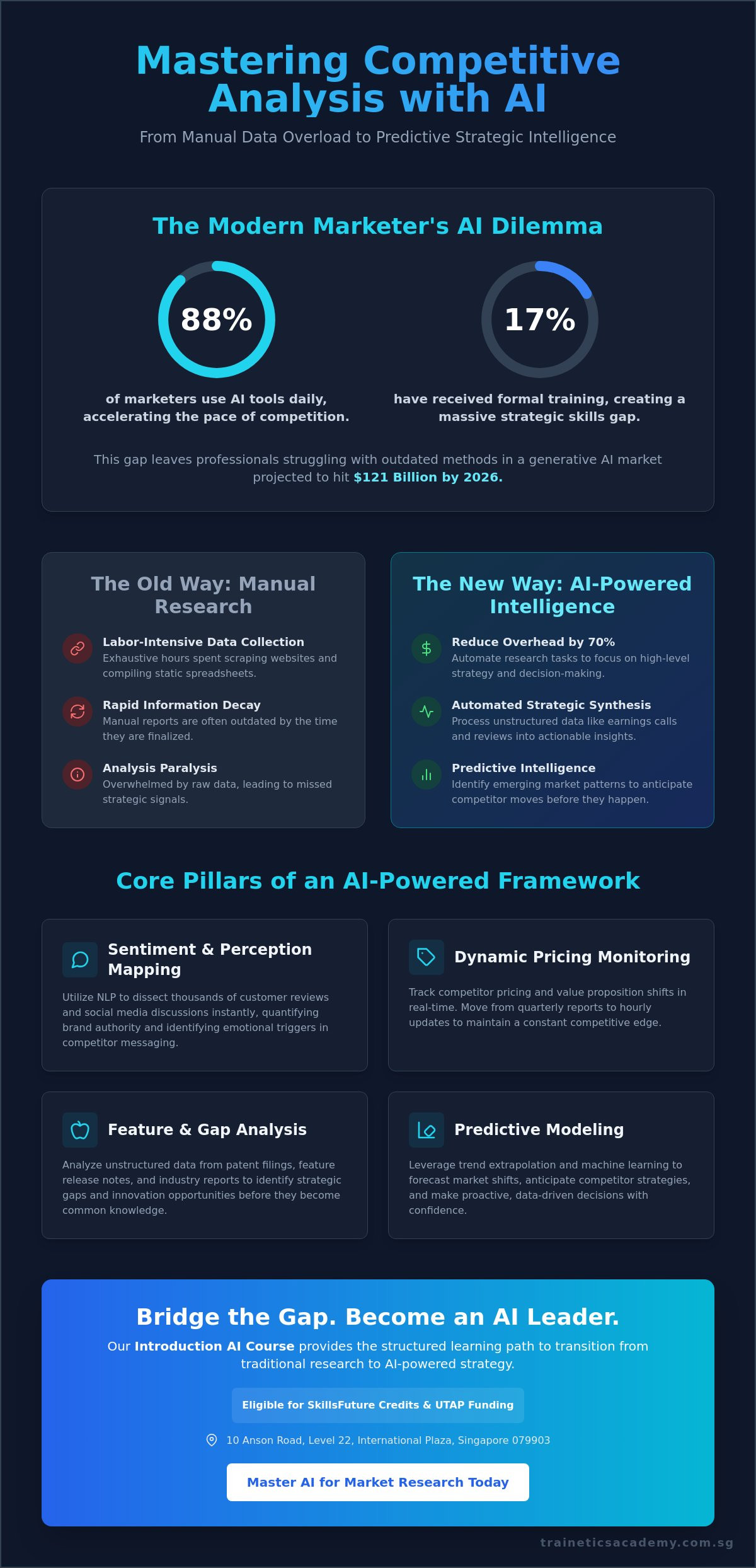
Did you know that while 88% of marketers now use AI tools daily, only 17% of users have received formal training to master these systems? This massive skills gap often leaves professionals trapped in manual research cycles that are outdated by the time the report is finished. You likely feel the weight of information overload while trying to identify subtle shifts in competitor pricing or messaging within a global generative AI market projected to reach $121 billion in 2026. Mastering AI for market research and competitive analysis is the only way to transform this raw data into predictive strategic intelligence that drives real growth.
We understand that you’re seeking a repeatable framework to accelerate your competitive intelligence reports without sacrificing scientific accuracy. This guide provides the technical mastery required to move beyond basic automation and into high-level strategic execution. You’ll learn how to deploy agentic AI systems that align with Singapore’s latest Model AI Governance Framework. For those ready to validate their expertise, our Introduction AI Course at 10 Anson Road, Level 22, International Plaza, Singapore 079903 is eligible for SkillsFuture Credits and UTAP funding. We’ll show you how to build a professional identity rooted in excellence and market leadership.
Key Takeaways
- Transition from labor-intensive manual data collection to automated strategic synthesis using advanced sentiment analysis and real-time value proposition tracking.
- Master the core pillars of AI for market research and competitive analysis to transform raw data into predictive intelligence with academic-level precision.
- Develop sophisticated prompt engineering techniques to extract high-quality insights while maintaining the necessary human oversight to prevent data hallucinations.
- Secure your position as an industry leader by adopting a structured learning path that bridges the gap between traditional research and AI-powered strategy.
The Evolution of AI for Market Research and Competitive Intelligence
The landscape of strategic intelligence has undergone a fundamental transformation. In previous years, researchers spent exhaustive hours scraping websites and compiling static spreadsheets. Today, Generative AI and Large Language Models (LLMs) have shifted the focus from basic data collection to automated strategic synthesis. Modern competitive analysis requires more than just knowing what rivals did last month. It demands a predictive understanding of what they’ll do next. By leveraging AI for market research and competitive analysis, professionals can now process unstructured data, such as earnings calls, patent filings, or social media sentiment, into actionable intelligence at a speed human analysts cannot match. This isn’t just about working faster; it’s about achieving a level of precision that was previously impossible.
The 2026 market dynamics require real-time monitoring because the shelf life of data has shrunk significantly. We’ve moved past the era where a quarterly report sufficed. In a world where 88% of marketers use AI tools daily, your competitors are likely using these systems to pivot their messaging and pricing in hours, not weeks. The difference between raw data collection and AI-driven insights is the ability to see the “why” behind the “what,” allowing you to anticipate market shifts before they fully materialize. This transition represents a move toward a more scientifically grounded approach to business strategy.
Why Manual Research Fails in the Modern Singapore Market
Singapore’s digital economy is moving at a pace that renders traditional research methods obsolete. For many Singaporean SMEs, the speed of digital transformation means that by the time a manual report is finalized, the underlying market conditions have already shifted. This information decay is a critical risk. Analysts today face a “noise vs. signal” problem, where the sheer volume of digital data hides the most important strategic indicators. Relying on manual scraping often leads to “analysis paralysis,” where you’re so overwhelmed by raw data that you fail to identify the subtle shifts in competitor value propositions that actually matter.
The Strategic Advantage of AI-Powered Intelligence
Integrating a structured AI framework allows you to reduce research overhead by up to 70% while increasing the accuracy of your forecasts. Through trend extrapolation, AI identifies emerging market patterns before they become obvious to your rivals. This empowers you to make high-stakes decisions with the confidence of a visionary mentor. To master these sophisticated tools, many professionals look toward high-quality SkillsFuture AI courses to build their technical foundation. Our Introduction AI Course at 10 Anson Road, Level 22, International Plaza, Singapore 079903 is Eligible for SkillsFuture Credits and UTAP funding. This AI course Singapore provides the rigorous methodology needed to excel in 2026’s competitive environment, ensuring you’re not just a participant in the market, but a leader who defines it.
Core Pillars of an AI-Powered Competitive Analysis Framework
Success in 2026 demands a disciplined methodology that moves beyond surface-level observations. A professional framework for AI for market research and competitive analysis is built upon four critical pillars: sentiment analysis, dynamic pricing monitoring, feature gap analysis, and predictive modeling. These pillars don’t operate in isolation; they form an integrated system that converts raw market signals into a high-definition map of the competitive landscape. By mastering these components, you move from a position of uncertainty to one of strategic dominance.
Sentiment and Perception Mapping
Understanding how the market perceives your rivals is the first step in identifying their vulnerabilities. Sentiment analysis utilizes Natural Language Processing (NLP) to dissect thousands of customer reviews and forum discussions instantly. This process allows you to identify specific emotional triggers in competitor marketing copy that resonate with your target audience. By mapping the “Share of Voice” across social and professional networks, you can scientifically quantify brand authority. This data-driven approach ensures your messaging is grounded in reality rather than intuition.
Automated Pricing and Feature Tracking
Regional Context: Monitoring the SEA and Singapore Landscape
Global data often lacks the nuance required to win in specific local markets. When tracking rivals within the International Plaza and the wider Singapore CBD area, your AI prompts must be adapted for local business terminology and cultural nuances. This regional focus ensures that your intelligence is both relevant and actionable within the South East Asian context. Professionals must also remain vigilant about compliance with local data protection standards during their research activities. For those seeking to sharpen these skills, exploring a specialized AI Course can provide the technical mastery needed to lead in this space. Using these tools effectively requires a commitment to continuous improvement and scientific validation.
The final layer of this framework is predictive modeling. By simulating competitor responses to market changes, you can anticipate their next moves with remarkable accuracy. This transition from reactive monitoring to proactive strategy is the ultimate goal of any sophisticated research program. It requires a blend of academic rigor and practical application to transform raw data into a shield for your business interests.
Step-by-Step: How to Conduct Competitive Analysis with AI
Deploying a sophisticated system for AI for market research and competitive analysis requires a transition from passive observation to active, methodological execution. Software alone won’t provide the strategic depth needed to lead your industry; you must master the cognitive frameworks that guide these tools. This step-by-step process ensures your intelligence reports are grounded in scientific rigor and professional excellence. By following this disciplined path, you’ll transform fragmented data into a cohesive shield for your business interests.
Step 1: Data Aggregation and Cleaning
The integrity of your output depends entirely on the quality of your inputs. You should identify high-authority sources such as earnings calls, LinkedIn executive updates, and specialized trade journals. Use AI to strip away the “marketing fluff” from competitor announcements, leaving only the technical and financial substance. This process mirrors the intensive data preparation we teach in our 1 day AI course Singapore workshops, where we emphasize that raw data is a liability until it’s properly refined. Organizing your data into structured repositories allows for a more logical flow during the synthesis phase.
Step 2: Advanced Prompting for Market Analysts
Effective prompting is the bridge between raw data and strategic insight. We recommend the “Role-Context-Task” framework to ensure your AI models operate with the mindset of a senior strategist. Ask the AI to identify “weak signals” within competitor job postings; for example, a sudden influx of hires in a specific technical niche often signals a strategic pivot before it’s officially announced. Iterative prompting is essential. You shouldn’t settle for the first response. Instead, you should drill down into specific strategic threats to uncover the nuances that general analysts miss. This level of technical mastery is a core component of any professional AI Course.
Step 3: Generating the AI-Assisted SWOT
Traditional SWOT analyses often lack the depth required for high-stakes decision-making. You should use AI to generate an “Impact-Weighted” SWOT, where every entry is quantified based on its potential effect on your market share. Use the AI to brainstorm specific counter-strategies for every identified competitor strength. This ensures your executive summaries aren’t just descriptive, but prescriptive. Professionals ready to validate these skills can explore our comprehensive curriculum, which provides the rigorous methodology needed to draft objection-handling talk tracks that empower your sales teams to win with confidence.
Overcoming the Limitations of AI in Market Intelligence
While the frameworks discussed earlier provide a massive advantage, you must address the inherent risks of automated systems. AI for market research and competitive analysis is a high-precision tool, yet it’s prone to “hallucinations” when processing complex financial or technical data. In 2026, even the most sophisticated agentic AI can occasionally misinterpret a nuanced earnings report or a technical patent filing. Relying blindly on these outputs without a “human-in-the-loop” strategy is a professional risk you can’t afford to take. True excellence requires a blend of machine efficiency and human intuition to ensure that high-stakes decisions are grounded in reality.
Another critical limitation is the “echo chamber” effect. As more companies use generative AI to produce content, there’s a risk that your research models will simply analyze other AI-generated summaries rather than original market signals. This cycle can dilute the strategic depth of your intelligence. You must maintain a disciplined approach that prioritizes primary sources to ensure your strategy remains unique and competitive. Adhering to the non-binding guidance found in Singapore’s Model AI Governance Framework for Agentic AI, updated in May 2026, is essential for maintaining these high professional standards.
Ensuring Data Accuracy and Verification
Professional readiness demands academic rigor in every report. You should always cross-reference AI-generated claims with primary source documents like official regulatory filings or technical specifications. Setting up specific “Fact-Check” prompts allows you to verify data points before they reach the executive summary. This methodical verification process is a core skill taught in any high-caliber AI course Singapore professionals trust. By treating AI as a co-pilot rather than an autopilot, you protect your organization from costly data errors and maintain your reputation as a visionary leader.
Ethics and Privacy in Competitive Intelligence
Ethics and privacy are non-negotiable in the modern business environment. While researching rivals, you must protect your own proprietary strategy. Never upload sensitive internal data or unreleased product roadmaps into public LLMs, as this can inadvertently train the models for your competitors. Maintaining these ethical boundaries is essential for long-term career security and professional integrity. Our AI courses for beginners and advanced practitioners emphasize these professional standards. Master the ethical deployment of these tools by enrolling in our professional Artificial Intelligence Course today.
Mastering AI for Market Research: Upskilling in Singapore
The demand for AI-literate market analysts has reached a critical peak in 2026. As enterprise spending on AI marketing in Singapore reflects a significant shift toward automated intelligence, professionals who can effectively utilize AI for market research and competitive analysis are becoming the most sought-after assets in the CBD. Transitioning from traditional research to an AI-powered strategy isn’t just about efficiency; it’s about raising professional benchmarks and securing a seat at the leadership table. You must move beyond the trial-and-error approach that characterizes hobbyist learning and embrace a path of scientific validation and technical mastery.
In a market where 63% of marketers are already using generative AI, standing out requires a deeper understanding of the underlying frameworks. This transition demands a professional identity rooted in precision and hard work. By mastering these tools, you ensure that your strategic intelligence is not just a reactive report, but a predictive engine that drives business growth. The path to excellence is structured and logical, moving from foundational concepts to the advanced applications required for the current dynamic environment.
Professional Certification and Career Growth
Building a robust portfolio of AI-driven market intelligence projects is the fastest way to demonstrate your readiness for high-stakes roles. While global online certifications offer general knowledge, a localized AI course Singapore based provides the specific regional context and networking opportunities essential for growth within the local business ecosystem. Structured learning ensures you master the multi-step tasks of agentic AI systems without the risks of data hallucinations discussed in previous sections. This methodical approach transforms you from a traditional researcher into a visionary strategist who values precision and continuous improvement. Investing in SkillsFuture AI courses allows you to align your professional development with national benchmarks for excellence.
Trainetics Academy: Your Partner in AI Excellence
Trainetics Academy offers the highest standard of technical training for professionals ready to lead. Our curriculum is specifically designed to help you master the frameworks required for modern market intelligence. This intensive workshop provides the academic rigor and practical career-focused messaging needed to excel. Our training focuses on international benchmarks while grounding every lesson in practical application. We don’t merely offer a class; we offer a gateway to a prestigious career.
Whether you’re looking for AI courses for beginners or advanced technical mastery, we provide the professional identity you need to succeed. Don’t leave your career growth to chance. A high-caliber Artificial Intelligence Course provides the technical foundation to outperform rivals and define your market. Elevate your research with our Artificial Intelligence Course and join a community dedicated to excellence and market leadership.
Securing Your Strategic Future in 2026
The evolution of market intelligence has reached a critical juncture where survival depends on the transition from passive observation to proactive, automated synthesis. By mastering the core pillars of sentiment mapping and real-time pricing analysis, you position your organization at the forefront of global industry innovation. Utilizing AI for market research and competitive analysis allows you to identify subtle shifts in rival strategies before they impact your market share. This disciplined approach ensures your decision-making is grounded in scientific rigor rather than guesswork.
Professional excellence is a journey of continuous improvement. Our curriculum is designed by industry-leading professionals to provide practical, intensive training that meets the highest standards of readiness. It’s time to step into a new professional identity and lead your industry with confidence. The future belongs to those who prepare with precision. We look forward to supporting your transition into a prestigious career in AI-driven strategy.
Master AI for your career at Trainetics Academy
Frequently Asked Questions
Can AI completely replace manual market research?
No, AI cannot fully replace the strategic intuition of a professional analyst. While it automates labor-intensive data collection and initial synthesis, high-stakes decisions require a human to verify context and ethical alignment. AI serves as a powerful co-pilot that handles the heavy lifting, allowing you to focus on high-level strategic execution and leadership.
What are the best free AI tools for competitive analysis in 2026?
Free versions of professional Large Language Models remain excellent starting points for basic sentiment analysis and data stripping. You can also utilize specialized browser extensions that summarize competitor press releases or news updates in real-time. However, enterprise-level intelligence often requires the advanced reasoning and data privacy protections found in paid, agentic AI systems.
How do I ensure the data AI provides about my competitors is accurate?
Verification requires cross-referencing results from AI for market research and competitive analysis with primary source documents like official regulatory filings or technical whitepapers. You should implement specific fact-check prompts that ask the AI to cite its sources or identify potential areas of uncertainty. This disciplined approach to data integrity is essential for maintaining professional standards and avoiding the risks of hallucinations.
Is an AI course for beginners enough to start doing competitive analysis?
Yes, a structured AI course for beginners provides the foundational methodology needed to begin basic research tasks immediately. It introduces you to core frameworks like sentiment analysis and basic prompt engineering. While advanced predictive modeling requires further technical depth, a solid foundation allows you to significantly reduce research overhead and improve report turnaround times.
How does prompt engineering improve market research results?
Prompt engineering transforms generic AI responses into highly specific strategic insights by providing clear context and role-based instructions. By using structured frameworks, you guide the AI to identify “weak signals” in competitor job postings or subtle pricing shifts. This technical mastery ensures your use of AI for market research and competitive analysis yields actionable intelligence rather than surface-level observations.
Are there SkillsFuture AI courses available for market analysts?
Yes, several SkillsFuture AI courses in Singapore are specifically designed to help professionals master these emerging tools. These programs often focus on practical applications, such as automating data aggregation or generating impact-weighted SWOT analyses. Enrolling in these courses allows you to align your skills with international benchmarks while leveraging local support for your professional development.
Can AI help me predict a competitor’s next product launch?
AI predicts potential product launches by analyzing patterns in patent filings, technical hiring trends, and subtle changes in marketing messaging. While it cannot provide a definitive date without internal data, it identifies the strategic trajectory of a rival. This allows you to prepare counter-strategies and objection-handling tracks before the competitor officially enters the market.
What is the role of the “Human-in-the-loop” in AI research?
The “Human-in-the-loop” serves as the final arbiter of strategic relevance and ethical compliance in the research process. While AI excels at processing vast datasets at scale, humans provide the nuance required to understand cultural shifts or complex competitive dynamics. This partnership ensures that the final intelligence report is both scientifically grounded and practically applicable to your specific business goals.
Disclaimer
AI Content Disclaimer: Some articles on this website may be generated or assisted by AI-powered content creation tools. While we strive for accuracy and relevance, readers should independently verify information before relying on it. The content is provided for informational purposes only and does not constitute professional advice.