Only 21.9% of Singapore’s F&B firms had adopted AI, according to a Ministry of Manpower report for Q1 2026. For AI for F&B business owners in Singapore, the pressing question isn’t whether to follow a trend, but which everyday task is genuinely worth improving first.
It’s understandable to be cautious. A new tool can add friction if it doesn’t suit the way your team works, and general AI tools may differ from systems built for specific business tasks. Start with one workflow you can assess, rather than a sweeping technology overhaul.
This guide explains how to identify a manageable use case, compare approaches based on workflow fit, information handling and staff impact, and plan a responsible first step. Foundational AI learning can also help you assess opportunities with greater confidence. Trainetics Academy offers an instructor-led Artificial Intelligence course, with online and offline learning options, for professionals building their understanding of AI.
Key Takeaways
- AI for F&B business owners in Singapore is most useful when it supports a specific operational need, rather than being adopted as a goal in itself.
- Assess possible use cases across service, kitchen, marketing and management by identifying the required information, human checks and a useful measure.
- Compare manual workflows, standalone generative AI tools and AI features within existing systems against your team’s needs.
- Start with one task: map the current process, assess the information involved, test carefully and review an observable measure such as completion time or staff feedback.
- Build foundational AI understanding to evaluate a tool’s limits and decide where human review belongs before exploring a business use case.
Why AI for F&B Businesses in Singapore Starts with a Real Operating Need
AI is not an objective in itself. In an F&B business, it can mean using data-driven systems or generative tools to support a defined task, such as sorting customer feedback, identifying patterns in recorded sales or drafting a routine message. A practical first test is whether the task happens often enough to matter and whether staff can check the result against a clear need.
That focus matters in Singapore, where service teams balance customer expectations with daily operational demands. Concerns about time, disruption, staff readiness and uncertain returns are reasonable. They are reasons to explore AI at a manageable scale, with input from the staff doing the work and a clear way to review the result.
Which recurring F&B tasks might be suitable for AI?
Look first at work that involves handling information repeatedly. A team might organise service feedback by topic, draft a response to a common customer enquiry or prepare wording for a menu update. These are decision-support tasks. Before using the result, staff should check tone, accuracy, ingredients, availability and the outlet’s operating context.
Stock and demand planning are also areas to investigate. Sales and stock records may help a team examine patterns, but an AI-generated suggestion does not guarantee more accurate purchasing or less waste. A promotion, supply issue or sudden change in demand can affect what the figures appear to show.
Automation is related to, but not the same as, AI. The Automated restaurant overview provides background on restaurant automation and robotics. When assessing a tool, distinguish actions that are automated from systems that analyse information or generate recommendations.
What should an owner clarify before exploring AI?
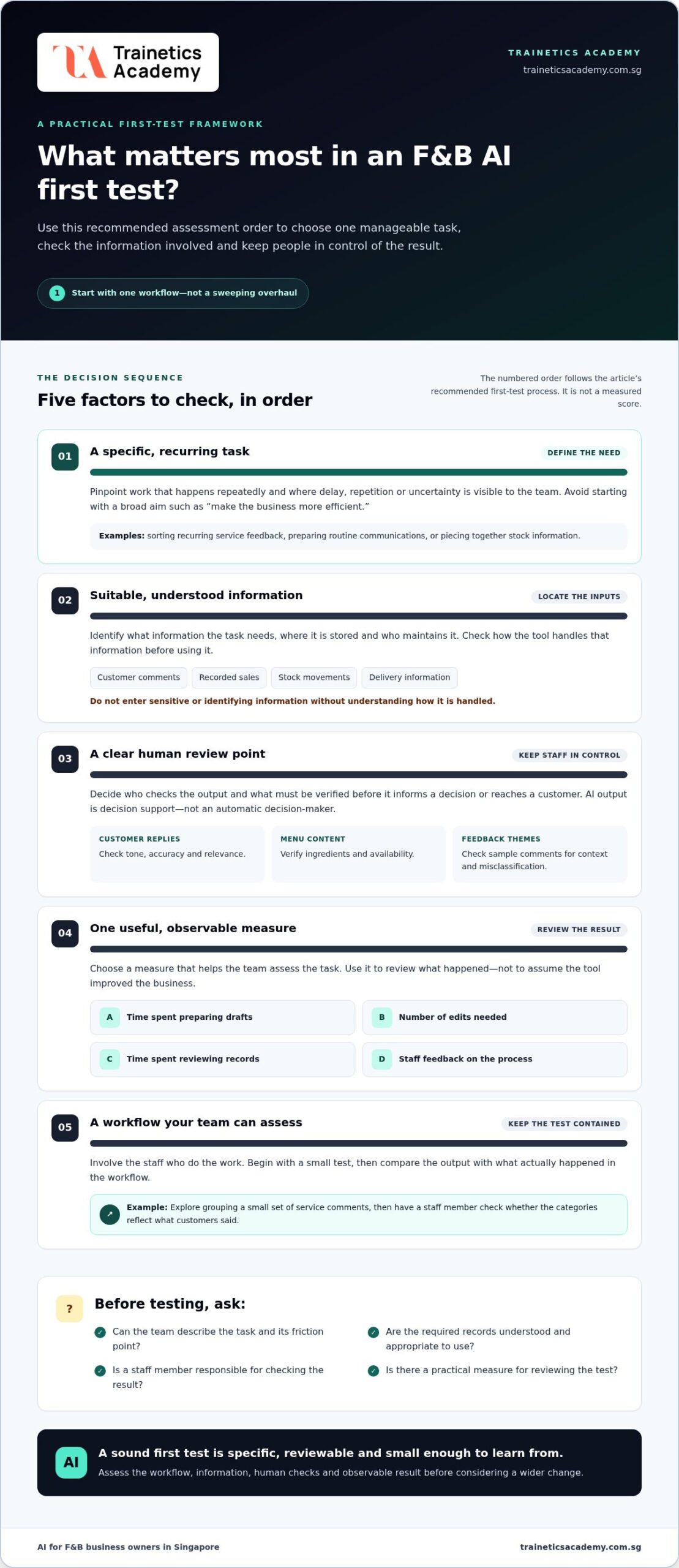
Start with a friction point your team can describe clearly. Perhaps staff spend time sorting recurring feedback, preparing routine communications or piecing together stock information from scattered records. A useful candidate is frequent, specific and visible to the people doing the work, rather than a broad ambition such as “make the business more efficient.”
- Define the task: Identify what staff do now and where delay, repetition or uncertainty occurs.
- Locate the information: Note what is recorded, where it is stored and who maintains it.
- Set a review point: Decide who will check AI output and what must be verified before it informs a decision.
Keep the first test contained. For example, use a small set of service comments to explore how feedback could be grouped. Then have a staff member check whether the categories reflect what customers actually said. Avoid entering sensitive or identifying information into a tool without understanding how that information is handled.
Foundational knowledge can help owners distinguish an AI suggestion from a sound business decision. Trainetics Academy’s Artificial Intelligence course offers a learning pathway for developing that understanding. For AI for F&B business owners in Singapore, a strong first step is a clearly defined task, suitable information and human oversight.
Practical AI Use Cases for Singapore F&B Operations
Useful applications depend on the outlet, the records available and the service model. A neighbourhood café, a food court stall and a restaurant with several locations may have different bottlenecks, so treat these examples as possibilities to assess, not a standard checklist. Singapore’s IMDA and Enterprise Singapore’s Food Services Industry Digital Plan provides sector context for digitalisation and AI adoption.
It helps to distinguish the kind of assistance involved. Generative AI creates or reshapes content, such as draft replies or summaries. Predictive analysis uses historical information to estimate what may happen, such as a change in demand. Broader machine-learning applications identify patterns in data to support tasks such as classification or recommendations. Each approach depends on suitable inputs and human review. None should be treated as an automatic decision-maker.
Customer communication, feedback, and menu content
For customer service and marketing, inputs might include customer comments, approved menu facts or common enquiry topics. Generative AI can draft response options, adapt a promotion for different channels or prepare an initial menu description. A staff member should verify the details, tone and relevance before anything reaches customers. Track a practical measure, such as time spent preparing drafts or the number of edits needed, rather than assuming the tool improves engagement.
AI can also group feedback into themes, such as comments about waiting time or a particular dish. Treat the result as a working summary, not a definitive account of customer sentiment. Compare sample comments with the suggested categories, look for missing context and correct misclassifications. Accurate, considerate communication helps protect customer trust.
Inventory planning and recurring administrative work
For back-of-house planning, useful inputs could include recorded sales, stock movements and delivery information. An analytical system may help surface patterns for staff to investigate, but the team should compare any suggestion with actual stock, supplier conditions, promotions and service plans. A suitable measure might be the time spent reviewing records or the frequency of stock discrepancies, not an assumed reduction in waste.
Management teams might use generative AI to summarise routine reports or prepare a first draft of an internal update using information they are authorised to share with the tool. Check figures, dates and omitted context before circulating the draft. A polished summary does not prove that the underlying data is complete.
- Front-of-house: Use enquiry topics to draft response options; have staff review accuracy and tone; measure preparation time or the edits needed.
- Back-of-house: Use stock and sales records to examine patterns; validate suggestions against current conditions; monitor review effort or discrepancies.
- Marketing: Use approved menu details to draft content; verify every claim before publication; track review time and corrections.
- Management: Use routine operational records for a draft summary; check source figures and context; assess whether the summary supports a clearer review.
For AI for F&B business owners in Singapore, the aim is to match one application to a task and a meaningful measure. Building foundational understanding through an Artificial Intelligence course can help owners assess what a tool does, where its limitations matter and which decisions should remain with people.
How to Compare AI Approaches for an F&B Business
The right approach depends on the task, not on how advanced a tool appears. A team preparing routine updates may need only a manual template or a standalone generative AI tool. A workflow involving recurring records across business functions may call for AI features embedded in existing systems, if those features suit the outlet’s processes. Compare options against the same operational need before considering a broader change.
Approach
Potential benefit
Prerequisites and limitations
Manual process
Keeps the task familiar and decisions directly with staff.
May remain repetitive or time-consuming. A clear process and consistent records still matter.
Standalone generative AI
Can help with a discrete task, such as drafting a routine message or summarising provided notes.
Staff must supply suitable information, review each output and transfer it into the workflow. It may not connect with existing systems.
AI within an existing workflow
May support analysis or recommendations within a broader process.
Depends on data quality, available features and integration requirements. Setup or workflow changes may add complexity.
Standalone AI tools versus AI within existing workflows
A standalone tool may suit a bounded task, but staff might need to move information in and out manually. AI embedded in a current workflow may reduce hand-offs or connect steps, yet it can bring additional process and integration considerations. Neither option is automatically better. Assess how well each fits the task, the quality of its inputs and how much review your team can realistically provide.
For a task such as drafting a response, compare the time spent preparing and checking a draft with the current method. If a task involves records across different systems, first establish whether the information can be used together and what staff would need to change. Avoid choosing a tool based on novelty alone.
How to assess reliability, privacy, and human oversight
Check outputs against source information before using them with customers or staff. Confirm facts, calculations and dates, and look for missing context. Provide only information appropriate for the selected tool and task, especially when records contain customer or business details. Assign a staff member to review outputs, and leave final decisions to people who understand the service conditions and operational context.
A low-disruption test can be small: use one defined task, keep the existing process available and compare completion time, correction effort or staff feedback. Set a stopping point if the output creates extra work or cannot be checked confidently. This gives AI for F&B business owners in Singapore a disciplined way to compare options without treating implementation as an all-or-nothing decision.
A Step-by-Step AI Adoption Plan for Singapore F&B Owners
A disciplined test gives your team a basis for deciding whether AI belongs in a workflow. Keep the scope narrow, involve the staff who perform the task and choose an observable measure before starting. This five-step plan makes exploration reviewable without promising savings or improved performance.
- Select one task. Choose a recurring activity with a clear purpose, such as preparing a routine internal summary.
- Map the workflow. Record who completes each part, what information they use and where delays or rework arise.
- Assess the inputs. Check whether the information is available, consistent and appropriate for the tool being considered.
- Test carefully. Run a limited trial with staff participation, human review and the current process available as a reference.
- Review the results. Compare observations with the baseline, then decide whether to continue, adjust or stop.
Set a baseline and design a manageable test
Before testing, document how the task is done now. Note completion time, hand-offs, corrections or recurring points of confusion. Choose one measure that reflects the friction, such as time to prepare a draft or the number of errors found during review. Keep the test limited to a defined task and period, and agree on who checks the output before it is used.
Include the staff doing the work in the test design. They can identify exceptions a process map may miss and judge whether a new step fits a busy service period. Compare tools against practical criteria: task fit, information requirements, review effort and workflow changes. Don’t assume a tool will deliver a benefit before the test.
Review results and decide what happens next
Compare the trial with your baseline using the same measure. Record unexpected outputs, corrections and extra steps, not just successful examples. Ask participating staff whether the process was clear, how much review it required and whether it disrupted other duties. This helps distinguish useful assistance from an output that looks polished but creates more work elsewhere.
Use the evidence to continue, adjust the test or stop. If results are mixed, refine the task or inputs before drawing a conclusion. If outputs cannot be checked confidently, don’t rely on them for decisions. For AI for F&B business owners in Singapore, a sound adoption plan keeps accountability with people and makes each next step proportionate to what the trial shows.
Build the knowledge to evaluate AI use cases with greater confidence through Trainetics Academy’s Artificial Intelligence course.
Build the AI Knowledge to Make Better F&B Decisions
Choosing an AI use case is only part of the work. Owners also need enough foundational knowledge to judge what a tool does, what information it depends on and where staff must apply their judgement. This can help turn a business question, such as how to review recurring feedback or assess an administrative task, into a more informed learning goal.
What foundational AI learning can help an owner understand
Start by distinguishing data, generative AI and machine learning. Data is the information supplied to or used by a system. Generative AI produces content in response to instructions, often called prompts. Machine-learning approaches use data to identify patterns or support predictions. An output may be useful, but it is not automatically accurate or appropriate for a business decision.
Input quality matters. Incomplete, inconsistent or unsuitable information can lead to outputs that miss important context. Human review provides a necessary check: staff can compare a result with its source, correct errors and decide whether it fits the situation. For an F&B owner, that might mean learning enough to assess a draft or analysis without assuming it reflects actual service conditions.
Bring a real operational question into the learning process. Define the task, the information involved and what a useful output would look like. This keeps foundational learning connected to a practical decision, while leaving room to conclude that AI may not suit that workflow.
Choose a learning format that fits professional commitments
Learning should be manageable alongside the responsibilities of running an outlet. Trainetics Academy offers online and offline learning options, with an interactive, instructor-led approach and experienced instructors. These formats give professionals options as they build their understanding, without assuming a particular schedule or promising a specific business result.
As you consider what to learn, connect the subject to your current question. Do you want to understand generative AI, assess where human review is needed or build confidence evaluating AI applications? Relating the learning to a specific workflow can make the subject more useful to your business decisions.
Trainetics Academy’s Artificial Intelligence course is one learning option for developing foundational knowledge. Bring a clear question from your business, then use what you learn to assess possible applications, limitations and review requirements with greater care.
Make Your Next AI Decision with Confidence
Your next step doesn’t need to be a major technology decision. Choose one question that matters to your outlet, then build the knowledge to assess possible answers with care. As you explore AI for F&B business owners in Singapore, focus on what a system can support, what it cannot reliably determine and where your team’s judgement remains essential.
That foundation can help you assess future tools and workflows against clearer criteria. Rather than following a trend, you’ll be better prepared to decide whether an AI application fits your business priorities and what responsible review should look like. Progress starts with a considered question and the confidence to evaluate it.
Strengthen your understanding of AI and prepare to assess opportunities with purpose. Explore Trainetics Academy’s Artificial Intelligence course and take your next step with confidence.
Frequently Asked Questions
Can AI help a small F&B business in Singapore?
It may, but the useful question is where it could fit, not whether a small outlet needs a broad technology change. An AI course can help an owner build foundational knowledge to assess a recurring task, the information involved and the role of staff review. Then decide whether a limited trial is appropriate, without assuming it will increase sales or reduce costs.
How can AI help with F&B inventory planning?
Data-driven tools may use historical stock or sales information to support planning. Foundational AI learning can help owners understand why the quality and relevance of those records matter. Bring an inventory question into your learning process, such as how to assess the usefulness of past records. Any recommendation still needs staff judgement about current stock, supplier conditions and menu requirements.
Does AI replace staff in restaurants and cafés?
AI can support tasks, but that is not a reason to assume people are no longer needed. Staff bring service awareness and context that a generated response or data analysis may not capture. Owners can learn about possible applications and discuss them with their teams, including where human review should remain part of the process. Course learning should not be treated as a prediction about employment.
Can AI work with an F&B business’s existing POS system?
Compatibility depends on the specific system, tool and workflow. Foundational AI learning can help owners understand the questions involved, such as what information a task requires and how it might be accessed. If integration is unclear, start by learning about the relevant concepts and consider whether a separate, limited task can be assessed without changing the POS workflow.
Is it safe to enter customer or business information into AI tools?
No course can make every AI tool automatically secure. Approach information use carefully by considering the task, the data involved and the tool’s stated handling practices. Avoid including details that aren’t needed, particularly identifying customer information. Before using an output, compare it with a trusted source and consider whether it is suitable to share with customers or staff.
Do F&B business owners need coding skills to learn about AI?
Foundational AI learning doesn’t necessarily require starting with software development. Owners can begin with a practical understanding of what AI tools do, how to describe a task clearly and why outputs need review. Some technical applications may involve coding, so don’t assume every use case is code-free. A useful learning goal is to assess a business question and recognise when deeper technical knowledge may be needed.
How can an F&B owner tell whether an AI trial is worthwhile?
Assess a trial systematically rather than judging it by first impressions. Before testing, record how the current task is completed and choose a measure, such as time, rework or staff feedback. Include the effort required to review AI output. Afterward, compare the observations with the existing process. Use the evidence to decide whether to continue, adjust the test or stop, rather than treating one result as a guarantee.
Disclaimer
AI Content Disclaimer: Some articles on this website may be generated or assisted by AI-powered content creation tools. While we strive for accuracy and relevance, readers should independently verify information before relying on it. The content is provided for informational purposes only and does not constitute professional advice.