Choosing an AI course can help you build relevant skills for a tech-focused role. Start by considering how AI skills fit your career direction, then look for a course that covers useful concepts and practical knowledge. A focused course can help you take a considered step toward work involving artificial intelligence while building confidence along the way.
It’s understandable to wonder whether your experience is enough for AI-related work. Start by identifying the contribution you want to make, then consider which AI knowledge could support that goal. This connects course learning with a clear career purpose, whether you’re developing within technology or bringing experience from another field.
This guide explores how to choose an AI course that can inform your career direction and help you prepare for technology-related opportunities. It also considers how practice, structured development and constructive feedback can support your progress. The aim is to help you choose a deliberate next step toward AI-related work, with a clearer sense of what you want to learn and why.
Key Takeaways
- Match your current strengths to a target role, then focus learning on the skills you still need to develop.
- Use projects, workplace contributions and transferable experience to show how you solve problems and add value.
- Choose a structured learning pathway that connects new knowledge with practical application.
- Use constructive feedback and mentorship to identify strengths, clarify expectations and guide your next steps.
- An Artificial Intelligence Course can help you build foundational knowledge when AI skills align with your career direction.
1. AI course learning, practice and confidence-building support
Build confidence in AI by linking course learning to the topics you want to understand. Start with an AI course that covers relevant concepts and identify its learning objectives. Note which skills involve understanding AI, communicating findings or applying digital tools. This gives your learning a clear purpose instead of leaving course topics disconnected from your goals.
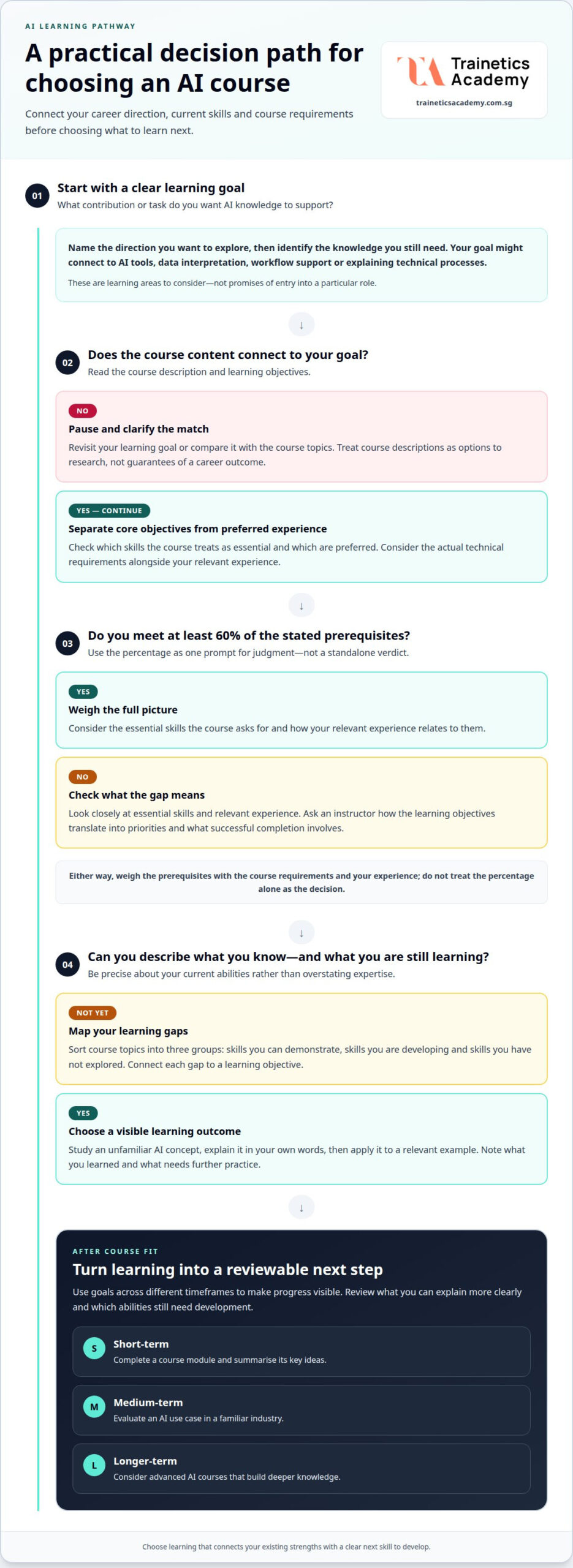
To assess your learning needs, sort the course topics into three groups: skills you can demonstrate, skills you’re developing and skills you haven’t explored. Connect each gap to a learning objective. If you want familiarity with AI applications, for example, look for learning that helps you understand their uses and limitations. Distinguish concepts you already know from those you can develop through course practice.
A knowledge gap can point to your next learning step. Choose an unfamiliar AI concept, study it through a structured course and write a short explanation in your own words. Then apply the idea to a relevant example, such as considering how an AI tool might support a routine task. This gives you a specific learning outcome to review without suggesting that course attendance alone proves practical expertise.
Learners can connect earlier experience to AI course content. A customer service professional may understand recurring user needs; a coordinator may be skilled at organising information and communicating process changes. These strengths can complement AI knowledge, especially when course exercises involve tool explanations, user needs or adoption support. Relate past experience to the lesson, then show how further learning is building your understanding.
Communication and prioritisation remain valuable alongside technical learning. Practise describing an AI concept in plain language, then explain why it matters to a particular task. For example, distinguish what an AI tool can assist with from what still requires human judgment. Clear explanations help you check your understanding, while prioritisation helps you focus your studies on course topics relevant to your goals.
Track your learning clearly as you progress through an AI course. Describe completed learning activities precisely: explain the concept you studied, the exercise you completed and what you learned. Avoid presenting familiarity with a tool as advanced expertise. A clear account of your current capabilities and learning direction gives you a useful record of your progress.
Building confidence in AI takes a defined learning goal and evidence of progress. Review the course topics, choose relevant AI learning and record what you can now explain or apply. Use those notes to identify areas for further practice and prepare examples of your learning. Each exercise can then show a deliberate connection between your existing strengths, course content and the AI concepts you hope to understand.
2. Building confidence through AI course learning and practice
Confidence in AI-related work grows when you can explain what you understand and what you’re still learning. An AI course can introduce concepts and give you a foundation for further study. Choose an AI learning goal, then review the skills it involves. Look for topics such as AI tools, data interpretation, workflow support or explaining technical processes. Use these topics to guide your next learning step.
Beginners and career changers can explore AI courses that connect with skills they already use. For example, a professional who understands customer needs could study how AI tools support customer-facing work. Someone experienced in analysis might explore courses involving data-informed decisions. These are learning options to research, not promises of entry into a role. Read each course description closely and consider its actual technical requirements before enrolling.
One common risk is treating every item in a course description as equally essential. Another is claiming AI expertise after introductory study alone. Separate core learning objectives from preferred experience, and describe your current ability precisely. Consider whether you meet at least 60% of a course’s stated prerequisites. Use that as one prompt for judgment, while weighing essential skills and your relevant experience.
Set an AI learning goal with a visible outcome. After studying an AI concept, for instance, write a short explanation of how it might apply to a familiar business task. Identify limitations or questions that need further investigation. This exercise tests your understanding and helps you explain your reasoning. It also shows where another lesson or guided practice could strengthen your knowledge.
Track progress with goals for different timeframes. A short-term goal might be completing a course module and summarising its key ideas. A medium-term goal could be evaluating an AI use case in a familiar industry. A longer-term goal may involve pursuing advanced AI courses that build deeper knowledge. Review these aims periodically, noting what you can explain more clearly and which abilities still need development.
Course guidance can make this plan more specific. Bring an AI course description and ask how its learning objectives translate into priorities. An instructor can help you assess course fit and shape your next learning objective. Ask what successful completion involves, then use the answer to guide your study.
Experimentation keeps learning moving. Apply a course concept to a small, relevant question, reflect on the result and identify what you would investigate next. A course or project that proves unsuitable can still clarify your learning preferences. AI education, like other technology learning paths, can involve changing focus. Each considered step can sharpen your understanding of where your skills and interests can contribute.
3. Building practical proof through AI course projects and workplace experience
A finished AI course project makes learning visible. Choose a task related to your target role, then document the problem, your approach and the result. For an AI-focused position, you might apply a skill developed through an AI course to test an AI tool on a clearly defined task and explain where its output needs human review. Describe your contribution accurately. The goal is to show your reasoning, not imply experience you haven’t gained.
Workplace experience can provide equally useful evidence for skills developed through AI courses. An internship, volunteer assignment or existing job may involve planning, analysis, writing or collaboration. For example, someone who coordinated a project can explain how they tracked actions, addressed delays and kept stakeholders informed, then relate these skills to an AI course project. Connect those responsibilities to the target role, then clarify which technical skills you used or are still developing through an AI course.
Transferable strengths become clearer through examples and AI course projects. A teacher might describe organising complex information for different learners, then show how an AI course helped them apply that skill to an AI task. A writer could show how they researched a topic, structured findings and revised work after feedback, including in an AI course project. A project manager might explain how they coordinated people and deadlines while completing an AI course project. These experiences don’t replace technical knowledge, but they can credibly demonstrate communication, accountability and problem-solving developed through AI courses.
Describe your experience with precise, active language. Start each CV bullet with an action, then state the task and its outcome. “Created a process guide for new volunteers” gives readers more context than “helped with onboarding.” For AI course projects, include a measurable result only when you can support it. A documented improvement in social media engagement, for example, can show how your contribution affected an audience.
Reflection helps turn AI course projects and workplace assignments into strong interview examples. After a project or assignment, record the challenge, decisions, outcome and lesson. Note what changed after feedback and what you would improve next time. This gives you a useful structure for explaining how you applied skills from an AI course instead of relying on broad claims about being adaptable or motivated.
Use a simple evidence folder to organise your AI course progress. Save project summaries, permitted work samples, feedback and notes about your role. Before an interview, choose examples that match the employer’s stated responsibilities. Explain the outcomes and how you applied AI course skills to help solve a difficult problem, while respecting workplace confidentiality. This record makes your strengths easier to communicate and gives your career development a practical foundation.
People moving into tech from another industry can present project management, customer service, writing, teaching and analysis as transferable skills developed through AI courses. Include volunteer work, internships or other activities on your CV when they demonstrate commitment and relevant skills. AI course projects, problem-solving and workplace contributions can also show how you work. The value of these examples lies in what they demonstrate, not simply where you gained the experience.
Make reflection part of your AI course routine: consider your successes, challenges and what you would improve. This can help you explain your value in interviews and workplace conversations. If you experience imposter syndrome, reflecting on your achievements, feedback and skills gained through AI courses can help you move forward despite doubt. At work, increase your visibility by sharing AI course project outcomes and explaining your contribution to solving difficult problems. Clear accounts of your actions and learning help others understand your contribution.
4. Choosing an AI course pathway for learning and application
A structured AI course pathway connects learning with practical tasks. Start by identifying an AI topic or task you want to understand. Choose a course that covers relevant concepts, then practise them through an exercise or project. This sequence helps you see how AI knowledge applies instead of collecting unrelated course notes.
Course activities can clarify how to apply what you learn. Check what each lesson covers and look for opportunities to practise with examples or exercises. Online courses and webinars can introduce AI concepts and help build your knowledge. Certifications may demonstrate focused study, but their relevance depends on the course content and the skills they assess.
Choose an AI course by checking what each learning activity helps you understand or practise. A useful course might involve a practical exercise, while a webinar may introduce a concept that you later apply to a task. An Artificial Intelligence Course can support structured learning in that subject. Connect each lesson to a task, example or question you can explain.
Communication practice can also help you explain what you learn in an AI course. Organise a short presentation about an AI concept using who, what, when, where, why and how. This 5W1H structure helps keep the content focused. Use an example or project from your learning to make the explanation clear.
Review your understanding by explaining AI concepts aloud, listening for gaps and refining your explanations without memorising a script. Prepare questions about topics you want to explore further. This gives you a plan for continued learning while leaving room to respond naturally to new ideas.
Applying AI course learning means using concepts and skills in relevant tasks. Identify what a task requires, such as accurate analysis or clear communication about your approach. Use those requirements to review your work and identify areas to strengthen. Specific feedback can help you understand what you have learned and where to focus next.
In Singapore, learners can explore AI through courses, webinars and mentorship. Check each learning option’s stated content and purpose. A clear AI learning pathway combines relevant instruction with practice, feedback and opportunities to apply new knowledge.
Before committing to an AI course, check whether its activities connect to your learning goals and provide opportunities to practise relevant tasks. Take online courses or webinars, and pursue certifications where they fit your goals. Choose between these options by considering what you can apply and explain afterward. Record your questions, practice and feedback, then use those notes to decide what to strengthen next.
5. Mentoring and constructive feedback
A mentor can help you turn AI-course questions into practical learning steps. Choose someone familiar with AI or AI teaching, such as an experienced AI professional or a fellow learner. Bring a specific question, such as how to improve a project prompt or which AI skill to practise next. Focused conversations make advice easier to apply.
Make mentorship purposeful. Before a discussion, share your AI-course learning goal and an example of your work. Ask what the example shows about your understanding and where it needs more detail. A mentor might suggest explaining your reasoning before describing the outcome. Use that guidance to revise an AI project or explanation, then return with the updated version for further feedback.
Peer feedback adds a useful perspective to AI-course practice. Ask a study partner to review an AI project explanation for clarity, then invite an instructor to assess its technical accuracy. Each reviewer notices different things. A peer may flag unfamiliar terms, while an instructor may identify a missing step in your method. Give reviewers a clear task instead of asking whether the work is simply “good.”
Constructive feedback works best when it is specific and points to an action. Replace “your AI project explanation needs work” with “show how you tested the AI result before presenting your conclusion.” The second comment identifies a change you can make. When receiving feedback, listen fully, ask for an example if needed and note the suggested next step.
Separate comments about your AI-course work from judgments about your potential. If a reviewer says your explanation skips key assumptions, that points to a communication skill you can practise. It doesn’t erase the analysis you completed. Revise the explanation, test it with another learner and note whether the key reasoning is clearer.
A simple feedback record can help track your AI-course progress. For each project or practice exercise, note the date, the feedback, the change you made and what improved. For example, record that you added context to an AI project explanation after a mentor found the opening unclear. This gives later conversations a concrete starting point and shows how you respond to guidance.
Mentorship also means learning about AI from experienced colleagues through thoughtful questions. Ask how they approach an AI task, what quality checks they use and how they communicate limitations. Then apply a relevant insight to your AI-course practice. Sharing knowledge with fellow learners can strengthen your own understanding, too. Explaining an AI process often reveals which steps you can describe confidently and which need more practice.
Trainetics Academy
Trainetics Academy can support your next learning step as you build knowledge for an AI-related career direction. Its Artificial Intelligence Course offers a structured way to explore AI concepts and connect learning with the skills you want to develop. Training can complement practical projects and workplace feedback as you prepare to explain your abilities to employers.
Consider this pathway if AI is relevant to your target role and you want guided learning rather than relying on scattered resources. Trainetics Academy offers interactive educational programmes led by qualified professionals, with both offline and online learning options. Use the course to strengthen your understanding, then apply what you learn to relevant tasks and examples from your experience.
To learn more about Trainetics Academy’s Artificial Intelligence Course, contact the academy.
Turn your next step into an AI course learning move
Building confidence with AI starts with choosing a course that fits your goals and taking a considered next step. Focus on what you want to learn, then use your course experience to build knowledge and confidence over time.
If AI is part of your learning goals, Trainetics Academy offers an Artificial Intelligence Course to support your learning. Consider which AI skills you want to develop, then decide how a focused course could help you build that knowledge. Taking a course-related step can make your AI learning more purposeful without requiring you to have every answer today.
Contact Trainetics Academy to explore your options. Take the next step by exploring an AI course that fits your learning goals.
Frequently Asked Questions
What skills can learners develop through an AI course?
An AI course can help learners develop clear documentation, attention to detail, prioritisation and an understanding of how AI tools can support tasks. For example, a learner can describe how they used an AI tool to explore a question, checked its output and communicated the next step. This shows organised thinking without claiming specialist experience. Choose examples that match your goals: reviewing AI-generated content can demonstrate careful checking, while comparing prompts can show prioritisation.
What projects can demonstrate AI course skills without work experience?
A concise prompt test, AI-supported user journey map or simple data dashboard can demonstrate practical thinking without paid tech experience. For a prompt test, describe the task, outline what you tried and record sample outputs with clear notes on the results. A user journey map can show where someone might use AI to support a digital service. Add a short note explaining your choices and limitations so reviewers can understand your process as well as the finished work.
Disclaimer
AI Content Disclaimer: Some articles on this website may be generated or assisted by AI-powered content creation tools. While we strive for accuracy and relevance, readers should independently verify information before relying on it. The content is provided for informational purposes only and does not constitute professional advice.