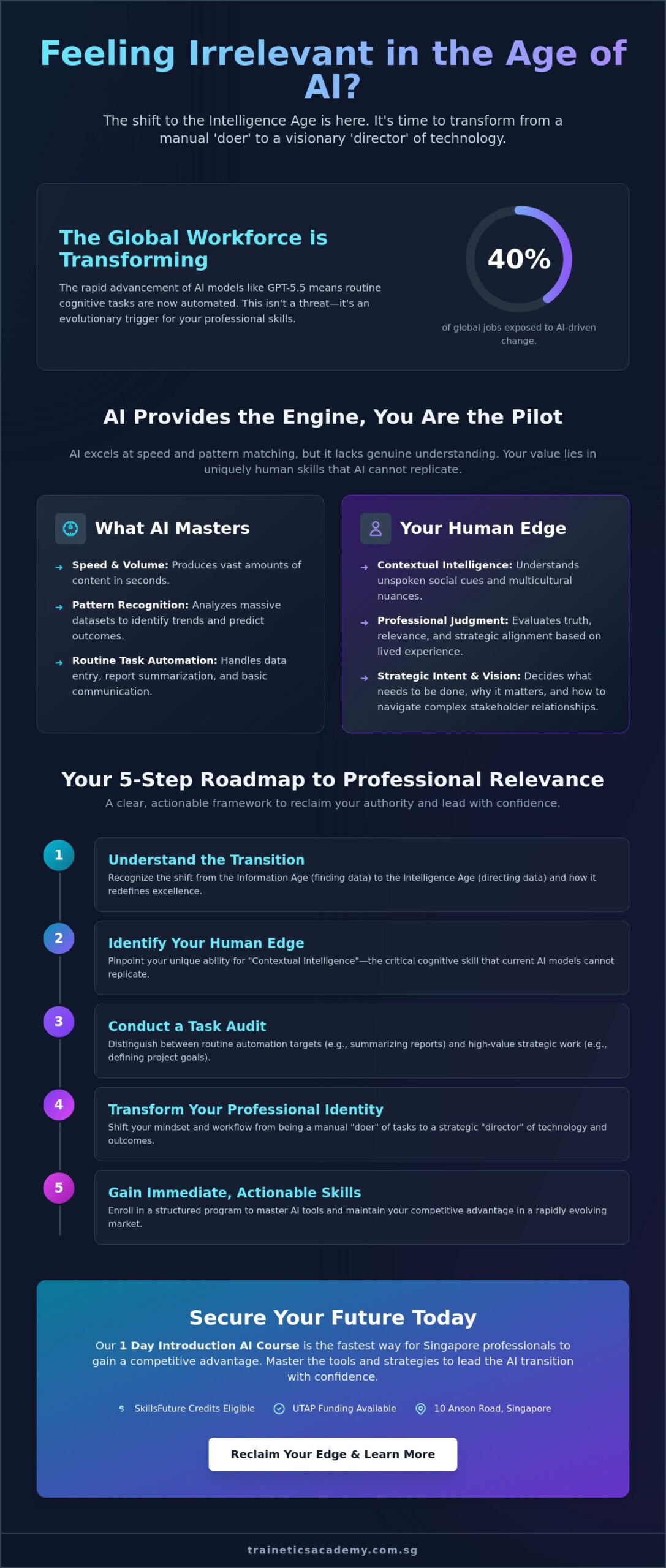
Nearly 40% of global jobs are currently exposed to AI-driven change, a statistic that underscores the rapid transformation of our professional world in 2026. As models like GPT-5.5 and Claude Opus 4.6 become standard office tools, it’s common to find yourself feeling irrelevant in the age of AI. You likely feel the weight of technological overwhelm and a creeping uncertainty about whether your hard-earned expertise still holds its value in a landscape dominated by automation.
We understand this anxiety, but true professional authority comes from mastery, not avoidance. This guide promises to transform your apprehension into a strategic advantage by providing a clear roadmap for the modern Singaporean workforce. You’ll learn to move beyond basic tasks and embrace a role as a visionary director of these powerful technologies. We will preview the essential human skills that AI cannot replicate and explain how an Introduction AI Course, which is eligible for SkillsFuture Credits and UTAP funding, can help you reclaim your edge. By selecting a 1 day AI course Singapore professionals use to stay ahead, you can secure your future from our base at 10 Anson Road, Level 22, International Plaza, Singapore 079903, and lead this transition with scientific precision and renewed confidence.
Key Takeaways
- Understand the transition from the Information Age to the Intelligence Age and how it redefines professional excellence in 2026.
- Identify your unique human edge through “Contextual Intelligence,” a critical cognitive skill that current AI models cannot replicate.
- Stop feeling irrelevant in the age of AI by conducting a task audit to distinguish between routine automation targets and high-value strategic work.
- Transform your professional identity from a manual “doer” into a technology “director” by mastering tools in a structured Artificial Intelligence Course.
- Gain immediate, actionable skills through a 1 day AI course Singapore professionals use to maintain their competitive advantage in a rapidly evolving market.
Table of Contents
Understanding Why You Are Feeling Irrelevant in the Age of AI
The Human Edge: What Artificial Intelligence Cannot Replicate
Legacy Skills vs. AI-Augmented Proficiency: A Comparative Framework
How to Reclaim Your Professional Relevance: A 5-Step Roadmap
Navigating the Future with an Introduction AI Course in Singapore
Understanding Why You Are Feeling Irrelevant in the Age of AI
AI Irrelevance Anxiety isn’t a sign of professional decline; it’s a logical psychological response to the sudden automation of routine cognitive tasks. In 2026, we’ve transitioned fully from the Information Age to the Intelligence Age. While the previous era rewarded those who could find and process data, this new era prioritizes those who can direct it. Many professionals in Singapore’s finance, legal, and marketing sectors describe a "creeping hollowness." It’s the unsettling feeling that occurs when a tool like GPT-5.5 produces in seconds what used to take you an entire afternoon. This fear is often linked to broader concerns about technological unemployment, where machines replace human labor in specific roles. You aren’t alone in this experience. It is a shared reality for nearly 40% of the global workforce currently exposed to AI-driven change.
To gain a deeper perspective on how these shifts impact our sense of value, watch this analysis on the current state of AI:
The Speed vs. Value Paradox
Speed used to be a competitive advantage. Today, it’s a commodity. If you define your worth by how fast you can draft an email or summarize a report, you’re competing against an algorithm that doesn’t sleep. AI has effectively commoditized basic data entry and business writing with ChatGPT. The market no longer pays a premium for output volume. Instead, professional value has shifted toward strategic intent. You aren’t being paid to write; you’re being paid to decide what needs to be written and why. In Singapore’s fast-paced business environment, the goal is no longer to be the fastest "doer" but to be the most insightful "director" of technology.
Psychological Displacement in the Modern Workplace
Feeling irrelevant in the age of AI often stems from an identity crisis. When a machine handles your core duties, it’s easy to lose your sense of purpose. However, there’s a vital distinction between task replacement and job replacement. AI might take over your spreadsheets, but it cannot take over your professional judgment or your ability to navigate complex stakeholder relationships. This internal friction is actually a signal. It’s a biological prompt telling you that your current workflow is ripe for evolution. Rather than viewing AI as a threat to your identity, see it as a tool that strips away the mundane, leaving only the work that requires true human mastery and leadership.
The Human Edge: What Artificial Intelligence Cannot Replicate
Large Language Models (LLMs) are formidable pattern matchers, but they are biologically incapable of consciousness. They function by predicting the most likely next word in a sequence based on vast datasets. They don’t "understand" the world; they simulate understanding. This distinction is vital for anyone feeling irrelevant in the age of AI. While a machine can draft a report, it cannot possess the lived experience required to judge the truth or cultural relevance of its output. You must view yourself as the pilot and the technology as the engine. The engine provides the thrust, but the pilot determines the destination, manages the turbulence, and takes ultimate responsibility for the safety of the journey.
In our local business landscape, "Contextual Intelligence" is your greatest asset. Singapore’s professional environment relies heavily on unspoken social cues and multicultural nuances that an algorithm simply cannot grasp. Relying too heavily on automated logic without human verification can lead to a negative cognitive impact of AI, where professionals lose the ability to think critically and independently. Reclaiming your edge means leaning into the traits that are fundamentally biological: ethics, accountability, and the ability to navigate ambiguity.
Emotional Intelligence and Nuanced Communication
AI struggles with high-stakes negotiation because it lacks skin in the game. It can’t feel the tension in a boardroom or pivot its strategy based on a client’s subtle change in body language. Effective leadership in 2026 requires a "Human-in-the-Loop" approach to ensure every piece of communication is ethically sound and culturally sensitive. Developing practical communication skills using ai tools allows you to bridge the gap between technical efficiency and human connection. This mastery ensures that your professional voice remains distinct and authoritative even when augmented by machines.
Complex Problem Solving and Strategic Vision
An AI can analyze a million data points to find a trend, but it cannot "want" a specific business outcome. It lacks ambition and the ability to care about a company’s long-term survival or its organizational culture. Human professionals are needed to provide the vision that gives data meaning. Strategic Intuition is the synthesis of data and lived experience. While the machine provides the "what," you provide the "so what" and the "what next." To ensure you are leading this evolution rather than being left behind, consider refining your leadership approach at our center at 10 Anson Road, Level 22, International Plaza, Singapore 079903.
Legacy Skills vs. AI-Augmented Proficiency: A Comparative Framework
The shift from manual cognitive labor to AI-augmented proficiency requires a fundamental change in how we view professional expertise. In the 20th century, value was found in the ability to perform repetitive analytical tasks and data retrieval. Today, feeling irrelevant in the age of AI is usually a symptom of clinging to these legacy methods. We’re moving away from a model where "knowing the answer" is the gold standard. In 2026, the real power lies in asking the right question through advanced prompt engineering. This shift doesn’t turn you into a passive observer; it elevates you to a position of higher-level creative control where you act as the final arbiter of quality.
Consider how business writing with ChatGPT alters the workflow. A traditional writer might spend 80% of their time drafting and only 20% editing. An augmented professional flips this ratio. They use AI to generate a "first draft" of possibilities, then spend their energy on strategic refinement, brand alignment, and ethical oversight. You aren’t becoming a button-pusher. You’re becoming an architect of information, ensuring every output meets the rigorous standards of your industry.
The Evolution of Professional Roles
Professional roles are evolving rapidly across Singapore’s economy. An Administrative Manager who once focused on scheduling and basic data entry now becomes an AI Operations Specialist, overseeing automated workflows to ensure peak efficiency. Similarly, a Junior Marketer doesn’t just execute social media posts; they evolve into a Campaign Strategist. They use AI to simulate market responses before a single dollar is spent. Middle-man tasks that only involve translating data from one format to another are declining, making room for roles that prioritize high-level synthesis and human judgment.
Redefining Productivity in 2026
Productivity is no longer measured by the hours you sit at your desk. It’s measured by the return on investment (ROI) of your decisions. While productivity tools for business can generate massive output, they require human direction to be effective. Without a human pilot, AI creates "busy-work"—content that exists but serves no strategic purpose. Impact-work, on the other hand, is the result of human intuition guiding machine speed. If you want to master this balance, enrolling in an AI course Singapore professionals trust is the first step. Our Introduction AI Course is eligible for SkillsFuture Credits and UTAP funding, providing a structured path for those seeking AI courses for beginners to reclaim their competitive edge.
How to Reclaim Your Professional Relevance: A 5-Step Roadmap
Moving from the psychological weight of feeling irrelevant in the age of AI to a position of authority requires a structured, actionable strategy. It’s not enough to simply "keep up" with tech news. You need a disciplined approach to integrate these tools into your professional identity. This five-step roadmap provides the scientific rigor needed to pivot from a legacy worker to an AI-augmented leader. By following this path, you transform technology from a threat into a force multiplier for your existing expertise.
Step 1: Audit your current tasks to identify "Automation Targets."
Step 2: Master the fundamentals through a structured artificial intelligence course.
Step 3: Develop true AI Literacy by understanding the probabilistic nature of Large Language Models.
Step 4: Double down on "Deep Human" skills like empathy, ethical judgment, and leadership.
Step 5: Adopt a "Beta Mindset" where you treat your skillset as a constantly evolving prototype.
Auditing Your Workflow for AI Integration
Start by listing every task you perform in a typical week. Categorize them by complexity and emotional requirement. Low-value, repetitive tasks like meeting transcription, data cleaning, or basic drafting are prime candidates for automation. By offloading these to AI, you can buy back approximately 10 hours of your week for high-level strategic thinking and relationship building. Cognitive Offloading is the deliberate delegation of routine mental processing to external tools to preserve human focus for complex problem-solving.
Building AI Literacy for Beginners
The fear of the "Black Box"—not knowing how AI reaches its conclusions—is a major driver of feeling irrelevant in the age of AI. Understanding that models process information through mathematical probability rather than human logic removes the mystery. This is why AI courses for beginners are your first line of defense. Hands-on practice is far superior to theoretical reading. You must interact with the models, test their limits, and witness their hallucinations firsthand to truly master them. This practical experience builds the confidence needed to direct AI with precision.
Continuous improvement is the hallmark of a Trainetics Academy professional. If you’re ready to stop observing and start leading, take the first step toward mastery by enrolling in an artificial intelligence course that prioritizes practical application over abstract theory.
Navigating the Future with an Introduction AI Course in Singapore
Trainetics Academy provides a gateway to a prestigious career through high-level education and scientific validation. Our training center at International Plaza serves as a hub for those ready to master the tools of the future with precision and confidence. We don’t just teach software; we build professional identities rooted in technical mastery. You’ll find that our approach moves beyond surface-level tutorials to deliver the academic rigor required for true industry leadership. By focusing on professional readiness, we help you bridge the gap between abstract technology and practical career outcomes in a competitive market.
A 1 day AI course Singapore professionals can attend is designed for maximum impact within a minimal timeframe. We recognize that your schedule is demanding and requires immediate results. Our curriculum focuses on high-search-volume skills that translate directly to your core workflow, ensuring your transition into the Intelligence Age is seamless. This intensive format allows you to transition from a passive observer to a confident director of AI tools in a single session. By the end of the day, the creeping sense of feeling irrelevant in the age of AI is replaced by a clear understanding of your unique human value. You’ll leave the session with immediate, actionable skills that can be implemented the very next morning.
Why Short-Term, High-Impact Training Works
The 1-day format is ideal for the busy Singaporean workforce because it prioritizes efficiency without sacrificing depth. You’ll engage with a curriculum designed by industry experts that focuses on professional readiness and technical mastery. This transition from "feeling irrelevant" to "becoming essential" happens through hands-on practice and real-world scenarios. We strip away the filler and focus on the technical mastery that employers in 2026 demand. You’ll gain the confidence to lead AI initiatives in your office, positioning yourself as a visionary mentor for your peers and raising professional benchmarks across your organization.
Leveraging Local Support for Lifelong Learning
Singapore provides a robust framework for professional development, and you should take full advantage of it to secure your career. You can learn more about maximizing your SkillsFuture Credit to ensure your skills remain at international benchmarks. Networking with other ambitious professionals at our training facilities also provides invaluable insights into regional industry standards and local accreditation contexts. This combination of high-level scientific discourse and practical career-focused messaging creates a distinct professional edge. Reclaim your edge and lead the AI revolution in your office today. The future doesn’t belong to the machines; it belongs to the professionals who know how to direct them with precision and authority.
Master Your Professional Evolution
The shift toward an AI-augmented landscape is an invitation to elevate your standards and redefine what it means to be a top-tier professional. By integrating the strategic roadmap discussed, you move past the psychological barrier of feeling irrelevant in the age of AI and enter a phase of technical mastery. You are no longer just a participant in your industry; you are a visionary director of the tools that shape it. The future demands a blend of scientific precision and human intuition that only a disciplined practitioner can provide.
Take the decisive step toward your next professional milestone and secure your spot in our upcoming 1-Day AI Course. This program focuses on professional readiness and the practical application of high-level concepts in a real-world setting. Your commitment to continuous improvement is the ultimate safeguard against obsolescence. Lead your organization with the confidence that comes from elite training and a clear strategic vision. The evolution of your career is not just an option; it is a gateway to a prestigious and secure future.
Frequently Asked Questions
Is it too late to start learning AI if I am already mid-career?
It’s never too late to start because mid-career professionals possess the industry experience and judgment that AI lacks. You don’t need to reinvent your career; you simply need to augment it with new technical capabilities. Mastering these tools allows you to leverage your existing expertise more efficiently. This strategic pivot ensures your professional identity remains secure and recognized for its high-level synthesis and leadership in a changing market.
Do I need a technical background to take an Artificial Intelligence course?
You don’t need a technical background to excel in an Artificial Intelligence course designed for professionals. The focus is on using natural language to direct models rather than writing code. By mastering the art of the prompt, you can command complex algorithms to perform sophisticated tasks. This approach ensures that the technology remains a tool for your expertise, not a barrier to your progress or professional growth.
How can I use my SkillsFuture Credit for an AI course in Singapore?
You can use your credits by logging into the MySkillsFuture portal and searching for SkillsFuture AI courses. Once you’ve selected a program that aligns with your career goals, you can submit a claim for the course fees during the registration process. This government support makes it easier to invest in your professional evolution and ensures your skills stay relevant in a rapidly changing technological landscape without significant financial strain.
What are the most essential AI skills for non-tech professionals in 2026?
The most essential skills include prompt engineering, strategic intuition, and ethical oversight. While machines handle data processing, professionals must provide the vision that gives that data meaning. Our AI courses for beginners focus on these core competencies, allowing you to move beyond basic tasks and embrace a role as a technology director who can navigate the complexities of a multicultural and fast-paced business environment.
Can AI really replace human creativity and decision-making?
AI can simulate creativity by remixing existing data, but it cannot replicate the biological drive or lived experience that fuels human innovation. Feeling irrelevant in the age of AI often happens when professionals focus on tasks that machines can commoditize. Human decision-making remains the final arbiter of strategic intent and ethical accountability. You provide the "why" behind every automated output, ensuring it meets the high standards of your specific field.
What happens if I don’t learn AI—will I really become irrelevant?
Choosing not to adapt increases the risk of professional displacement as the global economy shifts toward an intelligence-based model. While your job may not disappear, its responsibilities will evolve to require machine collaboration. Proactively mastering these tools through a 1 day AI course Singapore professionals use ensures you don’t end up feeling irrelevant in the age of AI, but instead become the person who directs these powerful engines to achieve superior business outcomes.
Where is the Trainetics Academy training center located?
Our training center is located at International Plaza in the heart of Singapore’s Central Business District. This central location provides easy access for busy professionals who want to balance their work commitments with high-impact learning opportunities. The facility offers a professional environment where you can engage in academic rigor and hands-on practice. It’s a space designed to foster leadership and technical mastery among the next generation of industry experts.
How does the UTAP funding work for the Introduction AI Course?
The Union Training Assistance Programme (UTAP) provides NTUC members with support to offset a portion of their training costs. You can apply for this assistance after completing your professional development program to help manage your upskilling investment. This support is part of a broader local framework designed to encourage lifelong learning and ensure the Singaporean workforce remains resilient and ready for the challenges of the modern, AI-driven economy.
Disclaimer
AI Content Disclaimer: Some articles on this website may be generated or assisted by AI-powered content creation tools. While we strive for accuracy and relevance, readers should independently verify information before relying on it. The content is provided for informational purposes only and does not constitute professional advice.