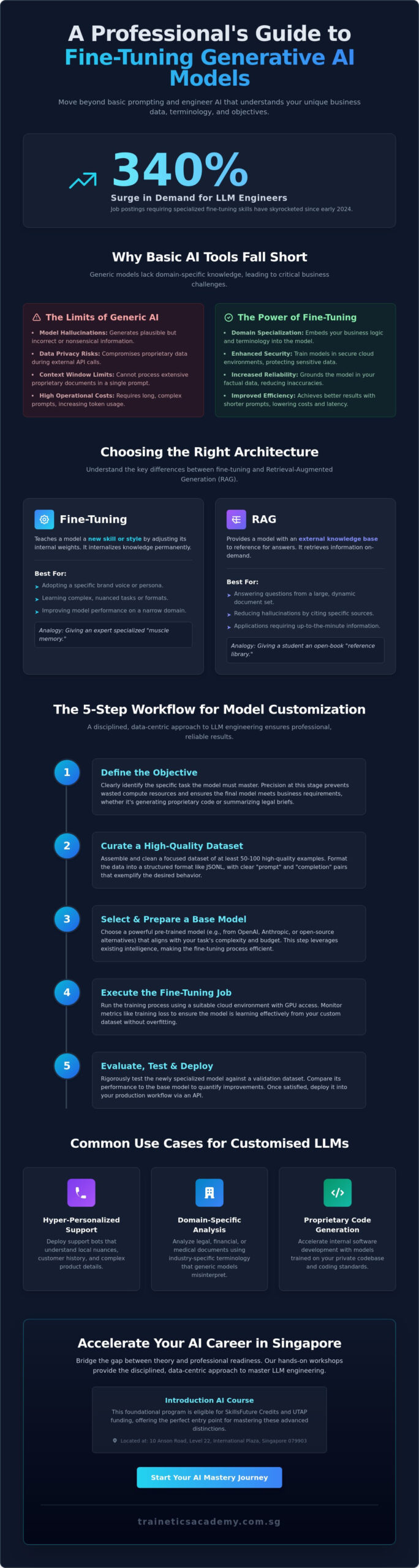
Job postings requiring specialized LLM engineering skills have surged by 340% since early 2024, signaling a new era of technical mastery in the digital economy. You likely recognize the frustration of generic AI tools producing hallucinations or the anxiety of compromising proprietary data privacy during model training. It’s clear that basic prompt engineering is no longer enough to maintain a competitive edge. Our professional fine-tuning generative ai models workshop empowers you to move beyond these limitations by establishing a rigorous, scientific framework for model customization.
This guide provides a comprehensive roadmap for specializing Large Language Models for your specific business data. You’ll understand the technical infrastructure required and learn how to distinguish fine-tuning from techniques like Retrieval-Augmented Generation (RAG). For those seeking hands-on guidance in a professional AI course Singapore, our Introduction AI Course is eligible for SkillsFuture Credits and UTAP funding. Located at 10 Anson Road, Level 22, International Plaza, Singapore 079903, this program is one of the premier SkillsFuture AI courses designed for those who value precision and professional readiness. We’ll now explore the strategic steps to ensure your mastery in this rapidly evolving field.
Key Takeaways
- Distinguish between Retrieval-Augmented Generation (RAG) and fine-tuning to determine whether your AI needs a reference library or specialized “muscle memory.”
- Master a structured 5-step workflow for model customization, focusing on precise objective setting and the curation of high-quality JSONL datasets.
- Identify the essential components of a professional fine-tuning generative ai models workshop, including hands-on GPU lab access and mentorship from production-level practitioners.
- Understand the technical infrastructure and cloud environments required to safely specialize Large Language Models for proprietary business use cases.
- Bridge the gap between theoretical AI concepts and professional readiness by adopting a disciplined, data-centric approach to LLM engineering.
What is Fine-Tuning and Why Does Your Business Need It?
Professional excellence in the field of artificial intelligence requires more than just utilizing off-the-shelf solutions. To truly lead in the 2026 Singapore tech landscape, businesses must transition from generic assistants to domain-specific experts. This transition is achieved through a process where a pre-trained model undergoes further training on a smaller, highly specific dataset. If you are researching What is Fine-Tuning?, it’s the bridge between a generalist AI and a specialized professional tool that understands your unique corporate DNA.
Attending a fine-tuning generative ai models workshop at our center, located at 10 Anson Road, Level 22, International Plaza, Singapore 079903, provides the technical foundation to execute this transition. This specialized training goes beyond standard SkillsFuture AI courses by focusing on high-level LLM engineering. Unlike foundational training which requires massive resources, fine-tuning leverages the intelligence already present in models like GPT-5 and refines it for specific tasks. This ensures every output aligns with your industry’s rigorous standards and technical terminology.
To better understand this concept, watch this helpful video:
The economic argument for this technical mastery is compelling. By specializing a model, you often reduce the need for long, complex prompts; this directly lowers token costs and improves response latency for high-volume operations. It also effectively addresses the “hallucination” problem. Generic models often guess when they lack specific data. A fine-tuned model is grounded in your factual corporate reality, significantly increasing the reliability and security of its responses.
Fine-Tuning vs. Prompt Engineering
While prompt engineering is a valuable skill, it eventually hits a “context window” limit. You simply cannot feed a model ten years of proprietary data in every query. Our Introduction AI Course is eligible for SkillsFuture Credits and UTAP funding, offering the perfect entry point for those who want to master these distinctions. Fine-tuning teaches the model a new voice or technical vocabulary permanently. It’s the difference between giving a student a textbook for an open-book exam and ensuring they have internalized the knowledge into their own professional identity.
Common Use Cases for Customised LLMs
We see transformative results across various sectors. Professionals who complete an AI Course in Singapore are now deploying hyper-personalized customer support bots that understand local nuances. Legal and financial firms use customized LLMs to analyze documents using industry-specific terminology that generic models often misinterpret. Internal software development teams are also using proprietary code generation models to accelerate builds while maintaining strict security protocols and international benchmarks.
How to Fine-Tune a Generative AI Model: A 5-Step Workflow
Mastering artificial intelligence requires a transition from passive consumption to active engineering. A professional fine-tuning generative ai models workshop moves beyond basic prompting to provide a structured, scientific approach to model refinement. Success in this discipline isn’t accidental; it’s the result of a disciplined five-step workflow that ensures your model meets international professional benchmarks and organizational standards.
Step 1: Defining the Objective. Every project begins with a clear, technical goal. You must identify exactly what task the model needs to master, whether it’s summarizing legal briefs or generating proprietary code for internal software teams. Precision here prevents wasted compute and ensures the model’s professional identity remains focused. Step 2: Data Curation. This involves gathering and cleaning high-quality JSONL datasets. In our AI course Singapore, we emphasize that data is the lifeblood of your model. Step 3: Selecting a Base Model. You must choose between open-source models like Llama 3 or high-performance closed-source APIs. With GPT-5 currently priced at $1.25 per million input tokens, your choice involves balancing long-term operational costs against specialized performance requirements. Step 4: The Training Process. This is where technical mastery happens. We utilize Parameter-Efficient Fine-Tuning (PEFT) to optimize the learning process. Step 5: Evaluation and Iteration. You must test your model against a “hold-out” dataset to ensure it can generalize its knowledge to real-world scenarios without losing its foundational capabilities.
Data Preparation: The Foundation of Success
High-level AI engineering prioritizes quality over quantity. You’ll find that 500 expert-level examples often outperform 50,000 noisy data points. It’s vital to format your data into prompt-completion pairs to guide the model’s learning path effectively. Before you begin, ensure total data privacy through rigorous anonymization and cleaning. This disciplined approach is a hallmark of our AI Course, where we prepare you for the technical demands of the modern industry while maintaining the highest standards of data security.
Understanding PEFT and LoRA
Technical efficiency is the cornerstone of modern AI development. Parameter-Efficient Fine-Tuning (PEFT) significantly reduces the hardware requirements for training large models by focusing on specific layers. LoRA is a technique that updates only a small fraction of model weights, allowing for rapid specialization without the need to retrain the entire architecture. By 2026, advancements in optimization mean you can now perform these complex tasks on consumer-grade hardware. This accessibility empowers professionals to build sophisticated tools without massive infrastructure costs, making SkillsFuture AI courses more relevant than ever for those seeking a prestigious career in tech.
Fine-Tuning vs. RAG: Choosing the Right Architecture
Selecting the optimal architecture is a critical decision for any lead developer or technical strategist. In our fine-tuning generative ai models workshop, we emphasize that this isn’t a binary choice but a strategic alignment with your specific business goals. Choosing the wrong path can lead to significant technical debt and inefficient resource allocation. You must determine whether your application requires a model that can look up information or one that has internalized specialized knowledge.
Think of Retrieval-Augmented Generation (RAG) as giving the AI a reference library; it can look up the most recent data on the fly. Fine-tuning is fundamentally different. It’s like giving the AI specialized muscle memory, embedding technical mastery directly into its internal weights. While RAG provides the “facts,” fine-tuning provides the “how,” including the tone, the logic, and the professional identity required for high-stakes environments. This distinction is vital for maintaining the high standards expected in the professional AI landscape.
In Singapore’s advanced tech hubs, the most sophisticated systems use a hybrid approach. They use RAG to inject real-time facts while relying on fine-tuned models to maintain a specific technical dialect or adhere to complex regulatory constraints. While API pricing makes RAG attractive for low-frequency tasks, high-volume applications requiring massive context windows often find that the investment in a fine-tuning generative ai models workshop and subsequent GPU hosting yields superior long-term ROI. The focus shifts from price-per-token to the total cost to achieve a successful result.
When to Choose RAG
Choose RAG when your data is dynamic and changes daily. If you’re tracking stock prices or local news, fine-tuning is simply too slow to keep pace with the shifting data. It’s ideal for massive knowledge bases that don’t require changes to the model’s underlying behavior. This path offers a lower initial technical barrier, making it a popular choice for those focusing on rapid deployment and factual accuracy over behavioral changes.
When to Commit to a Fine-Tuning Workshop
Commit to fine-tuning when the base model consistently fails to adopt your company’s unique voice or complex output formats despite perfect prompting. It’s essential for minimizing latency because you bake knowledge into the weights rather than passing thousands of tokens in every prompt. This approach is necessary for tasks where the base model lacks the domain-specific logic required for professional excellence. By internalizing these patterns, your AI becomes a more efficient and reliable extension of your professional team.
What to Look for in a Fine-Tuning Generative AI Models Workshop
Selecting a fine-tuning generative ai models workshop requires a discerning eye for technical depth and industry relevance. You should demand more than just theoretical lectures or surface-level coding exercises. A high-standard program must provide direct hands-on lab access to actual GPUs, such as NVIDIA H100 or A100 PCIe instances. This ensures you can navigate production-grade cloud environments and understand the real-world compute requirements for enterprise-scale projects. Expert mentorship is equally vital; you need practitioners who’ve successfully deployed models in high-stakes industries to guide your learning path.
Curriculum depth is another non-negotiable benchmark for professional excellence. Ensure the workshop covers modern optimization techniques like Quantized LoRA (QLoRA) and Reinforcement Learning from Human Feedback (RLHF). These methods are essential for creating models that are both memory-efficient and aligned with human values. Additionally, consider the networking opportunities within Singapore’s AI ecosystem. Connecting with other ambitious professionals fosters a culture of innovation and continuous improvement, which is a hallmark of any prestigious AI course Singapore.
The Importance of a Data-Centric Curriculum
Professional mastery involves prioritizing data engineering as much as model architecture. A visionary workshop teaches you to identify “poisoned” data that can degrade model performance or introduce subtle biases. You should also engage in practical exercises on synthetic data generation. This is crucial for niche industries where high-quality proprietary data is scarce. By focusing on data integrity, you ensure your specialized models meet international benchmarks for accuracy and safety.
Post-Workshop Support and Identity
Your transition from student to AI specialist requires building a professional portfolio that demonstrates tangible results. Access to alumni networks and ongoing technical updates is essential in this rapidly changing field. Completing a fine-tuning generative ai models workshop is just the beginning of your professional identity. For those planning a long-term career path, consult our AI certification Singapore 2026 guide to understand how different specializations fit together. We offer a supportive yet demanding environment designed to produce top-tier professionals who lead with confidence.
Ready to elevate your technical capabilities and secure your place in the future of tech? We invite you to explore our Artificial Intelligence Course and start your journey toward AI mastery today.
Accelerate Your AI Career with Trainetics Academy
Trainetics Academy stands as a visionary mentor in Singapore’s professional AI landscape. We don’t just teach software; we offer a professional identity rooted in excellence and technical mastery. Our immersive approach ensures you’re ready to meet the rigorous demands of a prestigious career from day one. This commitment to quality makes us a gateway for those who refuse to settle for generic training. Our fine-tuning generative ai models workshop serves as a critical milestone in this developmental journey, moving you from a user of technology to a primary architect of specialized intelligence.
The transition into high-level AI engineering requires a disciplined framework and a commitment to continuous improvement. We focus on producing practitioners who can navigate the complexities of model weights and data integrity with absolute confidence. This dedication to quality aligns with our mission to raise professional benchmarks across the region. When you join our community, you’re not just attending a class; you’re entering a supportive yet demanding environment designed to produce top-tier professionals who lead with technical authority.
Why Professionals Choose Trainetics
Our curriculum is designed by qualified professionals to meet international benchmarks and scientific standards. We prioritize practical, scientific validation over mere theoretical concepts, ensuring every technique you master is production-ready and technically sound. Small class sizes ensure direct interaction with industry leaders, allowing for a personalized learning path that satisfies the intellectual curiosity of advanced practitioners. This focus on individual growth and technical rigor is why our training programs are the preferred choice for those seeking a disciplined approach to career advancement.
Your Path to Becoming an AI Specialist
Your journey toward mastery begins with our foundational Artificial Intelligence Course. This program serves as the essential bedrock for more advanced technical specializations, providing the vocabulary and conceptual clarity needed for complex engineering tasks. As you progress, you’ll move into advanced modules focusing on model deployment and the robust evaluation systems discussed earlier. This structured progression ensures you build a deep, comprehensive understanding of the field rather than just learning isolated skills.
Transitioning into a specialized role requires a commitment to excellence and a professional network that supports your growth. After mastering the foundations, you’ll advance into workshops that focus on the technical infrastructure and regulatory frameworks essential for modern deployments. We’re dedicated to producing professionals who define the future of the industry through precision, disciplined innovation, and a relentless pursuit of excellence.
Lead the Future of AI Engineering
Mastering the technical nuances of model customization is a definitive step toward establishing your professional identity in the digital age. You’ve seen how fine-tuning transforms generic tools into specialized assets that understand your unique corporate DNA. By prioritizing high-quality datasets and leveraging advanced techniques like LoRA, you ensure your models meet the highest international benchmarks for precision and security. A specialized fine-tuning generative ai models workshop provides the hands-on environment necessary to transition from theoretical knowledge to production-level expertise.
Trainetics Academy has been a visionary mentor in this field since 2023, focusing exclusively on elite AI education. Our qualified professional instructors provide the scientific validation required to excel in Singapore’s competitive tech market. Strategically located in Singapore’s International Plaza, we’re dedicated to your success and professional readiness. Enrol in our professional Artificial Intelligence Course today and secure your place at the forefront of innovation. Your journey toward technical mastery starts with a single, disciplined step.
Frequently Asked Questions
How much data do I need for an effective fine-tuning generative ai models workshop?
Success in model specialization depends more on the integrity of your data than the sheer volume of records. While earlier sections highlighted the 500-example benchmark, a professional fine-tuning generative ai models workshop focuses on the diversity and technical accuracy of these samples. You must ensure your dataset represents the full spectrum of edge cases your business encounters to prevent the model from over-fitting on narrow patterns. Quality data acts as the primary driver for scientific validation in your AI applications.
Is fine-tuning more expensive than using standard AI APIs?
Fine-tuning requires a higher upfront investment in specialized compute but offers significant savings as your request volume scales. By internalizing complex instructions into the model weights, you reduce the number of tokens required for each prompt. This efficiency lowers the recurring costs associated with high-tier APIs, making it a more sustainable path for enterprises that require high-frequency, specialized outputs without the overhead of massive context windows. It’s a strategic shift toward long-term operational excellence.
Do I need a strong programming background for a fine-tuning workshop?
A functional grasp of Python and command-line interfaces is necessary to navigate the technical layers of LLM engineering. While the conceptual framework is accessible, the actual process of adjusting learning rates and managing JSONL files requires a disciplined, technical approach. We recommend that participants possess foundational coding skills to ensure they can fully engage with the hands-on labs and achieve professional-grade results. Technical mastery is the cornerstone of a prestigious career in this field.
Can I use SkillsFuture Credit for this advanced fine-tuning workshop?
Financial support from regional credits is currently reserved for our foundational certifications rather than these specialized technical labs. We recommend completing our primary AI training first to build the necessary scientific bedrock and professional readiness. This structured path ensures you have the prerequisite skills required to succeed in the more demanding environment of a specialized model engineering session while navigating the available support structures for continuing education.
How long does it take to see results from a fine-tuned model?
While the actual compute time for a fine-tuning generative ai models workshop lab can be completed in a few hours, the validation cycle is more extensive. You should account for the time needed to run comprehensive benchmarks and human-in-the-loop evaluations. This rigorous testing phase ensures the model adheres to your specific professional identity and maintains the high standards of accuracy required for production environments. Real-world impact is realized once the model consistently outperforms generic alternatives.
Is my company data safe when fine-tuning models in a workshop setting?
What is the difference between supervised and unsupervised fine-tuning?
Supervised fine-tuning guides the model toward specific outputs using labeled pairs, whereas unsupervised methods focus on absorbing a vast corpus of domain knowledge without explicit targets. Most professional applications rely on the supervised approach to achieve precise behavioral control. This ensures the AI doesn’t just learn a subject, but masters the specific logic and formatting required for your organization’s unique operational workflows. It’s the difference between general reading and targeted professional training.
Will fine-tuning help reduce the hallucination rate of my AI?
Fine-tuning is a powerful tool for grounding an AI in your specific ground truth, effectively narrowing its probability distribution toward factual accuracy. By teaching the model exactly what “correct” looks like in your industry, you significantly decrease the likelihood of it generating irrelevant or false content. This builds a sense of security and trust in the system, turning a generalist tool into a reliable professional expert. Grounding your AI in reality is essential for maintaining professional benchmarks.
Disclaimer
AI Content Disclaimer: Some articles on this website may be generated or assisted by AI-powered content creation tools. While we strive for accuracy and relevance, readers should independently verify information before relying on it. The content is provided for informational purposes only and does not constitute professional advice.