Start with one priority use case, then add others only when each has a clear business outcome and a way to measure it. That is a practical foundation for how to build a business case for AI training: link learning to a real workflow, estimate the costs, and compare expected benefits with the investment.
It is reasonable to seek visible returns from training while building the skills and judgement your organisation will need as AI use grows. A strong business case accounts for both, without treating AI itself as the goal.
This guide explains how to identify suitable use cases, estimate training and implementation costs in Singapore dollars, and compare conservative, moderate, and optimistic ROI scenarios. It also covers how to balance early efficiency gains with longer-term strategy, assess risks such as adoption and workflow disruption, and create a concise checklist to support an informed investment decision.
Key Takeaways
- Choose AI training use cases based on clear business goals, measurable workflow changes, and the people who will use the skills.
- Compare conservative, moderate, and optimistic benefit scenarios to see how sensitive the investment case is to adoption and results.
- Estimate the full cost of training, implementation, data preparation, and ongoing maintenance, including the time staff spend adapting to new workflows.
- Balance near-term efficiency gains with longer-term opportunities, and reassess priorities at regular milestones.
- Document key risks, accountable owners, success measures, and mitigations in a concise business case before committing resources.
Using sensitivity analysis for alternative ROI scenarios
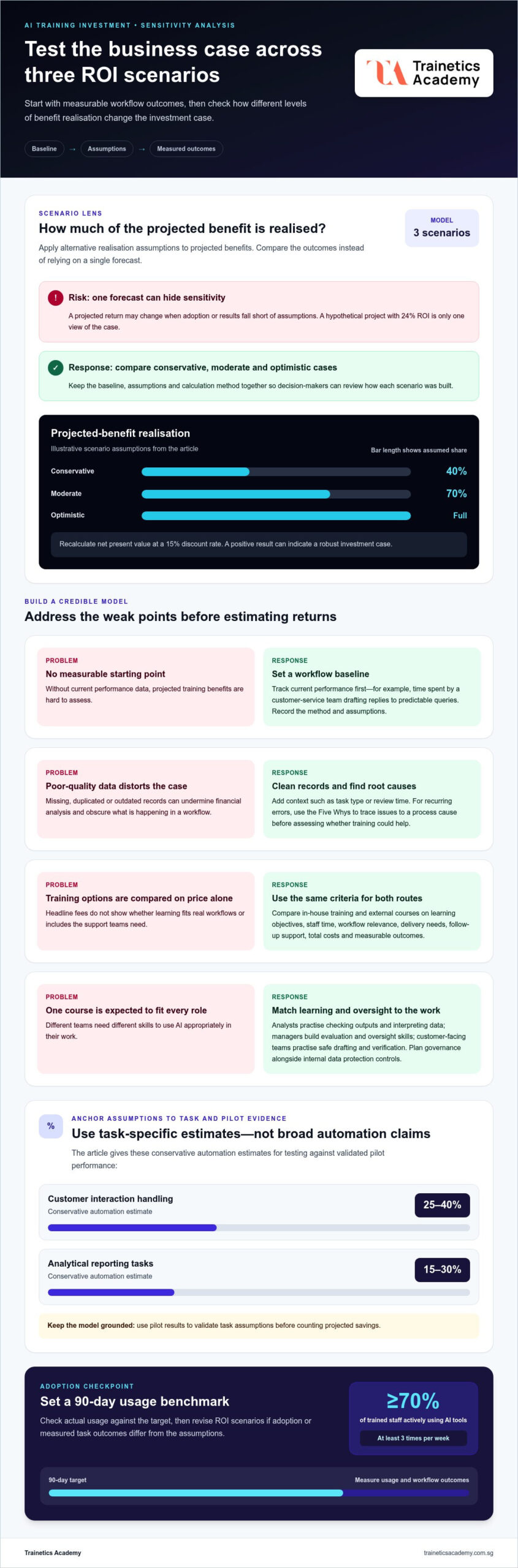
Build the case around measurable business outcomes, then test how changing assumptions affects the return. For example, model benefits at forty percent, seventy percent, and full realisation to compare conservative, moderate, and optimistic scenarios.
To see how a formal business case assesses options and costs, watch this project planning video:
- Set a baseline and vary the assumptions. Record current performance before estimating training benefits. For example, a customer-service team can track time spent drafting replies to predictable queries. Model how training might help employees use AI for part of that work, then test lower and higher adoption levels. Keep the baseline, assumptions, and calculation method together so decision-makers can review them.
- Compare scenarios, not a single forecast. Apply forty percent, seventy percent, and full realization of projected benefits to your conservative, moderate, and optimistic cases. A hypothetical AI project with a 24% ROI can look compelling, but lower adoption may change the result. Recalculate net present value at a fifteen percent discount rate; a positive result can indicate a robust investment case.
- Compare in-house AI training with external courses. Assess both options against the same criteria: learning objectives, staff time, relevance to actual workflows, delivery needs, and follow-up support. In-house training can use internal processes as examples, while an external course can provide structured learning. Compare total costs and measurable outcomes, not just headline fees.
- Use clean data and root-cause analysis. Check for missing, duplicated, or outdated records before using performance data in financial analysis. Add context, such as task type or review time, so the assessment reflects real work. If a workflow has recurring errors, use the Five Whys: ask why each issue occurred until the process cause is clear, then assess how training could address it.
- Match training and governance to the work. Identify the AI skills employees need in different roles. Analysts need practice checking outputs and interpreting data; managers need evaluation and oversight skills, while customer-facing teams need safe drafting and verification habits. For governance in Singapore, use the Second Edition of the Model AI Governance Framework, published by PDPC and IMDA, to structure oversight and responsible-use planning alongside internal data protection controls.
- Test funding assumptions before counting savings. Which Singapore grants or subsidies could support AI training for businesses? Assess SkillsFuture support and UTAP against the specific course and participant eligibility, and include funding only when the relevant criteria are met. This prevents projected subsidies from making an otherwise weak financial case appear viable.
Test funding assumptions against validated pilot performance. For customer interaction handling, apply a conservative automation estimate of twenty-five to forty percent; for analytical reporting tasks, use fifteen to thirty percent. These task-specific estimates keep projected benefits tied to pilot results rather than assuming broad automation.
Then set a 90-day target of at least 70% of trained staff actively using AI tools at least three times per week. Review actual adoption against that benchmark and revise the ROI scenarios if usage or measured task outcomes differ from the assumptions.
Balancing quick wins with long-term AI strategy
Use AI training to advance business goals, not to make AI the goal. Distinguish early workflow improvements from capabilities that support future growth.
Align AI Training with Business Strategy
Map each training initiative to a business priority, such as improving service quality, reducing repetitive work, or developing new offerings. Then assess how the use case supports competitive positioning and which teams can apply what they learn. A compelling case links the training format to measurable outcomes, rather than treating course completion as the result.
Traditional ROI calculations often use a 1-3-year horizon, but AI benefits can emerge at different speeds. Returns from experimenting and early adoption fall within 0-12 months, while transformation and scaling may take 2 or more years. Use both horizons when comparing initiatives, and determine which use cases make sense now versus later.
Set the Data Strategy
Identify the data employees need to apply AI skills to real work. Document where relevant information comes from, who maintains it, and whether teams can access it for the intended workflow. For example, a reporting team needs consistent source data before it can use AI effectively to draft or analyse reports.
Prioritise data quality and responsible access before expanding a use case. Disconnected records, unclear ownership, or inconsistent formats can limit employees’ ability to apply their training. Include data preparation in the plan, then check that each use case has suitable inputs and a clear process for handling outputs.
- Pair quick wins with change management. Choose a practical workflow where staff can test new skills without redesigning the entire operation. AI adoption may deliver 40-60% of theoretical maximum time savings during the first six months, so set expectations around learning and workflow adjustment. Explain why the change matters, show how the new process fits existing responsibilities, and give managers a role in reinforcing it.
Nearly 80% of AI projects typically do not scale beyond a proof of concept or lab environment. Plan for adoption from the outset: assign workflow owners, collect staff feedback, and decide how a successful pilot will move into routine operations. This keeps a quick win connected to a scalable strategy.
- Balance the initiative portfolio. An example allocation reserves 20-25% of initiatives for innovation and new services, 20-25% for customer value and growth, and 20-25% for operational excellence. It assigns 10-15% to responsible business transformation, with another 20-25% tied directly to revenue, margin, and profit. Use these categories as a discussion format, not a fixed rule.
- Review progress at defined milestones. Set measurable checkpoints at ninety-day intervals to reassess business-case scenarios and investment decisions. A useful target is at least three hours of weekly time savings per participant within 90 days, alongside meaningful AI use in at least two distinct workflows. Compare results with the original objectives, then continue, refine, or defer each initiative based on evidence.
Estimating AI acquisition, implementation, and maintenance costs
Build a full cost structure before comparing investment with expected outcomes. Compare expected benefits with total investment, and use a payback estimate to assess how long it may take for benefits to cover the initial outlay.
Calculate Training and Implementation Costs
List each cost category in Singapore dollars, including training, staff time, AI tools, data work, integration, and maintenance. Separate one-time project expenses from recurring charges so leaders can see the financial commitment over time.
Count staff opportunity cost as hours spent in training or implementation multiplied by the relevant loaded hourly cost. Include time for practice and workflow adjustment, not only classroom hours. Data engineering can account for 50-70% of upfront AI investment, while model building, business analysis, storage, CPU/GPU costs, and software licences can account for 30% to 50% of project costs. Treat these as separate estimates, not additive percentages.
Quantify Initiative Costs and Benefits
Define the project boundaries before assigning values. For a document-processing initiative, include training and data preparation, then estimate benefits such as reduced manual handling, fewer corrections, or faster completion. Use current operational records to establish the baseline, and count only benefits the team can measure.
Gartner research states that data preparation and integration typically consume 50-65% of AI project resources. Include these activities alongside tool and implementation costs, rather than treating them as incidental. Keep non-financial outcomes, such as improved knowledge or service consistency, visible in the business case without assigning unsupported monetary values.
Compare Projected and Actual Costs
Set a budget baseline for each project phase, then record actual spending against the same categories. The blueprint recommends projected costs at each phase remain within 5% of actual costs. Track variances in training hours, integration effort, tool usage, and maintenance, and document why each difference occurred.
Use a Singapore-dollar ledger that separates acquisition, implementation, training, and ongoing support. Review it at phase gates and update the forecast when actual usage changes. This helps a business partner or finance lead distinguish a one-off variance from a recurring cost that affects the investment strategy.
- Calculate ROI and payback over consistent periods. Subtract annual operating costs from annual benefits to find net annual benefit, then divide by total investment to calculate ROI. For payback, divide the initial investment by monthly net benefit. If benefits build gradually, use a month-by-month cash-flow schedule instead.
Keep the comparison consistent: match annual benefits with annual costs, and include maintenance in each relevant period. For example, if staff training saves time but requires ongoing tool costs, subtract those costs before calculating payback. Review projected and actual figures with project leaders, then update the forecast when measured outcomes differ.
Identifying AI training investment risks and mitigations
Measure success by whether employees can apply AI skills reliably in their roles. Useful indicators include task quality, review effort, exception rates, and whether staff follow the organisation’s approved workflow. Compare results with the existing process, then investigate differences before attributing them to training.
- Test adoption assumptions. Estimate how participation could affect projected benefits, then compare those assumptions with actual use. If employees avoid a trained workflow, identify the barrier: limited access, unclear responsibilities, or a poor fit with daily tasks. Assign an owner to address it, and do not scale the initiative until the cause is understood.
- Control output-quality risks. Identify tasks where an incorrect AI response could cause rework or affect a business decision. Define a review process that states who checks the output and what evidence they must verify. Track corrections and escalations by task type so managers can distinguish a training gap from a limitation in the workflow or model.
- Assess data exposure. Map the information employees may use with AI tools, then define which data belongs in each workflow. Include a practical exercise, such as asking staff to classify sample records before entering a prompt. This can show whether guidance is clear and whether teams can apply it consistently in their work.
- Stress-test the financial case. For AI deployments, the research recommends adding a technology risk premium of three to seven percentage points to the baseline cost of capital. Recalculate the investment case using that assumption. Record dependencies such as tool access, integration, and data quality, then show how changes to each could affect expected costs or benefits.
- Assess the risk of inaction. Project possible competitive disadvantage across twelve-, twenty-four-, and thirty-six-month horizons. For each period, describe a specific business exposure, such as slower analysis or difficulty adapting an existing service. Compare those consequences with the resources needed to develop relevant employee capabilities, rather than treating every AI opportunity as equally urgent.
- Reduce knowledge loss. Attrition can weaken the return on senior AI training investments when trained staff leave. A 12-month training commitment is one mitigation identified for this risk. Also document key practices and build knowledge-sharing into project routines, so useful insights remain accessible to colleagues and future team members.
- Assign mitigation owners. Give each risk a named owner, a review point, and a response if conditions change. For example, a project lead can review output corrections with the relevant manager and adjust the workflow or learning materials. This makes risk assessment an ongoing process rather than a static section in the investment proposal.
Building a checklist for an AI/ML business case
Use a concise checklist to connect an AI training decision with business outcomes. Keep the core case to a maximum of two pages, with detailed working assumptions attached separately.
- Define the business problem and market context. State which process needs improvement and why it matters now. For example, a service team might target repeated delays in drafting routine replies. Describe the market pressure or customer expectation behind the issue, then explain how AI skills could help address it. Define the business need before proposing a particular tool.
- Select use cases with clear owners. Choose use cases linked to an objective and an accountable team. Compare candidates by business value, workflow readiness, data suitability, and the effort needed to apply new knowledge. A concise shortlist helps stakeholders decide what to train for first and what to defer, rather than spreading effort across disconnected experiments.
- Specify outcomes and measures. Define how the initiative should change people, processes, and workflows. For a reporting task, measures might include turnaround time, correction frequency, and staff confidence in using AI outputs. Record the baseline, intended outcome, measurement method, and responsible person. Strong measures show whether training changes work, not just whether employees attended.
- Document the financial scenario and alternatives. Summarise training, staff time, tools, implementation, and maintenance costs in Singapore dollars. Compare the proposed approach with a credible alternative, such as delaying investment or addressing the workflow without AI. Show conservative, moderate, and optimistic benefit assumptions, and explain which inputs could change the decision. This makes the case useful when leaders challenge projections.
- Write the implementation plan. Describe the steps needed to achieve the business objective, including resources, the project team, milestone owners, and risk mitigations. For example, identify who prepares workflow data, who guides staff practice, and who reviews AI-assisted outputs. Assign clear accountability so stakeholders can link each milestone to a role and business outcome.
- Make risk controls part of the decision. Record the main operational, data, adoption, and output-quality risks alongside their mitigations. For example, if incorrect generated content could reach customers, specify a human review point and a way to log corrections. Include governance responsibilities and permitted data-use boundaries relevant to the Singapore workplace.
- Set a review rule before approval. State when the team will compare actual results with the chosen scenario, and what evidence would prompt continuation, revision, or a pause. Keep the main case within two pages; use supporting schedules for detailed calculations and assumptions. To connect the plan with structured employee learning, explore an Artificial Intelligence Course as a training option.
Trainetics Academy: Artificial Intelligence Course
Trainetics Academy offers an Artificial Intelligence Course for businesses whose cases identify an AI skills gap. Use the priorities already defined, such as safe tool use, output review, or applying AI knowledge to a specific workflow, to guide your training decision.
An AI course can help employees develop foundational knowledge before teams assess broader implementation needs. Keep the learning objective connected to the business outcome, and use your chosen measures to evaluate how training supports employees’ work.
Visit traineticsacademy.com.sg to explore the Artificial Intelligence Course.
Turn your training plan into a practical next step
Choose a team and connect its learning plan to a live workflow. A practical way to build a business case for AI training is to define how employees will apply what they learn in their daily work.
Keep the next step focused on implementation. Give team leaders room to gather feedback and refine the learning plan as employees put new skills into practice.
If you’re ready to discuss your organisation’s training priorities, get in touch. Move forward with purpose and a clear direction.
Frequently Asked Questions
How many use cases should you define?
There is no universal number; define cases separately when they lead to different investment decisions. If two proposed applications share learners, tools, and workflows, group them under one case unless their intended outcomes differ. For example, drafting internal updates and customer messages may need separate treatment if the audience, review process, or business decision differs. This keeps the scope clear without multiplying cases unnecessarily.
What should an AI training business case include?
Make the decision explicit, for example, whether leaders should fund a defined training initiative or defer it. State the scope, key assumptions, dependencies, and conditions that would prompt a review. Keep detailed calculations and supporting evidence separately, labelling each input with its source and date. This helps decision-makers distinguish estimates from commitments and understand what the proposal asks them to decide.
How to estimate productivity gains from AI training?
Separate time released from cash saved. Estimate productive capacity by multiplying time saved per task by task volume and realistic employee uptake, then subtract time spent checking outputs or correcting rework. For example, hours freed by preparing internal summaries may let staff handle other priorities, but do not automatically reduce payroll or operating costs. Count a financial saving only when the organisation can identify a corresponding cost reduction.
What are the risks and limitations of AI training investments?
Training develops employee capability, but it does not prove that learning will transfer across roles or remain useful as work changes. For example, an employee who can use AI for routine summaries may need different practice for specialised analysis. Treat course learning and workplace performance as separate outcomes, and consider whether employees need further learning as their responsibilities or tools evolve.
Disclaimer
AI Content Disclaimer: Some articles on this website may be generated or assisted by AI-powered content creation tools. While we strive for accuracy and relevance, readers should independently verify information before relying on it. The content is provided for informational purposes only and does not constitute professional advice.