Learning AI can open up new ways to contribute at work, but a pay increase is not automatic. To get a pay raise after learning AI, show how you have applied your skills to work your employer values and bring evidence your manager can assess.
It’s understandable to wonder whether AI training matters in your role, or whether a request for higher pay will sound premature. Completing a course shows that you have invested in learning, but practical examples make your case more credible: a process you improved, useful insights you uncovered, or time you saved while carefully checking AI outputs.
This article will help you identify role-relevant examples, document their impact and prepare a clear, professional conversation with your manager. You’ll also learn how to choose AI training that supports your longer-term career goals. Whether you’re exploring an AI course in Singapore or building on skills you already have, focus on applying what you learn responsibly and connecting it to contributions you can demonstrate.
Key Takeaways
- Separate completing AI training from applying AI at work and earning a raise. Learning can support your case, but it can’t guarantee a pay change.
- Build evidence your manager can assess by choosing a task, noting its starting point, applying AI responsibly and reviewing the result.
- Compare a pay adjustment with expanded responsibilities, promotion or a development plan to identify the recognition that best fits your goals and role.
- Prepare to get a pay raise after learning AI by reviewing your responsibilities, selecting relevant evidence and rehearsing a clear request.
- Choose AI training that aligns with your work and next career step. Consider course content, instructor experience, learning format and interactive practice.
Can Learning AI Help You Get a Pay Raise? Start with the Evidence
Learning AI, applying it at work and receiving a pay increase are three separate steps. Training builds knowledge. Applying that knowledge means using it appropriately in a real task, with human judgement and accountability. A raise is an employer’s decision, shaped by your contribution, role scope, compensation processes and the evidence you can present.
That distinction sets realistic expectations: an AI course can help you prepare to contribute, but it can’t guarantee a change in pay. A stronger case connects what you learned to work that matters in your role, then shows how your contribution relates to your responsibilities and expectations. The question isn’t simply whether you use an AI tool. It’s whether you can explain what improved, how you know and why that improvement matters to your team.
AI learning supports a raise discussion when it strengthens demonstrable work contributions. Keep the claim proportionate. If you can show clearer analysis or a more consistent process, describe that. If you haven’t measured an effect, don’t turn an impression into a quantified result. Your manager can assess a specific, well-supported example more readily than a broad claim about AI’s potential.
For example, an employee might use AI to help organise information for a recurring report, then check the output, correct errors and follow workplace requirements for handling information. Useful evidence would describe the task’s original challenges, the employee’s review steps and any verifiable change in quality, turnaround or rework. The example is persuasive only if the employee can substantiate those changes and explain their own contribution.
What employers may value beyond familiarity with AI tools
Knowing how a tool works is only a starting point. Employers may value whether you can identify a suitable problem, judge when AI output needs correction, communicate limitations and take responsibility for the final work. Those capabilities apply across roles, but the tasks and outcomes that matter will differ by employer and team.
There’s a meaningful difference between asking a tool to draft text and improving a process responsibly. Improvement might involve setting clear review steps, reducing avoidable hand-offs or making information easier for colleagues to use. Describe the steps you took and the evidence available. Don’t assume that using a particular tool, by itself, demonstrates greater value.
A foundational Artificial Intelligence course can help you build knowledge for practical workplace application. Interactive learning and instruction from experienced professionals can support your understanding, but your raise case still rests on how you apply that learning in your role.
Why salary headlines are not personal pay forecasts
Broad salary headlines can make a pay increase seem like an expected outcome of learning AI. They can’t account for your responsibilities, your employer’s compensation process or the evidence behind your contribution. A figure drawn from another role, organisation or market is not a personal pay forecast, and it may not reflect the context of your workplace in Singapore.
Assess your own situation instead: how your responsibilities have changed, what your employer’s review process considers and what evidence supports your contribution. A headline percentage cannot account for those details. Use role-relevant examples to open a grounded conversation, then discuss compensation in line with your employer’s process and your professional goals.
Turn AI Skills into Work Evidence Your Manager Can Assess
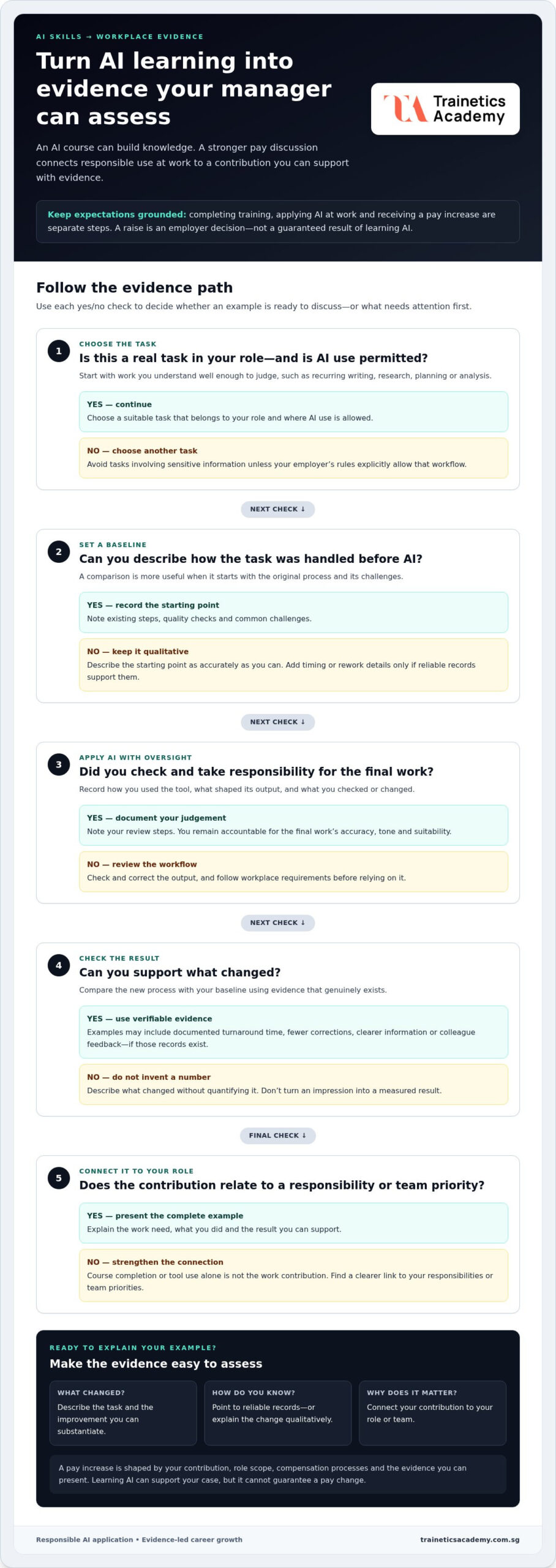
A useful evidence record shows more than which AI tool you tried. It connects a real work need to your approach, your judgement and an outcome you can support. Keep the process simple and repeatable. This makes it easier to explain your contribution without presenting personal learning activity as a business result.
- Choose a suitable task. Select recurring writing, research, planning or analysis that belongs to your role and where AI use is permitted. Avoid tasks involving sensitive information unless your employer’s rules explicitly allow the workflow.
- Record the baseline. Describe how the task was handled before using AI. Note existing steps, quality checks or common challenges. Add timing or rework details only if reliable records support them. Otherwise, keep the baseline qualitative.
- Apply AI with oversight. Record how you used the tool, what instructions or inputs shaped the output, and what you checked or changed. You remain accountable for the final work, including its accuracy, tone and suitability.
- Review the result. Compare the new process with the baseline using evidence you can substantiate. This could include documented turnaround time, fewer corrections, clearer information or feedback from colleagues, if those records genuinely exist.
A strong pay-raise case links an AI-assisted contribution to a specific work need. The link matters: your example should show how your actions supported a responsibility or team priority, not simply that you completed a course or experimented with a tool. If an outcome can’t be measured reliably, describe what changed without attaching an unsupported number.
Choose a work task where AI use is appropriate
Start with a task you understand well enough to judge the output. For instance, a project coordinator might use an approved AI workflow to organise non-confidential planning notes into draft action categories, then check each item against the source material before sharing it. The evidence is the controlled process and its relevance to the role, not an assumption that AI automatically made the work faster or better.
Use only tools and workflows your employer permits. Keep human review visible: note which parts you accepted, revised or rejected, and who was responsible for the final decision. This demonstrates practical judgement alongside familiarity with AI.
Record evidence without overstating results
Maintain a concise log for each example: the task, the work need, the AI-assisted approach, your review steps and the outcome. If reliable records establish a baseline, compare like with like. If they don’t, avoid numerical claims and label observations accurately. Don’t include confidential prompts, client details or internal documents in your notes unless workplace rules allow it.
Separate what you learned from what you delivered. A course or practice exercise shows development; a verified workplace contribution shows application. If you’re building the foundation for responsible use, an Artificial Intelligence course can support practical learning. Apply that knowledge to create work evidence your manager can assess, without overstating what the training itself achieved.
Compare a Pay Raise Request with Other Ways to Recognise AI Growth
A pay adjustment is one way to recognise professional growth, but it isn’t the only useful outcome to discuss. You may be seeking higher compensation for established contributions, clearer recognition of expanding duties, a route towards a more senior role or support to keep developing. These are different conversations, so identify your priority before deciding what to ask for.
Use this comparison to frame the discussion. What’s realistic will depend on your role scope, your employer’s processes and priorities, and the evidence you can bring. None of these options is guaranteed or available in every workplace.
When a direct pay-raise request may fit
Consider a direct request if your evidence connects to current responsibilities and shows a sustained contribution, rather than a single trial with an AI tool. Be ready to explain the work need, your role in addressing it and the outcome you can substantiate. Raise compensation professionally and in line with your employer’s review process. Keep the discussion grounded in your responsibilities, not just your enthusiasm for AI.
When to discuss progression or development instead
If AI-related work is changing your scope, discuss how those responsibilities fit your role and what progression could involve. If your workplace evidence is still developing, a development plan may help clarify what to practise and how your contribution will be assessed. Agree on clear expectations without assuming a particular timeline, title or outcome.
To get a pay raise after learning AI, decide whether your main goal is an immediate compensation review, recognition of expanded scope, progression or further learning. You can also build foundational knowledge through an Artificial Intelligence course and connect that learning to the path you want to pursue. A focused conversation helps your manager understand both the contribution you’ve made and the recognition you’re seeking.
How to Ask for a Pay Raise After Learning AI
A well-prepared conversation gives your manager a clear view of your responsibilities, your contribution and the compensation discussion you’re requesting. Don’t make course completion the centrepiece. Present your learning as context, then focus on how you’ve applied it to work that matters. Before setting a meeting, review your employer’s existing performance or salary review process so your request fits the appropriate channel.
- Review your responsibilities. Identify your current priorities and any duties or expectations that have changed. This helps frame your request around the role you perform, not AI skills in isolation.
- Select your strongest evidence. Choose workplace examples you can substantiate, and connect each one to a specific need or priority. Keep the supporting details concise.
- Prepare the request. State clearly that you’d like to discuss a pay adjustment. Explain why you believe your contribution supports that conversation, without assuming the outcome.
- Rehearse your opening. Practise explaining your case in a calm, direct way. Prepare to listen and respond to questions rather than trying to deliver a memorised pitch.
Prepare a concise case before the meeting
Organise your notes around your role, relevant AI learning and strongest work examples. For each example, explain the need it addressed, what you contributed and how the result relates to team or business priorities. Keep facts separate from your interpretation, and avoid unsupported claims. Then state the compensation discussion you want while staying open to feedback about how your case fits the employer’s process.
A professional opening could be: “I’d like to discuss how my responsibilities and recent contributions are reflected in my compensation. I’ve applied my AI learning to work relevant to our team’s priorities, and I’ve brought a few examples to explain the contribution. Could we talk about whether a pay adjustment is appropriate under our review process?” This invites a discussion without implying that a particular decision is due.
Keep the meeting focused. Share the most relevant examples first, then pause for your manager’s perspective. If you’re building practical AI knowledge, connect that learning to the responsibilities you want to strengthen, rather than treating training alone as the basis for a pay request.
Respond constructively to questions or a no
Your manager may ask for further evidence, explain that a review must follow a particular process or decline the request. Listen carefully and ask what contribution or expectations would support a future review. Clarify any next steps, responsibilities and how progress will be assessed. A no in one conversation doesn’t settle every future discussion, but neither does it guarantee a later increase.
- If more evidence is needed, ask which work outcomes would be most useful to document.
- If responsibilities are changing, clarify the expected scope and how it will be recognised.
- If the request isn’t moving forward, ask whether there’s a suitable point to revisit the discussion under the employer’s process.
To get a pay raise after learning AI, approach the meeting as a professional exchange: make a clear request, support it with relevant evidence and leave with a better understanding of expectations, whatever the immediate response.
Choose AI Training That Supports Your Next Professional Step
Choose training by starting with the work you want to do better, not with a promise of higher pay. Identify a task you handle now or a capability you want to build, then consider what foundational AI knowledge would help you approach it responsibly. This creates a practical bridge between learning and workplace application while keeping expectations grounded: a course can build capability, but it can’t promise a salary increase or a particular job outcome.
What to look for in an AI course
Assess how well the learning experience fits your professional starting point and goals. Course content should help you build knowledge you can apply, while the instructor’s experience and opportunities for interactive practice can shape how confidently you engage with the material. If you’re comparing AI courses for beginners, focus on whether the material suits your current understanding and the skills you want to use at work.
Format matters, too. Online learning may suit your schedule and circumstances, while offline classes may better match your preference for in-person participation. If you’re considering a 1 day AI course Singapore option, look closely at whether its scope aligns with your learning goals rather than assuming a shorter format will cover everything you need. Trainetics Academy’s Artificial Intelligence course features interactive learning with experienced instructors, with online and offline learning options.
For a focused decision, write down:
- Your starting point: What do you already understand about AI, and what concepts do you need to strengthen?
- Your work goal: Which task or responsibility would you like to approach with more knowledge?
- Your learning preferences: Would instructor guidance, interactive practice or a particular class format help you learn effectively?
This simple check can help you choose training for its relevance and learning value, not because you expect a course alone to change your compensation.
Connect learning to workplace application
Before studying, choose a practical question to revisit afterwards. For example, you might ask how AI could assist with organising information for a recurring work task, while keeping your employer’s rules and your own judgement central. After learning foundational concepts, consider whether the approach is appropriate, what review it would require and how you could assess its usefulness without exposing confidential information.
If you’re comparing SkillsFuture AI courses, assess the specific course content and learning experience against your goals rather than assuming every course has the same focus or funding status. Then connect those criteria to your responsibilities and next step. If you’re ready to build foundational knowledge, explore Trainetics Academy’s Artificial Intelligence course as a learning option for practical application.
If your longer-term goal is to get a pay raise after learning AI, choose training that supports relevant workplace capability, then apply what you learn thoughtfully. That gives you a sounder basis for developing your skills and deciding what evidence to build over time.
Build Your Next Career Step with Purpose
Your next move doesn’t have to depend on a single conversation about compensation. Treat AI learning as part of a longer professional plan: choose a skill to strengthen, look for opportunities to apply it responsibly, and keep developing the judgement that helps you contribute well. That steady progress can support future conversations about your role and growth.
If you want to get a pay raise after learning AI, anchor your ambition in the work you’re ready to take on and the value you can demonstrate. Learning can help prepare you for new challenges, but your career direction will be shaped by how you apply that knowledge and continue to grow.
Trainetics Academy offers an Artificial Intelligence course for learners building workplace knowledge. Learner testimonials praise the course quality, instructor expertise and personal improvement. Explore the Artificial Intelligence course and take a step towards developing your AI capability. Keep learning with purpose, apply your skills thoughtfully and move forward with confidence.
Frequently Asked Questions
Is learning AI enough to get a pay raise?
Not by itself. To get a pay raise after learning AI, connect your new knowledge to responsibilities your employer values. For example, if you’ve learned to assess AI-generated summaries, identify a suitable work task where that judgement could help, then clarify which outcomes matter to your team. Keep learning activity separate from workplace results, and use your employer’s review process to decide when to discuss compensation.
Can I ask for a pay raise if I use AI in my current role?
Yes, you can raise the topic professionally, provided you follow your workplace’s process. Before requesting a meeting, consider whether your AI use supports a responsibility you’re already accountable for or a priority your manager has identified. Be ready to explain your own role in the work and how you checked the final result. That makes the conversation more focused than simply saying you use AI regularly.
How can I show my manager that AI skills add value?
Prepare a brief, manager-friendly account of one relevant contribution. State the work need, what you handled, where AI assisted and what you verified yourself. Then explain why the result matters to your team, such as making information easier to act on. If you have a real document or feedback that supports your point, refer to it. Don’t create a metric after the fact or present an estimate as a measured result.
Should I tell my employer that I used AI for a work task?
Follow your employer’s policies and expectations about disclosing AI use. If you’re unsure how a particular workflow should be handled, clarify expectations through the appropriate workplace channel before using it. In a discussion about your work, be specific about which parts AI supported and which decisions you made or checked. Never enter confidential or sensitive material into a tool unless your workplace permits that use.
What should I do if my manager says no to a raise?
Ask for constructive feedback and what would need to change for your request to be reconsidered. You could clarify whether the decision relates to your evidence, role expectations, timing or the employer’s process, without assuming the reason. Before ending the conversation, confirm any agreed next steps and how you’ll know whether you’re making progress. Use the feedback to guide your development rather than treating one response as a verdict on your potential.
How do I choose an AI course for my career goals?
Start with a capability you want to build for your current or intended work, then compare course topics with that goal. Consider whether the level suits your starting point, how much instructor guidance you prefer and whether interactive learning will help you practise concepts. In Singapore, professional development should fit both your career direction and the work context where you plan to apply your learning. Treat training as capability-building, not a promise of higher pay.
Disclaimer
AI Content Disclaimer: Some articles on this website may be generated or assisted by AI-powered content creation tools. While we strive for accuracy and relevance, readers should independently verify information before relying on it. The content is provided for informational purposes only and does not constitute professional advice.