Did you know that 82% of small business owners are now leveraging AI to drive efficiency, yet many leaders still struggle to maintain professional standards amidst the surge of automated output? Mastering how to lead a team that uses AI tools effectively isn’t about technical coding; it’s about establishing a disciplined framework for human-AI collaboration. You likely feel the pressure to innovate while fearing that AI-generated errors might undermine your reputation. It’s a common tension for visionary mentors who value precision and scientific validation in their operations.
This guide promises to equip you with the strategic oversight required to manage an AI-integrated workforce with absolute confidence. You’ll learn to overcome team resistance and identify which tools actually drive measurable ROI for your specific business goals. We’ll examine the shift from simple assistants to autonomous agents and highlight how an Introduction AI Course eligible for SkillsFuture Credits and UTAP funding can bridge the skills gap. From our headquarters at 10 Anson Road, Level 22, International Plaza, Singapore 079903, we provide the roadmap for raising your professional benchmarks in this new era of bionic work.
Key Takeaways
- Transition from traditional management to a bionic workforce model that prioritizes the synergy between human creativity and generative efficiency.
- Master the essential competencies of strategic prompting and ethical oversight to understand how to lead a team that uses AI tools effectively while maintaining high professional standards.
- Apply a systematic 5-step framework to audit your current workflows and pilot specific productivity tools that deliver measurable ROI.
- Develop robust governance protocols to prevent critical thinking atrophy and ensure all AI-generated outputs meet your organization’s rigorous quality benchmarks.
- Identify high-impact Artificial Intelligence courses that provide the technical mastery and professional readiness required for a competitive edge in 2026.
Table of Contents
The Evolution of Leadership: Managing AI-Augmented Teams in 2026
Upskilling Your Team: Choosing an Artificial Intelligence Course
The Evolution of Leadership: Managing AI-Augmented Teams in 2026
The workforce of 2026 operates as a hybrid collective of biological intelligence and generative systems. This "bionic worker" model represents a significant departure from the traditional organizational structures of the past decade. Leaders who still rely on rigid "command and control" tactics find their authority eroding as speed and automation replace manual oversight. Understanding how to lead a team that uses AI tools effectively requires a fundamental shift in perspective. Instead of managing individual tasks, you must now manage the "intent and output" of your systems. This transition is vital for professional readiness in the Singaporean business landscape, where McKinsey estimates generative AI could create up to $4.4 trillion in annual economic value. While some economic scholars point to Technological Unemployment Explained as a potential risk of rapid automation, the modern leader views AI as a tool for augmentation rather than replacement.
To better understand how these workflows are changing and the tools available to your department, watch this helpful video:
Why Technical Fluency is the New Leadership Benchmark
You don’t need to write complex Python scripts to be a visionary mentor in 2026. However, you must possess "AI Fluency." This is the ability to match specific business challenges to the correct generative solutions. Traditional digital transformation focused on moving paper to screens, but AI-first leadership focuses on moving raw data to actionable decisions. High-level Artificial Intelligence courses are essential for leaders to identify these high-leverage opportunities. By mastering the core capabilities of these tools, you can raise professional benchmarks without getting lost in technical jargon. This professional readiness ensures you can guide your team through tech-driven change with absolute confidence and scientific precision.
The Manager’s Role in an Automated Workflow
Your role has evolved from a "doer" to an "editor-in-chief." This requires a "Human-in-the-Loop" (HITL) approach to leadership. You provide the strategic vision and the initial intent, while the AI handles the heavy lifting of data processing and drafting. This shift demands visionary mentorship rather than micro-management. You aren’t checking if the work is simply finished; you’re checking if the work is excellent. This involves refining the "Practical Communication Skills using AI Tools and ChatGPT for Professionals" within your department to ensure the output resonates with human nuance. Learning how to lead a team that uses AI tools effectively means ensuring every team member maintains the high standards of precision your industry demands.
Developing the Core Competencies of an AI-Era Leader
Professional excellence in the modern office is defined by three essential pillars: Strategic Prompting, Ethical Oversight, and Data Literacy. To master how to lead a team that uses AI tools effectively, you must first integrate these systems into your own executive routine. This sets a standard of professional readiness for your staff. While technical systems handle data, your emotional intelligence remains the anchor for your team. You must address the psychological impact of automation, ensuring your staff feels secure and empowered rather than replaced. Refined practical communication skills using AI tools allow you to translate complex data into clear, human-centric goals that drive performance.
Strategic Prompting for Team Directives
Delegation in 2026 involves more than just assigning a deadline. It requires "prompt engineering" for human-AI pairs. Vague directives like "summarize this report" lead to generic, low-value outputs. Instead, a visionary leader provides context, constraints, and desired tone. For instance, instructing a team member to use AI to "analyze this 50-page Q2 report for specific cost-saving opportunities in logistics, then draft a 3-paragraph executive summary for the board" ensures precision. Utilizing business writing with ChatGPT helps you streamline internal memos and project briefs, saving hours of administrative work. This efficiency allows you to focus on high-level strategy and mentorship. Mastering how to lead a team that uses AI tools effectively requires you to act as both a technical gatekeeper and a visionary mentor.
Ethical Frameworks and Risk Management
Leaders hold the ultimate responsibility for the integrity of their team’s output. This means identifying potential AI bias or "hallucinations" before they impact your clients or your reputation. Establishing clear internal policies on data privacy is non-negotiable, especially within the regulatory environment of Singapore. Your framework should align with global standards, much like the principles found in the National AI Strategy, which emphasizes trustworthy and responsible technology use. Ensure your team understands that data protection is a collective duty, not just an IT concern. With Gartner forecasting that worldwide AI spending will continue to grow significantly in 2026, the cost of an ethical breach is higher than ever. To ensure your leadership team is prepared for these challenges, consider enrolling in a professional AI course Singapore to raise your organizational benchmarks.
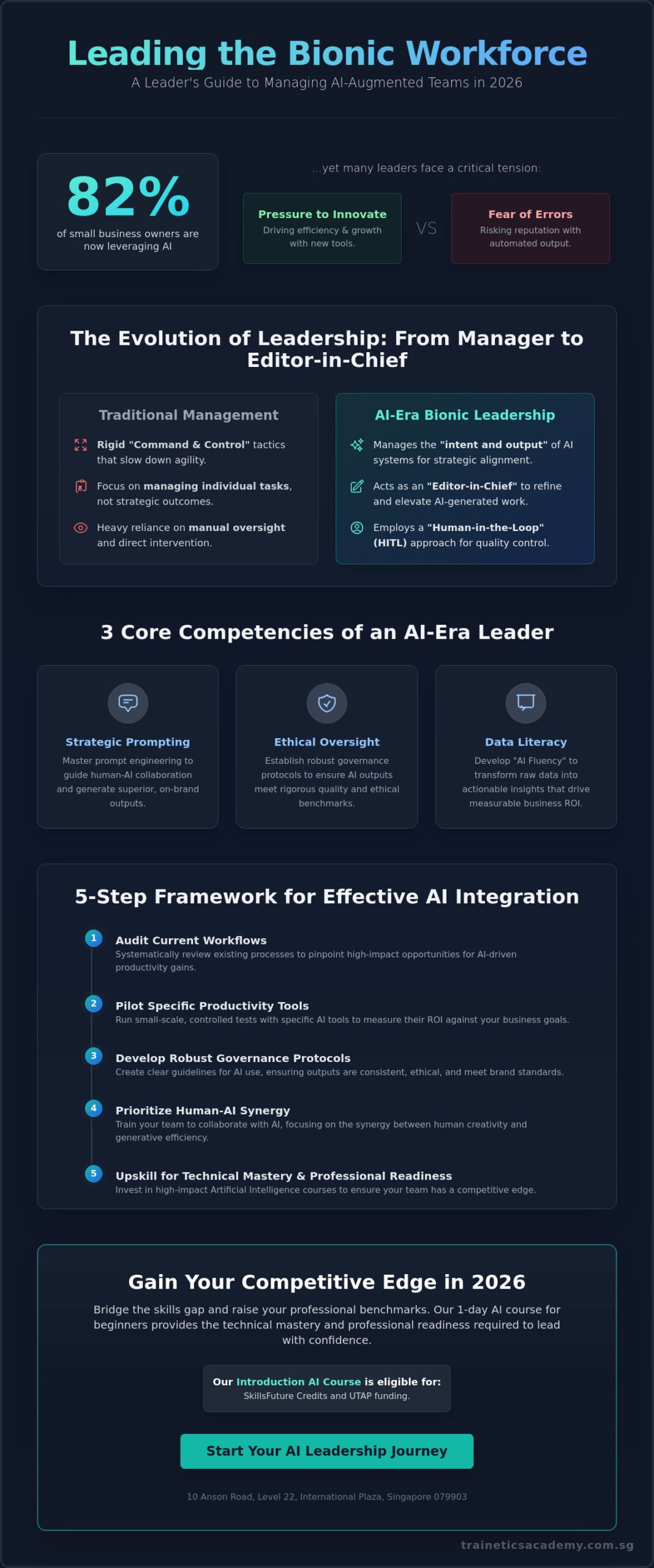
A 5-Step Framework for Effective Team AI Integration
Implementing generative technology requires more than just issuing login credentials; it demands a systematic architecture that ensures every automated action aligns with your professional identity. To understand how to lead a team that uses AI tools effectively, you must move beyond the "wait and see" approach and adopt a structured deployment strategy. This framework serves as your operational blueprint for raising professional benchmarks while maintaining the scientific precision your industry demands. By following these five steps, you transition from a spectator of change to a disciplined architect of a bionic workforce.
Step 1 & 2: Auditing and Tool Selection
Begin by conducting a rigorous audit of your department’s daily operations. Categorize every responsibility into "AI-ready" tasks or "High-Human" tasks. AI-ready tasks are typically repetitive and data-heavy, such as initial data transcription, basic content drafting, or calendar coordination. High-Human tasks require deep empathy, strategic negotiation, or complex moral judgment. Once identified, select a pilot group to test specific productivity tools for business that match these needs. Your selection criteria must prioritize data security and integration capability. Avoid generic tools that lack professional-grade privacy controls. Instead, focus on specialized systems that offer the technical mastery required for your specific market.
Step 3 & 4: Setting Standards and Feedback Loops
Establish a "Golden Standard" for every AI-assisted output. This is not a suggestion; it’s a leadership requirement. Create a "Human Verification Checklist" that every team member must complete before any AI-generated draft is finalized. This checklist ensures that the final product meets your quality benchmarks and remains free of hallucinations. To foster continuous improvement, implement a central log where staff share "prompt wins" and failures. This collective intelligence accelerates the learning curve for everyone. Managing how to lead a team that uses AI tools effectively also involves protecting the psychological safety of your staff. Reassure them that these tools are meant to amplify their expertise, not replace their professional identity. This encouragement helps reduce resistance and builds a culture of innovation.
Step 5: Sustainable Upskilling
The final step is to schedule regular training sessions to keep pace with the rapid evolution of generative models. The AI market in 2026 moves at a relentless speed, and yesterday’s techniques may already be obsolete. Encourage your team to enroll in a focused Artificial Intelligence Course to maintain their competitive edge. These training opportunities ensure your team remains technically fluent without long periods of downtime. The most successful leaders are those who treat AI education as a permanent part of their professional development strategy, ensuring their department is always prepared for the high standards of the modern industry.
Overcoming Common Obstacles in AI Leadership
Leading a high-performance team in 2026 requires more than a strategic roadmap; it demands the resilience to handle technical friction. The most persistent objection you’ll face is the fear of inaccuracy. If you don’t establish a culture of rigorous verification, your team’s professional readiness will suffer. Learning how to lead a team that uses AI tools effectively involves anticipating these hurdles before they compromise your output. You must act as a disciplined mentor, guiding your staff away from passive reliance toward active, critical engagement with generative systems. Precision matters. Accuracy is non-negotiable.
The Hallucination Hurdle: Ensuring Accuracy
In the context of Large Language Models, a hallucination is a confident response by an AI that is factually incorrect and unsupported by its training data. This is the primary risk for any leader overseeing automated workflows. To mitigate this, implement a multi-stage review process where every AI-generated claim is cross-referenced against primary sources. You’re the final arbiter of quality. Don’t let the speed of automation sacrifice the scientific grounding of your results. Establishing these checkpoints is a core component of professional excellence in the Singaporean market. It ensures your department maintains the highest standard of fitness education or corporate service available.
Fostering a Culture of Innovation, Not Replacement
Fear of job displacement is a significant barrier to effective AI integration. You must frame AI as a "digital intern" that handles cognitive grunt work, allowing your team to focus on high-level strategy and creative problem-solving. Reward team members who find creative ways to augment their roles rather than those who simply use tools to produce a high volume of low-quality work. Link AI proficiency directly to career growth and your organization’s professional benchmarks. By positioning these tools as a gateway to a more prestigious career, you transform resistance into ambition. This approach ensures your staff remains motivated and focused on technical mastery.
Understanding how to lead a team that uses AI tools effectively means knowing when to prioritize the human element. While AI can draft the foundation, your team must inject the empathy and nuance that machines cannot replicate. This is why refining Practical Communication Skills using AI Tools and ChatGPT for Professionals is essential for maintaining your brand’s voice. It ensures your communications remain authentic and impactful. If you’re ready to raise your professional benchmarks, enroll your department in a comprehensive Artificial Intelligence Course today to secure your competitive edge.
Upskilling Your Team: Choosing an Artificial Intelligence Course
Transitioning to a bionic workforce requires a commitment to academic rigor that self-guided tutorials simply cannot provide. While informal experimentation has its place, true professional excellence is forged through structured Artificial Intelligence courses designed for the corporate landscape. To master how to lead a team that uses AI tools effectively, your staff needs a curriculum that validates their technical mastery and aligns with international benchmarks. This formal approach ensures that every team member develops a professional identity rooted in precision rather than guesswork, providing the scientific grounding necessary for high-level performance.
Criteria for Selecting an AI Course in Singapore
When evaluating an AI course Singapore, look for a syllabus that emphasizes immediate application over abstract theory. A high-quality program should provide AI courses for beginners that cover both generative principles and specific business writing workflows. Ensure the provider offers interactive sessions where your team can test real-world scenarios in a controlled environment. Professional readiness depends on a Learning AI Course that balances technical depth with strategic utility, allowing your department to raise its operational benchmarks without unnecessary complexity or technical bloat.
Professional Training at Trainetics Academy
Trainetics Academy is dedicated to producing top-tier professionals who are ready to lead in a tech-driven market. We recognize that time is a critical asset for any manager, which is why our 1 day AI course Singapore is designed for rapid, high-impact learning. This intensive format allows your staff to gain comprehensive skills in a single session, ensuring they return to their roles with immediate, actionable insights. Our curriculum is delivered by industry leaders who value hard work and continuous improvement, providing your team with the supportive yet demanding environment necessary for true growth. This methodical training path ensures your staff is equipped with the professional readiness required to excel in the competitive 2026 landscape.
Seize Your Competitive Edge in the AI Era
The transition to an AI-augmented workforce is no longer a future projection; it’s a present reality. By mastering the pillars of strategic prompting and ethical oversight, you ensure your organization maintains its reputation for precision and excellence. Understanding how to lead a team that uses AI tools effectively allows you to reclaim valuable time while raising your professional benchmarks. You now have the framework to audit workflows and manage the psychological shift within your department with absolute confidence.
Your journey toward technical mastery continues at Trainetics Academy. Located at 10 Anson Road, Level 22, International Plaza, Singapore 079903, our curriculum is delivered by highly qualified professionals dedicated to your success. Our Introduction AI Course is eligible for SkillsFuture Credit and UTAP funding, providing a seamless path to upskilling. Empower your team with our eligible 1-Day Artificial Intelligence Course at Trainetics Academy and secure your identity as a visionary leader. The future of professional excellence is within your reach; lead it with discipline and foresight.
Frequently Asked Questions
How do I know which AI tools are safe for my team to use with sensitive company data?
You must prioritize enterprise-grade solutions that offer explicit "no-training" clauses and SOC 2 Type II compliance. These features ensure that your proprietary data is not absorbed into the public training sets of the model. Always review the administrative settings to align with local privacy standards. Selecting tools with robust data residency controls allows you to maintain the technical mastery and security your organization requires for professional excellence.
Can I lead a team using AI if I do not have a background in computer science or IT?
Professional leadership in 2026 centers on "AI Fluency" rather than the ability to write code. You don’t need a computer science degree to understand how to lead a team that uses AI tools effectively. Your role is to act as a visionary mentor who identifies business challenges and matches them to generative solutions. Focusing on strategic oversight and emotional intelligence ensures your team remains productive and scientifically grounded.
What is the best way to introduce AI tools to a team that is skeptical or resistant?
Start by automating a high-friction, low-value task that currently drains your team’s energy. When employees see AI as a "digital assistant" that removes administrative grunt work, their resistance often transforms into ambition. Frame the technology as a tool for personal growth and technical mastery. This approach fosters a culture of innovation where technology amplifies human expertise rather than threatening professional identity or job security.
How much time should my team spend on AI training compared to their regular tasks?
Allocate approximately 10% of weekly working hours to continuous learning and tool experimentation. The AI market moves at a relentless pace, so consistent upskilling is essential for maintaining professional readiness. Short, intensive programs like a 1 day AI course Singapore are highly effective for establishing a baseline. This structured approach prevents the fragmented learning that often occurs when staff members attempt to teach themselves without academic rigor.
Are there specific AI courses in Singapore that are eligible for government subsidies?
Professional training providers often structure their curriculum to remain eligible for local grants and subsidies. While you should check the current status of specific funding through official portals, these programs are essential for reducing the financial barrier to organizational upskilling. This support ensures that high-level education remains accessible to all tiers of leadership, allowing you to raise professional benchmarks without significant capital expenditure.
What happens if an AI tool makes a mistake that affects a client or project?
The leader remains the final arbiter of quality, which is why a "Human-in-the-Loop" framework is non-negotiable. If a mistake occurs, it’s often a failure of the review process rather than the tool itself. You must implement a multi-stage verification checklist for all high-stakes outputs. This disciplined approach to oversight protects your brand’s reputation and ensures that every project meets the rigorous professional benchmarks your clients expect.
How do I measure the ROI of my team’s usage of AI tools?
Measure ROI by tracking the reduction in "time-to-completion" for routine tasks and the subsequent increase in high-level strategic output. If your team saves twenty hours a week on drafting, those hours should be reinvested into innovation or complex problem-solving. Effective usage should lead to a measurable rise in your department’s professional benchmarks. Use these metrics to refine your strategy on how to lead a team that uses AI tools effectively.
Is a 1-day AI course enough to get my team started with effective tool usage?
An intensive 1-day program provides a professional foundation that allows for immediate implementation. While learning is an ongoing journey, a single day of structured training delivers the essential technical mastery required to navigate modern interfaces. It equips beginners with the confidence to apply generative tools to their daily workflows immediately. This short-term training is ideal for busy professionals who require professional readiness without long periods of downtime.
Disclaimer
AI Content Disclaimer: Some articles on this website may be generated or assisted by AI-powered content creation tools. While we strive for accuracy and relevance, readers should independently verify information before relying on it. The content is provided for informational purposes only and does not constitute professional advice.