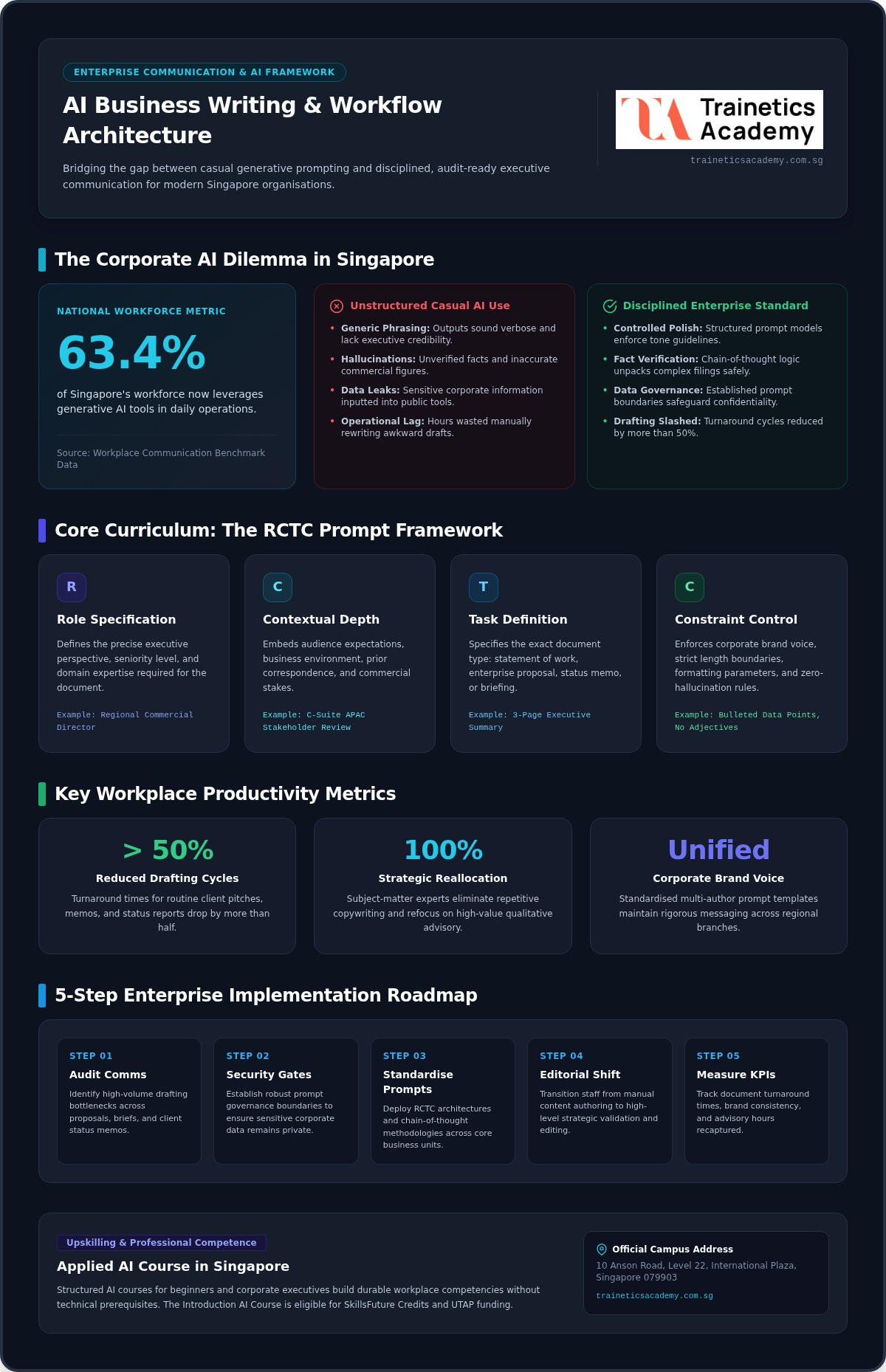
While 63.4% of Singapore’s workforce now leverages generative AI tools, most corporate communications still sound painfully generic, invent facts, or trigger internal data privacy alarms. Spending hours manually rewriting AI-generated emails, proposals, and stakeholder reports isn’t productivity; it’s an operational bottleneck. Enrolling in a rigorous AI business writing course Singapore professionals trust bridges the divide between casual experimentation and disciplined, audit-ready workplace execution.
You already understand that generative tools offer unmatched speed, but without systematic prompt engineering and brand-aligned controls, cleaning up awkward phrasing often consumes your entire afternoon. This guide reveals how to evaluate, select, and operationalise workplace writing workflows that slash drafting time by more than half while safeguarding corporate confidentiality. We will examine core curriculum benchmarks, review real-world enterprise applications, and explore foundational upskilling pathways like an introductory AI Course in Singapore to elevate your professional output.
Key Takeaways
- Identify the core curriculum pillars that distinguish an elite AI business writing course Singapore executives trust from basic, surface-level tutorials.
- Transition from manual content drafting to an efficient editorial model that slashes document turnaround times while elevating executive polish.
- Establish robust prompt security boundaries and custom brand guidelines to ensure sensitive corporate data stays strictly confidential.
- Deploy a systematic five-step implementation roadmap to audit high-volume business communications and integrate generative workflows immediately.
- Evaluate industry-aligned training programs, including an applied AI Course, to build durable workplace competencies without technical prerequisites.
Understanding the Value of an AI Business Writing Course in Singapore
Manual drafting drains operational momentum. When executives spend three hours piecing together status memos, client proposals, or board briefs, strategic execution stalls. An applied AI business writing course Singapore professionals pursue is not an abstract theory class; it is structured professional workflow training. Instead of treating large language models as novelty chat interfaces, structured corporate learning transforms them into disciplined drafting engines. As highlighted in an academic overview of AI in education, structured instruction ensures technology strengthens foundational competencies rather than encouraging superficial, unverified shortcuts.
Before standardising generative prompts across your daily correspondence, reviewing professional communication benchmarks ensures your messaging stays sharp. Watch this practical guide on workplace communication standards:
The Evolution of Corporate Communication in Singapore
As regional headquarters across Singapore accelerate decision cycles, communication standards have shifted dramatically. Teams can no longer spend days refining internal briefings. Today’s commercial environment demands crisp, data-backed memos delivered within minutes. Forward-thinking organisations are actively transitioning from slow manual authoring to hybrid, assisted workflows. In this model, staff focus on strategic framing and validation while artificial intelligence handles baseline sentence generation.
Bridging the Gap Between Generic Prompts and Business Polish
Relying on standard public chat prompts creates immediate operational risks. Raw outputs often sound oddly verbose, miss subtle commercial context, and lack executive credibility. Without rigorous training in contextual parameters, role specification, and iterative refinement, staff produce generic copy that damages brand authority. A structured course teaches professionals how to enforce tone guidelines, control output formatting, and eliminate hallucinated claims before text reaches a client.
Critical Productivity Metrics for Modern Business Teams
Implementing systematic writing frameworks directly influences key performance indicators across departments:
- Reduced drafting cycles: Turnaround times for routine client pitches and status reports drop by half.
- Strategic reallocation: Eliminating repetitive copywriting frees subject-matter experts to focus on qualitative client advisory.
- Unified corporate voice: Standardised prompt templates ensure multi-author proposals maintain consistent messaging across regional branches.
Core Curriculum: What to Look for in an AI Course Singapore
Public directories often list generic software modules that fail to differentiate basic consumer chat usage from high-stakes corporate drafting. A robust syllabus must move past entry-level prompts and teach auditable execution. When evaluating an AI business writing course Singapore professionals can actually apply on Monday morning, prioritise programmes built on enterprise governance, strategic prompting, and hands-on document reconstruction rather than passive video lectures. This practical capability aligns directly with the workforce upskilling initiatives promoted by Singapore’s National AI Impact Programme, which stresses applied competence over theoretical abstraction.
Advanced Prompt Architectures for Complex Documentation
Top-tier programmes discard simple queries in favour of robust architectural frameworks. Look for training that covers the Role-Context-Task-Constraint (RCTC) model to draft technical statements of work and enterprise proposals. Instructors should demonstrate chain-of-thought methodologies to unpack complex financial filings into clean executive summaries. You should also learn how to build reusable prompt templates that embed your organization’s internal tone and vocabulary directly into the language model’s instructions.
Enterprise Data Confidentiality and PDPA Compliance
Corporate risk multiplies when staff feed sensitive records into consumer-grade interfaces. Elite syllabi address local regulatory compliance explicitly:
- PDPA adherence: Protocols ensuring personal customer identifiers and identifiable data points are never ingested by public model retraining loops.
- Client redaction techniques: Pre-processing methods to anonymise proprietary deal terms before running synthesis prompts.
- Enterprise environment selection: Guidance on choosing secure corporate workspaces with strict data segregation and zero-retention policies.
Multi-Format Content Transformation Modules
Workplace productivity hinges on synthesising scattered business data into coherent narratives. A comprehensive curriculum trains participants to convert raw spreadsheet rows into crisp quarterly performance memos, extract actionable priorities from messy town hall transcripts, and transform deep research papers into executive briefs. If you want to develop these end-to-end competencies in a focused environment, exploring a practical AI Course will establish the structured workflows needed to produce polished, confidential business documentation.
Step-by-Step Implementation: Applying Course Skills to Daily Operations
Completing classroom hours is only the initial milestone. Real enterprise ROI happens when participants translate course methodologies directly into departmental workflows. The broader momentum behind Singapore’s push for practical AI skills highlights this shift toward applied utility across corporate teams. Moving from an ad-hoc prompt query to an institutional capability requires an orderly, phased roadmap.
To successfully integrate skills learned from an AI business writing course Singapore professionals complete, teams should execute this systematic four-step rollout plan:
Auditing Repetitive Communication Touchpoints
Begin by tracking the baseline hours spent across departments on recurring correspondence. Identify routine deliverables like vendor check-ins, client status updates, RFP narrative sections, and post-meeting summaries. Target low-risk, high-frequency documents first. Quantifying these initial hours establishes a clear operational benchmark, letting your leadership team measure real productivity gains once automated drafting begins.
Constructing Modular Departmental Prompt Libraries
Avoid letting individual employees guess their prompts. Elite teams maintain a shared internal knowledge repository with verified, tested prompt formulas tailored to specific deliverables. The table below demonstrates how replacing unstructured instructions with contextual prompts transforms typical corporate outputs:
| Document Type | Basic Prompt (Low Quality) | Structured Course Prompt (Executive Polish) |
|---|---|---|
| Client RFP Response | “Write a proposal introduction for our logistics software.” | “Act as an enterprise enterprise solution director. Draft a 3-paragraph executive overview addressing APAC supply chain volatility, emphasizing our zero-downtime SLA, and adopting an authoritative, consultative tone.” |
| Project Status Brief | “Summarize this project update email for management.” | “Synthesize these milestone notes into 3 concise bullet points for the steering committee. Categorise by: Delivered, In-Flight Risks, and Required Approvals. Restrict output to 150 words.” |
Executing the Human-in-the-Loop Fact-Checking Protocol
Draft generation is the middle step, never the final sign-off. Establish clear editorial ownership across every functional team. Designate designated reviewers responsible for cross-checking factual figures, verifying milestone dates, and confirming semantic nuances before any external dispatch. For teams seeking to strengthen these core editorial and review skills, online vocational providers such as the College of Media and Publishing offer specialized training in proofreading and copywriting. This systematic verification loop preserves personal accountability and protects corporate credibility.
Evaluating Training Providers: Selecting the Right Partner in Singapore
Selecting an educational partner requires looking beyond prestige metrics or slick marketing claims. While large tertiary institutions deliver broad conceptual overviews, busy commercial teams require actionable execution from the first hour. Finding the right AI business writing course Singapore executives rely on means scrutinising whether the training provider bridges software capabilities with actual boardroom writing standards.
Instructor Credentials and Real-World Business Acumen
Academic credentials alone don’t qualify someone to coach high-stakes business correspondence. Look for course mentors with proven backgrounds drafting executive deliverables, running strategic tenders, or managing enterprise communications. An effective instructor diagnoses subtle weaknesses in your live drafts, demonstrates why certain framing falls flat with stakeholders, and guides real-time iteration rather than leaning on rigid slide presentations.
Class Formats: Intensive 1-Day AI Course Singapore vs Multi-Week
Format dictates knowledge retention and operational momentum across corporate teams. Multi-week academic tracks often introduce friction through extended homework assignments that clash with active project sprints. Conversely, an intensive 1 day AI course Singapore professionals attend compresses the learning curve into a focused, high-impact day. Learners move rapidly through syntax mechanics, structured templates, and document stress-testing without losing an entire business week.
Location and Learning Infrastructure in the Central Business District
Physical immersion in an executive environment sharpens focus and encourages peer collaboration across departments. High-value training environments should offer:
- Central CBD access: Facilities located right in Tanjong Pagar ensure minimal commute friction for corporate executives during work hours.
- Modern training suites: Dedicated enterprise hubs like 10 Anson Road, Level 22, International Plaza, Singapore 079903 deliver fully connected, secure terminal stations for live drafting drills.
- No-code practical focus: Purpose-built sandboxes allow non-technical business leaders to master prompt logic without software installation headaches.
For organisations seeking support for professional upskilling, review whether your chosen programme aligns with local co-funding initiatives. For instance, the foundational Introduction AI Course qualifies as eligible for SkillsFuture Credits and UTAP funding, simplifying workforce transformation across your enterprise.
Ready to upgrade your team’s operational writing capabilities? Explore our applied AI Course to view upcoming cohort schedules and secure your corporate placement.
Accelerate Your Professional Mastery with Trainetics Academy
Achieving executive writing proficiency in an automated workplace requires structured guidance, rigorous practice, and an environment dedicated to professional excellence. Trainetics Academy serves as a premier destination for applied artificial intelligence education, equipping working professionals with the technical clarity required to thrive in fast-paced corporate settings. When choosing an AI business writing course Singapore executives recommend, our programmes bridge foundational model mechanics with daily operational performance.
Practical, Hands-On Curriculum Designed for Immediate Impact
Our interactive learning modules discard passive slide decks in favour of active document reconstruction. Learners participate in real-time prompt labs, converting fragmented meeting transcripts, raw project trackers, and dense commercial updates into polished executive briefs. Guided by experienced industry practitioners dedicated to raising professional benchmarks, participants master structured frameworks that streamline administrative workloads without sacrificing analytical depth. Whether you are exploring foundational AI courses for beginners or refining enterprise communication, the curriculum delivers measurable workplace competence from day one.
Convenient Central Hub at International Plaza
Located in the core of the financial district, our dedicated learning facilities are situated at 10 Anson Road, Level 22, International Plaza, Singapore 079903. Directly accessible via Tanjong Pagar MRT station, the campus allows professionals to step away from daily office distractions into a tech-enabled, highly collaborative classroom. In-person cohorts foster dynamic discussions, instant feedback, and valuable cross-industry networking among peers facing identical operational communication hurdles.
Streamlined Enrollment for Individuals and Corporate Groups
We work with individual professionals striving for personal career advancement as well as enterprise divisions seeking to standardise team-wide drafting protocols. Corporate groups can tailor workshop exercises around specific internal guidelines and departmental stylebooks. Our team also assists participants in navigating upskilling options; our foundational Introduction AI Course is eligible for SkillsFuture Credits and UTAP funding to support strategic capability development across the local workforce.
Reclaim your workweek and elevate your organisation’s communication standards. Review the Artificial Intelligence Course syllabus today to explore upcoming cohort dates and reserve your seat.
Transform Your Daily Business Drafting into a Strategic Advantage
Modern productivity isn’t defined by how quickly you type; it hinges on how systematically you direct generative models. Establishing structured prompt architectures, rigorous editorial review loops, and strict confidentiality protocols turns unpredictable drafts into authoritative stakeholder communications. Completing an applied AI business writing course Singapore professionals trust shifts your workflow from chaotic experimentation to reliable, high-impact workplace execution.
Mastering these frameworks ensures your team spends less time rewording generic copy and more time delivering high-level commercial insight. Trainetics Academy provides the dedicated guidance needed to achieve this transformation. Our curriculum strips away abstract code to focus squarely on real-world document generation, hosted right within our central learning campus at International Plaza, Tanjong Pagar. Reclaim your workweek and set a new benchmark for your organisation’s communication: elevate your corporate communication skills with an AI Course at Trainetics Academy.
Frequently Asked Questions
What is covered in an AI business writing course in Singapore?
An applied AI business writing course Singapore professionals attend focuses on operational document creation rather than abstract theory. Participants learn systematic prompt architecture, chain-of-thought analysis for complex reporting, and techniques for training models on internal corporate style guides. Comprehensive programmes also cover Singapore Personal Data Protection Act compliance protocols and multi-format content summarisation, enabling teams to transform messy meeting transcripts or tabular data into polished executive memos.
Can beginners without coding knowledge join an AI course Singapore professionals recommend?
Yes, modern business writing workshops require zero programming background or technical prerequisites. The curriculum centres entirely on natural language prompting, structural frameworks, and editorial refinement. Non-technical staff, including human resource managers, administrative specialists, and corporate directors, learn how to interact with large language models using everyday conversational English to automate routine business correspondence effectively.
Is an introductory AI Course eligible for SkillsFuture Credits and UTAP funding?
Yes, qualifying Singaporean learners can utilise their national upskilling balances and union training support programmes to offset module expenses. Eligible participants can apply these provisions toward designated training sessions to significantly reduce personal out-of-pocket commitments. Our administrative advisory team provides direct assistance during registration to help corporate sponsors and individual learners complete all verification steps smoothly.
How much time can an organisation save by adopting generative writing workflows?
Teams adopting structured drafting templates typically cut routine document creation cycles by more than half. Instead of spending hours drafting initial outlines for stakeholder reports, proposals, or vendor updates, staff generate structured first drafts within minutes. This efficiency shifts the employee’s role from manual typist to strategic editor, freeing up valuable hours each week for analytical decision-making.
How do enterprise teams safeguard proprietary data when using generative AI tools?
Organisations protect sensitive information by enforcing strict data anonymisation protocols and selecting secure corporate workspace environments. A dedicated AI business writing course Singapore teams attend teaches employees how to scrub client identifiers, financial figures, and private operational data before entering prompts, ensuring compliance with internal security mandates and national privacy frameworks.
What is the advantage of attending a 1 day AI course Singapore business leaders endorse?
An intensive 1 day AI course Singapore executives choose provides rapid, uninterrupted skill acquisition without disrupting weekly deliverables. Learners immerse themselves in practical prompt labs, address specific writing bottlenecks, and stress-test workflows in real time. This accelerated format eliminates the momentum loss common in drawn-out evening programmes, allowing participants to apply tested frameworks at work the following day.
Where are the in-person classes for Trainetics Academy located in Singapore?
In-person sessions take place at our corporate training facility within International Plaza in Tanjong Pagar. Located directly above Tanjong Pagar MRT station in Singapore’s central business district, the venue offers corporate learners modern computer workstations, interactive breakout spaces, and seamless transit accessibility for hands-on prompt drills and peer collaboration.
Disclaimer
AI Content Disclaimer: Some articles on this website may be generated or assisted by AI-powered content creation tools. While we strive for accuracy and relevance, readers should independently verify information before relying on it. The content is provided for informational purposes only and does not constitute professional advice.