Can a 1-day AI Course give you a useful, practical starting point without promising mastery overnight? Yes, when the learning goals are focused and you know how to apply what you learn. A short course can introduce key ideas and help you identify where AI may support your work, but meaningful progress still depends on practice beyond the classroom.
It’s reasonable to question what a single day of learning can deliver, especially when course descriptions make ambitious claims. Choose a course that matches your current knowledge, addresses a real work or personal goal, and sets out a clear learning scope. Trainetics Academy’s Artificial Intelligence course, also listed as Introduction to Artificial Intelligence, offers a structured starting point for building your understanding.
This guide will help you set realistic expectations for a short AI course in Singapore, compare options using practical criteria, and decide what to learn next. You’ll also find ways to connect introductory training with ongoing practice, so your first day of study becomes a purposeful step in a longer learning path.
Key Takeaways
- A 1-day AI Course can offer a focused starting point, while continued practice builds deeper capability.
- Clear learning objectives and guided practice help distinguish a useful course from one that is brief in name only.
- Compare course options by audience, objectives, practice, format, and follow-up, not promotional wording alone.
- Bring a non-sensitive task from work or daily life to connect new AI concepts with a practical learning goal.
- Explore Trainetics Academy’s Artificial Intelligence course and interactive learning approach as a next step.
What Can a 1-Day AI Course Realistically Help You Learn?
A short AI course can be a useful starting point, but it cannot create complete mastery in a single learning experience. A 1-day AI Course is best understood as a compact introduction: it can help you become familiar with core ideas, consider where AI may be relevant, and identify questions to explore further. The depth you gain depends on the course objectives, opportunities to practise, and how closely the material connects to your goals.
That distinction matters in Singapore, where learners may be comparing introductory options with different descriptions. A course can help you understand what AI covers, from machine learning to other areas described in this overview of Artificial Intelligence. Becoming familiar with concepts, however, is not the same as being able to design, implement, and assess advanced AI systems independently.
For a concise introduction to the topic, watch this video:
An introductory AI course builds foundational understanding and helps you identify relevant applications; advanced implementation expertise requires deeper study and sustained practice. Use this as a realistic benchmark when evaluating course descriptions. For learners in Singapore seeking a local starting point, Trainetics Academy offers a standalone Artificial Intelligence course.
Who might benefit from a short AI course?
Professionals who want a structured introduction can use a short course to organise what they’re learning and connect AI concepts with workplace questions. Beginners may benefit from guided learning before deciding whether to pursue a particular specialisation. Organisations can also use introductory learning as part of staff development, helping employees build a shared foundation without assuming that training alone will deliver business outcomes.
What should you expect to take away?
Look for clear objectives that describe what learners should understand or be able to explore. Practical learning can make abstract concepts easier to think through, especially when you consider a familiar task such as summarising information or organising ideas. The aim is informed familiarity, not guaranteed productivity gains or independent technical expertise. After the course, continued practice helps you test what you’ve learned, recognise limitations, and decide which skills deserve deeper attention.
- Check whether the stated objectives match your current level and learning goal.
- Consider whether there are opportunities to practise or apply ideas, not only hear explanations.
- Plan a next step, such as testing a suitable task or pursuing further study in a relevant area.
A compact course is most valuable when it gives you a sound basis for your next decision. Treat it as the beginning of a learning path, then build capability through deliberate practice and further study aligned with your needs.
What Makes a 1-Day AI Course Useful, Not Just Brief?
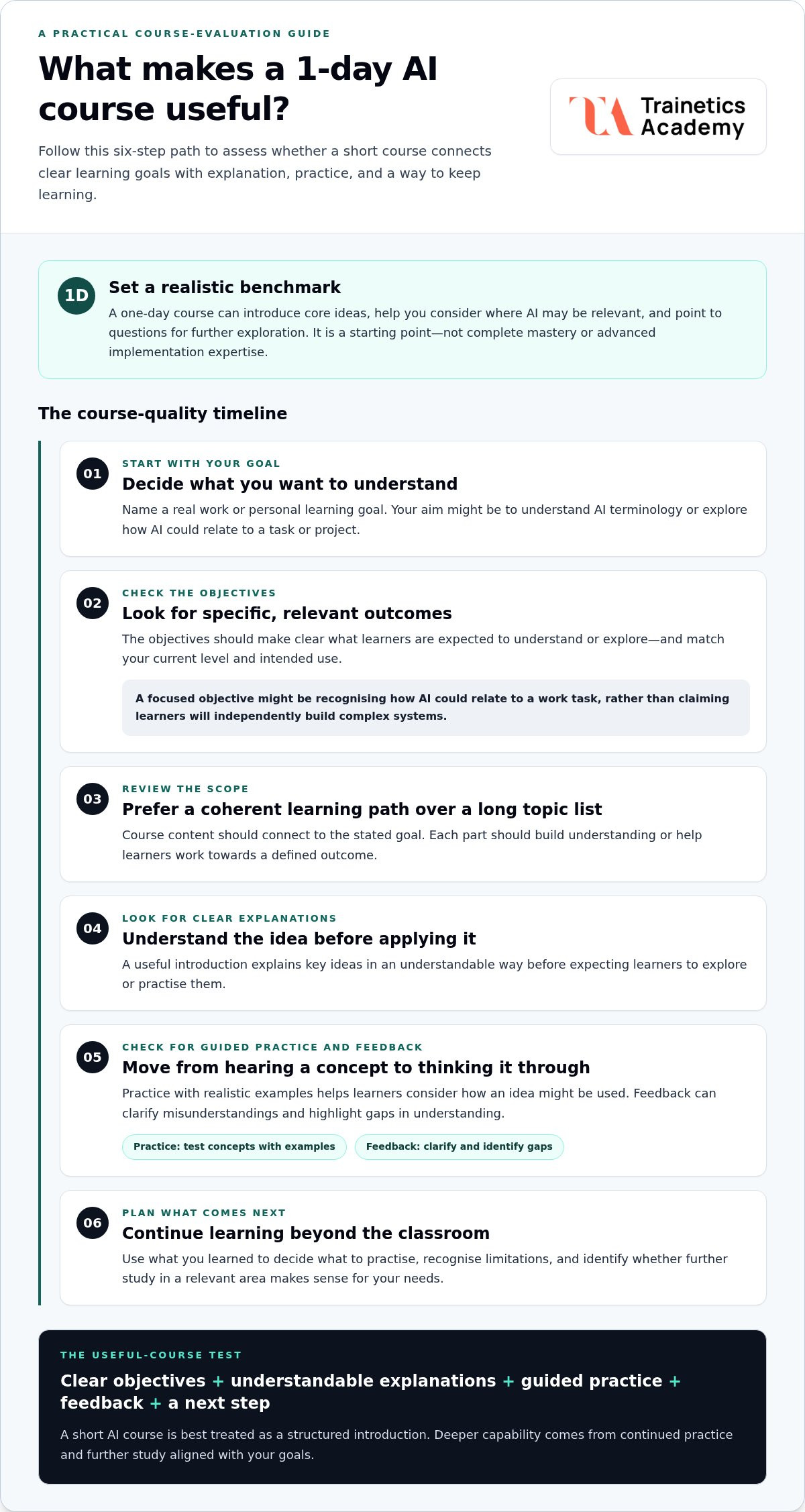
A focused course makes limited learning time count by connecting clear objectives with explanation, practice, and a way to continue learning. A long list of topics isn’t proof of depth. Instead, look for a coherent scope: each part should help you build understanding or work towards a defined learning goal.
This gives you a practical way to judge course descriptions in Singapore. If a programme promises sweeping transformation but doesn’t explain what learners should know or do afterwards, it’s difficult to assess its substance. Specific objectives set more credible expectations and help you decide whether the course suits your experience and intended use.
How learning objectives shape a short course
Useful objectives describe a capability or area of understanding, rather than a vague promise to become an AI expert. For example, an objective might focus on recognising how AI could relate to a work task, rather than claiming that learners will independently build complex systems. A focused scope also connects course content to your priorities, whether you want to understand AI terminology or explore its relevance to a personal project.
Before enrolling, consider whether the stated outcomes answer three questions: What will I learn? What will I be able to explore or practise? How does this relate to my goal? Clear answers make it easier to see whether the course is designed as a structured introduction or positioned as something more advanced.
Why guided practice and feedback matter
Practice gives learners a chance to apply an explanation to a realistic example and notice where their understanding needs work. Feedback can help clarify a misunderstanding or suggest a different way to approach a task. Neither element needs to promise instant expertise; their value is in helping you move from hearing a concept to thinking through how it might be used.
Instructor guidance can support that process by giving learners a knowledgeable point of reference as they develop their understanding. Trainetics Academy’s programmes use qualified instructors and an interactive learning approach.
Use this checklist to assess the design of a short AI course:
- Objectives: Are the expected learning outcomes specific and relevant to your goal?
- Explanation: Does the course make key ideas understandable before expecting you to apply them?
- Practice: Is there an opportunity to test concepts against realistic examples?
- Feedback: Can learners identify gaps or clarify misunderstandings?
- Next steps: Does the learning point towards a useful way to practise or continue?
A course description that addresses these elements gives you a stronger basis for judging its substance than promotional claims alone. For a structured introduction, explore Trainetics Academy’s Artificial Intelligence course.
How to Compare a 1-Day AI Course Before Enrolling
Course duration alone won’t tell you whether a programme is right for you. Compare its intended learners, learning objectives, opportunities to practise, delivery format, and follow-up. A clear description should explain the course’s scope and who it is designed to support. That makes it easier to judge fit instead of relying on broad promotional language.
Use this framework to assess options side by side. Record what each course describes, then consider how well those details match your goals.
| Audience | Objectives | Practice | Format | Follow-up |
|---|---|---|---|---|
| Who is the course intended for: beginners, working professionals, or learners with prior AI knowledge? | What knowledge or capability should you gain, and does it relate to your intended use? | Does the description explain how learners will engage with or apply the ideas? | Would online or classroom learning suit your preferences and schedule better? | Does the course point towards further practice or a next learning step? |
| Option A: ______ | Option A: ______ | Option A: ______ | Option A: ______ | Option A: ______ |
| Option B: ______ | Option B: ______ | Option B: ______ | Option B: ______ | Option B: ______ |
Which course criteria deserve the closest attention?
Start with objectives. If your goal is to understand AI at work, a course aimed at advanced technical implementation may not be the best match. Look for a coherent balance between explanation and practical learning, with enough detail to understand how the course approaches its subject. Then consider format: online learning may suit those who prefer remote participation, while classroom learning can be a better fit for those who value an in-person setting.
How to judge fit without expecting instant mastery
A short course can be a sound first step, not the whole learning journey. Introductory understanding helps you recognise concepts and consider their relevance; it doesn’t automatically confer advanced technical expertise or the organisational capability to implement AI at scale. Assess the stated scope against what you need now, and treat further study and practice as separate steps if your goal requires deeper capability.
When comparing a 1-day AI Course, be cautious of wording that implies a brief introduction will deliver broad transformation. Instead, use the course’s stated audience and objectives to set realistic expectations. A well-matched option should help you take a defined step, whether that means building foundational understanding or clarifying what to learn next.
For wider context on comparing AI learning options in Singapore, see this Singapore AI course selection guide. Use the same learner-first approach: prioritise clear scope and relevance over duration or persuasive claims.
How to Prepare for an AI Course and Put Learning into Practice
A clear goal helps you connect course ideas to something that matters in your work or daily routine. Before a 1-day AI Course, choose a familiar, low-risk task and think about what you want to understand. You don’t need to arrive with a technical problem to solve. A practical question, such as how AI might help organise non-sensitive information, can give your learning a useful point of focus.
Choose a practical learning goal before the course
Pick one recurring task or question, then define what progress would mean. It might be understanding which parts of a task could involve AI, or learning what to consider before relying on an AI-generated response. Keep the example free of confidential or personal information. Don’t enter sensitive workplace or individual data into AI tools unless you’re authorised to do so.
Use this sequence to carry your goal from preparation into continued learning:
- Choose a task. Select a routine activity or question that’s appropriate to explore.
- Identify a learning question. Decide what you want to understand about AI’s possible role in it.
- Practise. Apply relevant concepts to a non-sensitive example, using an appropriate learning activity or tool.
- Review. Examine the result for usefulness, accuracy, and limitations rather than assuming it’s correct.
- Continue. Set a small follow-up goal, such as revisiting a concept or practising with another low-risk example.
This process keeps expectations grounded. Your aim might be to identify questions for further study, not to automate a task or achieve a particular result immediately. A realistic goal makes it easier to assess what you learned and decide what to do next.
Turn introductory learning into continued practice
After the course, choose a simple example that doesn’t involve sensitive information and use it to revisit a concept. Reflect on what the AI output helped with, what needed checking, and what it couldn’t answer reliably. Keep the practice narrow. A short review of one example can reveal more about your next learning need than trying to apply every new idea at once.
Make your next step specific and manageable: review one concept, try a suitable task, or note a question to investigate. This approach builds a habit of checking outputs and thinking critically about limitations. For a broader progression beyond introductory study, the beginner’s AI learning roadmap offers additional context for planning continued learning.
Trainetics Academy offers a standalone Artificial Intelligence course as a structured starting point. Consider how its focus can connect with your learning goals and the next step you want to take.
Explore Trainetics Academy’s Artificial Intelligence Course in Singapore
For learners in Singapore looking for a structured starting point, Trainetics Academy offers a standalone Artificial Intelligence course, also listed as Introduction to Artificial Intelligence. It can help you build foundational understanding as a step in a longer learning journey. As you consider how it fits your goals, focus on the course’s stated scope and the knowledge you want to develop.
What learners can expect from Trainetics Academy
Trainetics Academy supports individuals and organisations through professional training. Across its programmes, the academy uses an interactive learning approach and qualified instructors with professional experience.
Online and offline learning options are available across the academy’s training programmes. Consider which setting best suits your learning preferences and circumstances. The academy also provides post-training support for up to 3 years, extending support beyond training.
Choose a relevant next step for your AI learning
Before enrolling, connect your learning goal with the course’s focus. Consider whether you’re seeking an introduction, want to build confidence with foundational ideas, or need a different level of study. A 1-day AI Course can offer a focused entry point. Choose a course whose scope and learning objectives match your expectations.
Trainetics Academy’s approach supports individuals and organisations as they develop professionally. Clear expectations help you make an informed decision: look for a fit between your current knowledge, the course’s stated focus, and the next capability you want to build. Further practice and study can then extend what you learn over time.
Explore the Artificial Intelligence course details to assess how this learning option aligns with your goals. Take the next step with a clear purpose, and choose a path that supports steady, continued development.
Make Your Next AI Learning Step Count
Your next step doesn’t need to be ambitious to be meaningful. Choose one capability you want to develop, then use it to guide what you study and practise next. A 1-day AI Course can mark the beginning of that process, helping you move from curiosity towards a more deliberate learning plan. Keep building from there: revisit what you learn, reflect on where it applies, and deepen your knowledge as your goals become clearer.
Trainetics Academy supports continued learning with post-training support for up to 3 years. Its interactive approach, qualified instructors, and online and offline learning options give you different ways to engage with training.
Explore Trainetics Academy’s AI learning options and choose a next step that aligns with your goals. Steady progress starts with a clear purpose, and each thoughtful step can strengthen your confidence with AI.
Frequently Asked Questions
Can I learn AI without knowing how to code?
Yes. A 1-day AI Course can introduce AI concepts without requiring you to start with coding, particularly if your immediate aim is to understand terminology or consider everyday applications. Coding becomes relevant for some technical pathways, such as building or modifying models, but it isn’t a universal starting requirement. For example, a manager exploring AI-assisted summaries can first focus on assessing outputs and deciding whether technical study fits their goals.
What is the difference between artificial intelligence and generative AI?
Artificial intelligence is the broader field of systems that perform tasks associated with human intelligence. Generative AI is a category of AI that creates new content, such as text, images, audio, or code, in response to prompts. A system that sorts incoming messages is an example of AI that isn’t necessarily generative, while a tool that drafts a reply uses generative AI. Knowing the distinction helps you describe what you want to learn.
Can I trust information generated by an AI tool without checking it?
No. Treat AI-generated information as a draft or a lead, not as verified evidence. A tool may produce confident wording while getting details wrong or leaving out important context. For example, if it summarises a policy, compare the summary with the original document before sharing or acting on it. For decisions involving health, finance, legal matters, or workplace obligations, consult an appropriate authoritative source or qualified professional.
Are all AI courses eligible for SkillsFuture Credit or UTAP?
No. Eligibility is course-specific, so don’t assume every AI course qualifies. Trainetics Academy’s Introduction AI Course is eligible for SkillsFuture Credits and UTAP. That eligibility doesn’t establish coverage for other courses. Before relying on funding, review the exact course name and the relevant scheme’s current conditions through official information, and make sure you understand any claim requirements that apply to your circumstances.
How can I practise AI skills after an introductory course?
Keep a simple learning log to turn practice into a deliberate routine. Record the task, what you asked the tool to do, what worked, and what needed correction. On a later attempt, change one part of your instructions and compare the result. This makes it easier to notice how your approach affects the output and identify a specific skill to develop next, rather than relying on impressions alone.
Can organisations enrol staff in AI training with Trainetics Academy?
Yes. Trainetics Academy supports organisations as well as individual learners through professional training. An organisation considering AI learning can first identify the staff groups involved and the shared knowledge they need, such as a common understanding of AI terminology or responsible evaluation of generated content. This gives the learning plan a clear purpose without assuming that course participation alone will produce adoption or productivity gains.
Disclaimer
AI Content Disclaimer: Some articles on this website may be generated or assisted by AI-powered content creation tools. While we strive for accuracy and relevance, readers should independently verify information before relying on it. The content is provided for informational purposes only and does not constitute professional advice.