87% of organizations currently grapple with critical skill gaps in machine learning and automation. As the National AI Council accelerates Singapore’s digital agenda, leaders face a high-stakes crossroads regarding in-house vs outsourced ai training for corporations. Hiring specialized talent remains prohibitively expensive, yet the fear of intellectual property leakage keeps many executives cautious about external partnerships. You’re likely feeling the pressure to modernize your operations without compromising proprietary data or exceeding annual budgets.
This guide provides the definitive framework for choosing between internal upskilling and external training to future-proof your workforce effectively. We’ll explore a clear decision matrix, calculate the ROI of upskilling, and identify how a high-quality AI Course can transform your existing team into an innovation powerhouse. Whether you’re searching for an AI course Singapore leaders respect or exploring SkillsFuture AI courses, mastering this transition is a strategic imperative. We’ll also highlight how specific foundational workshops, such as our Introduction AI Course, are eligible for SkillsFuture Credits and UTAP funding to support your corporate evolution.
Key Takeaways
- Master the strategic balance between immediate deployment and long-term sustainability by navigating the 2026 framework for in-house vs outsourced ai training for corporations.
- Protect your intellectual property and build proprietary capability by training internal teams to identify and execute high-value AI use cases specific to your industry.
- Gain access to international benchmarks and the latest technical methodologies by partnering with professional academies to provide rigorous Artificial Intelligence courses for your staff.
- Apply a precision-engineered 5-point decision matrix to evaluate your timeline, security needs, and budget when scaling corporate intelligence.
- Learn how to maximize your training ROI by identifying programs like the Introduction AI Course, which is eligible for SkillsFuture Credits and UTAP funding.
The AI Talent Dilemma: Building Internal Capability vs. External Reliance
The tension between rapid deployment and long-term organizational health defines the current debate over in-house vs outsourced ai training for corporations. In 2026, the establishment of the National AI Council (NAIC) signaled a shift where simply using tools is insufficient; corporations must now possess the intellectual capital to govern them. Outsourcing offers a seductive speed to market, yet it often creates a fragile dependency on external vendors who don’t understand your core business logic. True excellence requires a balance between external speed and internal sustainability.
A Learning AI Course has evolved from a luxury into a prerequisite for corporate survival in Singapore. With 87% of companies reporting significant skill gaps in machine learning, the cost of recruiting specialized AI engineers has reached unsustainable levels. Developing a baseline through structured Artificial Intelligence courses ensures that every department, from HR to finance, can speak the language of automation. This baseline is the first step in resolving the dilemma of in-house vs outsourced ai training for corporations, allowing leaders to build from a position of technical strength rather than desperation.
To better understand the specific skills required to bridge this gap, watch this helpful video:
The Risk of Total Outsourcing
Relying exclusively on third-party agencies leads to the “black box” problem. Employees use sophisticated tools without understanding the underlying mechanics, which stifles innovation and creates severe vendor lock-in. When external partners own the business logic, your long-term agility suffers. This reliance often results in a loss of proprietary data insights that should remain within your corporate walls. Without internal literacy, your staff cannot audit or challenge the AI outputs provided by vendors, posing a significant risk to operational integrity.
The Advantage of Internal Upskilling
Investing in corporate training and development preserves the deep industry-specific context that only your long-term employees possess. Providing a high-level AI course Singapore professionals can utilize boosts morale and improves retention by offering a prestigious career path. This is especially relevant for a diverse workforce, including those seeking a SkillsFuture AI course for seniors to remain competitive. You can effectively begin measuring the ROI of corporate training by observing direct productivity gains as staff automate manual workflows. For those starting this journey, our Introduction AI Course is eligible for SkillsFuture Credits and UTAP funding, providing a scientifically grounded entry point into technical mastery. Visit us at 10 Anson Road, Level 22, International Plaza, Singapore 079903 to discuss your team’s professional roadmap.
The Benefits of In-House AI Training: Cultivating Proprietary Expertise
Cultivating internal expertise allows your organization to move beyond basic automation toward true strategic differentiation. In the debate of in-house vs outsourced ai training for corporations, the “build” side offers a distinct advantage: the ability to fine-tune generative models on proprietary datasets that never leave your secure environment. When your own staff manages the training process, they apply deep institutional knowledge that no external vendor can replicate. This ensures that AI outputs align perfectly with your specific brand voice and operational logic, turning a generic tool into a specialized corporate asset.
A workforce trained through a structured Learning AI Course becomes a primary source of innovation. These employees are best positioned to identify high-impact AI use cases within their own workflows, from automating redundant data entry to predictive logistics. Research from the Center for Security and Emerging Technology highlights that the future of workforce training depends on blending technical literacy with domain-specific knowledge. By prioritizing an AI Course SkillsFuture strategy, you foster a culture of technical mastery that keeps your organization at the forefront of international benchmarks.
Data Privacy and Security
Singaporean SMEs must prioritize data sovereignty in 2026 to comply with evolving regional standards. Developing in-house teams significantly reduces the surface area for potential data breaches, as sensitive information remains within internal firewalls during the model-training phase. This approach is most effective when paired with robust cyber security protocols, ensuring that your AI implementation is both powerful and resilient against external threats.
Customization to Corporate Workflows
Generic AI tools often fail to address the nuanced pain points of specific departments. Upskilled employees excel at prompt engineering because they understand the “why” behind every task. Whether it’s Finance optimizing cash flow models or HR streamlining recruitment, department-specific training ensures that AI serves the business, not the other way around. This level of customization leads to measurable efficiency gains that far exceed the performance of off-the-shelf solutions. For finance teams specifically, understanding how AI for finance and accounting professionals in Singapore can automate tedious workflows and improve forecast accuracy is a critical step in this departmental transformation. If you are ready to elevate your team’s capabilities, consider enrolling them in our comprehensive Artificial Intelligence courses to begin this transformation.
Establishing this internal baseline is not merely a technical upgrade; it’s a commitment to professional excellence. When your staff masters these tools, they don’t just work faster; they work smarter. This internal capability creates a sustainable competitive moat that protects your business from the volatility of the external talent market. By investing in a high-quality AI course Singapore professionals trust, you secure your company’s role as a leader in the digital economy.
Evaluating Outsourced AI Training: Speed, Benchmarking, and Expert Insights
While building internal capability is a long-term goal, the path to technical mastery often begins with external guidance. Outsourced training involves partnering with professional institutions like Trainetics Academy to facilitate a high-level knowledge transfer. This approach provides a level of academic rigor and international benchmarking that is difficult to replicate within a corporate silo. When evaluating in-house vs outsourced ai training for corporations, you must consider the value of an objective, third-party assessment. External experts identify operational blind spots and ensure your team’s skills align with global professional standards.
Speed is a critical competitive factor in 2026. Developing an internal curriculum from scratch is a resource-intensive process that can delay your AI transformation by months. In contrast, using a pre-built, scientifically validated AI Course allows for immediate deployment. Professional providers treat AI education with the same precision as sports science, focusing on technical mastery and professional readiness. This structured approach ensures that your workforce isn’t just playing with tools but is following a disciplined learning path toward measurable outcomes.
Access to Specialized AI Talent
Finding internal mentors who understand advanced concepts like MLOps, Natural Language Processing (NLP), or ethical AI governance is a significant challenge. External training providers bring diverse perspectives gathered from multiple industries, offering insights that internal teams simply don’t have. Trainetics Academy acts as a visionary mentor, bridging the gap between theoretical science and practical corporate application. By leveraging external experts, your staff gains access to the same high-level strategies used in the government AI training series, ensuring responsible and effective implementation.
Cost Predictability and Scalability
Managing an internal training department introduces significant variable costs and administrative overhead. External Artificial Intelligence courses offer fixed, predictable pricing that simplifies your budgetary planning. This model allows you to scale training up or down based on your quarterly business objectives. When you learn how to ask for training in Singapore, presenting a clear cost-benefit analysis of fixed-fee external programs is often the most persuasive strategy for C-suite approval.
By choosing a partner dedicated to excellence, you ensure that your investment in in-house vs outsourced ai training for corporations delivers a workforce that is both technically proficient and strategically agile. This external collaboration serves as a catalyst for internal growth, providing the intellectual foundation required to eventually own your AI destiny. We focus on raising professional benchmarks, ensuring that your organization remains a leader in a competitive digital landscape.
A Decision Framework for Corporate AI Upskilling in Singapore
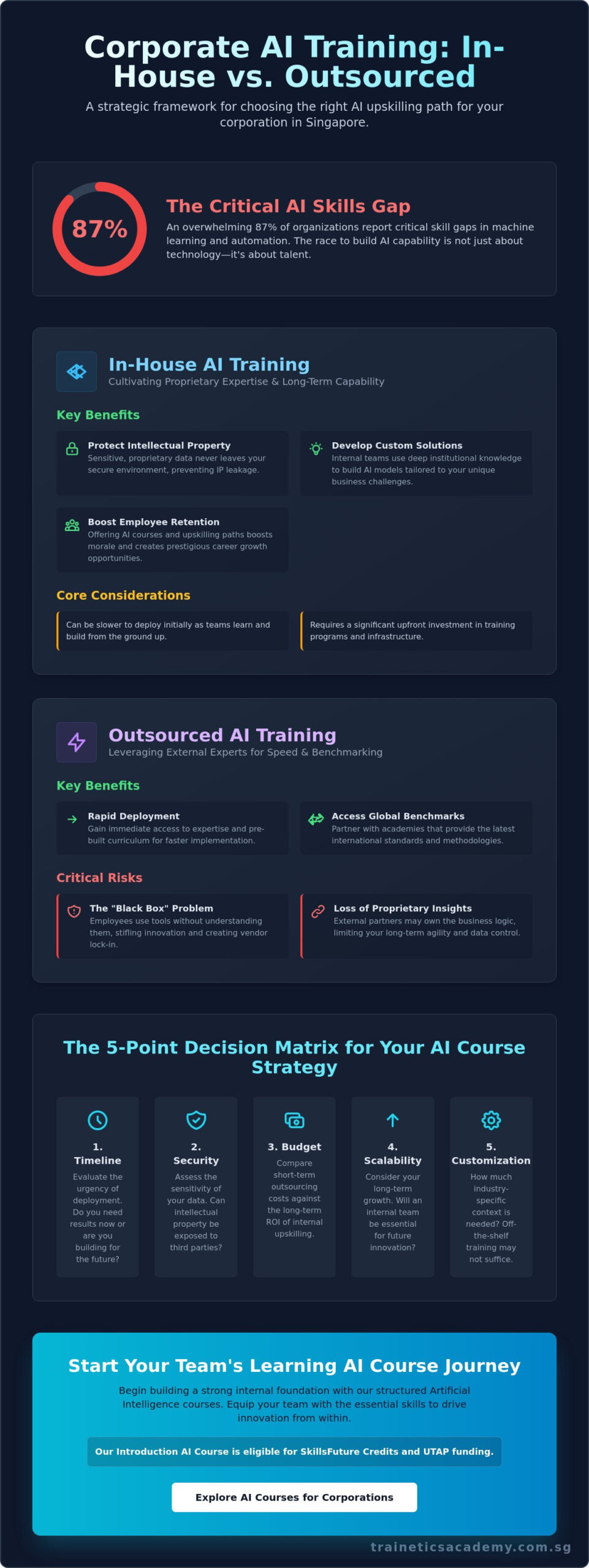
Navigating the in-house vs outsourced ai training for corporations decision requires a structured assessment of your operational priorities. We utilize a 5-point matrix to help leaders determine the most effective path forward. First, consider your timeline; urgent transformations often favor external expertise, while long-term capability building is best handled internally. Second, evaluate your budget structure, contrasting the fixed costs of external workshops with the variable, ongoing costs of internal training departments. Third, assess your security requirements for data handling. Fourth, define the sensitivity of your intellectual property. Finally, determine if AI is a core competency of your product or a tool for operational efficiency.
A hybrid approach often provides the most balanced results for modern enterprises. By using external academies to train internal “AI Champions,” you create a bridge between high-level theory and your specific business context. This method allows you to establish a baseline through an Introduction AI Course for all staff while developing deep expertise in key personnel. This strategy ensures that your workforce remains agile and capable of identifying new automation opportunities as they arise, effectively solving the in-house vs outsourced ai training for corporations dilemma through a blended model.
Strategic Budgeting for AI Initiatives
Singaporean corporations can align their training roadmaps with the National AI Strategy 2.0 to maximize their digital transformation efforts. Initiatives like the TechSkills Accelerator (TeSA) and the Enterprise Compute Initiative (ECI) provide the broader ecosystem support necessary for large-scale upskilling. By integrating these national priorities into your corporate training budget for 2026, you ensure that your investment in a Learning AI Course or Artificial Intelligence courses remains sustainable and high-impact. Prioritizing broad literacy through SkillsFuture AI courses ensures that no department is left behind during this rapid technological shift. For smaller organizations looking to maximize available government incentives, following a structured ai training strategy for smes singapore can help you leverage resources like the 40% Corporate Income Tax rebate and the S$10,000 SkillsFuture Enterprise Credit effectively.
Measuring ROI and Success Metrics
Training ROI is defined as the ratio of productivity gain to total training expenditure. To accurately track the success of your AI Course SkillsFuture planning, you must establish clear KPIs. Monitor the reduction in task completion time for automated processes and track improvements in employee engagement scores. Additionally, measure the accuracy and performance of any internal models developed by your upskilled team. These metrics provide the data-driven validation needed to justify continued investment in your workforce’s professional identity.
If you’re ready to define your team’s learning path, explore our Artificial Intelligence Course options. Establishing a clear framework today ensures that your organization doesn’t just survive the AI transition but leads it with precision and confidence.
Scaling Corporate Intelligence with Trainetics Academy
Trainetics Academy serves as the definitive catalyst for organizations navigating the final stages of the in-house vs outsourced ai training for corporations transition. We provide the academic rigor and scientific validation required to transform a workforce from mere users of technology into masters of it. Our curriculum is delivered by highly qualified professionals who emphasize professional readiness and technical mastery. By partnering with us, organizations do not just implement software; they raise professional benchmarks across their entire hierarchy, ensuring they remain competitive in an increasingly automated tech sector. This disciplined approach ensures that your corporate intelligence scales in alignment with international standards.
Our interactive learning path is designed to satisfy both the intellectual curiosity of advanced practitioners and the practical needs of beginners. We bridge the gap between rigorous sports-science-like precision and the dynamic world of corporate coaching. This unique linguistic and technical space allows your employees to develop a professional identity that is both scientifically grounded and practically applicable. By choosing a partner that values hard work and continuous improvement, you secure a sustainable competitive moat for your business.
The Introduction AI Course
The Introduction AI Course represents our foundational offering designed specifically for corporate groups. This program acts as a gateway to technical mastery, providing a structured learning path that accommodates a diverse workforce, including both beginners and seniors. By establishing a shared technical vocabulary, this course eliminates the “black box” problem discussed earlier, ensuring that all employees understand the mechanics of the tools they utilize daily. It is the essential first step for any firm looking to resolve the in-house vs outsourced ai training for corporations debate through a sustainable, high-impact hybrid model.
Partner with Trainetics Academy
We invite corporate leaders to explore customized training solutions designed for the unique demands of the 2026 job market. As a visionary mentor, Trainetics Academy offers a professional identity that empowers your staff to lead with confidence and precision. Our methodical approach ensures that your team is not just prepared for today’s challenges but is equipped to innovate for tomorrow. Secure your team’s future by initiating your comprehensive Artificial Intelligence courses enrollment today and witness the transformation of your corporate intelligence. Mastery is the result of structured, high-standard education, and your organization’s journey toward excellence begins here.
Secure Your Competitive Edge in the AI Era
Our expert-led curriculum at International Plaza provides the scientific validation your team needs to raise professional benchmarks. For those beginning this journey, the Introduction AI Course is Eligible for SkillsFuture Credits and UTAP funding, making elite education accessible for your entire staff. We invite you to visit us at 10 Anson Road, Level 22, International Plaza, Singapore 079903 to discuss your strategic roadmap. Empower your workforce with our Artificial Intelligence courses today. The path to industry leadership starts with a disciplined commitment to excellence. Your team’s evolution begins now.
Frequently Asked Questions
What is the primary difference between in-house and outsourced AI training?
In-house training focuses on building proprietary knowledge and cultural alignment within your own walls, while outsourced training provides immediate speed and access to international benchmarks. The choice regarding in-house vs outsourced ai training for corporations often depends on your specific timeline and technical requirements. Partnering with external experts allows your team to absorb a scientifically validated curriculum that’s difficult to develop internally without significant resource investment.
How do I measure the ROI of corporate AI training for my employees?
Measure your ROI by tracking the ratio of productivity gains against your total training expenditure over a six to twelve month period. A successful AI Course should lead to a reduction in task completion times and an improvement in the accuracy of internal models. You should also monitor qualitative metrics like employee engagement and the retention of high-performing staff who value professional readiness and continuous technical mastery.
Are AI courses in Singapore eligible for government subsidies in 2026?
Singapore supports professional development through specific regional frameworks designed to raise industry benchmarks. Our Introduction AI Course is Eligible for SkillsFuture Credits and UTAP funding, providing a fiscally responsible way for organizations to upskill their workforce. This support allows companies to integrate high-standard Artificial Intelligence courses into their 2026 budgets while ensuring their teams receive the rigorous training necessary for long-term career success.
Can non-technical staff benefit from an Artificial Intelligence course?
Non-technical staff benefit immensely by gaining the literacy required to identify automation opportunities and manage AI outputs effectively. A Learning AI Course for non-tech roles focuses on prompt engineering and ethical governance rather than complex coding. This ensures that every department, from HR to Finance, can contribute to the company’s digital transformation without the “black box” problems that arise from a lack of foundational understanding.
Is it better to hire new AI talent or upskill my existing workforce?
Upskilling your existing workforce is often superior because it preserves deep industry-specific business context that new hires don’t possess. While hiring fills immediate gaps, an AI Course SkillsFuture strategy builds a sustainable internal capability that evolves with your company. Training current staff fosters a sense of professional identity and loyalty, ensuring your AI implementation is guided by people who already understand your brand’s unique operational logic.
What are the risks of using external vendors for AI training?
The primary risks involve vendor lock-in and the potential loss of proprietary business logic if the training isn’t properly integrated. Without building internal literacy, your organization might struggle to audit or improve the AI tools provided by third parties. Choosing a mentor that emphasizes professional readiness helps mitigate these risks, ensuring that external expertise translates into a permanent internal capability rather than a temporary technical fix.
How long does a typical corporate AI upskilling program take to show results?
Initial efficiency gains typically emerge within three to six months as employees begin automating manual workflows and optimizing their daily tasks. A structured AI course Singapore leaders trust follows a logical path that moves from foundational concepts to practical applications. While achieving technical mastery is an ongoing commitment, the baseline skills established in a professional workshop provide immediate value through more precise decision-making and streamlined corporate processes.
Disclaimer
AI Content Disclaimer: Some articles on this website may be generated or assisted by AI-powered content creation tools. While we strive for accuracy and relevance, readers should independently verify information before relying on it. The content is provided for informational purposes only and does not constitute professional advice.