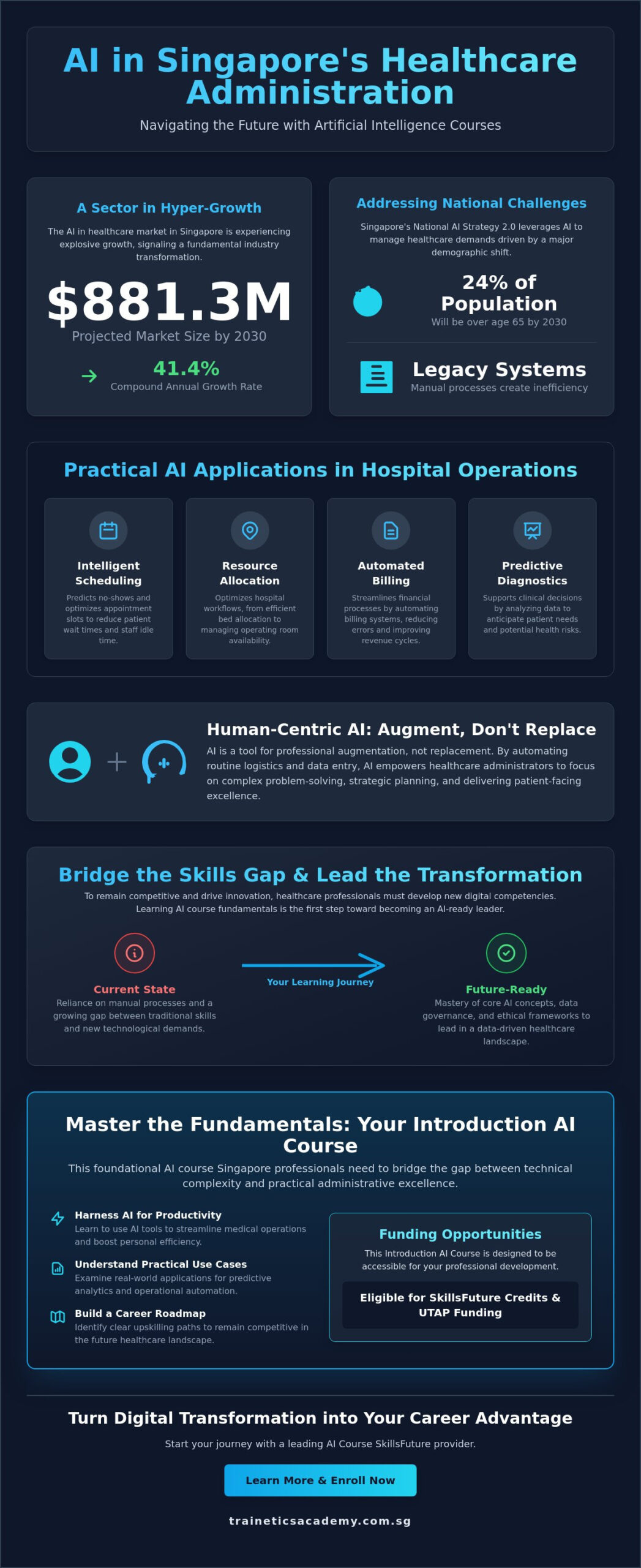
Did you know the AI in healthcare market in Singapore is projected to reach $881.3 million by 2030, fueled by a compound annual growth rate of 41.4%? This massive investment in ai in singapore’s healthcare administration signals a shift that goes far beyond simple automation. You’ve likely faced the exhaustion of manual data entry or the stress of complex scheduling conflicts, perhaps while wondering if your role will remain relevant as the National AI Strategy 2.0 takes hold. It’s time to replace that uncertainty with the confidence of a visionary leader.
You’ll learn how to harness these technologies to streamline medical operations and boost your personal productivity. We’ll examine practical use cases for predictive diagnostics and provide a clear roadmap for your professional development. We also identify how our Introduction AI Course is eligible for SkillsFuture Credits and UTAP funding, offering you a practical way to master Artificial Intelligence courses without the confusion of technical jargon. Discover how to turn digital transformation into your greatest career advantage.
Key Takeaways
- Understand how Singapore’s National AI Strategy 2.0 is integrating automation to manage the healthcare demands of an aging population.
- Discover how ai in singapore’s healthcare administration optimizes hospital workflows, from bed allocation to automated billing systems.
- Learn why AI is a tool for professional augmentation that enhances your role rather than replacing the human touch in medical administration.
- Identify the specific digital competencies and upskilling paths required to remain competitive in the 2026 healthcare landscape.
- Explore how an Introduction AI Course can bridge the gap between technical complexity and practical administrative excellence.
The Strategic Shift: Why AI is Reshaping Singapore’s Healthcare Administration
Harnessing ai in singapore’s healthcare administration means deploying sophisticated algorithms to orchestrate patient data, logistics, and resource allocation with surgical precision. It isn’t just about software; it’s about a fundamental transformation in how we deliver care. As of May 2026, Singapore’s National AI Strategy 2.0 has evolved to prioritize healthcare as a core mission. This strategic shift addresses the intersection of our ‘Smart Nation’ goals and the ‘silver tsunami’ of an aging population. Administrators are moving away from reactive firefighting toward a proactive model where predictive analytics anticipate patient needs. This evolution is guided by the National AI Council and Synapxe, ensuring that the digital framework remains secure and efficient.
To better understand how these technologies are reshaping the industry, watch this helpful video:
The Burden of Traditional Medical Administration
Legacy systems often rely on manual scheduling and fragmented data silos that hinder operational efficiency. These inefficiencies become unsustainable when we consider that by 2030, 24% of Singapore’s population will be over the age of 65. This demographic shift places immense pressure on hospital beds and outpatient clinics. AI serves as a vital solution to manpower shortages in non-clinical roles. By automating routine logistics, administrative professionals can focus on complex problem-solving and patient-facing excellence. For those looking to understand these foundational shifts, an Introduction to AI in Healthcare provides the necessary context for modernizing these legacy workflows.
By integrating ai in singapore’s healthcare administration, institutions are effectively raising the professional benchmark for operational speed and accuracy. This transition allows for a smoother patient flow, ensuring that resources are available exactly when and where they are needed most.
Regulatory Frameworks: AIHGle and Beyond
Compliance is the cornerstone of trust in the medical sector. The Ministry of Health (MOH) and the Health Sciences Authority (HSA) refreshed the AI in Healthcare Guidelines (AIHGle 2.0) on March 10, 2026. These updated standards provide a clear roadmap for the safe and responsible deployment of automation. Administrative staff must now master data governance and ethics to ensure patient privacy remains uncompromised. In 2026, the focus has expanded to include Large Language Models (LLMs) for hospital communications and patient engagement. Understanding these frameworks is no longer optional; it is a core competency for anyone seeking a prestigious career in healthcare management.
Administrative staff who embrace these guidelines position themselves as disciplined leaders in a rapidly changing environment. Mastery of these regulatory nuances ensures that the adoption of AI improves efficiency without sacrificing the high standards of care Singapore is known for globally.
Beyond the Clinical: Practical AI Applications in Hospital Operations
While public attention often centers on robotic surgery, the most immediate impact of ai in singapore’s healthcare administration happens within the invisible engine of hospital operations. Efficiency in the back office directly correlates with patient satisfaction and reduced burnout among staff. By automating the mundane, we empower administrators to reclaim their time for high-value strategic planning. This operational excellence is a vital component of Singapore’s National AI Healthcare Strategy, which aims to modernize every touchpoint of the patient journey from admission to discharge.
Intelligent Patient Scheduling and Resource Allocation
Predictive models now allow administrators to anticipate ‘no-shows’ with remarkable accuracy by analyzing historical attendance patterns and external factors. Instead of leaving expensive gaps in the schedule, these systems reallocate slots in real-time to patients on waiting lists. This logic extends to the management of operating theatres (OT), where AI balances surgeon availability, equipment sterilization cycles, and emergency case priorities to maximize throughput. Imagine a hospital where bed management isn’t a manual struggle of phone calls and spreadsheets, but a dynamic dashboard that predicts discharge times 24 hours in advance. This level of precision is the new benchmark for administrative leadership in our healthcare clusters.
Streamlining Financial Workflows and Insurance Claims
Natural Language Processing (NLP) is revolutionizing the financial side of medical care. It’s now possible to automate medical billing by extracting data directly from clinical notes, which significantly reduces human error in complex coding. This technology also accelerates insurance pre-authorisation; a process that used to take days now happens in minutes. For patients, this means greater transparency and fewer billing surprises at the point of discharge. Professionals who understand how to leverage these tools are becoming indispensable assets to their organizations. If you’re ready to lead this change, developing your expertise through a focused Artificial Intelligence Course can provide the technical mastery needed to oversee these automated systems.
Beyond financial workflows, AI-driven inventory management ensures that life-saving pharmaceuticals and medical supplies are always in stock without the waste of over-ordering. Meanwhile, ‘Virtual Administrative Assistants’ handle routine patient enquiries via secure portals, freeing up human staff to manage more sensitive patient relations. This isn’t about replacing people; it’s about elevating the administrative profession to a role of data-driven oversight and excellence.
Human-Centric AI: Debunking the Displacement Myth in Medical Admin
The primary concern among medical staff is whether ai in singapore’s healthcare administration will eventually lead to job displacement. It’s a valid anxiety, but the reality is far more encouraging. Singapore’s approach, detailed in Singapore’s National AI Strategy for Healthcare, emphasizes that technology should serve as a partner to the workforce. Instead of replacing roles, AI acts as an ‘Augmentation Tool’ that strips away the repetitive, soul-crushing tasks of manual data entry. This shift doesn’t remove the human element; it protects it by ensuring that administrators aren’t buried under piles of digital paperwork.
The Evolution of the Healthcare Admin Professional
The role is evolving from a traditional ‘File Manager’ to a sophisticated ‘AI Workflow Orchestrator’. While algorithms can process thousands of insurance claims in seconds, they lack the emotional intelligence required for nuanced patient advocacy. Empathy, ethical oversight, and complex problem-solving remain uniquely human domains. An AI might flag a scheduling conflict, but a human administrator understands the urgency of a patient’s trembling voice. This shift allows you to move away from clerical drudgery and toward high-value relationship management. Mastering these tools through a professional Artificial Intelligence Course ensures you remain the essential human-in-the-loop for ethical healthcare delivery.
Case Study: Successful AI-Human Collaboration in SG Clinics
By 2026, several clinics across the island have reported a noticeable reduction in staff burnout after implementing AI-driven triage and paperwork automation. Administrative teams now report spending significantly more of their day interacting directly with patients rather than staring at screens. This collaboration proves that machine precision combined with human empathy creates a superior healthcare experience for everyone involved. AI augmentation is the partnership between machine precision and human empathy. By embracing this change, you aren’t just keeping your job; you’re elevating your professional identity to meet international benchmarks of excellence. This transition from data entry to patient relationship management is what defines the modern, resilient healthcare professional in ai in singapore’s healthcare administration.
The transition requires a disciplined approach to learning and a commitment to continuous improvement. As we move further into 2026, those who view AI as a supportive mentor rather than a competitor will lead the industry. You have the opportunity to redefine what it means to be a healthcare professional in a digital age, focusing on the human connections that no algorithm can ever replicate.
Building the AI-Ready Healthcare Workforce in Singapore
Step-by-Step Roadmap to AI Literacy
Achieving mastery in this field follows a logical learning path that mirrors the depth of a professional curriculum. Use these steps to build your professional identity as an AI-ready administrator:
- Step 1: Understand the Logic: Grasp the foundational concepts of data sets and machine learning logic without getting lost in technical jargon. Knowing how an algorithm thinks is the first step to controlling it.
- Step 2: Audit Your Workflow: Pinpoint exactly where manual entry, legacy data silos, or scheduling conflicts slow down your daily operations. Identifying these pain points allows for targeted AI intervention.
- Step 3: Explore Automation: Test AI productivity tools designed for business automation. Focus on how these tools can manage patient flow or resource allocation.
- Step 4: Seek Formal Recognition: Enroll in a structured AI Course to validate your skills and gain formal recognition within the local job market.
- Step 5: Cultivate Curiosity: Maintain a mindset of continuous improvement. The goal is to remain agile as new models and guidelines, like the AIHGle 2.0, continue to evolve.
Leveraging Local Support for Professional Growth
Securing support for your upskilling journey starts with a clear, data-driven proposal to your management. Highlight how your training will reduce operational bottlenecks and directly improve the patient experience. Singaporean citizens have access to local training grants that make this transition accessible. Our Introduction AI Course is eligible for SkillsFuture Credits and UTAP funding, providing a practical pathway for your development. For a detailed breakdown of how to utilize your available funding, refer to our Maximizing Your SkillsFuture Credit for AI Courses in Singapore (2026 Guide).
Professional certifications carry immense weight in our regional educational framework. They signal to employers that you meet high-level scientific and practical benchmarks required for leadership in ai in singapore’s healthcare administration. By taking this step, you align yourself with international standards of excellence. Healthcare organizations looking to scale this upskilling across entire departments should also consider the strategic decision between in-house vs outsourced AI training for corporations to maximize return on their workforce investment. Clinic groups and private medical practices operating as smaller organizations can also benefit from reviewing a dedicated ai training strategy for SMEs in Singapore to ensure their teams are equipped with the right competencies within realistic budget frameworks. If you’re ready to raise your professional benchmarks and secure your career, explore our Artificial Intelligence Course to begin your transformation today.
Mastering the Fundamentals: Introduction to AI for Healthcare Professionals
Mastering the fundamentals of automation is the bridge between theoretical knowledge and operational excellence. At Trainetics Academy, we act as a visionary mentor for Singapore’s healthcare workforce, providing the academic rigor and motivational encouragement needed to excel in a digital age. Our curriculum is designed to demystify ai in singapore’s healthcare administration, transforming complex concepts into actionable strategies. We don’t just teach software; we offer a professional identity that aligns with the highest international benchmarks of medical management. By choosing a structured learning path, you ensure that your transition into an AI-enhanced role is both scientifically grounded and practically applicable.
Our Introduction AI Course is specifically tailored for non-technical administrators who need to oversee automated systems without becoming data scientists. You’ll engage with industry experts who bring real-world insights into the classroom, ensuring that every lesson addresses the unique challenges of the Singaporean medical sector. This interactive delivery style replaces technical jargon with clear, purposeful instruction, allowing you to lead digital transformation with confidence and security.
Why Trainetics Academy for Your AI Journey?
We believe in raising professional benchmarks through continuous improvement and disciplined study. Our Artificial Intelligence Course focuses on the intersection of innovation and practical administrative mastery. We address real-world challenges like bed management, automated billing, and patient flow optimization. For those who prefer the collaborative environment of physical sessions, our academy is located at 10 Anson Road, Level 22, International Plaza, Singapore 079903. This central hub serves as a gateway to a prestigious career, where you can network with other forward-thinking professionals dedicated to excellence in ai in singapore’s healthcare administration.
Enrolment and Career Advancement
Taking the first step toward upskilling should be a seamless experience that prioritizes your professional growth. We maintain a transparent approach to career development, focusing on your long-term readiness and the impact you’ll have on the healthcare ecosystem. Our programs are designed to satisfy the intellectual curiosity of advanced practitioners while remaining accessible to those new to the field. For a broader context on the industry’s future and how to navigate this evolving landscape, you can explore our AI Course Singapore: The Ultimate 2026 Guide for Professionals.
Whether you’re an individual seeking personal productivity gains or a corporate leader looking to upskill an entire department, we provide the tools necessary for success. Our enrolment process is straightforward and designed to get you started on your path to mastery without delay. Don’t let the rapid pace of technology leave you behind. Contact us today to learn how you can secure your professional future and lead the next era of healthcare excellence in Singapore.
Lead the Future of Medical Operations
The integration of ai in singapore’s healthcare administration has moved beyond theoretical discussion into a fundamental operational reality. You’ve seen how predictive scheduling and automated billing are already reshaping the landscape, allowing you to pivot from manual data entry to high-value patient advocacy. By mastering these tools, you don’t just keep pace with the industry; you set the benchmark for excellence. This transformation is your opportunity to reclaim your time and focus on the human connections that define exceptional care. The shift toward an AI-ready workforce is a gateway to a prestigious and resilient career.
Our interactive curriculum is delivered by qualified professionals who understand the unique demands of the Singaporean medical sector. We invite you to join us at 10 Anson Road, Level 22, International Plaza, Singapore 079903 to begin your journey toward technical mastery. Secure your future in healthcare administration with our Introduction AI Course today. Embracing this digital evolution ensures you remain a vital leader in a sector that values precision and empathy. The time to redefine your professional identity is now. We’re ready to mentor you through every step of this exciting transition.
Frequently Asked Questions
Is an AI Course necessary for non-clinical healthcare staff in Singapore?
Yes, an AI Course is vital for non-clinical staff to maintain professional readiness in a landscape driven by the National AI Strategy 2.0. As hospitals transition to data-driven models, understanding how to orchestrate these workflows becomes a mandatory skill. This training empowers you to move beyond manual logistics and assume a leadership role in the digital transformation of the medical sector.
How can I enroll in the Introduction AI Course at Trainetics Academy?
Enrolment is a straightforward process designed to help you begin your professional transformation without delay. You can register interest through our digital portal or visit our campus to discuss your career goals with our consultants. We focus on providing a seamless transition into your studies, ensuring you have the resources needed to master Artificial Intelligence courses and elevate your career standing.
Do I need a background in IT or coding to learn AI for healthcare administration?
No, you don’t need an IT or coding background to master the fundamentals of AI for healthcare management. Our curriculum is built for non-technical professionals, focusing on how to leverage automation for operational efficiency. We prioritize practical learning over abstract programming, ensuring you understand the logic behind the tools without needing to write a single line of code.
How is the Introduction AI Course structured for busy healthcare professionals?
The course is structured with a predictable and steady rhythm that respects your professional commitments. We move from foundational concepts to advanced applications in a way that mirrors a real-world learning path. This methodical flow ensures you absorb the curriculum deeply, allowing you to apply new skills to your administrative duties immediately while maintaining your current hospital responsibilities.
What specific AI tools are most relevant for medical clinic managers?
Clinic managers should focus on predictive scheduling, automated billing via Natural Language Processing, and AI-driven bed management. These specific tools are central to ai in singapore’s healthcare administration because they solve the most common bottlenecks in polyclinics. By mastering these applications, you can significantly reduce patient waiting times and improve the overall transparency of financial workflows within your facility.
Does Trainetics Academy offer support for corporate healthcare teams?
Yes, we provide specialized training solutions for healthcare organizations looking to upskill their entire administrative workforce. Our visionary mentors work with clinic groups and hospital clusters to ensure their teams meet the high standards expected in the 2026 digital landscape. This collective upskilling helps institutions raise their professional benchmarks and achieve greater operational precision across all departments.
How does AI administration impact patient data privacy in Singapore?
AI administration significantly strengthens patient data privacy by implementing automated governance that follows the Ministry of Health’s AIHGle 2.0 guidelines. These systems provide a more secure environment than traditional paper-based methods, reducing the risk of human error. Our training emphasizes the ethical oversight required to manage these digital frameworks, ensuring that patient security remains a top priority in your career.
Will AI eventually replace the need for administrative staff in hospitals?
No, AI is designed to augment human capabilities, not replace the essential administrative workforce in hospitals. While algorithms manage repetitive data entry, human professionals are indispensable for empathetic patient relations and complex ethical decision-making. In the context of ai in singapore’s healthcare administration, the goal is to elevate your role from a file manager to a sophisticated workflow orchestrator who leads with precision.
Disclaimer
AI Content Disclaimer: Some articles on this website may be generated or assisted by AI-powered content creation tools. While we strive for accuracy and relevance, readers should independently verify information before relying on it. The content is provided for informational purposes only and does not constitute professional advice.