Could a single oversight in data privacy or an unchecked algorithmic bias derail your professional reputation in 2026? As AI becomes the engine of the modern Singaporean workplace, the line between innovative efficiency and a costly PDPA violation has never been thinner. You’re likely feeling the weight of this responsibility, perhaps questioning who truly owns the content your team generates or how to build a formal framework for ethical use that actually works.
Mastering these complexities is no longer optional; it’s a critical business competency. By prioritizing an understanding ai ethics and risks course, you’ll gain the technical mastery and ethical clarity required to mitigate organizational risks effectively. This guide provides a clear roadmap to navigating governance while securing a professional identity rooted in excellence. We’ll examine the specific risks facing professionals today and introduce actionable frameworks that turn ethical implementation into your greatest leadership asset. For those ready to lead, our Introduction AI Course is eligible for SkillsFuture Credit and UTAP subsidies, ensuring your path to mastery is both accessible and scientifically grounded at 10 Anson Road, Level 22, International Plaza, Singapore 079903.
Key Takeaways
- Learn why 2026 marks a critical tipping point for AI regulation and how to align your corporate governance with emerging global standards.
- Discover how an understanding ai ethics and risks course provides the frameworks needed to identify algorithmic bias and ensure transparency in automated decision-making.
- Gain a step-by-step methodology for conducting internal AI audits and establishing robust Usage Policies to protect your organization from accidental PDPA violations.
- Evaluate the strategic advantages of a targeted 1 day AI course Singapore format for achieving professional readiness without the commitment of long-term academic programs.
- Understand the role of professional training in building a secure, ethical professional identity that meets the highest benchmarks of the modern Singaporean workplace.
The Growing Necessity of an Understanding AI Ethics and Risks Course
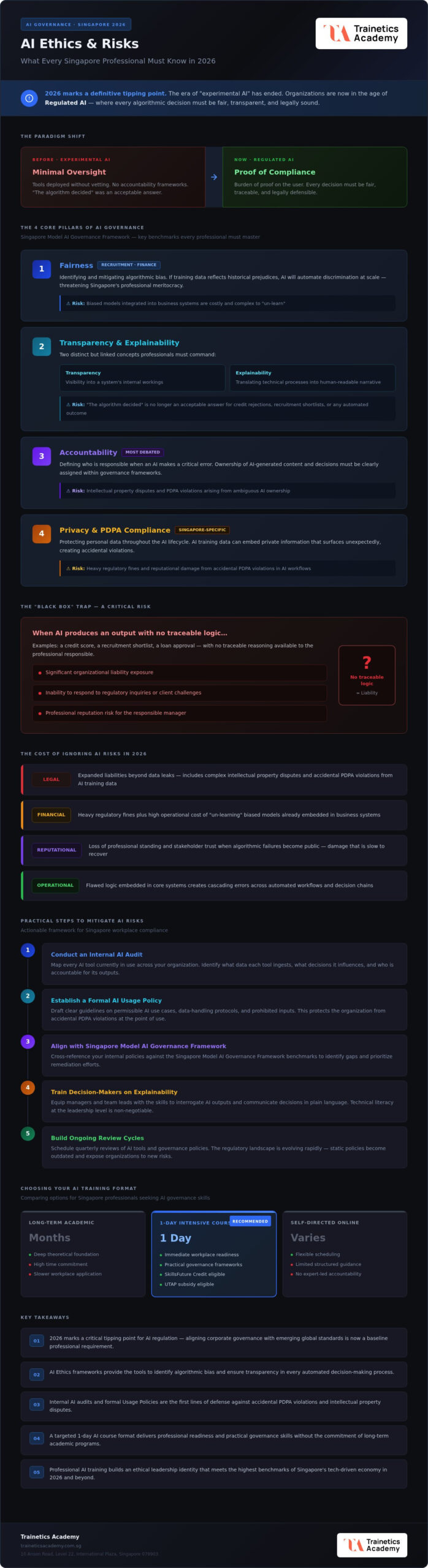
AI Ethics is defined as the system of moral principles and techniques intended to inform the development and responsible use of AI. It isn’t a mere academic exercise or a philosophical debate; it’s a technical and professional requirement for the modern workforce. As we move through 2026, the global market has reached a definitive tipping point for AI regulation and corporate accountability. The era of “experimental AI,” where organizations could deploy unvetted tools with minimal oversight, has officially ended. We’ve transitioned into the age of “regulated AI,” where the burden of proof rests on the user to ensure every algorithmic decision is fair, transparent, and legally sound.
Professionals who fail to prioritize an understanding ai ethics and risks course often fall into the “black box” trap. This occurs when an AI system produces an output—such as a credit score or a recruitment shortlist—without any traceable logic. If you can’t explain the reasoning behind an AI-driven conclusion, you’re exposing your organization to significant liability. Mastery in this field allows you to demystify these processes, ensuring your tools remain compliant with evolving international benchmarks while protecting your company’s integrity.
Why Singaporean Professionals Need Specialized AI Training
Singapore has set a high bar for professional readiness through the Singapore Model AI Governance Framework. This framework doesn’t just suggest best practices; it shapes local business standards and expectations for leadership. For professionals operating in this market, specialized training is the bridge between academic theory and practical workplace application. It transforms you from a passive user of technology into an ethical AI leader. By understanding these nuances, you protect your professional reputation and ensure your career trajectory remains on an upward path in a competitive, tech-driven economy.
The Cost of Ignoring AI Risks in 2026
The price of negligence is steep and multifaceted. Legal liabilities have expanded beyond simple data leaks to include complex intellectual property disputes and accidental PDPA violations stemming from AI training data. Financially, the impact includes heavy regulatory fines and the high operational cost of “un-learning” biased models that have already integrated flawed logic into your business systems. AI risk management is a non-negotiable skill for 2026 managers who wish to safeguard their organization’s future and operational stability.
At Trainetics Academy, we believe in raising professional benchmarks through rigorous, scientifically grounded education. Our Introduction AI Course provides the technical mastery and ethical clarity required to lead with confidence. Visit us at 10 Anson Road, Level 22, International Plaza, Singapore 079903, to begin your transition into a prestigious career in AI governance.
Decoding the Core Pillars of AI Ethics and Algorithmic Risks
To master the 2026 landscape, professionals must move beyond buzzwords and dismantle the four core pillars of AI governance. Fairness is the first critical benchmark. It involves identifying and mitigating algorithmic bias, particularly in sensitive sectors like recruitment and finance. If your training data reflects historical prejudices, your AI will simply automate discrimination at scale. In Singapore’s diverse professional ecosystem, this isn’t just an ethical failure; it’s a threat to social cohesion and organizational meritocracy.
The distinction between transparency and explainability is equally vital. Transparency refers to the visibility of the system’s internal workings, while explainability is your capacity to translate those technical processes into a human-readable narrative. If a client asks why their credit application was rejected, a vague reference to “the algorithm” won’t suffice. You must be able to trace the decision back to specific, justifiable data points. This level of oversight is a primary focus within an understanding ai ethics and risks course, where we empower leaders to demand clarity from their technical tools.
Accountability remains the most debated pillar. When an AI tool makes a critical error, the liability doesn’t rest with the software developer alone. The professional user is responsible for the final output. This necessitates a “human-in-the-loop” approach, ensuring that AI serves as a support system rather than a replacement for professional judgment. Coupled with rigorous data governance to maintain PDPA standards, these pillars form the foundation of a secure corporate strategy.
Identifying and Mitigating Algorithmic Bias
Bias often enters a system through developer assumptions or incomplete training data. For a manager, auditing these outputs doesn’t require a coding background. It requires a disciplined approach to testing. By regularly sampling AI-generated shortlists and checking for demographic outliers, you can spot feedback loops before they become systemic issues. This proactive stance ensures your team remains fair and inclusive, reflecting the high standards of the Singaporean workplace.
Generative AI Risks: Hallucinations and Misinformation
Generative AI presents unique challenges, specifically “hallucinations” where the model generates factually incorrect information with absolute confidence. These errors can be devastating when they appear in professional reports or legal filings. You must establish a verification protocol where every AI-generated fact is cross-referenced against a primary source before it reaches a stakeholder. Understanding what are the legal risks of using generative ai at work is essential for any professional aiming to mitigate these digital pitfalls. For those seeking to lead this ethical transition, our AI course Singapore curriculum provides the practical tools needed for immediate workplace application.
Evaluating the Best AI Course Singapore Options for Ethical Training
Choosing the right training path is a strategic investment in your professional identity. While global platforms offer a broad overview, they often lack the localized precision required for the Singaporean market. A high-quality AI course Singapore must prioritize three specific benchmarks: immediate practicality, local regulatory relevance, and the deep expertise of the trainers. You aren’t just looking for a certificate; you’re looking for the technical mastery that allows you to lead with confidence in a high-stakes environment.
For many busy professionals, a 1 day AI course Singapore format offers a superior return on time compared to multi-month academic programs. These intensive sessions focus on high-impact literacy and risk management rather than deep-level programming. It’s essential that even AI courses for beginners include a heavy emphasis on ethics. Literacy for non-programmers isn’t about learning to code; it’s about learning to lead technology with a critical, ethical eye. You need to know how to question an output, not just how to prompt a bot. This distinction separates a mere user from a visionary mentor in the digital age. For a comprehensive overview of how to select the right program for your career stage, our guide to the artificial intelligence course Singapore professionals are choosing in 2026 provides a detailed breakdown of available options and funding pathways.
SkillsFuture AI Courses: Maximizing Your Training Budget
Singapore’s commitment to lifelong learning makes high-level tech education remarkably accessible. The government’s support through various subsidies allows you to upskill without straining your personal or corporate budget. Specifically, the Introduction AI Course at Trainetics Academy is Eligible for SkillsFuture Credits and UTAP subsidies. This ensures that mastering an understanding ai ethics and risks course is a financially sound move for any professional. To get the most out of your available funds, refer to our guide on maximizing your skillsfuture credit.
What to Look for in an AI Ethics Curriculum
A robust curriculum must be grounded in the Personal Data Protection Act (PDPA). Generic courses often overlook these local nuances, leaving you vulnerable to domestic regulatory shifts. Look for programs that utilize hands-on case studies involving Singaporean SMEs and MNCs. This practical exposure ensures you can apply what you’ve learned to your specific workplace context immediately. Whether you choose a virtual or physical learning environment at 10 Anson Road, Level 22, International Plaza, Singapore 079903, ensure the delivery is interactive. Static lectures won’t prepare you for the dynamic challenges of 2026. You need a space where you can debate ethical dilemmas and stress-test risk frameworks before they’re deployed in a live business environment.
Practical Steps to Mitigate AI Risks in the Singapore Workplace
Once your audit is complete, you must establish a clear internal AI Usage Policy (AUP). This document should serve as a professional benchmark, defining which tasks are AI-eligible and which data categories are strictly off-limits. A robust AUP eliminates uncertainty and provides your team with a secure framework for innovation. Coupling this with “Human-in-the-loop” protocols ensures that high-stakes outputs, such as client-facing reports or financial shortlists, are never delivered without human verification. AI should act as a sophisticated co-pilot, but the final professional judgment must always remain with you.
Finally, prioritize continuous education. The digital landscape shifts weekly, and an understanding ai ethics and risks course provides the foundational technical mastery needed to spot emerging threats like data poisoning or prompt injection. Staying updated isn’t just about technical skill; it’s about maintaining a professional identity rooted in excellence and readiness. To begin implementing these strategies immediately, enroll in our Artificial Intelligence Course and lead your organization with scientific precision.
Ensuring PDPA Compliance with AI Tools
Data privacy is the cornerstone of ethical AI use in Singapore. You must implement strict anonymization protocols, ensuring that no personally identifiable information (PII) is ever fed into a generative model. In 2026, the intersection of AI data processing and PDPA compliance centers on the legal requirement for purpose limitation and accuracy in automated decision-making. For a practical checklist on safeguarding your team’s output, explore our guide on how to ensure data privacy when using ai tools.
Building an Ethical AI Culture
Technology is only as reliable as the people who operate it. Building an ethical AI culture starts with transparency. Employees must feel safe admitting they used AI tools without fear of professional reprimand. This openness allows for better oversight and peer review. Leadership plays a visionary role here, modeling ethical technology use and setting clear boundaries on what should never be fully automated, such as performance reviews or sensitive client negotiations. By fostering this environment, you transition your team from passive users to disciplined, ethical leaders. To help integrate these values across your entire organization, you can learn more about Unashamedly Ethical NPC and their work in ethics consultancy.
Elevating Your Career with Professional AI Training at Trainetics Academy
Trainetics Academy stands as a premier gateway for those seeking to raise professional benchmarks in the digital age. We don’t just teach technology; we cultivate a professional identity defined by precision and ethical leadership. By enrolling in our understanding ai ethics and risks course, you’re positioning yourself at the forefront of the industry. Our curriculum is designed with academic rigor, ensuring every participant masters the technical nature of AI governance while maintaining the highest standards of professional readiness. This methodical approach transforms a complex subject into a structured learning path, leading you toward a prestigious career as an ethical technology leader.
Our training environment at 10 Anson Road, Level 22, International Plaza, Singapore 079903, bridges the gap between high-level theory and the dynamic realities of the Singaporean workplace. You’ll learn from highly qualified professionals who understand the nuances of local regulatory frameworks and international benchmarks. This ensures your transition into an AI-enabled career is both scientifically grounded and practically applicable. We focus on the depth of the curriculum, satisfying the intellectual curiosity of advanced practitioners while remaining accessible to those just beginning their journey. By choosing Trainetics, you’re choosing a visionary mentor dedicated to your continuous improvement.
The Trainetics Advantage: Practical and Subsidized
Our Introduction AI Course serves as the definitive foundation for ethical and productive technology use. We recognize that professional development requires both quality and accessibility. This course is Eligible for SkillsFuture Credit and UTAP funding, making elite education a reality for any ambitious professional. Whether you prefer the energy of physical learning at International Plaza or the flexibility of our virtual platforms, our delivery remains interactive and high-standard. We treat your professional mind with the same discipline and focus on excellence that we apply to our most rigorous training programs, ensuring you gain a clear understanding ai ethics and risks course outcome that translates to immediate career growth.
Take the Next Step in Your AI Journey
Joining Trainetics Academy means entering a community of disciplined and visionary mentors who value hard work and precision. You aren’t just attending a class; you’re securing your future in an increasingly complex market. Take the definitive step toward professional mastery today. Visit us at 10 Anson Road, Level 22, International Plaza, Singapore 079903, to discuss how we can support your long-term career outcomes. Master the complexities of the modern workplace by enrolling in our Artificial Intelligence Course and lead your organization with the confidence that only scientific validation and expert training can provide.
Lead the Future of Ethical AI Governance
2026 demands more than just technical skill; it requires a professional identity rooted in ethical clarity and risk mitigation. By mastering the core pillars of fairness and transparency, you ensure your organization remains resilient against algorithmic bias and regulatory shifts. This journey begins with a commitment to continuous education and a disciplined approach to technology leadership in the Singaporean workplace. Each step you take toward governance strengthens your reputation as a trusted industry leader.
Securing an understanding ai ethics and risks course outcome is the most effective way to protect your professional standing and lead with confidence. Our expert-led interactive curriculum provides the scientific validation needed to bridge the gap between theory and workplace mastery. The Introduction AI Course is Eligible for SkillsFuture and UTAP subsidies, offering an accessible path to professional excellence. Join a community of visionary professionals dedicated to raising industry benchmarks and securing a stable digital future.
Enroll in our Introduction AI Course and lead with ethical confidence at our academy located at 10 Anson Road, Level 22, International Plaza, Singapore 079903. Embrace your role as a disciplined mentor and secure your career trajectory today.
Frequently Asked Questions
What is an understanding AI ethics and risks course?
An understanding ai ethics and risks course is a specialized training program designed to teach professionals how to deploy artificial intelligence responsibly. It focuses on identifying algorithmic bias, ensuring transparency, and maintaining human oversight in automated systems. By mastering these ethical frameworks, you protect your organization from legal liabilities while building a professional identity rooted in excellence. It bridges the gap between academic theory and practical workplace application.
Is the AI Course at Trainetics Academy eligible for SkillsFuture Credits?
Yes, our Introduction AI Course is Eligible for SkillsFuture Credits and UTAP funding. This financial support makes high-level tech education accessible to ambitious professionals looking to raise their professional benchmarks. By utilizing these subsidies, you can achieve technical mastery in AI governance without straining your budget. Our academy is dedicated to providing the highest standard of training to ensure you’re fully prepared for the 2026 digital landscape.
Do I need a technical background to take an AI course for beginners?
No technical background is required for our AI courses for beginners. These programs are specifically engineered for non-programmers, managers, and executives who need to lead AI implementation rather than write code. We focus on building AI literacy, ethical decision-making, and risk management. This approach ensures that you can critically evaluate AI outputs and lead your team with confidence, regardless of your previous experience with software development.
What are the biggest risks of using Generative AI at work in 2026?
The primary risks in 2026 include AI hallucinations, accidental PDPA violations, and unchecked algorithmic bias. Hallucinations occur when a model generates confident but false information, which can lead to professional errors in reports. Without a formal ethical framework, your team might also inadvertently process sensitive data through public models, risking heavy regulatory fines. Understanding these pitfalls is a central component of any high-standard understanding ai ethics and risks course.
How long is a typical AI course Singapore for working professionals?
A typical 1 day AI course Singapore format is designed to provide intensive, high-impact training for busy professionals. These sessions focus on immediate workplace application, covering essential literacy and risk mitigation strategies in a single day. This efficient structure allows you to gain a recognized professional identity and actionable frameworks without the lengthy commitment of traditional academic degrees. It’s an ideal choice for those seeking professional readiness in a competitive market.
Can I use UTAP to fund my AI training at Trainetics Academy?
Yes, you can utilize UTAP funding to support your professional development at Trainetics Academy. The Introduction AI Course is Eligible for UTAP subsidies, providing a cost-effective way to master the complexities of AI governance. This commitment to subsidized, high-quality education reflects our mission to be a gateway to prestigious careers. We ensure that every student receives the scientific validation and expert mentorship required to excel in the modern Singaporean workplace.
Where is Trainetics Academy located for physical classes?
Trainetics Academy is conveniently located for physical classes at 10 Anson Road, Level 22, International Plaza, Singapore 079903. Our facility provides a professional and academic environment where you can engage in interactive learning and debate ethical dilemmas with industry experts. We offer both physical and virtual platforms to accommodate the diverse needs of modern professionals, ensuring that the highest standard of AI training is always within reach.
How does AI ethics training help with PDPA compliance?
AI ethics training provides the technical mastery needed to align automated processes with PDPA standards. It teaches you how to implement data anonymization and purpose limitation, ensuring that AI models don’t process personally identifiable information unlawfully. By establishing these ethical boundaries, you mitigate the risk of data leaks and regulatory penalties. This training transforms you into a disciplined leader who can safeguard organizational integrity in an increasingly regulated digital ecosystem.
Disclaimer
AI Content Disclaimer: Some articles on this website may be generated or assisted by AI-powered content creation tools. While we strive for accuracy and relevance, readers should independently verify information before relying on it. The content is provided for informational purposes only and does not constitute professional advice.