The most useful AI course isn’t necessarily the one with the broadest syllabus or the most prominent funding details. For anyone exploring skillsfuture 2026, start with a clear professional goal: what do you want to be able to do with AI at work?
When comparing courses, focus on their stated learning outcomes, practical relevance and fit with your experience. Course listings and funding information can change, so use current SkillsFuture information as a starting point and assess each AI course on its own details.
This guide explains how to explore SkillsFuture AI courses in Singapore, compare options for beginners and experienced professionals, and choose a learning format that suits your schedule and goals. You’ll also find a practical framework for deciding whether an introductory or more focused AI course is the right next step. Trainetics Academy offers interactive AI learning through physical and virtual platforms, with training designed to support professional skill development. A purposeful choice can make your course a structured step towards applying AI more confidently in your role.
Key Takeaways
- Use skillsfuture 2026 course information as a starting point, then match your choice to a specific professional goal.
- Compare AI courses by intended learner, learning outcomes, format and practical workplace application, not title alone.
- Distinguish introductory AI literacy from specialised learning by identifying the skills and tasks each course focuses on.
- Treat funding as course-specific and review the latest information before making plans around it.
- Use a five-step selection process to assess your experience, intended application, preferred format, course outcomes and current listing information.
What SkillsFuture 2026 Means for Singaporeans Exploring AI Courses
SkillsFuture is Singapore’s lifelong-learning framework, supporting individuals as they develop skills throughout their working lives. For Singaporeans exploring AI courses, SkillsFuture 2026 is a starting point for discovering learning options and reviewing current course information. Finding a listing is only the first step. The right choice depends on what you want to learn and how you intend to apply it.
AI concepts can be relevant across many roles, from understanding how generative tools produce information to considering where AI may fit into everyday work. The subject is broad. A foundational overview of What is Artificial Intelligence? can help clarify the field, but a course decision should also take account of the tasks and responsibilities that matter in your role. Training can build knowledge and capability, but it doesn’t guarantee a particular career outcome.
How SkillsFuture course discovery helps AI learners
Use MySkillsFuture to explore AI-related course listings. Note each course’s title, stated outcomes and learning format. Treat a listing as an entry point for research, not a complete comparison: the title alone may not show whether a course focuses on foundational AI understanding or a particular workplace application. For a broader overview of course selection, read this guide to artificial intelligence courses.
Keep a short list of options and compare their published details side by side. This makes it easier to see what each course is designed to teach, rather than choosing based on a familiar title or a single feature. Course and funding information can change, so review the current listing when making your decision.
Why AI learning goals matter before browsing
Before opening a course catalogue, identify one or two tasks you want to understand or improve. You might want to learn AI fundamentals, assess AI-generated information more thoughtfully, or explore how AI tools could support a recurring task in your role. A specific aim gives you a practical basis for judging whether a course’s learning outcomes are relevant.
General AI familiarity and role-specific application are different learning goals. If you’re new to the subject, an introductory course may help you build a foundation. If you already understand the basics, look for outcomes that relate more closely to your work. This distinction helps you move from browsing SkillsFuture AI courses to selecting learning that supports a clear professional development goal.
How to Compare SkillsFuture AI Courses Beyond the Course Title
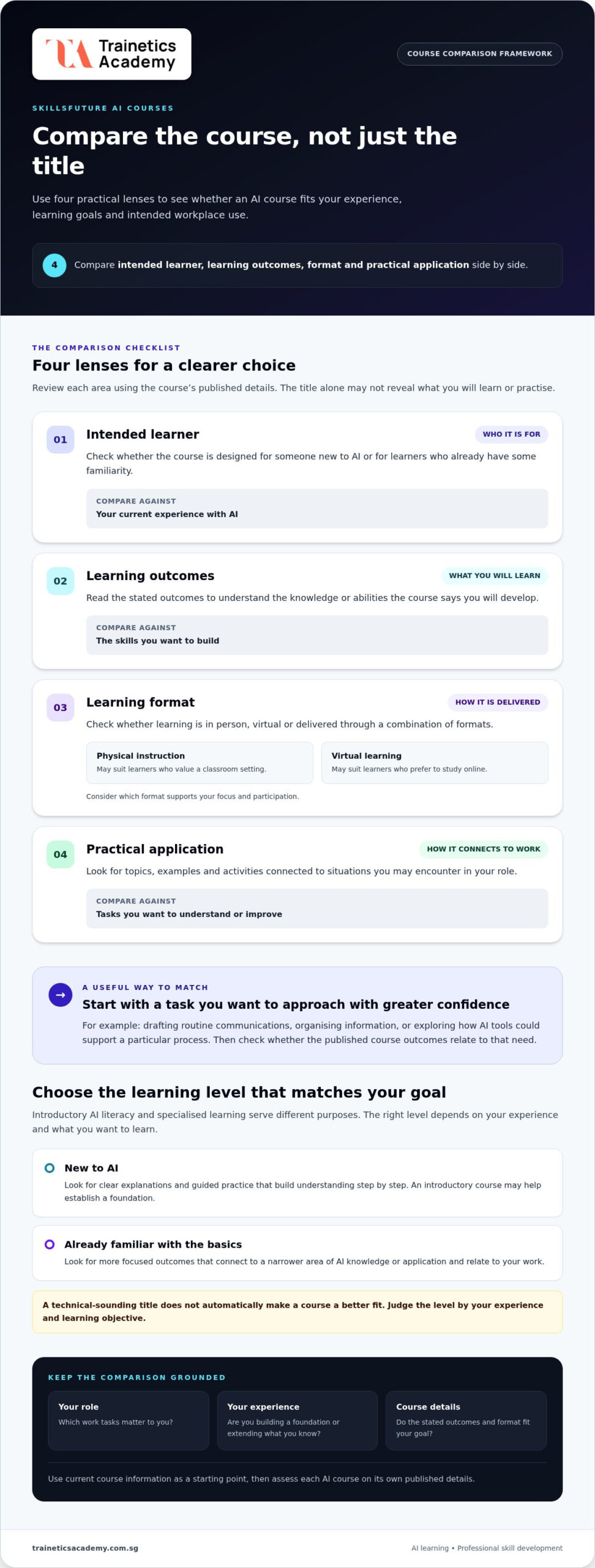
A course title may sound relevant without revealing what you’ll learn or practise. To compare SkillsFuture AI courses carefully, look at four areas: who the course is for, what you’ll learn, how it’s delivered, and how it connects to tasks you handle at work. This gives you a consistent framework for weighing options in skillsfuture 2026.
Intended learner: Does the course suit someone new to AI, or learners who already have some familiarity?
Learning outcomes: What knowledge or abilities does the course say you’ll develop?
Format: Is learning delivered in person, virtually, or through a combination of formats?
Practical application: Do the topics and activities relate to situations you may encounter in your role?
These comparison points help distinguish introductory AI literacy from more specialised learning. An introductory course should make core concepts accessible and help learners build a foundation. More specialised learning should connect its stated outcomes to a narrower area of AI knowledge or application. Don’t assume a technical-sounding title is automatically a better fit. The right level depends on your experience and learning objective.
Match course outcomes to your role and experience
List the work tasks you’d like to approach with greater confidence. These might include drafting routine communications, organising information, or understanding how AI tools could support a particular process. Then compare each course’s published outcomes and content with those needs. If you’re a beginner, prioritise clear explanations and guided practice that build understanding step by step. A course is more relevant when its learning goals connect with your intended application, rather than simply mentioning AI.
Compare learning format and practical application
Physical instruction may suit learners who value a classroom setting, while virtual learning may suit those who prefer to study online. Consider which format supports your focus and participation. Look for clear explanations, learning activities and examples that connect ideas to workplace use. For context on Singapore’s 2026 training landscape, this report on the SkillsFuture AI Subscription Initiative 2026 discusses an initiative, but a listing or initiative doesn’t replace comparing a course’s content with your goals.
For broader context on professional AI learning, explore this AI course Singapore guide. Trainetics Academy provides interactive artificial intelligence learning through physical and virtual platforms, offering learners a structured way to develop professional capability. Compare the course information with the outcomes you’re seeking, then use your role, experience and preferred learning format to guide your choice.
SkillsFuture Credit and AI Course Funding: What to Check in 2026
Check funding details for the specific AI course rather than assuming they apply based on the subject or another course’s listing. Trainetics Academy’s Introduction AI Course is eligible for SkillsFuture Credit and UTAP. Review the latest official information before making plans based on funding, since details can change.
For other options, use the current MySkillsFuture course listing to check the exact course name and its displayed information. Then review the relevant official guidance for claim steps and learner requirements. Rely on current sources rather than an older page, a general AI-course description or an informal summary.
What to verify before relying on funding information
Before enrolling, check that the information you’re reading refers to the exact course you intend to take. Review its current listing and follow official guidance for any claim process or learner requirements. Don’t assume that funding available for one AI course also applies to another, or that every learner can use the same support. For a broader explanation of how SkillsFuture Credit works, read the SkillsFuture Credit guide.
- Course identity: Match the name on the course listing with the course you intend to take.
- Current information: Use the latest listing and official guidance, not saved screenshots or outdated summaries.
- Claim details: Follow the relevant official instructions and review any stated learner requirements.
These checks help separate a course’s funding information from assumptions about AI training in general. If a detail is unclear or has changed, refer to the current official information before relying on it. Don’t estimate support or claim outcomes from details that apply to a different course or learner.
Separate course suitability from funding considerations
Funding can be an important part of your decision, but it doesn’t show whether a course fits your professional goals. Compare its stated learning outcomes, content and format with the skills you want to develop and the tasks you hope to approach with greater confidence. A course aligned with your work needs may be a stronger learning fit than one chosen on funding considerations alone.
Use a two-part decision: first assess whether the course supports a relevant learning goal, then verify its current funding information through the applicable official listing and guidance. This keeps your choice grounded in professional relevance and course-specific details as you explore AI learning in skillsfuture 2026.
A Practical Checklist for Choosing an AI Course in Singapore
A clear selection process can turn a long list of AI courses into a focused learning decision. Use this five-step checklist to assess your goals, experience and preferred learning approach before reviewing current course details in skillsfuture 2026.
- Step 1: Define a workplace learning goal. Identify one task or process where a stronger understanding of AI could be useful. For example, you may want to understand how AI tools can support routine writing or help organise information. Keep the goal specific to your role, and separate what you want to learn now from longer-term career ambitions.
- Step 2: Note your current experience. Be honest about your familiarity with AI concepts and tools. If you’re new to the subject, look for a course that explains foundational ideas clearly and supports learning with guided activities. If you already have experience, consider whether the course’s stated level and content offer a useful next step.
- Step 3: Compare intended application and outcomes. Read the learning outcomes and topic coverage, then ask whether they connect to the work task you identified. Look for a clear relationship between what the course teaches and what you want to understand or practise. Broad interest in AI is a starting point, but a defined application makes comparisons more meaningful.
- Step 4: Choose a suitable learning format. Consider whether physical or virtual instruction better supports your participation and schedule. Review how the course is delivered, and look for practical activities that match your experience level and intended use. The format should help you engage with the material, not merely fit a label you prefer.
- Step 5: Review current listing information. Check the exact course name, published details and latest listing before deciding. Once you’ve identified a suitable learning option, review relevant funding information through current official sources. Don’t use funding details for a different course as a basis for your decision.
Start with a specific workplace learning goal
Make your goal concrete enough to guide a course comparison. “Learn AI” is broad; “understand how AI-generated text can support routine drafting in my role” gives you a clearer point of reference. This doesn’t promise a measurable work result. It helps you evaluate whether the course content is relevant to your responsibilities and whether its level matches your experience.
Review the learning experience before deciding
Compare outcomes, topics, format and practical activities as one connected picture. A course should make sense for both what you want to learn and how you prefer to learn it. For a wider professional learning overview, explore Trainetics Academy’s AI course guide for professionals and consider how its artificial intelligence training aligns with your development goals.
Build Practical AI Skills with Trainetics Academy
After comparing course outcomes, format and relevance to your work, consider how a structured learning experience could support your next step. Trainetics Academy is a Singapore training provider offering artificial intelligence training for professional skill development. Its interactive learning is delivered through physical and virtual platforms, giving learners different ways to engage with AI education.
Choosing an AI course is not only about finding a topic that sounds useful. It’s also about approaching learning with a clear purpose: building familiarity with AI concepts, strengthening your understanding of the subject, or exploring how AI may relate to your professional responsibilities. As you assess options in skillsfuture 2026, use your role and experience to guide what you want from the learning process.
What learners can expect from Trainetics Academy
Interactive learning provides a structured setting for engaging with artificial intelligence concepts. Rather than choosing based on the title alone, consider how instruction can help you develop understanding step by step. Physical and virtual platforms offer different learning environments, so reflect on which setting best supports your participation and focus. Both formats are part of Trainetics Academy’s learning approach.
Connect your professional development goal to the kind of understanding you want to build. You may want to become more familiar with AI or consider its relevance to your role. A clear purpose gives you a useful lens for reviewing course information and thinking about how the learning may fit into your wider development. It also helps distinguish general interest from a defined professional learning objective.
Take the next step toward AI learning
Review the course details with your own goals in mind. Consider the published information, learning format and whether the course aligns with the professional capability you want to develop. This brings together the decisions covered in this guide: identify a goal, assess your experience, compare learning options and use current course information to make an informed choice.
Trainetics Academy’s artificial intelligence training offers a structured way to engage with AI learning through interactive instruction and physical or virtual platforms. Its AI course details provide information to consider alongside your development goals.
Take Your Next Step in AI Learning
Choosing an AI course starts with a professional goal, not a course title or funding detail. Use SkillsFuture course information to discover options, then compare each course’s intended learner, outcomes, format and relevance to the tasks you want to understand. Check current funding information for the specific course through official sources before relying on it. These steps bring focus to your skillsfuture 2026 search and help you choose a learning path that fits your experience and ambitions.
Trainetics Academy is a Singapore-based training provider offering artificial intelligence learning through interactive instruction on physical and virtual platforms. A structured course gives you a purposeful setting to build your understanding of AI and consider its relevance to your professional development.
Frequently Asked Questions
What is SkillsFuture 2026?
SkillsFuture 2026 describes Singapore’s lifelong-learning and skills-development context in 2026. For AI learners, treat course discovery, course suitability and funding checks as related but separate steps. Start with current official course information, then compare a course’s stated outcomes and format with your work goals. Check date-sensitive scheme details through official sources before making an enrolment decision, as information may change.
How do I find AI courses through SkillsFuture in 2026?
Use MySkillsFuture to explore current course listings and AI-related learning options. When you find a relevant course, compare its intended learners, outcomes, topic coverage and learning format. A title alone won’t tell you whether the course fits your experience or goals. Review the current listing and course information before deciding, and treat skillsfuture 2026 as a starting point for research rather than a complete comparison.
Can I use SkillsFuture Credit for an AI course at Trainetics Academy?
Trainetics Academy’s Introduction AI Course is eligible for SkillsFuture Credit and UTAP. Don’t assume the same funding applies to every AI course or learner. Before enrolling, check the current course listing and relevant claim information through official sources, keeping the course name consistent as you review details. Then compare the course outcomes with your learning goals to make sure it’s a suitable choice beyond funding considerations.
Are all AI courses covered by the same SkillsFuture funding?
No. Don’t assume every AI course has the same funding arrangements. Details can differ by course, so review the current listing and relevant official guidance for the exact programme you’re considering. Consider funding separately from course content, then assess whether the topics and outcomes suit your goals. This helps you avoid basing your decision only on a broad subject label or general funding statements.
What should I compare when choosing a SkillsFuture AI course?
Compare the intended learner, stated outcomes, AI topics, learning format and opportunities to apply concepts to work. Match these details to your experience and the tasks you want to approach with greater confidence. For example, a beginner may prioritise clear foundations, while someone with AI experience may seek more focused content. If funding matters, check the current details for that specific course separately.
Can beginners take an AI course in Singapore?
Yes, beginners can explore AI training by checking each course’s intended learner and starting level. Compare the stated outcomes with your current familiarity and preferred learning format. Look for course information that explains its scope clearly, rather than inferring the level from the title alone. Set a realistic learning goal connected to your role, then choose an option whose content and approach suit that starting point.
How do I choose an AI course that supports my career goals?
Begin with a specific work-related learning goal, such as understanding an AI concept or exploring its relevance to a task in your role. Compare that goal with each course’s outcomes, content and learning activities. Consider whether the format suits your schedule and learning preferences. Career outcomes vary, so don’t treat training as a guarantee of employment or promotion. Choose the course that best fits your development priorities.
Ready to take the next step? Explore Trainetics Academy’s artificial intelligence course and review how it fits your learning goals.
Disclaimer
AI Content Disclaimer: Some articles on this website may be generated or assisted by AI-powered content creation tools. While we strive for accuracy and relevance, readers should independently verify information before relying on it. The content is provided for informational purposes only and does not constitute professional advice.