An AI class can suit beginners and non-technical professionals when it starts with practical applications rather than coding prerequisites. In Singapore, AI learning options range from quick courses lasting one hour to a beginner-level course described as building job-ready skills in about 14 hours. The right choice depends on what you want to do with AI, such as research, content creation, or everyday business tasks.
It’s understandable to want practical skills without getting lost in technical theory. A structured ai class can help you practise using AI tools, assess their outputs, and apply them thoughtfully to work tasks.
This guide explains which AI course formats may suit your experience, what to look for in course content, and how AI skills can support workplace productivity and career development. You’ll also learn how to match your goals with practical exercises in research, writing, content creation, and data analysis.
Key Takeaways
- Match course depth to your experience and the tasks you want to improve, rather than choosing by title alone.
- Educators, students, and small businesses can focus their learning on practical needs in their own work and study contexts.
- Build a repeatable process for using AI to support research, writing, content creation, and data analysis while reviewing its output.
- Assess how AI training aligns with your current role and the capabilities you want to develop for future career opportunities.
- Explore Trainetics Academy’s Artificial Intelligence Course as a structured next step for building practical AI knowledge.
AI courses for beginners and non-technical professionals
Beginners can start with AI fundamentals, then practise tasks such as summarising research or drafting content. For non-technical professionals, a structured course should connect what they learn with workplace needs.
For a short overview, watch Jeff Su’s video, “Google’s AI Course for Beginners (in 10 minutes)!”
Beginner and Professional Course Options
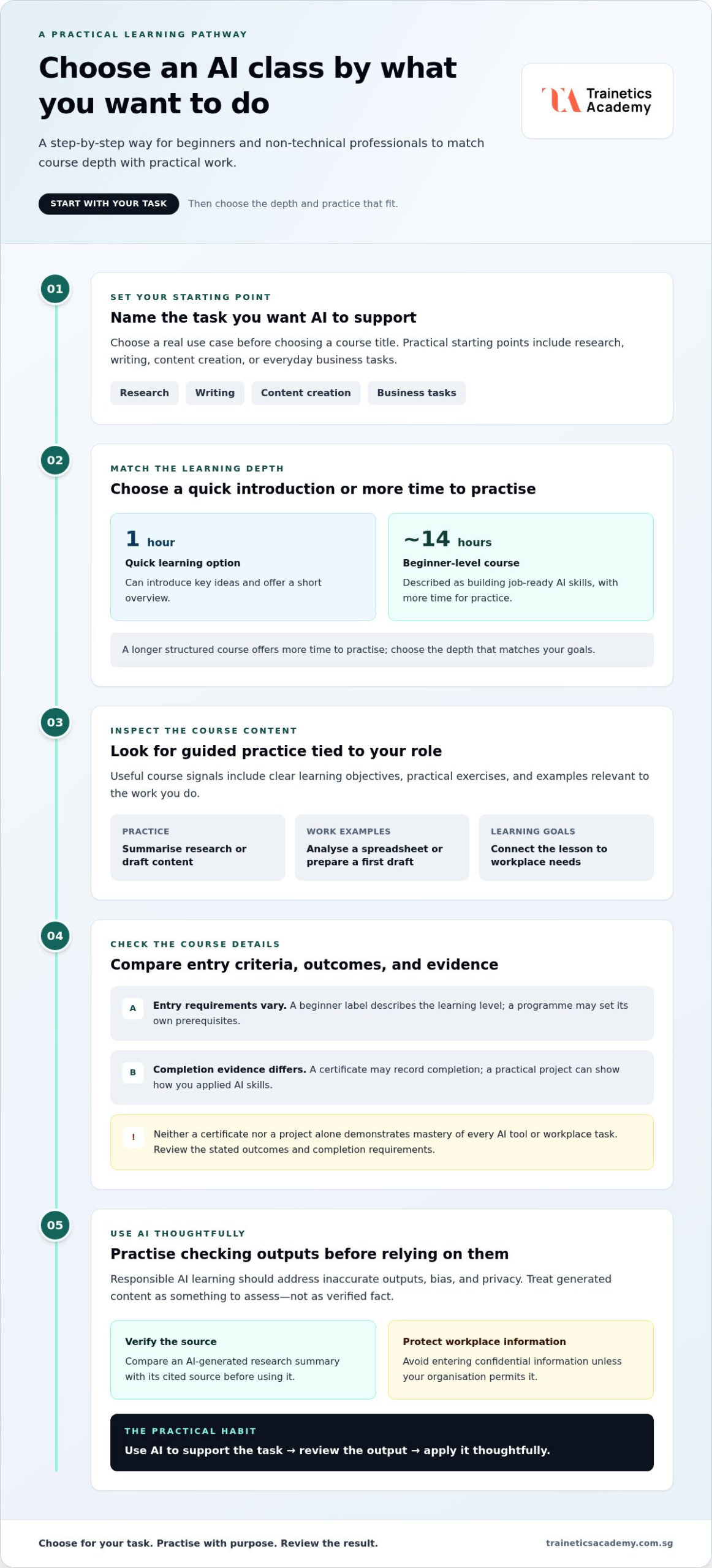
AI courses for beginners introduce core concepts before moving into practical exercises. A beginner-level course described in Singapore takes about 14 hours and focuses on job-ready AI skills. Professionals can compare courses by their applications, such as research, writing, or business tasks. Look for guided practice, clear learning objectives, and examples relevant to your role.
Google’s AI course resources include quick learning options lasting one hour. These can introduce key ideas, while a longer structured course offers more time to practise. Jeff Su’s video gives students a concise introduction to Google’s beginner AI course. Use it for orientation, then choose a course that matches your learning goals and desired depth.
Entry Requirements and Credentials
Entry requirements vary by course. A beginner label describes the learning level, while a specific programme may set its own prerequisites. The 14-hour course is listed as beginner level, which can help new learners assess its starting point. Before enrolling, compare stated entry criteria with your experience and the skills you want to build.
Course qualifications also vary. A certificate may record completion, while a practical project can show how you applied AI skills. Neither alone demonstrates mastery of every AI tool or workplace task. Review the stated learning outcomes and completion requirements to understand what credential or evidence the course provides.
Responsible Use and Risk Awareness
A responsible AI course should address inaccurate outputs, bias, and privacy. For example, compare an AI-generated research summary with its cited source before using it. Avoid entering confidential workplace information into a tool unless your organisation permits it. These habits help you assess outputs instead of treating generated content as verified fact.
Singapore’s SkillsFuture AI Subscription initiative may provide eligible Singapore Citizens aged 18 and above with complimentary subscriptions when they enrol in an eligible SkillsFuture AI course and meet programme requirements. SkillsFuture Credit is available to Singaporeans aged 25 and above for eligible courses. SSG course-fee subsidies can reach 70% for Singaporeans over 40; Some learners may be eligible for course-fee support, depending on their circumstances and programme requirements.
To evaluate an AI class, compare its instructor experience, student outcomes, practical exercises, and coverage of responsible use. Check whether examples reflect your work, such as analysing a spreadsheet or preparing a first draft. A focused course should help you practise specific tasks and build skills you can apply beyond the classroom.
AI training for educators, students, and small businesses
Useful AI training starts with your role and a practical task. In Singapore, educators, students, and small businesses may focus on different applications.
Which ai class suits children, students, or working adults? Choose based on age, experience, and intended use: youth learning can build AI awareness, while adults may focus on workplace tasks or teaching practice.
Topics and Tools Covered
Singapore AI classes may cover generative AI, prompt design, data analytics, and responsible use. Compare the exercises with a real task, such as drafting a lesson outline or summarising a spreadsheet. Practical learning should help you interpret outputs, identify errors, and turn information into useful insights.
The AI Ready ASEAN initiative aims to empower 5.5 million youths, educators, and parents. This regional program highlights the value of foundational AI learning across age groups. In Singapore, AI-Readiness for Individuals is designed to build knowledge and skills for workplace innovation and productivity improvements.
For small businesses, AI training can connect generative AI and analytics with daily workflows. A learner might use AI to organise customer feedback, then review the themes before making a business decision. This supports transformation through defined use cases rather than adopting tools without a clear purpose.
AI and data analytics training can teach you to organise information, find patterns, and explain results. For example, a small business owner could group common customer questions, then use those insights to improve a service guide. Practise checking outputs against source data before acting on a recommendation.
Educators can apply AI to lesson planning, resource development, and classroom examples. Students can use it to explore a topic, then compare generated explanations with course materials. A master trainer development pathway would also build facilitation skills, including designing demonstrations, guiding practice, and assessing whether learners can apply AI responsibly.
Training Delivery Formats
Singapore AI training may be delivered in person, online, or in a hybrid format. The right option depends on whether you need live demonstrations, flexible access, or direct practice with an instructor. A shared session can help a small business team focus on one workflow, while remote learning lets participants join from different locations.
Before enrolling, compare the delivery format with the intended learning activity. A session on generative AI prompts may work well online, while a group exercise analysing business data may benefit from guided interaction. Singapore’s AI-Readiness for Businesses is designed for organisations exploring or advancing AI use across sectors, with use cases and applications.
AI for research, writing, content creation, and data analysis
A practical learning sequence moves from understanding generative AI to testing it on familiar workplace tasks. For example, use a public report to practise questioning, summarising, and checking AI-generated responses. This connects AI concepts with productivity while showing where human judgement remains essential.
For research, start with a focused question, then ask an AI tool to organise possible themes. If you’re studying Singapore’s public transport, request a comparison framework rather than unsupported conclusions. Next, locate original reports, verify each claim, and distinguish evidence from generated suggestions. This builds research skills without treating fluent machine output as proof.
Writing exercises can make the tool’s role clear. Ask it to create an outline for a workplace briefing, then check whether the structure suits your audience. Provide only non-sensitive background, define the intended tone, and revise the draft against source material. Comparing the first output with your edited version shows how precise instructions shape useful results.
Practise content creation by adapting one approved topic into several formats. For example, turn a product update into a short email, a social post, and a frequently asked question. Confirm details, remove unsupported claims, and make sure each version suits its audience. This shows how generative tools can support production without replacing editorial responsibility.
Data analysis starts with clean, suitable information and a specific decision. You could review a sample table of monthly enquiries, group recurring themes, and ask AI to suggest patterns. Then compare its suggestions with the actual entries and note exceptions. This teaches you to treat machine-generated insights as leads for investigation, not final findings.
To apply these methods at work, select one task and define success criteria before using a tool. For a meeting summary, check completeness, accuracy, and clarity against your notes. For a spreadsheet explanation, trace each conclusion to its underlying data. These checks measure AI practice through work quality, not the volume of generated text.
Across research, writing, content, and analysis, use the same disciplined cycle: define the task, provide suitable context, review the output, and revise it. A useful course gives you repeated practice with distinct examples, such as a research brief and a spreadsheet. This progression turns foundational concepts into transferable skills for everyday workplace use.
AI in business and career development
AI training can help employees connect tools with clear business tasks. A customer service team, for example, could use AI to group recurring questions before updating its response guide. Staff should still check each suggested theme against actual messages. This keeps the workflow grounded in evidence and makes the tool’s role clear.
Career planning also benefits from understanding current labour-market signals. PwC’s June 2026 Global AI Jobs Barometer analysed more than one billion job ads across 27 countries. It reports that AI job postings increased by 108% between December 2022 and December 2024. The same report states that workers with AI skills earn an average wage premium of 62%. These findings show why practical AI skills can matter to career development, but they don’t guarantee a specific job or salary.
For broader workplace learning, PwC’s 2026 Global AI Jobs Barometer reports that 83% of workers said AI tools support their ability to develop new skills in their roles. An employee might use a generative tool to draft a project outline, then refine it using team requirements. The value comes from applying judgement, communication, and subject knowledge alongside the tool.
Choose AI training by first identifying an outcome related to your role. A sales analyst might want to summarise customer feedback, while a manager may need to assess suitable AI solutions for a workflow. Compare course exercises with that task. Look for practice in writing clear instructions, reviewing outputs, and explaining where human approval remains necessary.
Technical pathways have different demands. If you’re exploring machine learning, study how systems identify patterns in data. Coding can be useful for building or adapting technical workflows, but business users can begin with tool selection and output review. Strong language skills matter too: precise instructions help shape relevant results, and clear explanations help colleagues assess them.
If you’re considering a career transition, build evidence through small, documented applications. You could create a sample workflow that turns meeting notes into action items, then record the checks used to catch omissions. This demonstrates process knowledge, not just familiarity with AI tools. Explain the task, the tool’s contribution, and your review in any portfolio example.
Organisations can use the same method to plan workforce development. Start with a recurring task, define acceptable output, and train the team to test and review AI assistance. Singapore’s AI-Readiness for Businesses is designed for organisations exploring or advancing AI use across sectors, with use cases and applications. This focus connects AI training with business needs and practical adoption.
What AI classes are available in Singapore for beginners?
Beginners in Singapore can compare introductory learning, applied workplace training, and technical study. An introductory class explains core AI ideas; an applied course uses tasks such as drafting a briefing or reviewing information. Technical pathways explore machine learning and coding. Match the format to your goal, not just the course title.
One named option is AI for Essential Digital Skills, which focuses on using AI skills to solve workplace challenges. Its four modules and 13 assignments give learners a structured sequence to examine. The course includes a final project estimated at 60 minutes. Those details can help students assess its workload and applied learning before choosing a course.
Short introductory resources can help you sample a topic before committing to deeper study. Google AI resources include quick courses lasting one hour. Use a short lesson to learn basic terms, then identify a work task for further practice. For example, test whether an AI tool can organise non-sensitive notes into themes.
A one-day class suits learners seeking concentrated instruction, but the pace matters. Look for time to learn a concept, practise it, and review the result. A sample exercise might ask you to refine an AI-generated email, check its facts, and explain your edits. If the schedule only lists topics, it may offer less hands-on practice.
For workplace applications, compare AI-Readiness for Individuals in Singapore, designed to build knowledge and skills for workplace innovation and productivity improvements. Organisations exploring AI use can consider AI-Readiness for Businesses in Singapore, designed around use cases and applications across sectors. These distinct pathways help individuals and organisations shape learning around their needs.
Before selecting a course, use three checks: identify your learning goal, inspect the listed exercises, and compare the expected workload with your available time. A beginner looking to improve research may prioritise source review; a small business owner may focus on a practical workflow. Clear outcomes make it easier to judge whether a class is a good fit.
For a structured next step, explore an Artificial Intelligence Course that can help build practical foundations.
Course choice can also depend on whether the examples suit your interests. The program’s AI use case studies cover business, education, finance, and gaming in Singapore. This range gives beginners a basis for considering which applications they want to understand and how AI may be used in different settings. Before enrolling, note which subject areas matter most to your goals and see whether the course description addresses them. If not, a class with a more relevant focus may suit you better than one chosen simply because it sounds broad.
Budget and comparison can help narrow the options as well. The page says Singaporeans aged 30 and below may use leftover PSEA funds to offset fees for eligible courses. Check eligibility and course status before relying on that support, and compare the remaining fee with the time and learning activities involved. The page says its review evaluated over 30 AI courses in Singapore, so beginners can use its comparisons as a starting point rather than assuming every course serves the same purpose. Match the choice to your goal, preferred subject area, and available resources, then look for a clear opportunity to practise what you learn.
Trainetics Academy: Artificial Intelligence Course
Trainetics Academy offers an Artificial Intelligence Course for learners ready to develop their understanding of AI. It can be a useful next step if you want to connect foundational learning with professional development and explore how AI relates to your work. Before choosing a course, identify a goal, such as understanding AI tools or applying new knowledge to workplace tasks. A clear direction helps you assess what you want to gain.
Explore the Artificial Intelligence Course to see whether it aligns with your learning goals. For details, visit traineticsacademy.com.sg or contact Trainetics Academy.
Turn Your AI Learning Into a Practical Next Step
Choose one task you want to handle with greater confidence, then use it to guide your next learning decision. You might want to prepare a clearer first draft, organise information, or assess where AI fits in a work process. A defined objective makes an ai class relevant to your responsibilities and gives you a practical way to apply new knowledge.
As you consider your next step, focus on building sound judgement alongside familiarity with AI tools. Effective use depends on asking precise questions, reviewing generated material, and deciding when human expertise should lead. These habits grow through deliberate practice and continued learning.
Trainetics Academy offers an Artificial Intelligence Course for learners seeking a structured way to develop their AI knowledge. Contact Trainetics Academy about AI classes to discuss your learning goals. Take the next step with purpose and keep building skills you can put to work.
Frequently Asked Questions
Which Singapore schools and providers offer AI courses?
Learners in Singapore can explore AI courses from providers such as Trainetics Academy and Google. Trainetics Academy offers an Artificial Intelligence Course, while Google provides beginner learning resources. To narrow your options, distinguish instructor-led training from short self-paced lessons. If you’re preparing to use AI in a workplace process, guided exercises may suit you; if you’re exploring basic terminology, a concise online resource may be a good starting point.
How much do AI classes in Singapore cost?
Fees vary according to course content, duration, delivery format, and instructor guidance. For Trainetics Academy’s Artificial Intelligence Course, pricing depends on the case and is provided after a quote request. Compare what each fee covers, including learning materials, practice activities, and assessment. Funding eligibility can also affect a learner’s out-of-pocket cost, so consider course-specific funding terms alongside the fee.
How do I choose an AI class based on my goals and experience?
Choose an ai class by matching its learning outcomes to a task you want to perform. A first-time learner might prioritise guided practice, while someone already using AI tools could seek exercises that develop evaluation skills. Review the outline for relevant examples, prior knowledge, and assessment methods. For instance, a communications professional may value a writing exercise more than a coding-focused module.
Disclaimer
AI Content Disclaimer: Some articles on this website may be generated or assisted by AI-powered content creation tools. While we strive for accuracy and relevance, readers should independently verify information before relying on it. The content is provided for informational purposes only and does not constitute professional advice.