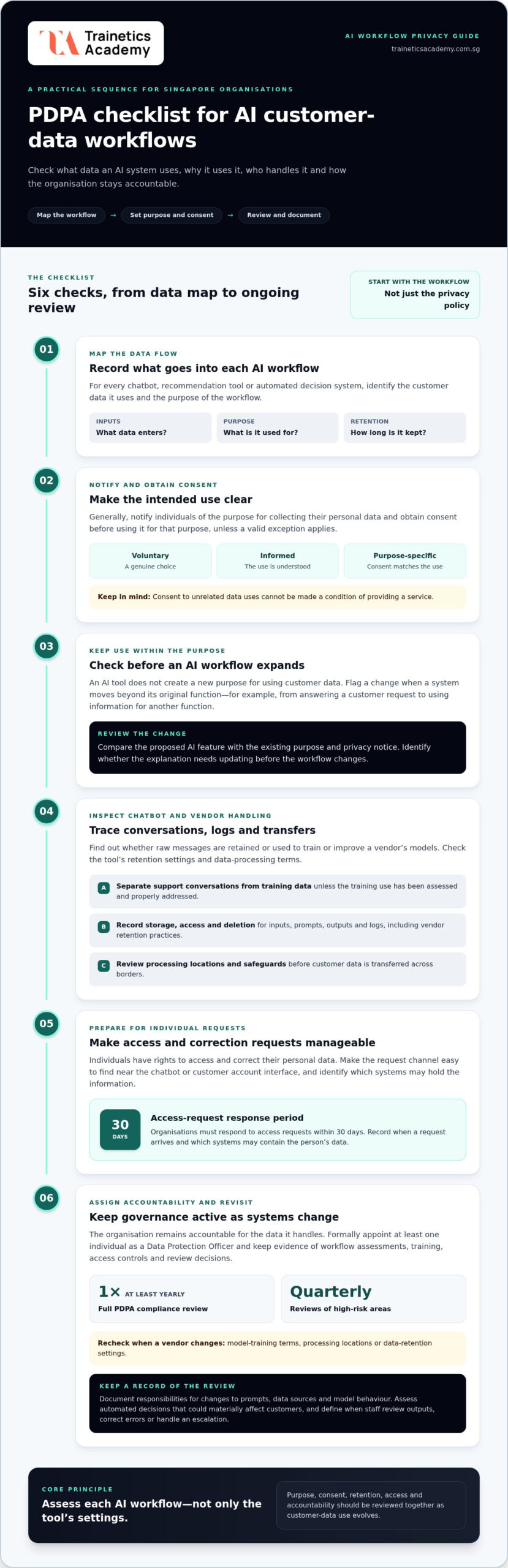
An AI tool does not create a new purpose for using customer data. A PDPA compliance checklist for using AI with customer data starts with identifying and notifying people of the purpose, obtaining voluntary, informed and purpose-specific consent unless a valid exception applies, and keeping AI processing within that purpose. Singapore organisations must also formally appoint at least one individual as a Data Protection Officer.
That may sound straightforward, but a chatbot or AI assistant can create privacy issues if it reuses details for unrelated marketing, retains more information than needed, or mishandles an access request. Looking beyond the tool’s settings is important: accountability remains with the organisation handling the data.
This guide turns PDPA requirements into practical checks for consent and notices, purpose limits, accountability, access and correction requests, and chatbot data handling. It also explains what to review when a vendor processes data or an AI feature changes how customer information is used, so you can assess the workflow before relying on it.
Key Takeaways
- Map each AI workflow to the customer data it uses, its purpose, and how long the data is retained.
- Find out whether chatbot conversations are used to train a vendor’s models, and limit access to raw logs.
- Prepare a process for access and correction requests; organisations must respond to access requests within 30 days.
- Review overseas processing locations and safeguards before customer data is transferred across borders.
- Assess whether information handled by an AI system can identify an individual, on its own or when combined with other information.
Consent, notification, purpose limitation and accountability obligations
AI professionals need to understand how privacy obligations shape system design, rather than treating compliance as a final review. In Singapore, organisations generally notify individuals of the purpose for collecting personal data and obtain consent before using it for that purpose, unless a valid exception applies. An AI course can help learners connect these rules to data flows, model inputs and product decisions.
Consent must be voluntary, informed and specific to the purpose. Organisations cannot make consent to unrelated data uses a condition of providing a service. This distinction matters to AI teams when a workflow expands from answering a customer request to using information for another function. Learners should practise identifying that change and assessing its impact before deployment.
To see how governance and security fit into AI data use, watch this video:
These exercises help learners build practical judgement alongside technical AI skills. They also show why organisations should assess data-processing agreements and a tool’s retention settings before adopting an AI system. A disciplined learning approach helps teams recognise privacy implications early, communicate across technical and business roles, and make responsible decisions as AI workflows evolve.
- Map purpose to system function. Have learners document what each AI feature does with customer information and flag functions that extend beyond the original purpose.
- Analyse consent design. Review a sample interface and identify whether individuals can understand the intended use and make a voluntary choice.
- Assess notice changes. Compare an existing privacy notice with a proposed AI feature, then identify where the explanation may need updating.
- Examine accountability. Assign responsibility for reviewing changes to prompts, data sources and model behaviour, and keep a record of the assessment.
- Connect retention to system design. Identify where training examples and operational records are stored, then document when each category should be deleted.
A PDPA compliance checklist for using AI with customer data should test each workflow, not just the privacy policy. For every chatbot, recommendation tool or automated decision system, record what data enters, whether it trains a model, who can access it, and how staff review its output. Singapore organisations must formally appoint at least one individual as their Data Protection Officer to oversee data-protection obligations.
What Is the PDPA Compliance Checklist?
Accountability needs routine review, not a one-time launch assessment. Schedule a full PDPA compliance review at least once a year, with quarterly reviews of high-risk areas. Keep the PDPA compliance checklist for using AI with customer data current when a vendor changes its model-training terms, processing locations or data-retention settings. Such changes can affect protection, access controls and transfer arrangements.
Use these checks to examine training data and decision-making:
- Trace customer conversations. Find out whether raw messages are retained and whether a vendor uses them to train or improve its models. Keep support conversations separate from training data unless that training use has been assessed and properly addressed.
- Map the data lifecycle. Record where inputs, prompts, outputs and logs are stored, who can access them, and when they are deleted. Include the vendor’s retention practices and any overseas transfer in the workflow record.
- Review automated decisions. Identify decisions that could materially affect a customer, such as a service eligibility result. Define when a staff member must examine the relevant input and output, correct errors, or handle an escalation.
- Test for inaccurate or unfair outputs. Use representative examples to check whether missing, outdated or misleading customer details change the result. Record the test, its findings and the corrective action.
- Prepare for breaches. Give staff a clear route to report exposed prompts, misdirected chatbot replies or unexpected data disclosure. Incident procedures should cover AI-generated data exposure, not only conventional system failures.
Train staff to recognise customer data in prompts, exports and generated responses. Annual PDPA training for all staff, with specialised instruction for high-risk roles, helps employees follow handling procedures and escalate unusual requests. A practical exercise could use a fictional chatbot conversation containing a name and contact details, then ask staff to identify permitted access and safe handling steps.
Keep evidence of the DPO appointment, workflow assessments, training, access controls and review decisions. These records help the organisation explain its safeguards if a data breach occurs or the PDPC investigates. Documented reviews also give teams a clear basis for correcting a risky AI workflow before it causes further exposure.
A privacy notice should explain how individuals can submit an access or correction request. Make the channel easy to find beside the chatbot or customer account interface. For example, direct users to a named privacy contact or request form, then record when the request arrives and which systems may hold their information.
Access and correction requests
The PDPA gives individuals in Singapore rights to access and correct their personal data. Organisations must respond to access requests within 30 days. An AI system can complicate this process because relevant information may sit across customer records, chatbot logs, prompts, outputs and vendor platforms. Map those locations before a request arrives, so staff can identify the records and route the request properly.
Access controls support both data protection and request handling. Limit raw chatbot logs to staff who need them, and restrict the administration dashboard to authorised roles. For an AI agent, store credentials in a secure vault and scope them to the data objects its workflow requires. These safeguards reduce unnecessary access and help teams identify which systems hold requested information.
Use a controlled process to handle each request:
- Record the request and its scope. Note whether the individual seeks access to personal data, correction of a detail, or both. A customer asking to correct an outdated phone number needs a different action from someone seeking records of chatbot interactions.
- Locate the relevant data. Search customer records, conversation logs and AI workflow stores using approved identifiers. Keep a record of the systems reviewed, so staff can explain how they handled the request.
- Review before disclosing information. Check that the response relates to the requesting individual and does not expose another person’s data. A chatbot transcript may contain information about multiple customers, so review it before release.
- Correct source records and connected workflows. If a customer corrects an address, update the authoritative record and assess whether connected AI outputs or stored profiles also need correction. Otherwise, an outdated value may reappear in a later response.
- Track the response period. Record the receipt date and monitor the 30-day period for an access request. Escalate delays internally so the response is not lost between the privacy contact, customer service team and system owner.
Build a clear audit trail for each request: the systems searched, records reviewed, correction made and response date. This makes rights easier to exercise and gives the organisation a consistent record of its actions. Keep the privacy notice aligned with the actual request channel and the AI systems processing customer information.
The PDPA sets enforceable personal-data duties, administered by Singapore’s Personal Data Protection Commission (PDPC). Singapore’s AI Verify Testing Framework offers practical tests for transparency, fairness and bias, robustness and security, safety, and performance. Use these tests to inform controls, not to replace PDPA obligations.
What Happens If a Chatbot Mishandles Data?
Before sharing customer data with an AI vendor or cloud provider, identify the data, purpose, processing location, retention, and safeguards. Review contractual data-protection commitments, model-training use, and overseas transfers before enabling access.
Show users a privacy notice where the chatbot collects information, and explain how to raise a privacy request. If a chatbot mishandles data, preserve relevant logs, restrict further access and escalate the incident through the organisation’s response process. The Data Protection Officer should coordinate the organisation’s data-protection obligations, while the PDPC can investigate complaints and issue directions or financial penalties for breaches.
Use these checks before launch and during operation:
- Map vendor processing locations. Record where the AI provider stores and processes customer data, including overseas locations, because a transfer must meet Singapore PDPA conditions.
- Review overseas transfer safeguards. Confirm contractual commitments and protections for each destination; Singapore’s PDPA permits overseas transfers subject to conditions generally requiring comparable protection.
- Reduce exposure before transfer. Mask identifiers that the AI workflow does not need, and encrypt personal data in transit and at rest to strengthen security.
- Test the AI workflow. Apply AI Verify assessments for fairness and bias, transparency, robustness and security, safety, and performance; retain findings and corrective actions.
- Prepare breach escalation steps. Include chatbot disclosures and vendor incidents in response procedures, with clear roles for the privacy lead and Data Protection Officer.
- Check notification triggers. A breach involving personal data of 500 or more individuals is notifiable regardless of harm. After assessing a breach as notifiable, notify the PDPC within 3 calendar days.
- Keep privacy requests actionable. Maintain a process to locate and delete a specific customer’s data on request, while recognising that information incorporated into AI algorithms may be difficult to remove.
Personal data includes information that identifies an individual on its own or when combined with other information. A chatbot message may contain a name, phone number, email address, delivery address or payment reference. A collection inventory should cover more than form fields: include free-text messages, uploaded files, conversation logs, and information inferred or generated during processing. At Trainetics Academy, we emphasise the importance of maintaining thorough data inventories to support overall compliance.
PDPA scope for AI systems processing customer personal data
Singapore’s Personal Data Protection Act 2012 governs the collection, use and disclosure of personal data by private sector organisations, according to Singapore Statutes Online. The rules can apply when a business uses a chatbot, recommendation system or AI agent to process identifiable customer information. The technology does not change the need to assess what data enters the system and how it is used.
Map each data flow from collection to deletion. For a customer-support chatbot, record where a message is received, which AI component processes it, what information appears in the response and where logs are stored. Identify the team and any vendor with access. This map helps show whether each data type is used for a defined business purpose.
Reduce exposure before data reaches an AI system’s reasoning step. Remove or mask fields the workflow does not need. For example, a chatbot answering a delivery question may need an order reference, but not a full payment-card number. Check whether NRIC and card numbers are stripped when messages first arrive. Limiting inputs also reduces sensitive information in prompts, logs and generated outputs.
For AI training, anonymisation must prevent information from being linked back to an individual. Pseudonymised data can still be personal data if other information can reconnect it to someone, so protect it accordingly. Replacing a name with a code does not necessarily remove privacy obligations; assess the remaining fields and linkability before using the dataset.
Use these inventory checks for each AI application:
- List the information collected. Include direct identifiers, free-text details, attachments and data created by the workflow.
- Document the purpose and access path. Note why each field is processed, which AI components receive it, and which roles can view it.
- Set retention and deletion steps. Record where copies or conversation logs remain, then specify how the organisation removes them when no longer needed.
- Test whether data is genuinely anonymised. Ask whether a person can still be identified by combining the dataset with other information.
For AI training, anonymisation must prevent information from being linked back to an individual. Pseudonymised data can still be personal data when other information can reconnect it to someone, so treat it with personal data protection safeguards. Do not assume that replacing a name with a code removes all privacy obligations; assess the remaining fields and linkability before using the dataset.
Trainetics Academy offers an Artificial Intelligence Course for learners building their understanding of AI. For professionals in Singapore researching an AI course, it offers a learning-focused next step after exploring how AI intersects with customer data and privacy.
Trainetics Academy: Artificial Intelligence Course
People exploring AI courses for beginners or strengthening existing knowledge can consider whether structured AI learning fits their goals. The course supports professional development in artificial intelligence, but does not replace an organisation’s PDPA assessment or legal advice about a specific data-processing decision.
Make the principles in this guide a routine part of AI planning. Assign an owner to each workflow, and revisit its data use whenever the system, vendor or business purpose changes. This helps make privacy review part of responsible AI development rather than a task reserved for launch or incident response.
To learn more, contact Trainetics Academy or visit traineticsacademy.com.sg.
Make Responsible AI Practice Part of the Next Step
Build the capability to discuss AI clearly across technical and operational teams. Shared understanding helps people identify where customer information enters a workflow, frame useful questions and recognise when specialist privacy input is needed. Deliberate learning and open discussion can help teams make sound decisions as AI tools and their uses evolve.
Singapore’s PDPA applies to private-sector organisations that collect, use or disclose personal data, including through AI systems. For example, if a retailer feeds identifiable customer enquiries into a tool that drafts replies, the organisation should assess that processing as part of its data handling. The AI’s automated nature does not remove the organisation’s responsibility to consider the information and workflow involved.
Continue developing your AI knowledge and professional practice. Contact Trainetics Academy to discuss training, and take your next step with confidence.
Frequently Asked Questions
How does PDPA apply to AI systems?
AI and privacy intersect whenever a system uses information that can identify a person. A customer-support model might infer a delivery issue from a message, then generate a response using account details. The privacy assessment should consider both the original input and information created or surfaced by the system. Limiting data in prompts and reviewing outputs helps reduce unnecessary exposure.
How are AI and privacy related?
Handle sensitive customer details with particular care, even when they appear in ordinary chat messages. Someone might include health information or an identity number while asking about a service. Limit collection to what the task requires, restrict who can view the information and avoid sending unnecessary details into an AI prompt. Consider whether the workflow can answer using a less revealing description instead.
What About Sensitive Categories of Data?
Organisations must consider PDPA requirements for personal data throughout an AI workflow, from collection through use and disclosure. For example, assess whether an AI feature changes who receives customer information or how the organisation uses it. A practical review should cover the workflow’s purpose, access, retention, vendor involvement and customer request handling, then assign owners to safeguards and follow-up actions.
What does Singapore’s PDPA require when using AI to process customer data?
Organisations generally need to notify individuals of the purpose and obtain consent before using their personal data for that purpose, unless a valid exception applies. Consent should be voluntary, informed and specific. For example, a message sent to ask about an appointment should not automatically become permission for unrelated promotional use. Review notices if an AI feature changes how customer information is used.
What are the PDPA rules for consent, notification and purpose limitation in AI use?
An organisation may rely on a PDPA exception only when the specific circumstances meet its conditions. An AI tool’s usefulness, efficiency or vendor status does not by itself establish an exception. Before processing without consent, identify the applicable basis, document why the workflow meets it, and limit the information used to what the purpose requires.
When can an organisation rely on exceptions to consent under Singapore’s PDPA for AI?
Singapore’s PDPA permits overseas transfers subject to conditions that generally require the receiving party to provide protection comparable to the PDPA. Before using an overseas AI service, identify where data is processed and stored, then examine contractual safeguards and the provider’s data-handling commitments. Include downstream processing in the review so transfers to cloud providers or subprocessors are not overlooked.
What cross-border data transfer rules apply to customer data processed by overseas AI services in Singapore?
The PDPA requires organisations to implement reasonable security arrangements to protect personal data in their possession. For an AI system, tailor controls to the data and workflow: restrict raw conversation logs to authorised roles, protect administrator credentials and limit an agent’s permissions to necessary records. Review access when staff responsibilities or system connections change, and include AI-related exposure scenarios in incident procedures.
What security safeguards and access controls does the PDPA require for AI systems using customer data?
The PDPA requires organisations to implement reasonable security arrangements to protect personal data in their possession. For an AI system, tailor controls to the data and workflow: restrict raw conversation logs to authorised roles, protect administrator credentials, and limit an agent’s permissions to necessary records. Review access when staff responsibilities or system connections change, and include AI-related exposure scenarios in incident procedures.
Disclaimer
AI Content Disclaimer: Some articles on this website may be generated or assisted by AI-powered content creation tools. While we strive for accuracy and relevance, readers should independently verify information before relying on it. The content is provided for informational purposes only and does not constitute professional advice.