AI courses can help learners understand how to use AI-generated content responsibly. Guidance on AI use starts with a clear distinction: using a tool doesn’t make its output your own, and changing the wording doesn’t remove the need to credit the ideas or sources behind it.
It’s understandable to feel uncertain when learning about AI. Plagiarism can involve copied wording, unattributed paraphrased ideas, or references that don’t exist. In Singapore, your institution’s rules matter: expectations for AI use vary, so a tool that supports learning in one task may be unsuitable for another.
This guide gives you four practical ways to apply what you learn in an AI course: read your institution’s AI policy, quote and paraphrase with care, use AI as a learning aid rather than a substitute for your own thinking, and acknowledge permitted AI assistance in your assignment. You’ll also learn to verify AI-generated claims and references, keep a record of how you used a tool, and protect the academic integrity of your work from the first draft to submission.
Key Takeaways
- Review an AI course’s learning objectives and requirements before enrolling.
- Check whether the AI course covers the topics and tools relevant to your learning goals.
- Use an AI course to build your understanding, then assess what you learn through practice.
- For an AI course, check how lessons and activities support your learning before you enrol.
- Compare AI course options carefully; a single rating alone may not show whether a course suits your needs.
1. Choosing an AI course
Start by checking your learning goals and the details of each AI course you are considering. Courses vary in their topics, format, and level, so a general article cannot determine which one is right for you. One course, for example, may cover AI fundamentals while another focuses on using AI tools. Compare the course description and learning objectives before enrolling. Understanding what a course covers is essential to choosing AI courses that fit your needs.
Look for the specific skills you want to learn, not just a broad mention of artificial intelligence. A course may focus on understanding AI, writing prompts, exploring tools, or applying AI in your work. If the course description is unclear, identify the topic you want to study and ask the provider before enrolling. A question such as “Does this course cover AI tools for writing?” is easier to answer than “Is this an AI course?”
- Find the course details: Read the course description, learning objectives, and schedule. Note whether each document explains the AI topics covered.
- Match the course to your goals: Check whether it covers AI fundamentals, prompting, tools, or practical applications. Don’t assume one course covers every topic.
- Identify the expected level: Look for information about prior knowledge and whether the course is suitable for beginners. Use these details to find an AI course that matches your experience.
- Resolve unclear details early: Send the provider a focused question about the course and the specific topic you want to learn. Keep the reply with your course notes.
Apply your learning goals to the entire course. If an AI course focuses on fundamentals rather than tool practice, its content differs from a course that asks you to work directly with AI tools. Keep your notes and course materials so you can track what you have learned. These checks make choosing an AI course a deliberate process, not a last-minute decision.
Check for details that apply to a particular course. One may cover AI concepts, while another focuses on practical applications or specific tools. Read the relevant course information each time; don’t assume that topics from an earlier course will be covered again. If course descriptions seem unclear, use the stated learning objectives and ask the provider for clarification.
Before enrolling, make a short course note: record what you want to learn, which topics are covered, and what remains unclear. This gives you a practical basis for comparing options. If a course does not cover a priority topic, consider another one. If it matches your goals, use the stated details to make an informed choice.
2. Quotation and paraphrasing practices
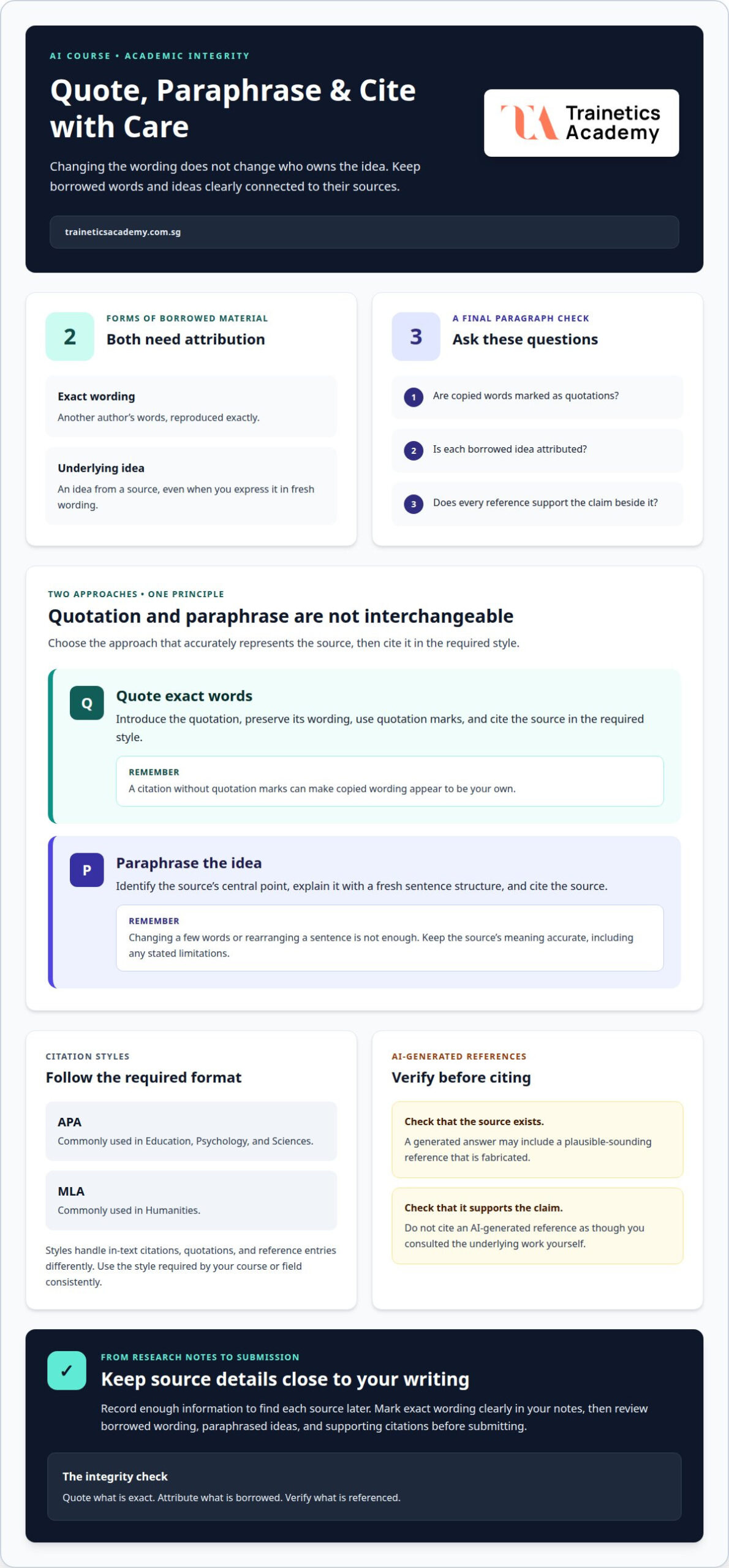
Use quotation marks whenever you reproduce another author’s exact words. Introduce the quotation, preserve its wording, and cite the source in the required style. For example, a sentence copied from a journal article needs quotation marks and a citation, even if it is only one sentence. A citation without quotation marks can wrongly suggest that the wording is yours.
Paraphrasing changes the wording, not ownership of the idea. Read the source, identify its central point, then explain it using a fresh sentence structure. Cite the source because the underlying idea still came from its author. For instance, changing “regular movement supports mobility” to “consistent activity can help people move more freely” still requires attribution if the claim came from a particular study.
Changing a few words or rearranging a sentence does not make a responsible paraphrase. Compare your draft with the source: if your sentence follows the original structure or retains distinctive phrases, revise it further or quote the wording directly. Keep the meaning accurate. A paraphrase that omits a qualification, such as a study’s stated limitation, may misrepresent the source despite using different words.
Record each source alongside the research notes it supports. Include enough details to find the source later, and clearly mark exact wording in your notes. This separation helps prevent a draft phrase from being mistaken for your own writing. It also makes citations easier to add during revision, rather than relying on memory after several sources have informed a paragraph.
Choose the citation style required by your course or field, then use it consistently. APA is commonly used in Education, Psychology, and Sciences; MLA is commonly used in Humanities. Citation styles vary across fields, so use the style required by your course or publication consistently. These styles handle in-text citations, quotations, and reference entries differently, so don’t combine formats in one assignment.
Generative AI gives you another reason to inspect every citation. A generated answer may include a plausible-sounding reference, but a fabricated reference may itself constitute academic misconduct, even without proof that AI produced it. Check that each cited source exists and supports the specific claim. Don’t cite an AI-generated reference as though you consulted the underlying work yourself.
Before submission, review each paragraph for borrowed wording, paraphrased ideas, and supporting citations. Ask yourself: Are copied words marked as quotations? Is each borrowed idea attributed? Does every reference support the claim beside it? This final review turns careful note-taking into consistent citation practice.
3. AI-generated content and academic integrity
Text-matching software compares submitted wording with available published sources; AI detectors estimate whether text was machine-generated. The research facts here name no specific checker or price, so compare the tool type and access plan rather than assuming a cost. Text-matching software may not identify AI-generated wording as a match to published sources.
For Singapore copyright questions, distinguish permission to use AI for an assignment from permission to reuse material. An institution’s assignment rules do not, by themselves, establish rights to generated output or training data. Treat AI responses and source material cautiously, and don’t assume generated wording makes underlying material free to use.
Review AI-assisted work by checking each claim, locating every cited source, and comparing the wording with material you consulted. Confirm that sources exist and support the claims, then document your own revisions. A detector score or text match is a signal to investigate, not a substitute for reviewing authorship and citations.
Submitting AI-generated work as your own can breach academic integrity if it misrepresents authorship or violates assignment rules. Consequences depend on the institution’s policy and the circumstances; an allegation must be substantiated on the balance of probabilities, meaning misconduct is more likely to have occurred than not. No universal penalty applies across institutions.
Academic integrity involves more than whether a detector flags a submission. Generative AI can invent facts and references, so even a polished answer may contain unsupported claims. If a chatbot supplies a journal citation, locate the article and confirm that its findings match the sentence. If you cannot verify the source, remove the claim or find reliable evidence.
Keep evidence of your process as you work. Save drafts, research notes, and a verifiable version history when your assessment requires one. These records help show how your ideas developed and which parts came from your analysis. They also make it easier to explain your method or conclusion if your teacher asks about the submitted work.
- Check the task: Compare AI use with the assignment’s stated conditions.
- Verify claims: Open each cited source and confirm its relevance.
- Review authorship: Make sure the final work reflects your understanding.
- Retain process records: Keep drafts and notes that show your contribution.
Assignments assess the reasoning behind an answer, not just the finished text. Use generative AI for practice, such as generating questions about a topic you have studied, then test your understanding without relying on its response. If you cannot explain a paragraph in your own words, revisit the subject before submitting it.
4. Acknowledging AI-generated content in AI courses
In an AI course, make your acknowledgement reflect the AI’s actual contribution to your learning or course work. If a tool helped refine a sentence, describe editing support rather than saying it wrote a draft. If AI-generated text remains in work you submit for the course, identify that contribution clearly. This precision helps readers understand authorship and supports avoiding plagiarism with AI-generated content.
For course work, use the required disclosure format. State whether AI helped with planning, wording, analysis, or another task, and distinguish its contribution from your own. For example, if a tool suggested a structure but you developed the argument, make that distinction explicit. Avoid broad statements that hide whether AI generated submitted passages.
AI courses can also explore how to disclose AI use in published material. A company could explain that AI assisted with an initial draft and a staff member reviewed and revised it. This is a practical disclosure approach, not a claim that every business must use one universal format. The wording should accurately describe the workflow and suit the material’s purpose.
Before submitting course work, compare your disclosure with the final document. If you removed an AI-generated passage, don’t imply it remains in the submission. If generated wording or ideas remain, describe their role accurately. This final comparison makes avoiding plagiarism with AI-generated content more than a generic statement about tool use.
- Describe the actual contribution: Distinguish brainstorming, editing, and generated material.
- Match disclosure to the final work: Make sure the note reflects what remains in the submission.
- Follow the required format: Use the course instructions for acknowledgement and documentation.
- Keep the wording precise: Avoid claims that understate or overstate the AI’s role.
In an AI course, keep relevant records in a form that is easy to connect to your work. A clear filename, dated draft, or brief note about a tool’s role can help distinguish your revisions from generated suggestions. If your instructor requests supporting material, provide it in the format specified for the course. Don’t include private or unrelated chat content unless requested.
Acknowledging AI assistance does not transfer responsibility for the final work to a tool. You remain responsible for its accuracy, relevance, and alignment with the course requirements. Disclosure also prompts useful reflection: can you explain which decisions were yours and why you kept particular AI suggestions? That clarity strengthens your authorship and makes responsible AI use visible.
In an AI course that follows the open lane of the two-lane approach, generative AI is permitted for take-home written assessments but must be acknowledged. Identify which parts of the work were generated by AI and which you created. When documenting use, state how the tool was used and describe the prompt that generated the response.
Save a transcript of the AI chat and provide it as an appendix or through an online link. The page recommends crediting the AI tool or platform in both the text and reference list when AI-generated content is used, and including the chat or prompt date in the references.
5. What should an AI course teach about evaluating AI-generated content?
An AI course can help learners understand how AI detectors estimate whether text was generated by examining linguistic and structural features, which can include perplexity, burstiness, and sentence structure. The result is an estimate, not direct evidence of who wrote a passage. Learners can study how a detector may flag text for review, while understanding that its score cannot establish authorship on its own.
AI courses can also cover why short submissions pose a particular challenge. AI-text detectors are much less reliable for documents under 300 words. A brief response gives a detector less text to assess, so learners should understand that its score should not carry the same weight as a fuller review of the assignment and its development.
False positives are another useful topic in an AI course. With a 1% false-positive rate, a detector could flag one assignment in a class of 100 as having a high score, even if no students used generative AI. This example shows why a high score needs context. It does not prove that a particular student used an AI tool.
Courses that cover responsible AI use can explain why detection tools should be used cautiously: human-written text can be incorrectly labelled as AI-generated. An AI-detector score alone is insufficient evidence for alleging misconduct. Learners can explore how an investigation should consider evidence both supporting and challenging the allegation, including drafts, notes, the assignment process, and the student’s explanation.
- Read the result as a signal: Treat a detector score as a prompt for further review, not a verdict.
- Consider document length: Give extra caution to scores on work under 300 words.
- Review both sides: Look for evidence that may confirm AI use and evidence that may disconfirm it.
- Assess the work itself: Consider whether the student can explain its claims and reasoning.
An AI course can teach learners to consider the whole assignment. For example, compare the submitted work with available drafts and ask the student to explain a key conclusion. Inability to answer questions about the assignment, including in a post-assignment viva, may be a clear signal of AI use. Consider it alongside other evidence, rather than treating it as proof by itself.
Courses can also explain how to keep plagiarism and AI use distinct. A detector estimates whether text may have been generated by AI; it does not establish that the text was copied from a source. Conversely, a low AI score does not show that every idea or quotation has been attributed correctly. Review citations and authorship separately.
For students taking AI courses, the practical response is to preserve drafts and notes, understand the submitted work, and follow the assignment’s AI rules. For educators, course learning about AI can support careful assessment, not replace it. A fair decision weighs the full evidence and avoids relying on a single automated score.
Trainetics Academy
Trainetics Academy is a useful next step for learners who want to build a stronger foundation in artificial intelligence. Its Artificial Intelligence Course can help develop your understanding of AI and support more informed decisions about using these tools in study or work. Apply that knowledge alongside your institution’s rules, careful source checking, and clear acknowledgement of AI assistance. An AI course complements these practices; it does not replace assignment-specific instructions or your responsibility for submitted work.
If you’re ready to strengthen your understanding of artificial intelligence, contact Trainetics Academy about its Artificial Intelligence Course.
Choose an AI course to build your skills
An AI course can help you learn how to use AI tools with purpose, whether you want to explore a concept, test your understanding, or organise your ideas. Consider what you want to learn before choosing a course, then apply those skills thoughtfully in your studies and work.
A useful next step is to strengthen your understanding of artificial intelligence itself. This knowledge can help you assess what these tools can do, recognise where human judgement matters, and use AI more thoughtfully in future assignments. Trainetics Academy offers an Artificial Intelligence Course for learners who want to build that foundation.
Build your AI skills with curiosity and discipline, and keep your academic work genuinely yours. Contact Trainetics Academy for support as you continue learning about AI.
Frequently Asked Questions
What are the types of plagiarism?
Plagiarism can be classified according to what is misrepresented. Direct plagiarism uses another person’s words without clear attribution; mosaic plagiarism combines borrowed phrases with original wording; and self-plagiarism presents previously submitted work as new. Accidental plagiarism can happen when notes fail to distinguish quotations from a writer’s own ideas. These labels help identify a problem, but an institution’s policy determines how it assesses a specific submission.
What counts as plagiarism in AI-generated content?
Assess the submitted work against the task’s authorship expectations. For example, if an assignment asks for a personal reflection, an AI-written account of experiences the student never had misrepresents whose perspective the work presents. AI output may also reproduce distinctive language or ideas from material used to generate a response. The key issue is not simply whether a tool was used, but whether the submission accurately represents its sources and authorship.
How can I properly cite AI-generated text, images, and research?
Keep the record of AI assistance separate from citations for evidence. An AI tool may be acknowledged as the source of generated wording or an image, while factual claims still need references to supporting research. For an image, place the required credit beside the figure or in its caption. For research, cite the original article or dataset you actually consulted, not a source name supplied only by a chatbot.
How can I use AI tools without copying or paraphrasing sources too closely?
Use AI to test your understanding rather than asking it to rewrite a source passage. For example, ask it to generate questions that check your grasp of a concept, then answer them from your own notes without looking at the original wording. Build your explanation around your reasoning and evidence. If a distinctive phrase appears in your draft, identify its source and either quote it with attribution or express the idea in your own words.
Disclaimer
AI Content Disclaimer: Some articles on this website may be generated or assisted by AI-powered content creation tools. While we strive for accuracy and relevance, readers should independently verify information before relying on it. The content is provided for informational purposes only and does not constitute professional advice.