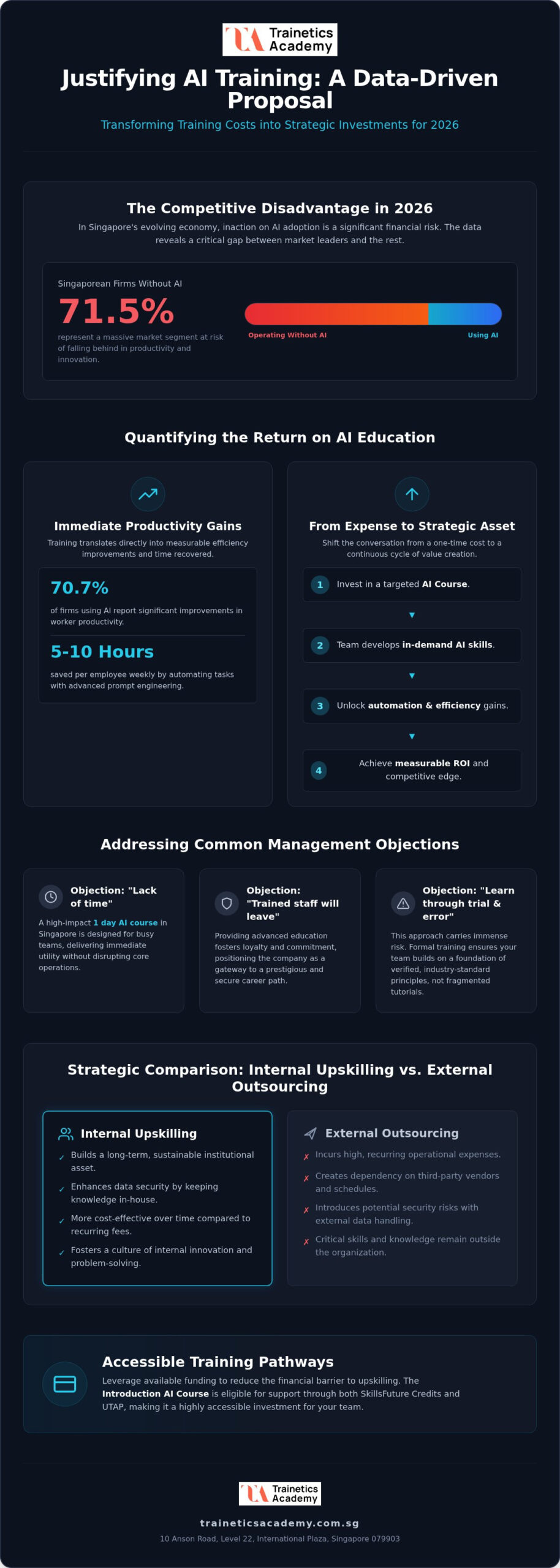
What if the greatest threat to your organization isn’t a competitor’s pricing, but the fact that 71.5% of Singaporean firms are still operating without artificial intelligence? This data point from April 2026 illustrates a massive opportunity for those who can bridge the skills gap before the market saturates. Management often views training as a discretionary expense rather than a core asset, which is why many professionals struggle when asking for budget approval. Learning how to justify training costs to management requires shifting the conversation from personal growth to a disciplined analysis of return on investment and risk mitigation.
We’ll show you exactly how to master the art of securing budget for professional development by quantifying the ROI of AI education. This guide provides a framework for aligning technical training with your company’s specific KPIs and demonstrating a clear timeline for productivity gains. We’ll explore the strategic differences between internal upskilling and outsourcing, giving you the data needed to prove that an AI-ready team is a requirement for 2026. By following this roadmap, you’ll turn a simple course request into a powerful proposal for institutional excellence.
Key Takeaways
- Transform training from a perceived luxury into a strategic necessity by highlighting the competitive risks of falling behind in Singapore’s 2026 AI-driven economy.
- Quantify the immediate ROI of an Artificial Intelligence Course through tangible metrics such as hours recovered via automation and measurable improvements in output quality.
- Master how to justify training costs to management by presenting a structured, data-backed proposal that aligns technical mastery with your organization’s specific KPIs.
- Evaluate the long-term financial benefits of building an internal AI-ready team compared to the recurring expenses and security risks of external outsourcing.
- Navigate budget constraints by leveraging regional funding frameworks, specifically noting that the Introduction AI Course is eligible for SkillsFuture Credits and UTAP.
The Challenge of Securing Training Budgets in 2026
Executives often categorize professional development as an “extra” rather than a fundamental pillar of business resilience. In a fiscal environment where every dollar is scrutinized, learning how to justify training costs to management becomes a vital skill for any ambitious professional. This resistance usually stems from a fundamental misunderstanding of what modern upskilling provides. It isn’t just about personal growth; it’s about professional readiness in an era where technical mastery is the only way to maintain a competitive edge. When training is viewed as a cost to be cut, the entire organization risks falling into a state of scientific and operational stagnation.
Common Management Objections to AI Courses
Many leaders rely on outdated assumptions that stall innovation. One frequent objection is the lack of time. However, a 1 day AI course Singapore provides a high-impact solution that respects the operational schedule of busy teams while delivering immediate utility. Another common fear is that trained employees will leave for higher-paying roles once they’ve earned a certification. In reality, providing high-level education fosters a sense of security and loyalty, positioning the company as a gateway to a prestigious career. Finally, management might suggest that staff can learn through trial and error. This approach is scientifically unsound and carries immense risk. Formal training at Trainetics Academy ensures that your team builds a foundation based on verified principles rather than fragmented online tutorials.
The Cost of Inaction in the 2026 Economy
Remaining stagnant while the market evolves is a high-risk strategy. According to data from 2026, 70.7% of Singaporean firms using AI report significant improvements in worker productivity. Companies that fail to adopt an Artificial Intelligence Course for their staff are essentially choosing to operate at a lower efficiency level than their competitors. These rivals are already using automated workflows to undercut market pricing and accelerate delivery times. The skills gap isn’t just a HR concern; it’s a financial leak. When teams fall behind in AI adoption, they spend hours on manual tasks that could be completed in minutes. This leads to massive productivity losses that compound over time. To stay relevant, you must understand the landscape of Mastering In-Demand AI Skills in Singapore (2026) to ensure your department remains an asset rather than a liability. Learning how to justify training costs to management is no longer optional; it’s a prerequisite for leadership in the modern economy.
The ROI of an AI Course: Quantifying Efficiency and Innovation
Training ROI is the ratio of productivity gains to the total cost of the AI course. Quantifying this value is the most persuasive tool when learning how to justify training costs to management. It moves the discussion from a subjective feeling of improvement to an objective financial benchmark. In Singapore’s 2026 economy, where over 70% of firms report productivity jumps after AI adoption, the data speaks for itself. Leaders don’t just want to hear about better work; they want to see the “time recovered” metric. By highlighting how professional development directly impacts the bottom line, you transform a budget request into a strategic investment proposal.
Measuring Productivity Gains from Prompt Engineering
Precision in communication with AI models is a core pillar of professional readiness. A 1 day AI course Singapore provides immediate relief for departments bogged down by repetitive administrative burdens. By mastering advanced prompt engineering, employees can automate complex reporting, email management, and data synthesis. This often translates to saving five to ten hours per week per person. In marketing, finance, and operations, “AI-first” workflows ensure that high-value human intelligence is focused on strategy rather than formatting. For those looking to optimize their tech stack, exploring Top AI Productivity Tools for Business in Singapore is an excellent starting point for building your business case. This technical mastery reduces the error rate in data entry and content generation, ensuring that quality remains high even as output speed increases.
Long-term Value: Innovation and Scalability
Beyond immediate time savings, an Artificial Intelligence Course equips your team to identify entirely new revenue streams. Trained professionals recognize patterns in consumer data that were previously invisible, allowing for faster, data-driven decision-making. This creates a foundation for scalability where business operations expand without the traditional requirement of increasing headcount. To secure budget approval, present a “Value Realisation” timeline. This document should map out the first 90 days post-training, highlighting specific milestones where AI-driven insights will reduce operational friction. When you explain how to justify training costs to management, emphasize that an internal team capable of prompt engineering is an asset that appreciates over time.
By demonstrating how our Artificial Intelligence Course acts as a force multiplier for existing talent, you prove that education is a gateway to a prestigious career for your staff and a more profitable future for the firm.
Strategic Comparison: Internal Upskilling vs. External Outsourcing
Choosing between hiring external consultants and developing internal talent is a pivotal leadership decision that defines a company’s operational trajectory. Many organizations fall into the trap of outsourcing AI implementation, only to find themselves burdened by the hidden costs of recurring consultancy fees and a lack of institutional context. When you’re learning how to justify training costs to management, the most powerful argument is the preservation of company-specific knowledge. An external agency might understand the technology, but they don’t understand your unique operational friction or customer nuances. By investing in an Artificial Intelligence Course for existing staff, you create a team of graduates who apply technical mastery directly to your specific business goals.
The Cost-Avoidance Model for Training
A robust training proposal highlights the massive savings achieved by reducing reliance on third-party agencies. Hiring a new specialist in 2026 often requires a salary premium that far exceeds the cost of upskilling a loyal employee who already understands your workflow. Furthermore, third-party software implementation often carries a premium that far exceeds the cost of upskilling an internal lead to manage the transition. By empowering your team to handle data analysis and content automation in-house, you eliminate the middleman and regain control over your data security. For a deeper look at the landscape, consult our AI Course Singapore: The Ultimate 2026 Guide for Professionals. This shift doesn’t just save money; it accelerates the speed of innovation because your team no longer waits for an external vendor to update a workflow.
Retaining Talent Through Professional Development
The 2026 economy is characterized by a fierce talent shortage, particularly for AI-literate professionals. Replacing a high-performing employee can cost up to twice their annual salary when factoring in recruitment, onboarding, and lost productivity. Conversely, offering professional development acts as a powerful retention tool that demonstrates a commitment to your staff’s long-term career path. It’s a strategic move that builds a “prestigious career” mindset within your office walls. Trainetics Academy positions itself as more than a school; we offer a professional identity that makes the transition into an AI-enhanced role feel both secure and scientifically grounded. This approach ensures that your team feels valued, knowing they’re receiving the highest standard of education available in Singapore. When you explain how to justify training costs to management, emphasize that an internal team capable of prompt engineering is an asset that appreciates over time.
Step-by-Step Guide to Crafting Your Training Proposal
Securing budget approval isn’t about asking for permission; it’s about presenting a business case so robust it would be irresponsible to decline. Understanding how to justify training costs to management requires a methodical approach that mirrors a financial investment strategy. Start by identifying the specific friction points in your current workflow. Are you losing hours to manual data cleanup? Is your lead generation speed lagging behind competitors? Once these pain points are clear, gather hard data on course duration and outcomes. While professional programs in Singapore often feature regional subsidies to lower the barrier to entry, your focus should remain on the technical mastery the curriculum provides.
Next, align your request with 2026 company KPIs. If the firm is prioritizing digital transformation, frame the AI course Singapore as the engine for that change. Prepare a ‘Risk vs. Reward’ analysis for your executive summary. The reward is the significant expected increase in AI investment returns forecasted for the next two years; the risk is remaining part of the stagnant majority that hasn’t yet adopted these tools. Finally, schedule a formal pitch. Don’t wait for a casual chat; request a dedicated slot to present your findings with a clear call to action.
Aligning with Corporate Goals
Professional readiness is achieved when individual growth mirrors organizational ambition. Learning how to justify training costs to management involves linking your new skills to broader digital transformation initiatives. If your department is tasked with accelerating lead generation, show how prompt engineering can automate the initial outreach phase. Use professional terminology like “operational efficiency” and “strategic scalability” to build credibility with senior leaders. This demonstrates that you aren’t just looking for a “perk,” but are focused on raising professional benchmarks for the entire team.
The Pitch Checklist: What to Include
Your proposal should be a concise, data-driven document that leaves no room for ambiguity. Include an executive summary of the AI course Singapore curriculum, focusing on outcomes rather than just features. Detail the estimated ROI timeline, showing when the “time recovered” will offset the initial investment. Highlight available government support frameworks to show financial prudence without losing focus on the high-level scientific discourse. To strengthen your proposal further, referencing the best SkillsFuture training providers in Singapore for AI courses can help management see that your chosen institution meets the highest standards of accreditation and practical delivery. This structured approach reassures management that the transition into AI is both scientifically grounded and fiscally responsible.
Review our comprehensive Artificial Intelligence Course curriculum to gather the specific data points you need for your formal pitch.
Implementing the Solution: Choosing the Right AI Course in Singapore
Securing approval is the first hurdle; selecting a partner that delivers on the promised ROI is the second. Trainetics Academy stands as the premier choice for professionals in Singapore because we bridge the gap between academic theory and high-level professional readiness. Our curriculum isn’t a collection of generic tutorials. Instead, it’s an interactive, professionally-led experience designed to produce top-tier results. When you’ve mastered how to justify training costs to management, your final piece of evidence should be the quality of the institution itself. We offer a professional identity that empowers your team to raise industry benchmarks immediately upon completion. This isn’t just about learning software; it’s about mastering the science of human-AI collaboration to drive innovation.
High-Impact, Short-Term Training
For teams with demanding operational schedules, a 1 day AI course Singapore provides the perfect balance of intensity and efficiency. These short professional courses with certification do more than just teach technical mastery; they build significant team morale by proving the organization’s commitment to its staff’s future. Employees who feel equipped to handle the 2026 economy are more engaged and productive. You can explore more about this in our Short Professional Courses with Certification: 2026 AI Upskilling Guide. This targeted approach ensures that the “time recovered” metrics we discussed earlier begin to manifest within the very first week post-training. By focusing on immediate skill application, we ensure that the transition into an AI-enhanced career feels scientifically grounded and exciting.
Taking the First Step with Trainetics Academy
Ready to transition from proposal to practice? You can visit our facility at 10 Anson Road, Level 22, International Plaza, Singapore 079903 to discuss tailored corporate group enrollment or individual development plans. Our advisors can help you verify how your team can maximize budget efficiency. It’s vital to note that our Introduction AI Course is eligible for SkillsFuture Credits and UTAP funding, providing a fiscally responsible path toward AI literacy. Whether you’re looking for AI courses for beginners or advanced strategic workshops, we provide the structured learning path necessary for success. This predictable pace builds trust and ensures every participant absorbs the depth of our curriculum. Don’t let your department remain among the 71.5% of firms yet to adopt these tools. Secure your spot in our next Artificial Intelligence Course today and solidify your position as a forward-thinking leader in the Singaporean market.
Secure Your Strategic Advantage in the AI Era
Mastering the technical nuances of artificial intelligence is no longer a personal choice; it’s a prerequisite for organizational survival. We’ve explored how to justify training costs to management by shifting the narrative from expenditure to long-term value realization. By quantifying productivity gains and comparing the stability of internal upskilling against the risks of outsourcing, you create a compelling case for professional readiness. This strategic shift ensures your team remains an asset rather than a liability in a high-speed market.
Trainetics Academy offers the academic rigor and practical mastery needed to excel. Our expert-led 1 day AI course Singapore ensures that your team stays ahead without disrupting daily operations. This is the most fiscally sound time to invest in your future, especially since the Introduction AI Course is eligible for SkillsFuture Credits and UTAP funding. Take the lead in your industry by building a foundation of excellence that sets new professional benchmarks. You don’t just gain a certification; you secure a professional identity grounded in scientific validation.
Enroll in the Artificial Intelligence Course at Trainetics Academy and transform your career today. We look forward to helping you reach your highest professional potential.
Frequently Asked Questions
How do I calculate the ROI of an AI course for my team?
Calculate the return by dividing the total value of hours saved by the initial investment. If an employee saves five hours weekly through prompt engineering and automation, the annual time recovered often justifies the cost within months. You should also factor in the reduction of manual errors and the ability to handle higher volumes of work without increasing headcount. This data-driven approach provides the financial evidence leadership requires to approve the expenditure.
Can I use SkillsFuture Credits for an AI course Singapore at Trainetics Academy?
Singaporean professionals can utilize regional support frameworks to offset the cost of high-level technical education. By applying your personal credits, you reduce the direct financial burden while gaining essential skills for the 2026 economy. We suggest checking your available balance on official portals to see how these can be applied to your training. Our advisors can provide the necessary documentation to facilitate your professional development journey and ensure a seamless enrollment process.
What is the best way to present a training budget request to a skeptical manager?
Start by aligning the training with immediate business pain points rather than personal growth. When learning how to justify training costs to management, present a “Value Realisation” timeline that shows exactly when the team will start seeing efficiency gains. Use professional terminology to frame the AI course Singapore as a strategic necessity. Highlighting that competitors are already using these tools can help overcome resistance by emphasizing the risk of falling behind.
Is a 1 day AI course Singapore enough to see real productivity gains?
A 1 day AI course Singapore is specifically designed for busy professionals who need immediate, actionable skills. While deep mastery takes time, a single day of intensive training in prompt engineering and workflow automation can save hours of administrative work each week. Our curriculum focuses on high-impact tools that provide a rapid return on investment. This ensures your team gains the professional readiness needed to implement AI-driven solutions the very next day.
Are there government subsidies eligible for corporate AI training in Singapore?
The Singapore government promotes AI adoption through funding initiatives designed to enhance workforce readiness. These regional frameworks often provide significant fee offsets for individuals and SME-sponsored employees. While specific claim limits vary, these subsidies ensure that professional development remains a fiscally responsible choice. These programs reflect the National AI Strategy’s goal of ensuring local businesses remain competitive through a highly skilled and AI-literate workforce in a digital economy. For a comprehensive overview of institutions that qualify under these schemes, reviewing the best SkillsFuture training providers in Singapore for AI courses can help you identify the most credible and funding-eligible options available.
What happens if management says there is no budget for training in 2026?
If a budget is denied, shift the conversation to the “cost of inaction.” Remind management that 70.7% of firms using AI report improved productivity, meaning a lack of training is effectively a decision to remain less efficient than rivals. Suggest a pilot program or highlight the use of personal credits to minimize the company’s direct financial contribution. This demonstrates your commitment to finding a solution that respects fiscal constraints while addressing critical technical gaps.
How do I align AI training with my company’s digital transformation strategy?
Align your training request by positioning AI as the core engine of your company’s digital transformation initiatives. Instead of treating the AI course Singapore as a standalone event, show how it enables the redesign of end-to-end processes. Explain how trained staff can lead the transition from manual workflows to data-driven, automated systems. This ensures that the training supports broader departmental targets and contributes directly to the organization’s long-term technological roadmap for sustainable growth.
Why should I choose Trainetics Academy over online-only AI courses?
Trainetics Academy provides an interactive, professional-led environment that online-only courses cannot replicate. Our physical campus offers the rigor and peer collaboration necessary for mastering complex technical concepts. You can visit us at 10 Anson Road, Level 22, International Plaza, Singapore 079903, to experience our standard of excellence firsthand. This supportive yet demanding environment is specifically designed to produce top-tier industry professionals who are ready to raise professional benchmarks immediately.
Disclaimer
AI Content Disclaimer: Some articles on this website may be generated or assisted by AI-powered content creation tools. While we strive for accuracy and relevance, readers should independently verify information before relying on it. The content is provided for informational purposes only and does not constitute professional advice.