What if the most critical asset in the 2026 global economy isn’t a computer science degree, but the ability to command machine intelligence with precision? You likely feel the mounting pressure to adapt as over 80 percent of enterprises deploy generative AI applications this year. It’s common to feel paralyzed by technical jargon or the fear that you’ll need years of retraining to remain relevant. However, the reality is that the barrier to entry has vanished. You can learn ai without a tech background and achieve professional mastery by focusing on linguistic clarity and strategic implementation rather than syntax.
This guide provides a rigorous roadmap to help you secure your career in an automated world. We’ll explore how non-technical leaders are using AI to drive business growth and optimize daily workflows with scientific efficiency. You’ll discover how our Introduction AI Course is eligible for SkillsFuture Credits and UTAP funding, making elite-level training accessible at 10 Anson Road, Level 22, International Plaza, Singapore 079903. By the end of this article, you’ll understand how to leverage these tools to build a professional identity that’s both future-proof and results-driven.
Key Takeaways
- Realize that professional AI mastery in 2026 relies on orchestration and natural language interfaces rather than traditional programming skills.
- Focus on AI strategy and no-code tools to secure a competitive advantage and drive business growth without a computer science degree.
- Implement a practical 2026 roadmap to learn ai without a tech background by mastering prompt engineering and identifying high-impact automation opportunities.
- Access professional-grade training through the Introduction AI Course, which is eligible for SkillsFuture Credits and UTAP funding for qualified Singaporeans.
Demystifying Artificial Intelligence: Why You Don’t Need to Be a Coder in 2026
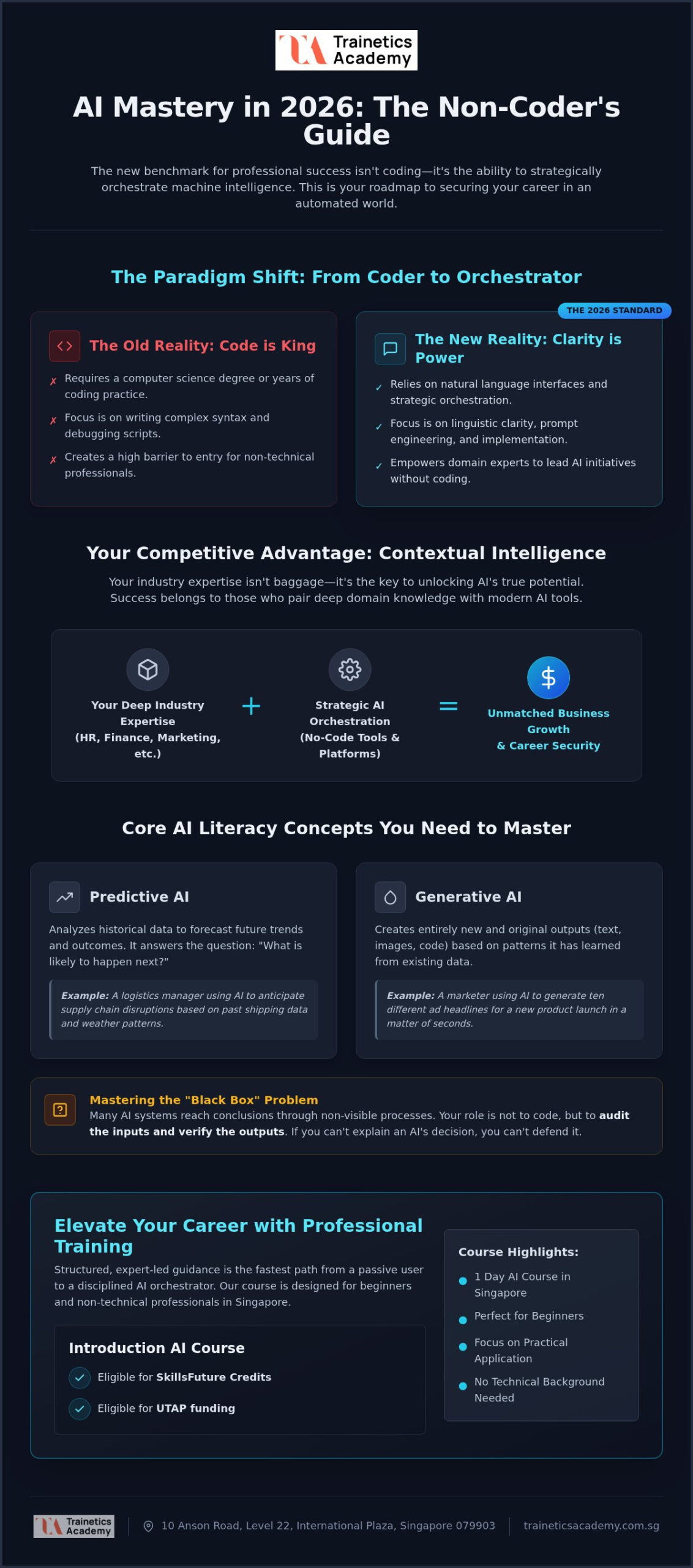
2026 has redefined the professional benchmark for technical proficiency. If you want to learn ai without a tech background, you must first discard the outdated notion that artificial intelligence belongs solely to engineers. Today, AI literacy is defined by orchestration rather than execution. We’ve moved beyond the “low-code” era into a period dominated by “no-code” and natural language interfaces. This transition means your ability to communicate clearly is now more valuable than your ability to debug a script.
The “tech background” myth serves as a psychological barrier that prevents talented professionals from claiming their seat at the table. For those seeking a comprehensive overview of artificial intelligence, it’s clear the field has evolved from rigid algorithms to flexible, intuitive systems. You don’t need to understand the underlying calculus to drive business value. You simply need to understand the strategic application of these tools within your specific industry.
The Rise of Natural Language Programming
Why Domain Experts are the New AI Leaders
A data scientist might build a model, but a seasoned marketer understands the nuance of consumer psychology required to make that model effective. This is “Contextual Intelligence.” Your years in HR, finance, or operations are not baggage; they are your competitive advantage. You understand the problems that need solving. AI simply provides the lever to solve them at scale. Success in this new economy belongs to those who pair deep industry expertise with modern AI orchestration. You don’t learn ai without a tech background to become a technician; you learn it to become a more effective, data-driven leader.
Achieving this level of professional readiness requires structured, expert-led guidance. By focusing on how these systems integrate with your existing workflow, you transform from a passive user into a disciplined orchestrator. This strategic shift is what separates those who are displaced by technology from those who use it to raise professional benchmarks and lead their organizations into the next phase of machine intelligence.
The Anatomy of AI Literacy: Core Concepts for Non-Technical Professionals
To master the machine, you must first master its logic. Professional AI literacy in 2026 isn’t about memorizing Python libraries or understanding neural network architectures. Instead, it focuses on foundational competencies that allow you to orchestrate complex systems. This approach aligns with the U.S. Department of Labor’s AI Literacy Framework, which prioritizes critical thinking and strategic application over niche technical skills. When you choose to learn ai without a tech background, you’re building a mental framework for how intelligence can be deployed to solve business problems.
Most beginners struggle because they don’t distinguish between Predictive and Generative AI. Predictive AI analyzes historical data to forecast future trends, such as a logistics manager anticipating supply chain disruptions. Generative AI, however, creates entirely new outputs based on patterns it has learned. Understanding this distinction is vital. It allows you to identify whether you need a tool to forecast a result or one to create a solution from scratch. Both are essential, yet they require different management styles. To explore how these technologies are being applied across industries, our guide on generative AI use cases in business provides a structured framework for identifying high-impact opportunities in your sector.
You must also confront the “Black Box” problem. Many AI systems reach conclusions through processes that aren’t visible to the user. As a professional, your role isn’t to fix the code inside the box. Your role is to audit the inputs and verify the outputs. If you cannot explain the logic behind an AI-driven decision, you cannot defend that decision to your stakeholders. This level of accountability is why many professionals enroll in a professional AI Course to transition from passive users to disciplined orchestrators.
Generative AI and the Creative Workflow
In 2026, tools like ChatGPT have evolved into cognitive partners. The focus has shifted from simple content generation to sophisticated strategic reasoning. You aren’t just using these tools to write emails; you’re using them to simulate market scenarios or stress-test business plans. For those ready to apply these concepts, our guide on Top AI Productivity Tools for Business in Singapore offers practical starting points for your daily operations.
From Tools to Agents: The 2026 Evolution
We’ve entered the era of “Agentic AI.” Unlike a standard tool that waits for a prompt, an AI agent can execute multi-step workflows independently. It can research a competitor, synthesize the findings into a report, and draft a response strategy without constant intervention. This requires you to adopt the identity of an AI Manager. You’re no longer a technician; you’re a supervisor of digital labor. This shift is the most compelling reason to learn ai without a tech background today. You aren’t competing with programmers. You’re competing with other leaders who know how to deploy these agents with scientific precision.
Comparing Learning Paths: Coding Bootcamps vs. AI Courses for Beginners
Selecting the correct educational trajectory is a critical decision for any professional aiming to thrive in 2026. While technical bootcamps were once the primary route into the industry, the return on investment for mid-career leaders has shifted toward strategic orchestration. Understanding What Is Artificial Intelligence (AI)? remains foundational, but spending months mastering back-end development is rarely the most efficient path for those in management or operations. You don’t need to build the infrastructure to be the one who directs its power.
A technical bootcamp often requires a massive time commitment, focusing on the granular “how” of software engineering. In contrast, a high-impact 1 day AI course Singapore focuses on the “why” and “where” of business implementation. For a professional looking to learn ai without a tech background, the goal isn’t to replace the engineer; it’s to lead the transformation. This requires a curriculum that prioritizes high-level strategy over line-by-line coding. To choose the right path, evaluate your goals based on these criteria:
- Immediate Utility: Determine if you need skills that can be applied to your current workflow by Monday morning.
- Strategic ROI: Assess whether your career growth depends on building new tools or managing existing AI ecosystems.
- Resource Allocation: Consider if your professional identity is better served by deep technical niche mastery or broad strategic leadership.
The Technical Path: When is it Necessary?
Deep technical training remains vital for specialized roles such as Data Architects or Machine Learning Engineers who develop the core models. However, 90 percent of business roles do not fall into this category. Attempting to learn complex coding languages at this stage can lead to “Technical Debt” for your professional development, consuming cognitive resources that should be dedicated to visionary leadership. When you learn ai without a tech background, your value lies in your ability to translate business needs into machine-executable strategies, not in your ability to write the underlying algorithms.
The Strategic Path: Leading the AI Transformation
The strategic path focuses on “AI Prompt Engineering” as the primary linguistic tool for the 2026 workforce. This involves structured experimentation and the logical clarity required to command sophisticated AI agents. Because the quality of your AI output is a direct reflection of your communication clarity, many leaders find that Business Writing Courses in Singapore are a necessary prerequisite for advanced prompting. Mastering the art of the prompt allows you to build an “AI-First” mindset within your department, ensuring that every operation is optimized for maximum efficiency and scientific precision.
Our AI Course at Trainetics Academy is specifically designed to bridge the gap between technical complexity and professional excellence. We provide a learning path that respects your time and your existing expertise, focusing on the outcomes that matter to your career. By choosing a strategic education, you adopt a professional identity that is both future-proof and rooted in the pursuit of excellence.
Your 2026 Roadmap: How to Start Learning AI Without a Tech Background
Transitioning from a traditional role into an AI-driven leadership position requires a structured tactical plan. While earlier sections established the strategic value of orchestration, this roadmap provides the exact steps to implement that strategy. By 2026, the ability to learn ai without a tech background has become a standardized professional transition. You don’t need to reinvent your career; you need to enhance it through a disciplined sequence of skill acquisition and practical application. If you’ve ever wondered is it too late to learn ai, the answer is clear: 2026 represents a unique strategic entry point where the barriers to professional mastery have never been lower.
- Master the ‘Art of the Prompt’: Move beyond basic queries. Focus on structured experimentation to discover the precise linguistic triggers that produce elite-level outputs from generative models.
- Identify ‘Low-Hanging Fruit’: Audit your current workflow for high-volume, repetitive tasks. These are your primary targets for automation and immediate efficiency gains.
- Join a Professional Community: Surround yourself with peers who value technical mastery. Engaging in a weekend AI workshop Singapore allows for the interactive rigor necessary to solidify your new skills.
- Prioritize Ethical Compliance: Stay informed on PDPA regulations and AI ethics. In Singapore, professional readiness includes the responsible management of data and machine logic.
- Earn a Recognized Certification: Validate your non-technical AI expertise through a program that emphasizes strategic leadership and professional excellence.
Practical Prompt Engineering for Daily Tasks
Prompting is the primary interface for the modern professional. To save 50 percent of your work time, treat AI as a cognitive partner for first-draft generation. For emails, use: “Draft a high-stakes client response that addresses these specific concerns while maintaining a tone of authoritative partnership.” For reports, try: “Synthesize this 20-page document into a three-paragraph executive summary focusing on operational risks.” For data, use: “Identify three anomalies in this Q3 performance set and suggest potential causes.” Use iterative prompting to refine these outputs until they meet your high standards for precision.
Navigating the Singapore AI Ecosystem
Maintaining relevance in the local job market means understanding how Information Technology in Singapore supports non-technical sectors. The 2026 professional landscape demands that leaders in HR, finance, and operations speak the language of machine intelligence. By following this roadmap, you transform from a user into a visionary mentor within your organization. Take command of your professional trajectory by exploring our comprehensive AI Course options.
Elevate Your Career with Trainetics Academy’s AI Course Singapore
Trainetics Academy stands as the definitive bridge between technical complexity and professional excellence. Our mission is to empower the modern workforce with the tools required to orchestrate machine intelligence with scientific precision. If you want to learn ai without a tech background, you need a mentor that values discipline and practical application over abstract theory. We don’t just teach you how to use software; we help you build a professional identity that’s resilient in the face of automation. Our curriculum is designed for those who recognize that the future of leadership is inextricably linked to technological mastery.
The Introduction AI Course is our flagship program for non-programmers. It distills complex concepts into actionable strategies, allowing you to return to your office with immediate, high-impact skills. This 1 day AI course Singapore focuses on the strategic deployment of AI agents and the mastery of natural language programming. By removing the technical barriers, we allow you to focus on what matters most: driving business growth and securing your career in a sophisticated, automated economy.
Why Trainetics Academy is the Preferred Choice for Non-Tech Learners
We believe in interactive rigor. Our sessions are led by industry experts who understand the unique challenges faced by mid-career professionals. We don’t settle for surface-level summaries. Instead, we provide a deep dive into the logic of AI, ensuring you can audit and manage these systems with confidence. This focus on professional readiness ensures that you aren’t just learning a tool; you’re adopting a visionary mindset. Our AI courses for beginners are structured to move you from foundational understanding to advanced application in a single, intensive day.
Registration and Subsidies Made Simple
Financial barriers shouldn’t hinder your pursuit of excellence. The Introduction AI Course is Eligible for SkillsFuture Credits and UTAP funding, making elite-level training accessible to ambitious Singaporeans. We’ve streamlined our enrollment process to support both individual career transitioners and corporate teams looking to upskill. Whether you’re a marketer, HR professional, or finance director, this program provides the scientific grounding you need to lead your department’s AI transformation.
Join us at 10 Anson Road, Level 22, International Plaza, Singapore 079903 to begin your journey. Our facility is designed to foster professional growth and networking among Singapore’s future AI leaders. Don’t let technical anxiety hold you back from the most significant career opportunity of the decade. Take the first step toward becoming an AI-literate professional by registering for our upcoming intake. Your transition into a prestigious, future-proof career starts with a single day of focused, expert-led education.
Master the Future of Professional Leadership
The evolution of machine intelligence in 2026 has removed the technical barriers that once sidelined non-programmers. You now possess the opportunity to learn ai without a tech background by focusing on strategic orchestration rather than syntax. Your domain expertise in fields like marketing, finance, or operations is the catalyst that makes AI tools truly effective. By adopting a disciplined approach to prompt engineering and agent management, you secure a competitive advantage that’s both intellectually grounded and practically powerful. The shift from execution to orchestration is the new benchmark for professional excellence.
It’s time to claim your seat at the forefront of this industrial shift. Our expert-led sessions provide the interactive rigor needed to translate complex technology into business growth. The Introduction AI Course is Eligible for SkillsFuture Credit and UTAP subsidies, ensuring that prestigious education remains accessible to all ambitious professionals. We invite you to visit our campus at 10 Anson Road, Level 22, International Plaza, Singapore 079903 to begin your transition into a visionary role.
Enroll in our Introduction AI Course and Future-Proof Your Career Today. The path to excellence is open; we’re here to guide you toward a prestigious and secure professional identity. Step into the future with confidence and command the tools of tomorrow.
Frequently Asked Questions
Is it really possible to learn AI without knowing how to code or do advanced math?
Yes, it’s entirely possible to master machine intelligence without a background in computer science or calculus. Modern platforms utilize natural language interfaces that prioritize your ability to articulate strategic goals over your capacity to write syntax. This shift means that clear communication is the primary skill needed to learn ai without a tech background in the current professional economy. You focus on orchestration rather than technical execution.
How long does it take for a non-technical person to become proficient in AI tools?
You can achieve foundational proficiency in as little as 24 hours through a structured 1 day AI course Singapore. While deep mastery is an ongoing process of experimentation, a single intensive session provides the frameworks necessary to automate daily tasks immediately. Most professionals report a significant increase in their workflow efficiency within the first week of implementing these strategic tools in their daily operations.
Are AI courses for beginners in Singapore recognized by employers?
Employers in the 2026 economy prioritize candidates who can demonstrate tangible productivity gains using artificial intelligence. Organizations seek professionals who understand AI strategy and orchestration rather than those who simply have technical certifications. Completing a professional AI course Singapore signals to leadership that you are ready to drive innovation and manage digital labor with the precision required by modern industry benchmarks.
What is the best AI course for someone with zero tech background?
The Introduction AI Course is specifically engineered for individuals with no prior programming experience. It bridges the gap between technical complexity and business application by focusing on no-code orchestration and prompt engineering. This program serves as a premier choice for those looking for AI courses for beginners that yield immediate professional results and a secure professional identity in an automated world.
Can I use SkillsFuture Credits for AI courses at Trainetics Academy?
The Introduction AI Course at Trainetics Academy is Eligible for SkillsFuture Credits and UTAP funding for qualified Singaporeans. This financial support makes it easier for mid-career professionals to access high-level education at our facility located at 10 Anson Road, Level 22, International Plaza, Singapore 079903. We recommend verifying your available credit balance through the official portal before proceeding with your course registration.
What are the most essential AI tools for non-tech professionals to learn first?
Beginners should prioritize mastering Large Language Models for strategic reasoning and Agentic AI for workflow automation. These tools act as cognitive partners that handle repetitive tasks like report generation or market research. Learning these first allows you to see the immediate ROI of SkillsFuture AI courses in your specific industry while building the confidence to manage more complex machine intelligence systems.
How does learning AI help me get promoted if I work in a non-tech role like HR or Sales?
AI proficiency allows you to handle higher-level strategic work by automating time-consuming administrative functions. In HR, this might mean using AI to simulate candidate success, while in Sales, it involves predictive lead scoring and personalized outreach at scale. Demonstrating this level of efficiency positions you as a visionary leader who can significantly scale department output without the need to increase headcount. For a deeper look at how these capabilities translate across departments, explore our comprehensive overview of generative AI use cases in business to identify the highest-impact applications for your specific role.
What happens if I find the Introduction AI Course too difficult?
Our curriculum is designed with academic rigor but remains accessible through expert-led interactive sessions. If you encounter challenges, our mentors provide direct support to ensure you grasp the foundational logic before moving to advanced applications. We maintain high standards to ensure every student leaves our campus at 10 Anson Road, Level 22, International Plaza, Singapore 079903 with a professional identity that is secure.
Disclaimer
AI Content Disclaimer: Some articles on this website may be generated or assisted by AI-powered content creation tools. While we strive for accuracy and relevance, readers should independently verify information before relying on it. The content is provided for informational purposes only and does not constitute professional advice.