By 2026, the “wait and see” approach to automation has become a recipe for obsolescence in the Singaporean market. You’ve likely realized that staying competitive requires more than just awareness; it demands a mastery of specific generative ai use cases in business to drive efficiency and innovation. While the fear of displacement is real, the true risk lies in failing to adapt to these international benchmarks of professional excellence. This guide provides a structured framework to help you transition from AI confusion to technical mastery. You’ll discover how to identify safe, high-impact tools and implement a curriculum for team upskilling that prioritizes ethical data use. If you’re searching for SkillsFuture AI courses or AI courses for beginners, we’ll show you how to leverage the Introduction AI Course at 10 Anson Road, Level 22, International Plaza, Singapore 079903. This 1 day AI course Singapore professionals trust is eligible for SkillsFuture Credits and UTAP funding, offering a gateway to the professional identity required in this new era of business leadership.
Key Takeaways
- Understand the shift of Generative AI from an experimental tool to a core operational layer within the 2026 Singapore economy.
- Identify high-impact generative ai use cases in business across marketing and sales to drive immediate efficiency and technical mastery.
- Discover industry-specific applications tailored for Singapore, including automated customs documentation for logistics and virtual staging for real estate.
- Master the ethical frameworks and PDPA compliance strategies necessary to manage data privacy and mitigate AI hallucinations effectively.
- Learn why structured professional education is essential for transitioning from basic AI awareness to a state of professional readiness.
Understanding the Landscape of Generative AI in Business (2026)
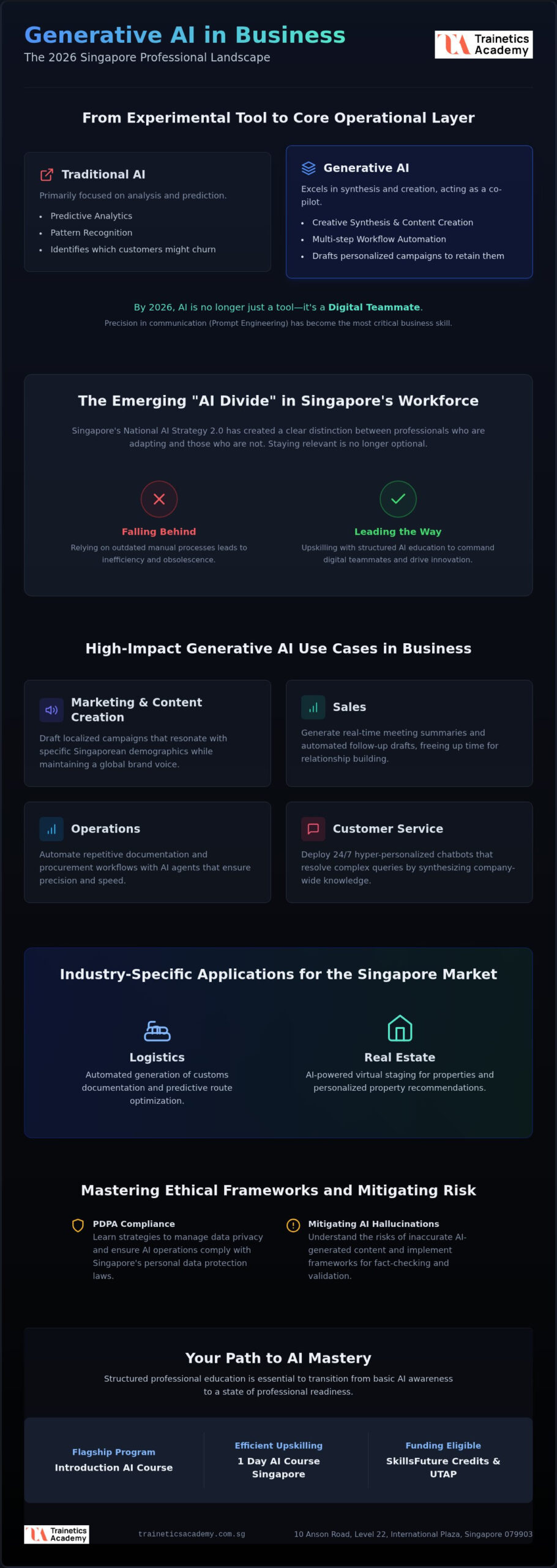
Generative Artificial Intelligence represents a fundamental shift in professional productivity. Unlike traditional AI, which primarily focuses on predictive analytics and pattern recognition, Generative AI excels in synthesis and creation. It acts as a sophisticated co-pilot, assisting with creative, analytical, and operational tasks that previously required intensive human labor. By 2026, the Singaporean economy has integrated these technologies as a core operational layer, moving beyond the experimental phase of the early 2020s to a state of absolute necessity.
The primary differentiator lies in the creative output. While traditional models might tell you which customers are likely to churn, Generative AI actually drafts the personalized outreach campaigns to retain them. This capability is at the heart of modern generative ai use cases in business. Natural Language Processing (NLP) serves as the critical bridge here; it allows non-technical professionals to interact with complex algorithms using standard English, effectively democratizing high-level technical mastery across all organizational tiers.
The Evolution from Tools to Digital Teammates
We’ve moved past simple chatbots. In 2026, AI agents handle multi-step business workflows with significant autonomy. These agents don’t just answer questions; they execute tasks. Businesses are increasingly adopting small, specialized models tailored to specific niches like local legal compliance or regional logistics rather than relying solely on massive, general-purpose engines. In this environment, prompt engineering has emerged as the most critical business skill of the decade. It’s the language of leadership in an automated world where precision in communication determines the quality of output.
Why Singapore Professionals Must Adapt Now
Singapore’s National AI Strategy 2.0 has accelerated the integration of AI across all sectors, from finance to fitness education. This state-led initiative has made AI literacy a benchmark for professional readiness. A distinct “AI Divide” is forming between those who have upskilled through a structured AI Course and those who rely on outdated manual processes. Staying relevant requires a commitment to continuous improvement and scientific validation of one’s skills.
Standing still is no longer an option. If you’re concerned about your timing, consider if it’s too late for AI? Why 2026 is your strategic entry point for establishing a competitive advantage. At Trainetics Academy, located at 10 Anson Road, Level 22, International Plaza, Singapore 079903, we focus on bridging this gap through our Introduction AI Course. This 1 day AI course Singapore professionals trust is eligible for SkillsFuture Credits and UTAP funding, ensuring you aren’t just using tools, but leading digital teammates.
Core Generative AI Use Cases Across Key Business Functions
The integration of automation into departmental workflows is no longer a luxury. It’s a standard for professional readiness in the 2026 economy. By examining specific generative ai use cases in business, leaders can identify where human creativity and machine efficiency intersect. This intersection is most visible in marketing, where localized campaigns for the Singapore market now require hyper-personalization to cut through digital noise. Sales teams also benefit from real-time meeting summaries and automated follow-up drafting, allowing them to focus on relationship building rather than administrative tasks.
Operations and customer service have undergone similar transformations. Repetitive documentation and procurement workflows are now handled by AI agents that ensure precision and speed. In customer service, the shift toward 24/7 hyper-personalized chatbots has redefined the user experience. These agents don’t just provide canned responses; they resolve complex queries by synthesizing information from across the company’s knowledge base. Professionals seeking to master these departmental workflows often start with a structured AI course Singapore leaders recommend for its practical, career-ready focus.
Revolutionizing Marketing and Content Creation
Marketing is the first frontier. By utilizing AI for professionals, a marketing manager in Singapore can draft localized campaigns that resonate with specific heartland demographics while maintaining a global brand voice. SMEs that previously lacked design budgets now generate high-quality visual assets in seconds. This democratization of design allows for A/B testing at a scale that was previously impossible, ensuring every dollar of ad spend is backed by generative iterations and performance data.
Human Resources and Talent Management
Talent management has shifted from administrative tracking to strategic development. Recruiters now streamline high-volume hiring by summarizing hundreds of resumes in seconds, focusing their time on the interview process. Beyond hiring, AI drafts personalized employee development plans and onboarding guides tailored to individual career paths. To further enhance this process, you can visit Spacewize to see how static training documents are transformed into interactive e-learning courses. By analyzing employee sentiment through generative models, HR leaders can identify workplace culture trends and intervene before issues escalate, raising the professional benchmark for the entire organization.
Finance and Automated Reporting
Precision is the cornerstone of finance, and Generative AI enhances this through rigorous data extraction. Invoices and receipts are processed autonomously, with AI generating narrative summaries of complex financial spreadsheets for stakeholders. This allows finance teams to move from data entry to strategic advisory roles. Furthermore, these models assist in fraud detection by recognizing subtle patterns that deviate from established financial norms, providing a layer of security that is both scientifically grounded and practically essential.
Industry-Specific Applications for the Singapore Market
The impact of automation is most profound when applied to the unique regulatory and cultural landscape of Singapore. By 2026, industry-specific generative ai use cases in business have matured, offering localized solutions for sector-specific challenges. In the real estate sector, agents now use GenAI to draft compelling property descriptions for HDB and Condo listings, representing some of the most practical generative ai use cases in business today. Virtual staging tools transform empty units into move-in-ready visions without the need for physical furniture, significantly reducing marketing lead times. This technical mastery allows professionals to present properties with a level of scientific precision that appeals to modern buyers.
Logistics firms, operating within one of the world’s busiest transshipment hubs, utilize AI for route optimization and the automation of complex customs documentation for regional shipping. These systems synthesize vast amounts of data to ensure compliance and speed. Retailers have moved beyond basic e-commerce to offer virtual try-on experiences and AI-driven inventory forecasting that accounts for local festivities and seasonal demand shifts. Even legal and professional services have seen a shift; rapid contract review and legal research synthesis are now the standard for maintaining professional readiness in a fast-paced market.
This shift toward high-tech retail environments also allows specialized businesses to better showcase complex products; for instance, check out S5 Tech to see how premium sim racing gear is presented to enthusiasts in Singapore.
AI Tools for Singapore Real Estate Agents
Agents now lead the charge in digital transformation by using AI to manage high volumes of client inquiries via WhatsApp and Telegram. These agents don’t just reply; they provide instant valuation reports and market trend analyses that build immediate trust. By creating professional video walkthroughs from static photos using GenAI, they offer an immersive experience that was once the exclusive domain of high-budget agencies. This efficiency allows them to focus on high-value negotiations rather than administrative drudge work.
The SME Advantage: Competing with Global Giants
Small and medium enterprises no longer need massive departments to compete globally. A 1 day AI course Singapore professionals trust can empower a small team to act like a large agency. By automating repetitive documentation and procurement, SMEs save significant costs and reallocate resources toward innovation. Understanding which top AI productivity tools for business in Singapore to implement is the first step toward this transformation. At Trainetics Academy, we provide the framework for this transition, ensuring your team is equipped with career-ready skills that meet international benchmarks.
Overcoming Implementation Barriers and Ethical Risks
Successful integration of automation isn’t merely about technical deployment; it necessitates a rigorous commitment to governance and professional standards. While identifying generative ai use cases in business is the first step, actual implementation often hits a wall due to data privacy concerns. In Singapore, the Personal Data Protection Act (PDPA) remains the most significant regulatory benchmark. Professionals must ensure that sensitive client information isn’t fed into public models where it could be stored or used for future training. Beyond privacy, managing the risk of “hallucinations” is vital. Without a scientifically grounded auditing process, businesses risk disseminating inaccurate information that could damage their professional reputation.
The skill gap in the local market represents another formidable barrier. There is a distinct shortage of professionals who understand how to audit generative outputs for bias or technical inaccuracies. Protecting proprietary business data in an open AI environment is a complex challenge that requires a visionary approach to security. Without localized models or secure “sandboxes,” a company’s unique intellectual property is at risk. Transitioning to an AI-driven workflow is only possible when these technical and ethical guardrails are firmly in place.
Ensuring Data Privacy and Security in Singapore
Best practices for maintaining security involve strict depersonalization of data before it reaches any AI engine. This includes stripping away NRIC numbers and specific identifiers to remain compliant with evolving legal standards. By 2026, the complexity of AI-related litigation has increased, making internal usage policies a necessity for any corporate team. You must establish a clear linguistic and technical framework that dictates how and when AI tools are utilized, ensuring that innovation never compromises organizational integrity.
Building an AI-First Culture
Creating an AI-first culture starts at the leadership level. Visionary mentors must convince stakeholders that upskilling is an investment in professional readiness, not just an operational cost. Measuring the ROI of this transition involves tracking improvements in precision and the reduction of manual error rates. Encouraging team experimentation is healthy, provided it occurs within strict safety guardrails. When a department commits to a structured AI Course, they’re adopting a professional identity that values excellence and continuous improvement.
Bridge the gap between potential and performance by enrolling in our Introduction AI Course. At Trainetics Academy, we provide the expert-led training required to navigate these ethical complexities and establish a leadership position in your industry.
Mastering AI Skills: Your Path with Trainetics Academy
Self-learning often feels like wandering through a labyrinth without a map. While the internet is flooded with tutorials, they frequently lack the academic rigor and scientific validation required for professional-grade implementation. Relying on trial and error with generative ai use cases in business can lead to costly mistakes, especially regarding data security and operational efficiency. You need more than just a passing familiarity with tools; you need a professional identity that commands respect in the 2026 Singaporean market. Fragmented knowledge is a liability in a high-stakes corporate environment where precision is the baseline for success.
Trainetics Academy bridges this gap by offering a curriculum rooted in excellence and career-ready skills. Our approach is fundamentally different from hobbyist classes. We provide a supportive yet demanding environment where you learn from industry leaders who value precision and continuous improvement. By training at our International Plaza facility, you enter a gateway to technical mastery designed specifically for non-programmers. We don’t just teach you how to use AI; we teach you how to lead with it, ensuring your transition into an AI-driven role is both secure and scientifically grounded. This methodical flow of information reflects the organized nature of our training programs and the systematic approach we take toward professional development.
Why Choose the Introduction AI Course?
Our Artificial Intelligence Course focuses on the practical application of prompt engineering and tool integration. You’ll move from a state of uncertainty to technical confidence in just one day. We’ve designed the curriculum to satisfy the intellectual curiosity of advanced practitioners while remaining accessible to beginners. You’ll walk away with a framework for identifying the most impactful generative ai use cases in business, allowing you to raise professional benchmarks within your own organization immediately. The curriculum is built on international standards, ensuring your skills remain relevant as the technology evolves.
Start Your AI Journey Today
The transition into an AI-enhanced career should feel both exciting and grounded in reality. Enrolling in the best AI course Singapore has to offer ensures you aren’t left behind by the speed of digital evolution. If you’re concerned about your technical background, our guide on how to learn AI without a tech background provides the necessary reassurance to begin. Take the first step toward a prestigious career by joining a community dedicated to producing top-tier professionals. Your path to mastery begins with a single day of focused, expert-led training designed to produce immediate, measurable results in your daily business operations.
Secure Your Competitive Advantage in the AI Era
The transition to an AI-integrated economy is a definitive shift that demands immediate action. You’ve seen how generative ai use cases in business are no longer experimental novelties but essential components of professional readiness. From hyper-personalized marketing to automated logistics documentation, the capacity to synthesize complex data determines your competitive edge. Mastering these tools isn’t just about efficiency; it’s about claiming a professional identity that values precision and technical mastery.
Staying relevant in the 2026 market requires more than just curiosity; it requires a commitment to rigorous training. Don’t let the speed of evolution overwhelm your potential. A structured learning path ensures you navigate ethical risks and data privacy with the confidence of an industry leader. By focusing on practical applications rather than abstract theory, you’ll bridge the gap between basic awareness and professional excellence. Enroll in our Artificial Intelligence Course and master business automation today! We’ve tailored this training for non-technical professionals who want to lead their teams with scientific validation. Take charge of your professional future and start your journey toward excellence now.
Frequently Asked Questions
What are the most common generative AI use cases for small businesses?
Common generative ai use cases in business for SMEs include automated social media content generation, personalized email marketing, and rapid drafting of internal documentation. These tools allow small teams to execute high-volume tasks with the precision of a much larger agency. By automating the administrative “drudge work,” business owners can reallocate their focus toward strategic growth and client relationship management.
Is it safe to put my company’s financial data into ChatGPT?
It’s generally unsafe to input proprietary financial data into public, consumer-facing versions of AI tools unless you’ve enabled specific privacy settings. Public models often use input data to train future iterations, which could lead to sensitive information leaks. Professionals should utilize enterprise-grade environments or “zero-retention” settings to ensure compliance with local data protection standards and maintain corporate security benchmarks.
Do I need to know how to code to use generative AI in business?
You don’t need coding skills to effectively implement generative AI in a professional setting. Modern AI interfaces utilize Natural Language Processing, allowing you to interact with complex models using standard English. The most critical skill is prompt engineering, which focuses on linguistic precision rather than technical programming. This accessibility makes it an ideal time for non-programmers to pursue technical mastery.
How can AI help with customer service for a Singapore-based SME?
AI enhances customer service by providing 24/7 hyper-personalized responses through localized chatbots that understand regional context. These agents resolve complex queries by synthesizing information from your company’s specific knowledge base, reducing wait times for clients. This level of responsiveness builds trust and ensures your business maintains the high professional standards expected in the Singaporean market.
What is the best AI course for beginners in Singapore?
The best AI course for beginners is one that balances academic rigor with practical, career-ready applications. Trainetics Academy offers a structured 1 day AI course Singapore professionals trust for its focus on non-programmers. Our curriculum provides a professional identity and the technical confidence needed to lead in an automated world, ensuring you receive the highest standard of education available in the local market.
Can my company get funding for AI training at Trainetics Academy?
Singaporean professionals can access various financial support schemes to assist with their upskilling journey. At Trainetics Academy, we help students navigate the available pathways to ensure their transition into an AI career is both affordable and scientifically grounded. This commitment to accessibility allows a broader range of practitioners to achieve the technical mastery required for the 2026 economy.
How long does it take to see ROI from implementing AI tools?
Many businesses report measurable improvements in productivity within the first few weeks of implementation. ROI is typically seen through the reduction of manual labor hours and the acceleration of content creation cycles. By identifying high-impact generative ai use cases in business early, organizations can quickly offset their initial training and software costs through significant gains in operational efficiency.
What are the legal risks of using AI-generated content in marketing?
The primary legal risks involve potential copyright infringement and non-compliance with the Personal Data Protection Act. If AI-generated content inadvertently mirrors existing protected works or utilizes sensitive data without consent, your company could face legal exposure. It’s essential to establish internal usage policies and conduct human audits of all generative outputs to ensure they meet both legal and professional standards.
Disclaimer
AI Content Disclaimer: Some articles on this website may be generated or assisted by AI-powered content creation tools. While we strive for accuracy and relevance, readers should independently verify information before relying on it. The content is provided for informational purposes only and does not constitute professional advice.