By 2026, the competitive advantage isn’t found in who writes the best prompts, but in who builds the most seamless, agentic workflows. If you’re still spending ten hours every week on manual data consolidation, you aren’t just losing time; you’re falling behind the pace of modern business. Automating report generation with ai tools has evolved from a luxury into a core professional competency for those pursuing excellence. At Trainetics Academy, located at 10 Anson Road, Level 22, International Plaza, Singapore 079903, we believe technical mastery is the gateway to a prestigious career.
We understand the frustration of high error rates during spreadsheet-to-slide conversions and the pressure to deliver precise insights at high speeds. This guide provides the exact steps to transform tedious manual entry into high-impact, automated systems that ensure data accuracy. You’ll learn how to master the technical frameworks required to build a reliable reporting workflow. For those seeking immediate upskilling, our Introduction AI Course is eligible for SkillsFuture Credits and UTAP funding. We’ll explore the transition from basic automation to sophisticated AI integration, ensuring you’re ready to set a new benchmark for professional productivity.
Key Takeaways
- Eliminate the reporting debt that limits your growth by transitioning from manual entry to integrated agentic workflows.
- Utilize LLMs as reasoning engines to connect disparate data sources directly with AI interfaces for reliable synthesis.
- Master the exact two-phase process for automating report generation with ai tools, ensuring every output is grounded in factual accuracy.
- Secure your professional identity by applying technical AI mastery to complex business challenges through structured training.
The Evolution of Business Reporting: Why Automate with AI?
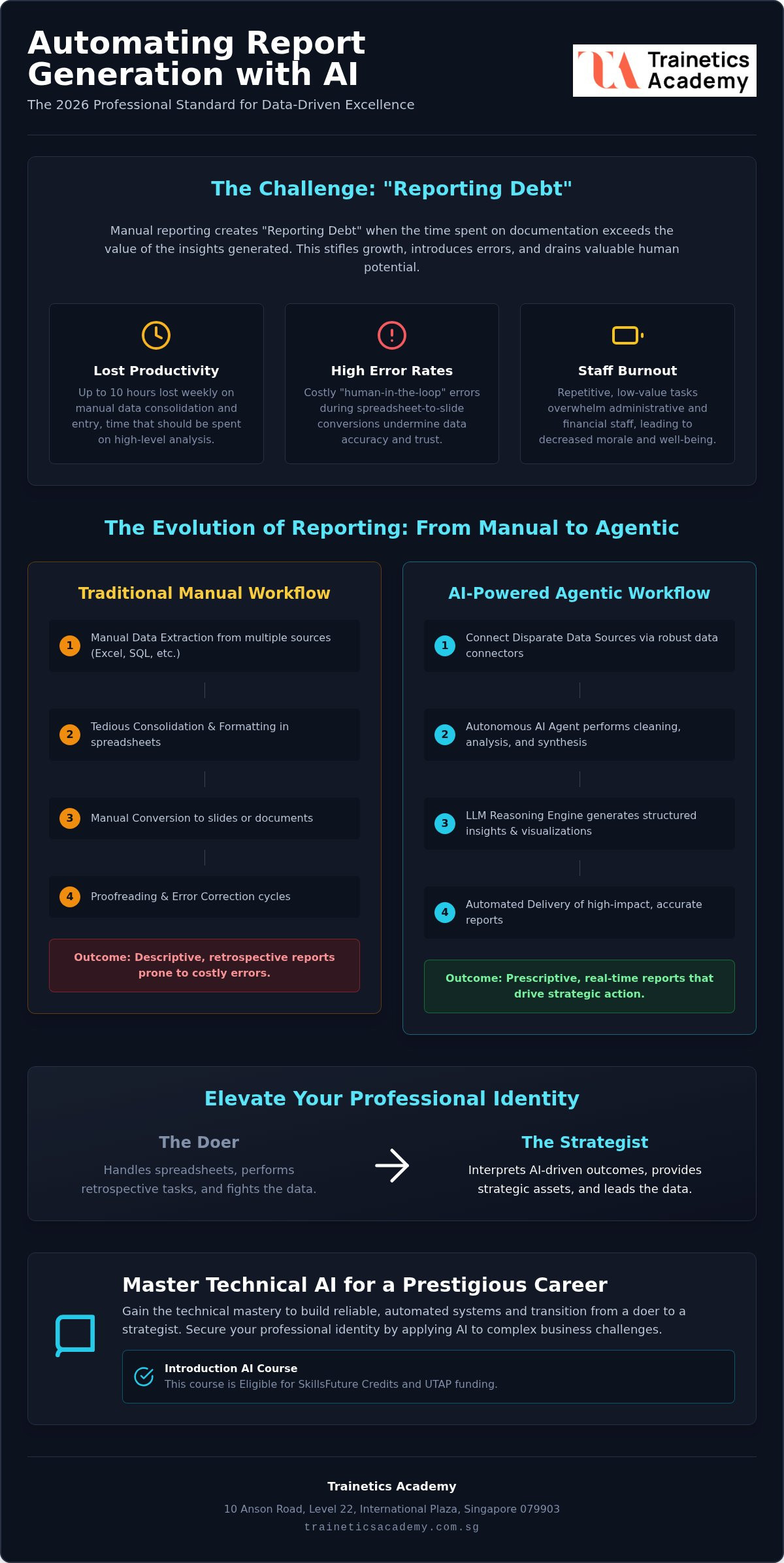
In the 2026 digital economy, business reporting has transitioned from a retrospective task into a real-time strategic asset. Traditional methods often rely on a legacy report generator that requires heavy manual intervention, creating what we call “Reporting Debt.” This debt occurs when the time spent on documentation exceeds the value of the insights generated, effectively stifling growth for Singaporean firms. Automating report generation with ai tools solves this by shifting the focus from descriptive reporting, which merely states what happened, to prescriptive AI reporting that dictates what to do next. This evolution ensures that data doesn’t just sit in a warehouse but actively drives the next phase of your professional journey.
To better understand this concept, watch this helpful video:
The Hidden Costs of Manual Reporting
Report Automation is the systematic use of LLMs to synthesize data into structured insights. When professionals manually consolidate and format data, they lose hours that should be spent on high-level analysis. For those in finance or logistics, “human-in-the-loop” errors aren’t just inconvenient; they’re costly. In the fast-paced 2026 market, accuracy is a non-negotiable benchmark of excellence. Reducing this manual burden directly impacts employee well-being. It lowers burnout rates for administrative and financial staff who are often overwhelmed by repetitive tasks. By automating report generation with ai tools, organizations reclaim lost time and redirect human intelligence toward innovation. You’re no longer fighting the data; you’re leading it.
AI as a Gateway to Professional Excellence
Mastering these tools elevates your professional identity. You move from being a “doer” who handles spreadsheets to a “strategist” who interprets AI-driven outcomes. This transition aligns with international professional benchmarks, ensuring you remain relevant on a global scale. If you’re interested in how this applies to specific sectors, check out our AI in Singapore Finance: 2026 Transformation Guide. By adopting these technologies, you don’t just work faster. You work with a level of precision that defines the modern industry leader. This technical mastery is the foundation of a prestigious career in an increasingly automated world. We view this shift as an opportunity to raise professional standards and secure a future defined by excellence and scientific rigor.
Key AI Technologies for Automated Report Generation
To master the art of automating report generation with ai tools, you must first understand the underlying technical architecture. In 2026, Large Language Models (LLMs) serve as the primary reasoning engine, but they don’t operate in isolation. They require robust data connectors to bridge the gap between legacy systems like Excel or SQL and modern AI interfaces. This integration allows for a seamless flow of information, turning raw numbers into structured insights. Recent academic research on AI report generation confirms that these generative systems are most effective when they handle the entire pipeline from extraction to visualization without manual interference.
From Prompts to Autonomous Agents
Simple prompting is no longer the gold standard for professional documentation. Today’s industry leaders rely on agentic workflows, where autonomous agents manage multi-stage tasks. These agents don’t just follow a single command; they clean data, perform deep analysis, and apply complex formatting rules. In specialized sectors like logistics, domain-intelligent AI understands the nuances of supply chain metrics, reducing the need for manual oversight. If you’re looking to lead these transformations, enrolling in a professional AI Course can help you develop the necessary technical mastery to build these systems yourself.
The Role of Multimodal AI
Modern reporting demands more than just text. Multimodal AI enables the simultaneous generation of tables, charts, and even full MSL decks. This technology ensures brand compliance by utilizing AI-driven design templates that maintain visual consistency across all outputs. By automating report generation with ai tools, you can produce comprehensive decks that are ready for the boardroom in minutes rather than days. For a deeper look at the software driving these changes, explore our Top AI Productivity Tools for Business in Singapore.
Visual AI has also revolutionized the creation of charts and posters. Instead of manually adjusting axes and legends, professionals use agentic systems to determine the most effective way to represent specific datasets. This isn’t just about aesthetics; it’s about accuracy. When your reporting tools can autonomously select the right visualization type based on the data’s logic, the risk of misinterpretation drops significantly. This level of precision is what separates a standard practitioner from a true industry leader who values scientific validation and professional readiness.
Comparing AI Tools: From Prompt-Based to Agentic Workflows
Selecting the optimal environment for automating report generation with ai tools requires a deep understanding of your organizational architecture. While general-purpose LLMs like ChatGPT or Claude offer unparalleled creative flexibility, they often lack the deep data integration required for complex business reporting. For Singaporean enterprises, the choice usually hinges on security and ecosystem synergy. Proprietary systems provide a controlled perimeter, whereas open-source models offer customization at the cost of increased technical debt. Evaluating these options is a core component of any high-level AI Course designed for modern professionals.
Microsoft Copilot and Ecosystem Integration
Microsoft Copilot represents the pinnacle of ecosystem integration for the corporate world. It allows you to automate reports directly within Excel and PowerPoint, pulling live data from your existing spreadsheets without external exports. This keeps sensitive information within your enterprise-grade security perimeter, a critical factor for local compliance and data sovereignty. Administrative professionals who have completed SkillsFuture AI courses often find this integration to be the fastest path to productivity. It transforms the reporting process from a manual struggle into a streamlined, automated workflow that mirrors the high standards of the global market.
Specialized Agentic Platforms
When your documentation requires deep scientific, financial, or technical precision, specialized agentic platforms are the superior choice. Unlike prompt-based tools, these systems utilize multi-agent architectures to verify facts, cross-reference datasets, and apply industry-specific formatting. This significantly reduces the need for manual “reworking” of drafts, as the AI understands the underlying logic of the report. For those in high-stakes industries, our AI in Logistics and Supply Chain Course Singapore provides the technical mastery needed to implement these advanced solutions.
The learning curve for an AI course Singapore professional varies based on the chosen toolset. While prompt-based systems are accessible, mastering agentic workflows requires a disciplined approach to technical education. We advocate for a learning path that moves from foundational concepts to advanced applications, ensuring you don’t just use the tools, but lead the strategy. This commitment to excellence is what defines the next generation of industry leaders. By choosing the right tool, you aren’t just saving time; you’re building a professional identity rooted in innovation and precision.
Step-by-Step: How to Build Your First AI-Automated Report
Transitioning from understanding tools to active implementation requires a disciplined, four-phase approach. Automating report generation with ai tools isn’t a one-click solution; it’s a technical workflow that demands precision and grounding. To lead in the 2026 economy, you must view the reporting process as a series of interconnected steps where human intelligence directs AI capability. This method ensures that the final deliverable isn’t just a summary, but a strategic asset that meets international professional benchmarks.
Gathering and Cleaning Your Data Sources
Phase 1 focuses on data preparation. AI models operate best when spreadsheets and notes are structured logically with clear headers and consistent formatting. Before uploading any sensitive information to an AI tool, you must omit personally identifiable information (PII) to maintain enterprise-grade privacy standards. The “Garbage In, Garbage Out” principle remains the most critical law in AI reporting; your output is only as sophisticated as the data you provide. Grounding your AI in high-quality, cleaned data ensures the final report reflects reality rather than hallucination.
Structuring the Agentic Prompt
Phase 2 and 3 involve defining the persona and building the agentic prompt. You must specify the “Who” and “Why” of the report, whether it’s a high-level executive summary or a technical logistics audit. Using advanced prompt engineering, you can structure instructions that guide the AI through multi-stage reasoning. This includes setting constraints on tone, length, and specific KPIs that must be highlighted. For a deeper look at integrating these techniques, see our Applying AI Skills to Your Current Job: 2026 Guide. Mastery of these instructions allows the AI to function as a digital analyst rather than a simple text generator.
The final phase is the human-expert review. No automated system is complete without a professional verifying the logic and accuracy of the output. This iterative refinement ensures the report meets the highest industry benchmarks. By automating report generation with ai tools, you reclaim the time needed for this critical oversight. You move from being a manual data entry clerk to a visionary mentor who ensures every insight is scientifically grounded. If you’re ready to secure this professional identity, consider joining our next AI Course to master these workflows in a hands-on environment.
Structuring your first automated report requires patience and a commitment to technical mastery. By following these phases, you ensure that your automated systems are reliable, secure, and accurate. This systematic approach is what separates a beginner from a professional who is ready to lead in a data-driven world. Your goal is to build a reliable automated reporting workflow that saves hours of weekly labor while improving the overall quality of your business insights.
Mastering AI Automation: Training Opportunities in Singapore
The 2026 job market demands more than just basic digital literacy; it requires a deep commitment to technical excellence. For professionals in Singapore, the ability to lead digital transformation projects is the ultimate differentiator. Mastering the art of automating report generation with ai tools provides a tangible way to demonstrate this leadership. While theoretical knowledge offers a foundation, true professional readiness comes from applying these skills to real-world business challenges. Trainetics Academy acts as a visionary mentor, guiding you through this transition with a curriculum rooted in scientific validation and practical application.
Choosing the Right AI Course Singapore Path
Passive video courses often fail to provide the depth needed for high-stakes business environments. We prioritize interactive, professional-led learning that mirrors the high standards of the global fitness and business industries. A high-quality Artificial Intelligence Course should cover everything from data grounding to agentic workflow construction. Our Introduction AI Course is eligible for SkillsFuture Credits and UTAP funding, making it accessible for those ready to raise their professional benchmarks. This structured approach ensures you don’t just learn about AI; you gain a professional identity as a technical master.
Busy managers often struggle to find time for extended training programs. A 1 day AI course Singapore workshop is specifically designed to bridge the gap between busy schedules and the need for upskilling. It provides a focused, high-impact environment where you can immediately apply new techniques to your reporting workflows. This efficiency is critical in a market where speed and accuracy are the primary drivers of success. By the end of a single session, you’ll have the tools to replace hours of manual labor with precise, automated systems.
Next Steps for Professional Growth
Once you’ve acquired these skills, the next step is justifying the investment to your leadership. By using ROI-focused reporting skills, you can clearly demonstrate how automating report generation with ai tools reduces operational costs and improves data accuracy. This evidence-based approach is the hallmark of a disciplined industry leader. For more details on our curriculum, check out our AI Course 1 Day Training Using SkillsFuture checklist. We invite you to visit us at 10 Anson Road, Level 22, International Plaza, Singapore 079903 to start your journey toward technical mastery and professional excellence.
Lead the Future of Data-Driven Strategy
The transition from manual documentation to sophisticated agentic workflows represents more than just a productivity gain; it’s a fundamental shift in your professional identity. By automating report generation with ai tools, you move beyond the role of a data processor to become a visionary strategist who values precision and scientific rigor. This guide has detailed the technical frameworks and grounding techniques necessary to ensure your automated systems meet the highest international benchmarks. You now possess the roadmap to eliminate reporting debt and drive prescriptive insights that lead to measurable business growth.
Now is the time to solidify these skills through disciplined mentorship. Our professional training is delivered by industry leaders who are dedicated to raising the benchmarks of excellence within the Singaporean market. Master AI automation today with Trainetics Academy’s professional AI Course and secure your place at the forefront of your industry. The path to technical mastery is clear; we’re here to ensure your journey is both scientifically grounded and professionally transformative. Your future as an AI-enabled leader starts with a single, decisive step toward excellence.
Frequently Asked Questions
Can AI tools generate financial reports that are 100% accurate?
AI tools don’t achieve absolute 100% accuracy without expert oversight. While automating report generation with ai tools significantly reduces human error in data entry, the “Garbage In, Garbage Out” principle still applies. You must treat AI as a high-speed analyst that requires your final validation. Professional excellence in 2026 relies on this hybrid approach where machine efficiency meets human precision to ensure every financial insight is scientifically grounded.
Is it safe to upload sensitive company data to AI report generators?
Safety depends entirely on the environment you choose. Public LLMs pose risks, but enterprise-grade ecosystems like Microsoft Copilot keep data within a secure perimeter. Professionals should prioritize tools that offer data sovereignty and compliance with local standards. Understanding these security nuances is a key part of any comprehensive AI course Singapore leaders attend to protect their organizational integrity while scaling their automated workflows.
Do I need coding skills to automate reports with AI tools?
No, you don’t need coding skills to excel in this field. Modern AI interfaces rely on natural language processing, meaning your ability to communicate clearly is more valuable than writing Python. Our AI courses for beginners focus on mastering prompt engineering and logical structuring rather than syntax. This accessibility allows professionals from all backgrounds to achieve technical mastery and transform their daily operations through disciplined AI application.
Which AI tool is best for creating visual decks and presentations?
Microsoft Copilot is currently the leader for integrating data directly into PowerPoint. However, multimodal AI tools are rapidly evolving to generate text, tables, and images simultaneously. These tools ensure brand compliance through automated design templates. Choosing the right software is a strategic decision we cover in our 1 day AI course Singapore sessions, helping you select platforms that align with your specific presentation benchmarks.
How much time can I realistically save by automating my reports?
Most professionals realistically save between 10 to 15 hours per week by automating their documentation. This reclaimed time allows you to move from repetitive manual consolidation to high-level strategic analysis. Automating report generation with ai tools eliminates the “reporting debt” that often stifles individual career growth. By streamlining these processes, you secure your professional identity as a strategist who prioritizes innovation over administrative labor.
Are there any SkillsFuture AI courses specifically for administrative staff?
Yes, there are specific SkillsFuture AI courses tailored for administrative and support staff. These programs focus on practical automation rather than theoretical data science. Trainetics Academy provides training that helps administrative professionals master tools for scheduling, reporting, and data management. This education is designed to raise professional benchmarks and ensure that every team member is ready for the technical demands of the 2026 digital economy.
Can AI automate reports that require data from multiple different software platforms?
Yes, AI can synthesize data from multiple software platforms using robust data connectors. These tools bridge the gap between Excel, SQL databases, and cloud-based CRM systems. By building an integrated workflow, the AI acts as a central reasoning engine that pulls disparate facts into a single, cohesive report. This capability is essential for managers who need a holistic view of their business operations without manual cross-referencing.
What is the difference between a simple prompt and an agentic workflow in reporting?
A simple prompt is a one-off instruction, while an agentic workflow involves multi-stage reasoning. Agents can autonomously clean data, perform analysis, and then format the output without constant human intervention. This 2026 standard for automation reduces the need for manual “reworking” of drafts. Moving from basic prompting to agentic mastery is a core objective for those seeking a prestigious career in the age of artificial intelligence.
Disclaimer
AI Content Disclaimer: Some articles on this website may be generated or assisted by AI-powered content creation tools. While we strive for accuracy and relevance, readers should independently verify information before relying on it. The content is provided for informational purposes only and does not constitute professional advice.