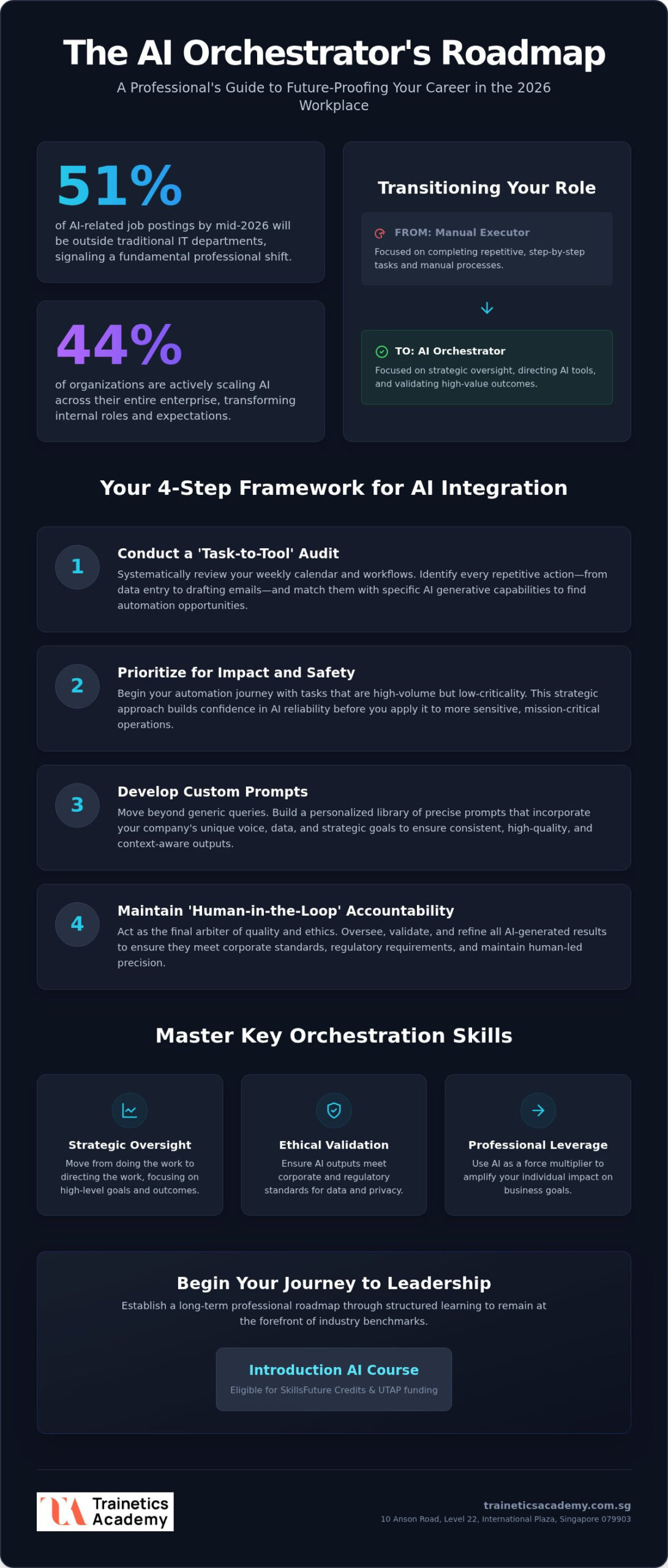
Did you know that by mid-2026, 51% of AI-related job postings are now found outside of traditional IT departments? This shift signals a fundamental change in the professional landscape where technical mastery is no longer optional. If you feel overwhelmed by the rapid pace of development or fear your position might become redundant, you aren’t alone. Many professionals struggle with the gap between theoretical knowledge and practical execution. However, applying ai skills to my current job role is the most effective way to secure a competitive advantage. At Trainetics Academy, located at 10 Anson Road, Level 22, International Plaza, Singapore 079903, we focus on bridging this gap through rigorous, science-based training.
This guide provides the exact framework you need to transition from a task executor to an AI orchestrator. You’ll learn how to automate repetitive workflows and elevate the quality of your professional output to meet international benchmarks. We’ll explore how our Introduction AI Course, which is eligible for SkillsFuture Credits and UTAP funding, empowers you to lead with confidence. By the end of this article, you will have a clear roadmap to position yourself as an indispensable leader within your team while future-proofing your career against the shifts of 2026 and beyond.
Key Takeaways
- Transition from a manual executor to an AI orchestrator, shifting your focus toward strategic oversight and complex problem-solving.
- Execute a systematic “Task-to-Tool” audit to begin applying ai skills to my current job role by identifying automation opportunities in your weekly schedule.
- Enhance professional output across administrative and finance functions while maintaining “Human-in-the-Loop” accountability for all AI-generated results.
- Navigate the 2026 regulatory landscape by understanding data sovereignty and ethical implementation within your specific corporate framework.
- Establish a long-term professional roadmap through structured learning, such as an Introduction AI Course, to remain at the forefront of industry benchmarks.
The Shift from Execution to AI Orchestration in the 2026 Workplace
The professional landscape in 2026 has reached a critical juncture. We’re moving past the initial wave of AI experimentation into a phase of deep integration. For many, the fear of role redundancy is being replaced by a realization of professional leverage. The Workplace impact of artificial intelligence has shifted from simple automation to a more nuanced model of augmentation. While automation handles tasks on your behalf, augmentation works alongside you to amplify your existing expertise. This evolution requires a fundamental change in how you approach your daily responsibilities. Effectively applying ai skills to my current job role is no longer a luxury; it’s a strategic necessity for those who wish to lead. Instead of being the one who executes every manual step, you become the visionary who directs the system.
By August 2026, McKinsey reports that 44% of organizations are scaling AI across their entire enterprise, up from 38% just a year ago. This rapid adoption in Singapore marks a tipping point where internal roles are being fundamentally transformed. The transition involves a psychological shift from viewing AI as a competitor to seeing it as a source of professional leverage. You are no longer just a worker; you are an orchestrator. You manage the inputs, refine the outputs, and ensure that every digital tool aligns with your company’s high standards of excellence.
Why AI Literacy is the New Professional Standard
Basic awareness is no longer sufficient for career progression. In 2026, companies prioritize professionals who demonstrate functional mastery over theoretical knowledge. This competency directly influences your internal promotion potential and salary trajectory. AI Orchestration is the strategic management of generative tools to achieve business outcomes. By mastering this mindset, you’re not just using a tool; you’re redesigning your professional identity. Effectively applying ai skills to my current job role means you can deliver higher quality output in a fraction of the time, positioning yourself as a high-value asset in any organization.
The Rise of Agentic Workflows in Singapore Offices
Singaporean workplaces are increasingly adopting agentic workflows, where autonomous AI agents collaborate to solve complex problems. This shift is particularly evident in high-ROI areas like Marketing, Sales, and Administration. As these agents take over the heavy lifting of data processing and initial drafting, the professional’s role shifts toward validation and ethical oversight. You are the final arbiter of truth and quality. Enrolling in a structured Artificial Intelligence Course provides the technical foundation needed to oversee these agents effectively. This ensures that the speed of AI is always balanced by the precision of human judgment.
- Strategic Oversight: Moving from doing the work to directing the work.
- Ethical Validation: Ensuring AI outputs meet corporate and regulatory standards.
- Professional Leverage: Using AI to multiply your individual impact on business goals.
A 4-Step Framework for Mapping AI to Your Current Workflow
Mastering the “Orchestrator” mindset requires more than just enthusiasm; it demands a structured methodology. While 74% of frontline employees are now regular AI users according to June 2026 BCG data, few have a systematic plan for integration. Moving from sporadic tool usage to a cohesive strategy is the secret to applying ai skills to my current job role effectively. This transition ensures that your productivity gains are measurable and sustainable rather than accidental.
- Step 1: Conduct a ‘Task-to-Tool’ Audit: Review your previous week’s calendar. Identify every repetitive action, from data entry to drafting emails, and match them with specific generative capabilities.
- Step 2: Identify High-Volume, Low-Criticality Tasks: Start your automation journey with tasks that consume significant time but carry lower stakes. This builds your confidence in the tool’s reliability before moving to mission-critical operations.
- Step 3: Develop Custom Prompts: Move beyond generic queries. Build a library of prompts that incorporate your company’s unique tone of voice, specific data sets, and internal formatting requirements.
- Step 4: Create an ‘AI Feedback Loop’: Treat every output as a draft. Refine your prompts based on the results you receive, creating a continuous cycle of improvement that sharpens the AI’s accuracy over time.
Audit Your Tasks: Automation vs. Augmentation
Efficiency begins with categorization. Divide your workload into three primary buckets: creative, analytical, and administrative. Apply the 80/20 rule to your schedule. Focus your AI implementation on the 20% of “bottleneck” tasks that typically consume 80% of your administrative energy. By automating these routine functions, you reclaim the cognitive space required for high-level strategic work. This disciplined approach prevents the “productivity paradox” where tools are adopted without a clear impact on professional output. It’s about working smarter, not just faster.
Developing Your Personal AI Tech Stack
Your choice of tools should reflect the rigorous standards of your industry. In 2026, the most successful professionals integrate AI directly into their existing ecosystems, such as Microsoft 365 or Google Workspace. This seamless integration minimizes friction and allows for real-time data reconciliation. For those looking to deepen their technical mastery, exploring an AI Course Singapore: The Ultimate 2026 Guide for Professionals provides a comprehensive overview of the current market leaders. Selecting the right stack is a foundational step in your professional evolution. If you’re ready to formalize these capabilities, consider how a structured Artificial Intelligence Course can help you validate your skills against international benchmarks.
Applying AI Skills Across Key Professional Functions
Transitioning from a general framework to specific departmental applications is where the “Orchestrator” mindset delivers tangible ROI. Every professional function possesses unique bottlenecks that can be dissolved through targeted automation. Successfully applying ai skills to my current job role requires understanding these nuances. Whether you are managing complex logistics or reconciling multi-million dollar ledgers, the goal remains the same: elevating the standard of professional output through scientific precision. By August 2026, McKinsey reports that nearly nine in ten organizations use AI in at least one business function. This widespread adoption proves that the competitive edge now belongs to those who can translate technical potential into functional excellence.
AI for Administrative and Operations Professionals
Administrative roles are seeing some of the fastest returns on investment. Professionals who leverage a 1 day AI course Singapore are transforming their daily operations from manual execution to high-level oversight. Consider the impact of prompt engineering on routine documentation. Some industry professionals report reducing report drafting time by 60% by using structured templates and generative tools. Beyond simple drafting, AI now handles complex multi-timezone scheduling and logistics coordination. This allows ops managers to focus on strategic vendor relationships rather than the minutiae of calendar management. It’s a shift that turns an administrative assistant into a logistics strategist. For those specifically managing supply chain operations, an AI in logistics and supply chain course Singapore offers targeted training to master predictive analytics and demand forecasting within your existing workflows.
Strategic AI Use in Finance and Sales Roles
In the high-stakes environments of finance and sales, accuracy is the primary benchmark. Finance professionals use AI for predictive analytics and real-time data reconciliation, ensuring 100% audit accuracy without the manual labor of previous years. Machine learning models now identify customer churn patterns before they happen, allowing sales teams to intervene with personalized outreach at scale. This proactive approach is a significant leap from traditional reactive sales methods. By applying ai skills to my current job role in these sectors, you aren’t just saving time; you are protecting the organization’s bottom line through data-driven foresight.
- Human Resources: Streamlining internal communication and drafting complex policy documents with linguistic precision.
- Marketing: Using sentiment analysis to gauge public reaction to campaigns in real-time.
- Accounting: Automating data entry while maintaining rigorous compliance with local and international financial standards.
This department-level implementation ensures that AI isn’t just a separate tool but a core component of your professional identity. When you master these specific applications, you position yourself as an indispensable leader capable of raising the professional benchmarks of your entire team.
Navigating Data Security and Ethical Implementation
Professionalism requires more than just speed; it demands uncompromising integrity. As you progress in applying ai skills to my current job role, you must recognize that data security is a shared responsibility, not just an IT department concern. Understanding your organization’s AI policy and data sovereignty is the first step toward ethical implementation. You must know exactly where your data resides. Sensitive company information should never enter a public model without proper sanitization. In 2026, the “Human-in-the-Loop” (HITL) requirement is the gold standard for professional accountability. You act as the final safeguard against AI hallucinations that can undermine critical business reports.
Adopting a disciplined approach to data privacy ensures that your use of technology remains an asset rather than a liability. Public AI models often lack the enterprise-level trust layers required for sensitive operations. By maintaining a strict boundary between public tools and proprietary data, you protect both your company and your professional reputation. This level of precision is what separates a true AI orchestrator from a casual user.
The Ethics of AI-Generated Content at Work
Disclosing AI usage to management and clients is essential for building long-term trust. While generative tools can draft complex content, you must ensure your brand voice and professional integrity remain intact. This involves actively identifying and addressing bias in AI outputs during decision-making processes. An orchestrator doesn’t simply accept a result; they interrogate it. Maintaining this level of scrutiny ensures that your professional output reflects high standards of excellence rather than just automated convenience. You are responsible for every word and figure that leaves your desk.
Securing Your Professional Reputation
Fact-checking has emerged as the most critical professional skill in 2026. Your reputation depends on the accuracy of the information you provide. Building trust with leadership requires transparent adoption strategies that prioritize data privacy. You can find a comprehensive roadmap for these practices in the AI Course 1 Day Training Using SkillsFuture: The 2026 Professional Checklist. Mastering these guardrails allows you to innovate without compromising your career security. It’s about being a visionary leader who values precision as much as innovation.
Secure your professional standing by enrolling in our Introduction AI Course, which is eligible for SkillsFuture Credits and UTAP funding. This structured training provides the ethical framework needed to lead your team through the complexities of the 2026 workplace.
Your Professional AI Roadmap: From Learning to Leadership
The journey toward becoming an AI-literate leader is a deliberate process of professional evolution. It requires more than just technical knowledge; it demands a commitment to continuous growth. As model updates occur with increasing frequency, building a resilient learning habit is the only way to maintain your competitive edge. You don’t need to be a data scientist to lead. You need to be the person who understands how to bridge the gap between algorithmic potential and business reality. By positioning yourself as the “AI Champion” within your department, you secure a professional identity rooted in innovation. Justifying the transition to your management involves demonstrating the clear ROI of applying ai skills to my current job role through improved accuracy and significant time savings.
A structured roadmap ensures that your efforts aren’t wasted on fragmented learning. You should focus on frameworks that allow for immediate application within your existing workflows. This strategic approach transforms you from a spectator of technological change into a visionary who directs it. When you lead by example, you raise the professional benchmarks for your entire team, creating a culture of excellence that values scientific validation and efficiency.
Choosing the Right AI Course for Beginners
For many Singaporean professionals, SkillsFuture AI courses represent the most effective entry point into this field. These programs are specifically designed to meet the needs of busy PMEAs who require high-impact results in a short timeframe. Hands-on, 1-day workshops are particularly beneficial as they focus on immediate skill application rather than abstract theory. Enrolling in a structured Introduction AI Course provides the rigorous foundation necessary to oversee automated systems with confidence. This formal training ensures your technical mastery is grounded in industry best practices and international standards.
Next Steps for Career Resilience
Your next performance review is the ideal opportunity to present your AI implementation proposal. Document the specific tasks you’ve optimized and the resulting improvements in output quality. This data-driven approach proves that applying ai skills to my current job role is a strategic asset for the company. Beyond your internal role, networking with other AI-literate professionals in Singapore will provide ongoing insights into emerging trends and local regulatory shifts. If you’re ready to discuss a comprehensive training plan for your department, visit us at 10 Anson Road, Level 22, International Plaza, Singapore 079903. Taking these steps today ensures your career remains secure and ambitious in the face of the 2026 workplace transformation. As you plan for this future, resources like New Launch can help you stay informed about the evolving residential landscape in Singapore.
The transition from manual execution to strategic orchestration marks the new standard of professional excellence in 2026. By mastering the 4-step framework and applying these techniques across your specific business function, you’ve moved beyond basic awareness toward functional mastery. Effectively applying ai skills to my current job role ensures that you remain an indispensable leader capable of navigating data security and ethical implementation with precision. You now possess the roadmap required to bridge the gap between theoretical knowledge and practical work results.
Your professional identity is defined by a commitment to rigorous standards and continuous improvement. Don’t let the rapid evolution of technology become a barrier to your career security. Instead, embrace these tools as a source of leverage to amplify your impact and deliver results that are both scientifically grounded and practically superior. We invite you to join a community of forward-thinking professionals dedicated to raising industry benchmarks.
Enroll in our Introduction AI Course and transform your career today through our 1-day practical workshop at International Plaza taught by industry experts in Singapore. We look forward to helping you reach the next benchmark in your professional journey.
Frequently Asked Questions
Will applying AI skills to my job role eventually lead to my replacement?
No, applying ai skills to my current job role focuses on augmentation rather than replacement. While the World Economic Forum expects 92 million roles to be displaced by 2030, 170 million new ones are projected to emerge. You aren’t being replaced; your role is simply evolving. By shifting to an “AI Orchestrator” mindset, you manage high-level outputs instead of performing manual inputs, which increases your professional leverage.
How do I start using AI at work if my company doesn’t have a policy yet?
Begin by automating high-volume, low-criticality tasks that don’t involve proprietary or sensitive company data. Focus on personal productivity boosters like drafting email templates or summarizing public research papers. Once you demonstrate a measurable improvement in your output quality, draft a formal implementation proposal for your manager. This proactive approach positions you as a visionary leader who values both innovation and safety, helping the organization establish its first formal AI governance framework.
What are the best AI courses for beginners in Singapore for 2026?
The best programs for beginners focus on immediate professional application rather than abstract theory. Look for courses that cover prompt engineering, agentic workflows, and ethical implementation within a corporate context. Our Introduction AI Course is specifically tailored for professionals who need to master these tools quickly. This curriculum ensures you can transition from a manual executor to an AI orchestrator, raising your professional benchmarks in a competitive and fast-moving market.
Can I use SkillsFuture Credit for a 1 day AI course Singapore?
Yes, Singaporeans can utilize SkillsFuture Credits for our Introduction AI Course. This foundational program is specifically designed to support lifelong learning and professional readiness in a rapidly evolving market. This 1 day AI course Singapore provides hands-on experience with prompt engineering and task automation. It allows you to integrate generative tools into your daily workflows immediately, ensuring your skills meet the high benchmarks of the 2026 professional landscape.
How do I avoid AI hallucinations in my professional work?
Avoiding hallucinations requires a strict “Human-in-the-Loop” (HITL) protocol where you act as the final validator for every piece of content. Use AI to create initial drafts, then cross-reference all figures, dates, and claims with verified primary sources. Implementing a structured feedback loop where you refine your prompts based on previous errors also helps. Never treat AI output as a final product; it’s a sophisticated starting point that requires your expert oversight.
Which AI skills are most in demand for non-technical roles in 2026?
In 2026, the most sought-after skills for non-technical roles include prompt engineering, sentiment analysis, and AI orchestration. Employers value professionals who can direct autonomous agents to solve complex business problems. For those in administrative or finance roles, the ability to perform data reconciliation and predictive forecasting using generative tools is a significant advantage. Mastering these capabilities allows you to deliver higher-quality professional output while reclaiming time for high-level strategic thinking.
How do I handle data privacy when using AI tools for work tasks?
Data privacy starts with understanding your organization’s specific security protocols and data sovereignty. Never input sensitive client information or proprietary trade secrets into public AI models. Instead, sanitize your data by removing identifying details before processing any task. If you’re unsure about a specific tool, consult your IT department or refer to international standards for best practices. Maintaining this level of caution protects your company and reinforces your reputation as a disciplined professional.
What is the best way to explain my AI usage to my manager?
Frame your usage around measurable business outcomes and increased efficiency. Show your manager “before and after” examples of your work, highlighting how applying ai skills to my current job role has reduced drafting time or increased forecasting accuracy. Emphasize that you remain the final arbiter of quality through a “Human-in-the-Loop” approach. This transparency builds trust and demonstrates that you are using innovation to raise the professional benchmarks of your department.
Disclaimer
AI Content Disclaimer: Some articles on this website may be generated or assisted by AI-powered content creation tools. While we strive for accuracy and relevance, readers should independently verify information before relying on it. The content is provided for informational purposes only and does not constitute professional advice.