What if an AI decision appears accurate overall but repeatedly disadvantages people from a particular group? The risk can be hard to spot when historical data carries forward past patterns or when a model performs well by broad measures. Mitigating bias in AI-driven decisions means looking beyond a single accuracy score and asking who benefits, who may be overlooked, and why.
A well-performing model does not necessarily produce fair outcomes. It can also be unclear who should question a recommendation, explain its limits, or review results after deployment. These challenges call for a disciplined approach, not a last-minute check.
This guide explains where bias can enter the AI lifecycle, from data collection and preparation to deployment and ongoing use. You’ll find practical ways to assess data and outcomes, compare model performance with fairness considerations, and establish human review and accountability. A stronger grasp of AI fundamentals can help people evaluate outputs with greater care, while regular monitoring helps organisations identify when decisions need a closer look.
Key Takeaways
- Distinguish an AI recommendation from a final decision, and assess whether its outcome is appropriate for the people affected.
- Trace potential bias through data, proxy variables, model objectives, and decision workflows; removing sensitive attributes alone may not be enough.
- Compare overall model performance with outcomes for relevant groups and the real-world context of each decision.
- Use lifecycle checkpoints to document purpose, data limitations, evaluation choices, and who is accountable for review.
- Mitigating bias in AI-driven decisions also depends on AI literacy, so professionals can question outputs and recognise when specialist expertise is needed.
What does mitigating bias in AI-driven decisions actually mean?
An AI-driven decision uses a system’s analysis or recommendation to inform an outcome, such as prioritising applications for human review. The system may advise a person, or it may automatically determine what happens next. That distinction matters: a recommendation can be questioned before action, while an automated final decision may affect someone without individual review.
Bias arises when patterns in data, system design, or use produce systematic advantages or disadvantages. Consistency alone doesn’t establish fairness. A screening tool might apply the same rule to every application yet reproduce patterns in historical records that disadvantage qualified candidates with less conventional career histories. This is an illustrative example, not empirical evidence. The broad causes and social impacts of algorithmic bias show why the issue extends beyond a model’s code.
For a practical overview of identifying and reducing bias in machine learning, watch this video:
AI bias mitigation is the ongoing process of identifying, reducing, and monitoring unfair patterns across the design and use of an AI system. Mitigating bias in AI-driven decisions is a lifecycle discipline, not a final model check. It requires people to examine what the system is for, what information it learns from, and how its outputs shape real outcomes.
Where can bias enter an AI-supported decision?
Bias can begin with problem framing: what outcome is being predicted, and whose needs count as success? Data collection may leave some groups or situations underrepresented, especially when rich cultural traditions are absent from standard datasets. For those interested in studying indigenous heritage and perspectives that often sit outside mainstream digital archives, you can visit African Ancestral Traditional School to explore structured cultural courses. Historical records can reflect earlier decisions rather than an objective measure of potential, so a model may carry those decisions forward.
Human choices continue to shape results. Labels define what the system treats as a successful outcome; thresholds determine which cases are flagged; and deployment decisions determine who relies on the output and whether a person can challenge it. Bias can emerge at any of these stages, even if sensitive attributes are not directly used.
What is the difference between bias, error, and unfairness?
Error is a prediction that misses the mark. Some errors occur unpredictably; bias refers to a systematic pattern, such as repeated underestimation for a particular group. Unfairness concerns the consequences and context: who is burdened, what opportunity is at stake, and whether the decision process is appropriate.
No single metric can answer every fairness question. A measure that helps assess one decision may miss harms in another. Teams need to examine relevant groups, the system’s purpose, and the real-world impact before deciding what fair performance should mean.
How data, models, and people can shape AI decision bias
Bias rarely comes from one isolated variable. It can develop through a chain of choices: how a problem is framed, which records are collected, what the model is asked to optimise, and how people act on its output. The NIST AI Risk Management Framework offers a structured reference for thinking about AI risks across a system’s lifecycle. The practical lesson is to examine the whole decision process, not just the model.
Omitting sensitive fields doesn’t guarantee neutral decisions, because other variables can still carry related signals. A postcode, employment history, or service-use pattern may correlate with characteristics a team doesn’t intend the system to consider. Whether that creates an unfair impact depends on the data and setting, so teams need to test rather than assume.
How can historical data reproduce past patterns?
Recorded outcomes show what happened under earlier practices, not necessarily what should happen. In a hypothetical lending system, past repayment records might reflect who was previously offered particular products as well as people’s ability to repay. If some groups are missing or their records are less complete, the model may learn a less reliable pattern for them. These are plausible mechanisms, not proof that a specific system is biased; investigation requires context-specific evidence.
Data quality matters at every stage. Missing entries, inconsistent categories, or labels that measure an imperfect substitute for the intended outcome can distort what a model learns. Before treating historical patterns as a sound basis for future decisions, ask how records were gathered, who they represent, and what each label actually captures.
How do proxies and human choices affect outcomes?
Seemingly ordinary inputs can function as proxies. For example, a service-allocation model might use travel distance or prior service use to prioritise requests. Those fields could reflect relevant needs, but they could also correlate with access barriers. That hypothetical possibility should prompt testing, not an assumption about any particular population or system.
People shape outcomes by defining “success,” selecting labels, and setting thresholds for action. A threshold that sends only high-scoring cases to review may leave others without scrutiny. After deployment, reviewers may also display automation bias, giving a system recommendation more weight than their independent assessment warrants.
- Check whether the target label measures the outcome the organisation actually values.
- Test whether input variables act as proxies and whether errors differ across relevant groups.
- Give reviewers clear authority and guidance to question recommendations, record overrides, and flag patterns for investigation.
Practical AI understanding can help professionals ask sharper questions about inputs, outputs, and limitations. Those exploring an Artificial Intelligence Course can use that learning to strengthen their critical evaluation of AI systems.
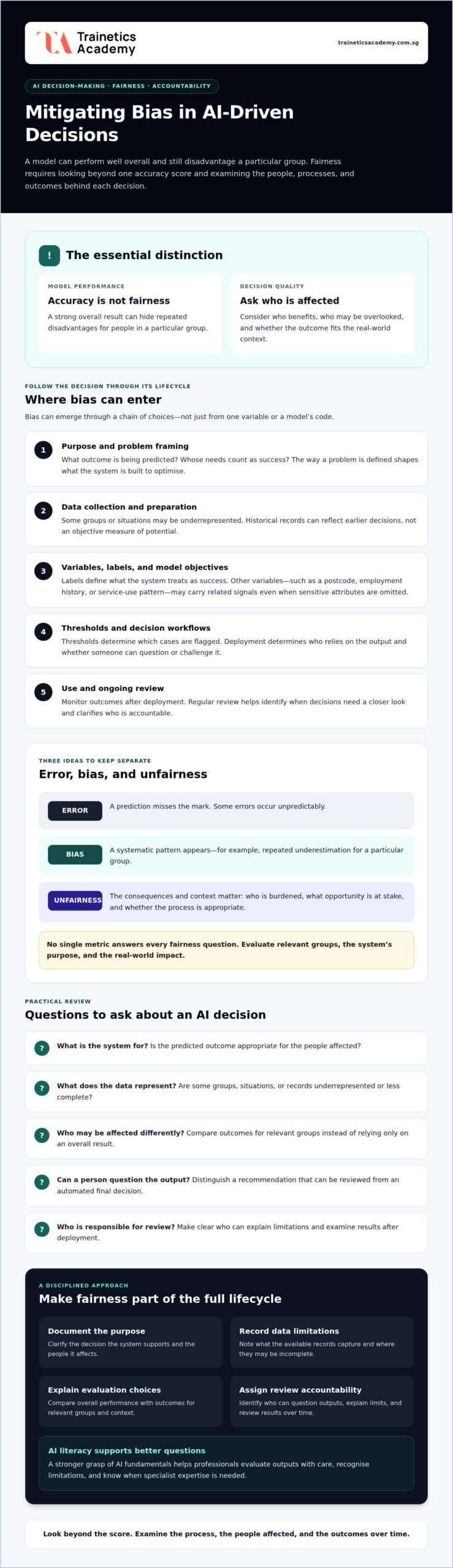
How to assess whether an AI decision process is unfair
A model’s overall accuracy can look strong while errors cluster around particular groups or decision stages. Assess the full process: who is represented in the evaluation data, what the system gets wrong, and what those errors mean for people affected. Mitigating bias in AI-driven decisions requires evidence about outcomes, not confidence in a single performance score.
Use this comparison to structure a review:
Which questions should teams ask before trusting model results?
Check whether evaluation data reflects the people who will be affected, and identify groups or situations that are missing. Compare error patterns across relevant groups and decision stages, not only at the final outcome. Ask whether reviewers and affected people can understand the result, raise a concern, or correct inaccurate input. If the evidence is incomplete, treat that as a limitation, not reassurance.
Why is explainability useful but not proof of fairness
An explanation can help reviewers investigate which inputs influenced an output and identify issues worth testing. It doesn’t, by itself, establish that outcomes are equitable. A transparent model may still rely on unsuitable data or produce unequal impacts, while an explanation designed for technical specialists may not help a decision-maker or affected person. Select explanation methods for the model and audience, then assess outcomes separately.
For workplace AI tools, responsible evaluation should include the task, the people affected, and the human review process. The AI productivity tools guide can help frame that assessment alongside a tool’s practical use. Record what was tested, what remains uncertain, and who will respond if monitoring reveals a problem.
A practical lifecycle checklist for reducing bias in AI decisions
Bias checks work best when they begin before a tool is selected and continue after it enters use. Mitigating bias in AI-driven decisions means setting clear expectations, testing the system against its intended context, and assigning people to respond when outcomes raise concern. Use these checkpoints to make that process concrete.
Before procurement: define the decision and its boundaries
- 1. Specify the purpose. Record what decision the AI will support, who may be affected, and what outcome the organisation wants to improve. State where the tool should not be used, including situations where its output is outside the system’s intended scope.
- 2. Examine data and limitations. Ask how relevant the data is to the intended use, which people or cases it represents, and where records may be incomplete or inconsistent. Document known gaps and avoid treating past outcomes as automatically suitable targets.
During testing: evaluate evidence and prepare oversight
- 3. Test before relying on outputs. Assess performance and potential impacts across groups relevant to the decision, as well as across decision stages. Record the evaluation measures chosen, why they fit the use case, and what the results don’t establish.
- 4. Assign accountable reviewers. Name the people responsible for checking outcomes and investigating concerns. For consequential or uncertain decisions, define when human review is required, who can override a recommendation, and how a case should be escalated.
Keep a concise record of the tool’s purpose, data limitations, testing approach, known risks, and accountable reviewers. This gives teams a consistent reference when questions arise or assumptions need to be revisited.
After deployment: monitor, respond, and reassess
- 5. Create a route for questions. Make clear how users or affected people can raise concerns or correct relevant information. Set out who receives a concern, how it is reviewed, and when it should be escalated.
- 6. Recheck when conditions change. Assign reviewers to monitor outcomes and document significant changes to the system or its use. Reassess performance when the data, users, workflow, or decision context changes, since earlier testing may no longer reflect current conditions.
AI knowledge can strengthen the questions you ask about system purpose, limitations, and oversight. Trainetics Academy’s Artificial Intelligence Course provides a way to build a stronger foundation for evaluating AI use.
Build the AI literacy needed to question AI-driven decisions
AI literacy helps professionals assess how a system is being used, what information shapes its outputs, and where its limitations matter. It doesn’t require everyone to become a machine-learning specialist. It does mean knowing when to question a recommendation, seek further evidence, or involve people with the right technical or legal expertise. That practical judgement supports the wider work of mitigating bias in AI-driven decisions.
What capabilities help professionals use AI responsibly?
Build confidence in interpreting outputs without treating them as facts. This critical mindset applies across domains, from operational decision support to specialized analytics platforms like sahamcerdas.com, which leverages AI for stock market insights. In every application, professionals should ask what information went in, what context might be missing, and whether an input could distort results. These questions also strengthen communication between decision-makers, technical teams, and affected people. General AI literacy supports informed use, but it isn’t a substitute for specialist model development or legal advice.
How can Singapore organisations approach AI learning?
Use role-relevant exercises to connect AI concepts with actual work. When comparing AI courses for beginners or a 1 day AI course Singapore, review the stated scope and learning outcomes to see whether they suit your needs. If searching for SkillsFuture AI courses, check the eligibility details for each specific course rather than assuming all courses qualify. Singapore organisations can also consider whether group learning fits their team’s needs. For broader professional learning context, read the AI Course Singapore professional guide.
Trainetics Academy offers an Artificial Intelligence Course with interactive learning through physical and virtual platforms. To build your practical understanding of AI, explore AI learning.
Make Fairness a Continuing Part of AI Use
Mitigating bias in AI-driven decisions takes more than removing sensitive fields or checking a model’s overall accuracy. Teams need to examine how data, design choices, and human workflows shape outcomes, then assess impacts in the context of the decision being made.
A disciplined approach carries through the full lifecycle: define the tool’s purpose and limits, test relevant outcomes, document evaluation choices, and assign people to review concerns. Keep monitoring after deployment, especially when users, data, or decision processes change. AI literacy strengthens this work by helping professionals question outputs, identify uncertainty, and know when specialist input is needed.
Building that understanding is a practical step towards more thoughtful AI use. Trainetics Academy offers an Artificial Intelligence Course with interactive learning through physical and virtual platforms. Explore AI learning and continue developing the confidence to evaluate AI with care. Consistent scrutiny and accountable human judgement can help organisations use AI more responsibly.
Frequently Asked Questions
What does mitigating bias in AI-driven decisions mean?
Mitigating bias in AI-driven decisions means identifying, reducing, and monitoring patterns that may produce unfair outcomes throughout an AI system’s use. It involves examining the purpose of a decision, the data and model, and how people use the output. A recommendation should be assessed in context, not judged only by whether the system applies its rules consistently or achieves strong overall performance.
Can AI make decisions without bias?
No system should be assumed to make decisions without bias. Data may reflect earlier practices, while model objectives, input choices, and deployment workflows can shape results. Teams can work to reduce unfair patterns, but fairness depends on the decision and its effects. Regular evaluation and human judgement are important, particularly when an output may influence access to employment, services, or other significant opportunities.
How can you detect bias in an AI decision system?
Compare errors and outcomes across groups relevant to the system’s purpose, and examine each stage where the output influences a decision. Check who is represented or missing in the evaluation data, and look beyond overall accuracy. For example, a screening tool could perform well overall while overlooking a pattern of lower selection for a particular group. Investigate the context and practical impact before drawing conclusions.
Does removing sensitive data remove AI bias?
No. Removing fields such as age or ethnicity doesn’t necessarily remove signals associated with them. Other variables, such as location, employment history, or prior service use, may correlate with sensitive characteristics. Whether those variables lead to unequal outcomes depends on the specific data and use. Teams should assess relevant inputs and test outcomes rather than treating the removal of sensitive fields as proof of fairness.
Why is human oversight important in AI-driven decisions?
Human oversight provides a way to question recommendations, consider context the system may not capture, and respond when an output seems unsuitable. Reviewers need clear authority to investigate, override, or escalate a recommendation rather than accepting it automatically. This is especially important for consequential or uncertain decisions. Oversight works best when roles, review steps, and routes for raising concerns are defined before the system is relied upon.
What should organisations do if an AI system shows unequal outcomes?
Investigate the difference before assuming its cause. Review the data, evaluation method, model behaviour, and decision workflow, then assess how people are affected. Document findings and limitations, assign accountable reviewers, and consider restricting or pausing reliance on outputs while a concern is examined. Retest after changes, provide a way to raise or correct concerns, and continue monitoring to see whether the issue persists or shifts.
Disclaimer
AI Content Disclaimer: Some articles on this website may be generated or assisted by AI-powered content creation tools. While we strive for accuracy and relevance, readers should independently verify information before relying on it. The content is provided for informational purposes only and does not constitute professional advice.