In a global labor market where professionals with AI skills command a 62% wage premium as of June 2026, the distinction between a hobbyist and a master has never been more critical. You likely recognize that a collection of generic, automated outputs no longer suffices to impress top-tier employers who demand technical rigour and evidence of real-world problem-solving. Building a professional portfolio with AI projects requires a strategic shift from simple prompting to executing complex logic that addresses specific industry pain points. We understand the fear that your work might appear “lazy” or that your technical process remains opaque to non-technical recruiters. This guide provides a definitive roadmap to selecting and showcasing high-impact projects that validate your expertise. You’ll discover how to leverage the Introduction AI Course, which is eligible for SkillsFuture Credit and UTAP funding, alongside other SkillsFuture AI courses to bridge the gap between foundational theory and professional readiness. This article outlines the exact steps to document your technical journey and secure the high-level interviews your career ambition deserves.
Key Takeaways
- Recognize the 2026 global shift from AI awareness to tangible application to maintain a competitive wage premium.
- Identify high-impact projects by mapping AI logic to industry-specific pain points and measurable business ROI.
- Master a structured engineering roadmap for building a professional portfolio with AI projects from problem identification to final evaluation.
- Learn to document technical workflows using case study templates that effectively bridge the communication gap with non-technical hiring managers.
- Discover how professional training through the Introduction AI Course builds the technical mastery required for high-level career outcomes.
Why AI Projects are Essential for Your 2026 Career Portfolio
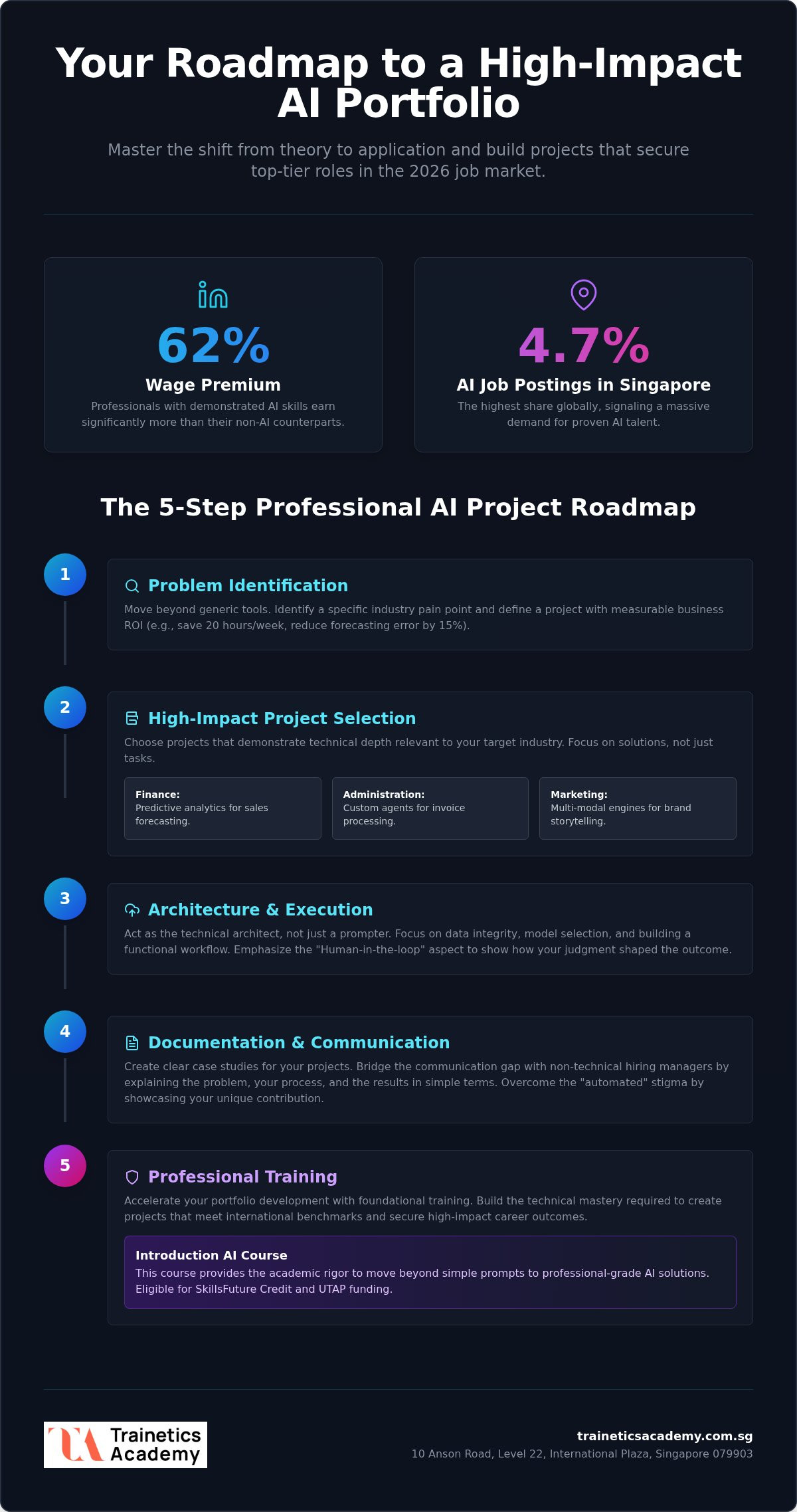
The professional landscape in Singapore has moved beyond the novelty of generative tools. By 2026, 4.7% of all job postings in Singapore mention AI skills, the highest share globally according to The Stanford AI Index Report. This shift is driven by the fact that workers with AI skills now earn a 62% wage premium over their non-AI counterparts. Simply listing “AI awareness” on a resume is no longer a competitive advantage; employers demand proof of execution.
Static resumes fail because they cannot demonstrate the iterative logic required to solve business problems. Building a professional portfolio with AI projects serves as a bridge between theoretical knowledge and industrial application. It transforms you from a passive user into a technical architect. A structured portfolio proves you can handle data integrity, model selection, and deployment, which are the hallmarks of modern technical mastery.
The New Professional Benchmark in Singapore
Firms in the city-state now prioritize “AI-first” talent. This isn’t about using AI to write emails; it’s about scientific validation. A professional portfolio must demonstrate technical depth, showing how you integrated specific models into a functional workflow. There is a clear difference between an AI-assisted portfolio and an AI-centric project. The former uses AI as a crutch, while the latter treats AI as the core engine of a business solution. By focusing on building a professional portfolio with AI projects, you signal that you’re ready to raise industry benchmarks.
Overcoming the ‘Automated’ Stigma
Recruiters often fear that AI-related work is merely plagiarized or low-effort. You must address this by highlighting your role as the director of the technology. Focus on the “Human-in-the-loop” aspect to show how your judgment shaped the final output. AI competency is the ability to architect, not just execute, AI workflows. This distinction separates the visionary professional from the casual prompter, ensuring your work carries the weight of authentic expertise.
Establishing this level of professional readiness requires a foundation in excellence. The Introduction AI Course at Trainetics Academy, located at 10 Anson Road, Level 22, International Plaza, Singapore 079903, is eligible for SkillsFuture Credit and UTAP funding. This training ensures your projects meet international benchmarks. It provides the academic rigor necessary to move beyond simple prompts and into the realm of professional-grade AI solutions that secure high-impact career outcomes.
Selecting High-Impact AI Projects for Your Industry
Strategic selection is the hallmark of a disciplined professional. You shouldn’t just build a generic chatbot; you must identify a specific friction point in your sector. Building a professional portfolio with AI projects requires evaluating the “Project ROI” from an employer’s perspective. Will this automation save 20 hours a week? Does this predictive model reduce forecasting error by 15%? These are the metrics that secure job offers. Hiring managers in 2026 value the ability to translate technical capabilities into measurable business outcomes.
Industry-Specific Project Ideas
Different sectors demand different types of proof. Finance professionals should focus on predictive analytics. For example, using AI to forecast quarterly sales based on historical data demonstrates technical depth. In Administration, building custom agents that process complex invoices or legal documents shows you understand workflow optimization. Marketing experts benefit from multi-modal engines. This involves using prompt engineering to synchronize text, image, and video generation for cohesive brand storytelling. Each of these projects addresses a real-world pain point rather than performing a simple, isolated task.
The Project Selection Matrix
When building a professional portfolio with AI projects, the selection matrix helps you avoid the trap of “busy work.” You must compare project difficulty against current market demand. High-impact results don’t always require high-code complexity. Low-code tools, when architected correctly, solve massive problems. However, you must navigate the information technology landscape in Singapore with precision. Ethical AI and data privacy are non-negotiable benchmarks. Hiring managers prioritize candidates who can explain how they protected sensitive data during model training and deployment.
Beginners often struggle to find their niche within the vast AI ecosystem. Starting with an AI Course allows you to identify which industry-specific pain points align with your career goals. This foundational step ensures you don’t waste time on low-signal projects that fail to move the needle. By aligning your projects with market demand, you prove your professional readiness to lead in an AI-driven economy. If you’re ready to master these skills, consider joining our next cohort for the Introduction AI Course to begin your journey toward technical excellence.
A Step-by-Step Guide to Building a Professional AI Project
Execution is where the amateur and the professional diverge. While many attempt to build in a vacuum, building a professional portfolio with AI projects requires a disciplined, four-phase approach that mirrors industry-standard development cycles. This structured methodology ensures your work isn’t just a collection of scripts, but a validated solution that addresses real business needs. You must move beyond the “prompt and hope” mentality to adopt a rigorous engineering mindset.
- Phase 1: Problem Identification. Begin with a high-friction business challenge, such as automating complex supply chain documentation or predicting customer churn with high-dimensional data.
- Phase 2: Tool Selection. Choose your stack based on performance benchmarks. This involves deciding between Large Language Models (LLMs) like GPT-4o, computer vision frameworks, or agentic automation tools.
- Phase 3: Development. Build through iterative testing. Professional readiness demands that you document your failures and pivot points as clearly as your successes.
- Phase 4: Evaluation. Measure your model’s accuracy, latency, and cost-efficiency. A project without metrics is merely a hobby; a project with a 95% precision rate is a career-defining asset.
Defining the AI Solution Architecture
Modern employers look for candidates who can architect multi-step workflows rather than single-prompt interactions. You must demonstrate how your solution integrates external data sources safely and ethically, ensuring data privacy is maintained at every layer. To demonstrate technical mastery, you must document the ‘why’ by explaining how your model’s specific architecture, such as its reasoning capabilities or context window, directly addresses the project’s unique constraints. This level of transparency builds the trust necessary to lead technical teams.
Practical Implementation for Beginners
Starting your first build can feel daunting without a structured environment. Leveraging a 1 day AI course Singapore can provide the immediate technical immersion needed to kickstart your first professional project. These intensive sessions teach you how to use AI productivity tools for business to accelerate your development timeline without sacrificing quality.
Professionalism also requires the use of version control and iterative testing. You shouldn’t just “finish” a project; you should evolve it. By demonstrating a history of updates and refinements, you prove to recruiters that you understand the lifecycle of a deployed AI model. If you’re ready to transition from a beginner to a practitioner, the Introduction AI Course provides the academic foundation to build these high-impact systems. This training delivers the professional rigor required to meet international benchmarks and raise your professional profile within the Singaporean market.
Documenting Your AI Projects for Maximum Impact
Recruiters often lack the time to parse complex code repositories or deep-dive into raw scripts. They require a high-level business summary that proves your ability to solve tangible problems. Building a professional portfolio with AI projects involves more than providing a link to a repository; it requires a structured narrative that bridges technical execution and business value. The anatomy of a professional AI case study follows a rigid logic: Problem, Process, Solution, and Result. By quantifying your success with metrics like “30% time saved” or “15% accuracy improvement,” you provide the scientific validation top-tier firms demand.
Visualizing your AI logic is equally vital for clarity. Use flowcharts or AI-native canvases to explain complex, multi-step workflows. This transparency allows stakeholders to see the underlying architecture behind your model’s behavior. Additionally, maintaining a “Prompt Library” showcases your engineering mastery. By documenting your iterations and refinements, you prove that your results aren’t accidental but the product of disciplined technical rigour.
The Professional AI Case Study Template
An effective template begins with an Executive Summary. This is your 30-second pitch that highlights the core business challenge and your specific intervention. Follow this with a Technical Breakdown of the tools, data sources, and logic employed. Finally, include a “Lessons Learned” section. This demonstrates a growth mindset and the troubleshooting skills necessary to manage real-world AI deployments. It shows you can handle the unpredictable nature of machine learning with a steady, professional hand.
Presenting to Non-Technical Stakeholders
You must translate “black box” AI logic into simple business terms to build trust with decision-makers. Focus on the operational benefits rather than the underlying mathematics. Video walkthroughs are excellent tools for demonstrating functional AI agents in action, providing visual proof of efficacy. When building a professional portfolio with AI projects, you must also tailor your presentation to meet the cyber security and compliance standards of Singaporean firms. Demonstrating an understanding of local data governance acts as a rallying cry for your professional readiness.
Mastering these presentation skills is just as important as the technical build itself. If you want to ensure your work stands out in a crowded market, explore our AI Course to learn how to document and showcase your technical mastery to industry leaders.
Accelerating Your Portfolio with Professional AI Training
While self-directed experimentation demonstrates initiative, the labor market in 2026 operates on a higher standard of proof. Building a professional portfolio with AI projects is a rigorous undertaking that benefits from a structured academic framework. Professional certification provides the scientific validation employers require. It signals that your technical skills have been audited against rigorous benchmarks. You aren’t just showing you can use a tool; you’re proving you can architect a solution within a professional identity. Joining a community of AI-driven professionals in Singapore provides access to collective intelligence and industry insights that are impossible to replicate in isolation. This collaborative atmosphere fosters innovation and leadership, ensuring you remain at the cutting edge of technological shifts.
Mastery Through Structured Learning
The curriculum at Trainetics Academy focuses on professional readiness. We facilitate your transition from simple, hobbyist-level tools to complex, enterprise-grade AI applications that solve high-impact business problems. Receiving instruction from industry experts puts you in direct contact with practitioners who understand the nuances of the local market. These mentors provide the academic rigor and troubleshooting guidance necessary to ensure your projects carry the weight of technical precision. This environment transforms your learning path from a series of disjointed experiments into a logical progression toward career excellence. You’ll gain the confidence to present your work to high-level stakeholders, knowing it stands on a foundation of scientific validation.
Professional Development and Growth
Utilizing professional training resources allows you to focus entirely on technical mastery while building a body of work that commands significant wage premiums. This structured approach ensures your skill set remains ahead of the rapid growth in AI job demand without unnecessary friction. By aligning your development with international benchmarks, you reassure prospective employers of your readiness to lead in a complex environment. Your journey toward technical leadership and a prestigious career begins with a disciplined step. Don’t leave your professional identity to chance or unverified self-study. Investing in your growth today secures your position as a visionary leader in an AI-centric world.
Our systematic approach ensures you don’t just learn AI; you master the professional application of it. Start building your AI portfolio today with Trainetics Academy and secure your place at the forefront of the dynamic, AI-driven economy. Technical mastery is the key to unlocking the high-level interviews your career ambition deserves.
Secure Your Place in the AI-Driven Economy
The transition from an AI enthusiast to a technical leader requires a commitment to excellence and a body of work that speaks for itself. By focusing on building a professional portfolio with AI projects, you demonstrate the ability to architect complex workflows and deliver measurable results. You’ve learned that success lies in selecting high-impact challenges, documenting iterations with transparency, and quantifying your impact on business efficiency. These projects act as your professional identity in a competitive market, proving you can navigate the technical rigour of modern enterprise.
To ensure your portfolio meets the highest industry benchmarks, professional validation is essential. Our curriculum is designed for immediate career application, providing the academic rigor needed to stand out. You can Enroll in our Introduction AI Course and build your professional portfolio today. Take command of your professional trajectory; with the right training, your technical mastery will redefine your career potential and open doors to prestigious opportunities.
Frequently Asked Questions
Do I need to be a coder to build an AI project for my portfolio?
You don’t need extensive programming knowledge to begin building a professional portfolio with AI projects. Many high-impact solutions use low-code automation frameworks and agentic tools that prioritize logic over syntax. While technical depth is valued, employers in 2026 often look for the ability to architect workflows and solve business problems. Focus on demonstrating how you use AI to improve efficiency and accuracy within your specific industry domain.
Is the Introduction AI Course eligible for training grants in 2026?
Yes, our foundational training is eligible for the professional development credits and subsidies available to Singaporeans. These financial supports are designed to empower professionals to pursue technical mastery without excessive overhead. By utilizing these available grants, you can commit to a structured learning path that transforms your career trajectory through verified expertise and scientific validation. This ensures that high-level education remains accessible to those aiming for excellence.
What are the best AI projects for a finance professional in Singapore?
Finance professionals should focus on automated risk assessment and algorithmic auditing rather than simple data entry. Developing a project that identifies anomalies in large transaction datasets or automates the verification of regulatory compliance provides high-signal proof of mastery. These solutions address the specific pain points of the Singaporean financial sector. They show you can translate technical AI capabilities into measurable fiscal security and operational precision.
How many projects should I include in my professional AI portfolio?
Aim for three to five high-impact projects rather than a large gallery of generic outputs. Quality and depth are the primary metrics for building a professional portfolio with AI projects in 2026. Each case study should follow a clear narrative of problem, process, and result. Including too many projects can dilute your message; instead, focus on a few that demonstrate your ability to handle complex logic and data integrity across different business scenarios.
Can I use AI-generated content in my portfolio projects?
You can use AI-generated content provided you document the refinement process and human judgment involved. Employers value the “human-in-the-loop” aspect, as it proves you can audit and improve AI outputs. Simply presenting raw, unedited generations suggests a lack of technical rigour. Showcasing your prompt iterations and the logic used to verify model accuracy demonstrates the professional mastery that separates architects from casual users.
How do I justify the cost of an AI course to my employer?
Justifying the investment involves demonstrating the immediate productivity gains and the significant wage premiums associated with AI skills. Emphasize how the training allows you to automate redundant tasks, saving the company valuable hours and raising professional benchmarks. By presenting a clear ROI through improved accuracy and efficiency, you show that the course is a strategic asset for the organization’s long-term growth and innovation.
What tools are covered in a 1 day AI course Singapore?
A 1 day AI course Singapore typically covers agentic AI frameworks and multi-modal integration strategies. You’ll learn to use automation frameworks that bridge different software applications, creating seamless workflows that solve real-world problems. The focus is on practical, interactive mastery, allowing you to move from theoretical concepts to functional builds within a single session. This intensive format is designed for professionals who need immediate, high-impact results.
Where is Trainetics Academy located for physical classes?
Trainetics Academy is located within the Central Business District at International Plaza. This premier location serves as a hub for professional development, offering an environment conducive to interactive learning and peer networking. Our facility provides the technical infrastructure required for students to transition from basic AI awareness to the advanced execution of complex, high-impact business solutions. This central hub ensures easy accessibility for professionals working in the city.
Disclaimer
AI Content Disclaimer: Some articles on this website may be generated or assisted by AI-powered content creation tools. While we strive for accuracy and relevance, readers should independently verify information before relying on it. The content is provided for informational purposes only and does not constitute professional advice.