Did you know that while 96% of business leaders want training impact measured, only 8% of organizations actually track the tangible business results of their learning initiatives? This significant gap represents a prestigious opportunity for you to demonstrate a commitment to operational excellence. We understand the pressure of returning to the office and wondering how to write a post-training report for my boss that justifies the investment in your professional growth. It’s common to feel a sense of urgency to prove that your time spent pursuing technical mastery was a strategic move for the organization’s future.
This guide will teach you how to transform your training insights into a sophisticated document that proves ROI and advances your professional standing. You’ll learn to translate complex concepts from an AI course Singapore into business benefits that management appreciates. We’ll provide a clear, professional report structure and share tips on highlighting mastery of tools like generative AI. We’ll also preview how to frame your participation in the Introduction AI Course, which is eligible for SkillsFuture Credits and UTAP funding, as the first step in a high-level learning path at 10 Anson Road, Level 22, International Plaza, Singapore 079903. By the end, you’ll have a roadmap to turn a 1 day AI course Singapore into a catalyst for your career advancement.
Key Takeaways
- Move beyond basic summaries by learning to frame your training as a strategic investment that directly supports your organization’s pursuit of excellence.
- Discover the precise structure for how to write a post-training report for my boss that highlights measurable ROI and professional readiness.
- Apply your technical mastery immediately by using generative AI tools to synthesize complex training modules into concise, actionable business briefs.
- Align your 1 day AI course Singapore insights with specific department KPIs to demonstrate the practical application of your new skills.
- Establish your professional identity as a visionary leader by implementing a structured 30-60-90 day plan following your training.
The Strategic Purpose of a Post-Training Report
In the competitive landscape of the 2026 Singaporean economy, professional readiness is defined by an individual’s ability to operationalize knowledge. A post-training report is far more than an administrative formality; it’s a high-stakes proposal that signals your transition from a student to an internal consultant. While many view these documents as a simple task to check off, industry leaders recognize them as the primary vehicle for the transfer of training into measurable business assets. By documenting your insights, you’re not just recalling information; you’re proposing a roadmap for organizational growth.
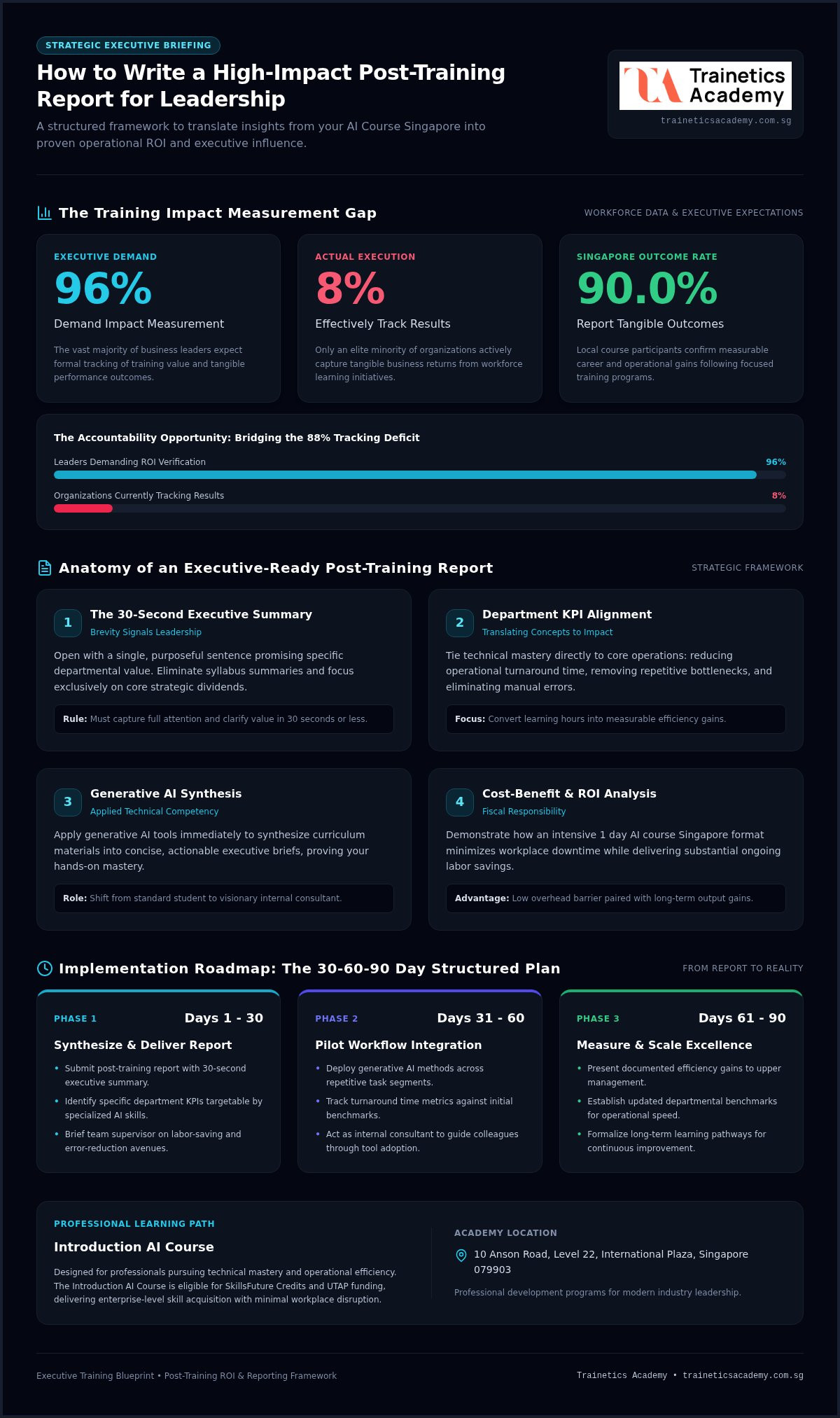
When considering how to write a post-training report for my boss, you must prioritize clarity and strategic alignment over generic summaries. Recent data shows that 96% of business leaders demand impact measurement, yet only 8% of organizations effectively track it. Your report serves as a rare beacon of accountability. It demonstrates that you’ve synthesized the curriculum of your AI Course to solve specific departmental challenges. This approach transforms a standard feedback loop into a powerful tool for career visibility and influence.
To better understand the core questions your report should answer, watch this helpful video on professional communication:
Building Your Professional Identity Through Reporting
A well-crafted report signals leadership potential by showcasing your ability to apply academic rigor to practical business observations. By documenting your progress at Trainetics Academy, located at 10 Anson Road, Level 22, International Plaza, Singapore 079903, you establish yourself as a visionary mentor within your department. You aren’t just reporting on a class; you’re raising professional benchmarks. This disciplined approach reassures management that you’ve achieved technical mastery and are prepared to guide the team through the integration of new technologies.
The ROI Mindset: Why Your Boss Cares
Mastering how to write a post-training report for my boss enables you to bridge the gap between theory and profit. Your supervisor’s primary concern is the return on investment. In Singapore, where 90.0% of training participants report achieving at least one tangible outcome, your report must translate “learning hours” into “efficiency gains.” Address the cost-benefit analysis directly by highlighting how the intensive nature of a 1 day AI course Singapore format minimizes downtime while maximizing skill acquisition.
Focus on how your new specialized AI skills will reduce operational turnaround speed or eliminate manual errors. Since the Introduction AI Course is eligible for SkillsFuture Credits and UTAP funding, your report should emphasize that the financial barrier was low while the potential for labor savings remains high. This ROI mindset proves you’re a disciplined professional dedicated to continuous improvement and fiscal responsibility.
Essential Components of a High-Impact Report
A common mistake professionals make is confusing a post-training report with a syllabus summary. Your manager doesn’t need a play-by-play account of every module covered. They need to understand how your time away from the desk translates into a competitive advantage for the firm. When you sit down to consider how to write a post-training report for my boss, remember that brevity is a hallmark of leadership. A high-impact report focuses on the “so what” of your education, discarding technical filler in favor of strategic outcomes. By following a structured framework, you ensure your document is read, understood, and acted upon.
Crafting the Executive Summary
Your executive summary should capture attention in 30 seconds or less. Start with a single, purposeful sentence that promises a specific value to the department. For instance, instead of saying you attended a class, state how the Introduction AI Course will reduce manual data entry by 15% within the next quarter. This direct approach respects your manager’s time and immediately justifies the resources spent on your professional development. It frames the training not as an expense, but as a catalyst for operational efficiency.
The body of your report should prioritize the top three insights that will impact the business. These takeaways must be grounded in the current standards set by SkillsFuture Singapore, ensuring your feedback aligns with national benchmarks for excellence. Clearly articulate how these insights solve existing pain points, such as automating repetitive workflows or enhancing client engagement through predictive analytics. This level of analysis proves you’ve achieved a high standard of technical mastery.
The Implementation Roadmap
A visionary mentor doesn’t just identify problems; they provide a roadmap for solutions. Your implementation plan should distinguish between short-term “low-hanging fruit” and long-term strategic goals. Immediate ROI can often be found in small workflow adjustments or the introduction of a new prompt library for the team. By linking these goals to international benchmarks, you demonstrate that your training at Trainetics Academy has prepared you to raise professional standards across the board.
- Resource Requirements: Identify the specific tools, software, or team hours needed to execute your findings.
- Measurable KPIs: Define what success looks like, such as a 10% reduction in project turnaround time.
- Knowledge Transfer: Propose a timeline for sharing these insights with your colleagues to multiply the training’s value.
Drive the conversation toward action by concluding with a clear set of next steps. This transitions the report from a static document into a dynamic proposal for change. If you’re ready to start building this professional identity, you can explore our full range of AI training solutions to find your next step. This disciplined approach to reporting ensures that your new skills aren’t just learned, but are effectively operationalized for the benefit of your entire organization.
Modern Reporting: Traditional vs. AI-Enhanced Methods
Traditional manual reporting methods often fail to capture the dynamic nature of technical education. If you’re wondering how to write a post-training report for my boss that truly stands out, the answer lies in leveraging the very tools you studied. In 2026, using generative AI to draft and refine your documentation isn’t just a shortcut; it’s a demonstration of professional readiness. This approach aligns with modern training evaluation and effectiveness frameworks by focusing on speed and the practical application of skills. By automating the drafting process, you move from mere transcription to high-level strategic analysis.
Using AI to Summarise Technical Training
The most efficient way to synthesize your learning is to feed your raw course notes into a Large Language Model (LLM). This allows you to extract business-centric bullet points that resonate with management. You can prompt the AI to identify specific efficiency gains or workflow improvements relevant to your department. It’s vital to refine the output’s tone to match your company’s professional standards, ensuring the final document reflects your unique professional identity. For a deeper look at the software available, explore our guide on the Top AI Productivity Tools for Business. This method turns hours of manual synthesis into minutes of focused refinement.
Visualizing Data for Better Impact
Bosses respond to data that is both scientifically validated and visually compelling. Use AI-enhanced visualization tools to create charts that project potential time-savings and financial ROI based on your new skills. Instead of describing a more efficient workflow, show a comparative graph of current versus optimized turnaround times. This transforms technical data into a persuasive visual narrative that justifies your participation in the 1 day AI course Singapore format. A disciplined professional uses these visuals to provide a clear, logical path toward organizational improvement, making the report’s recommendations impossible to ignore.
Ethics and transparency are the cornerstones of authoritative reporting. While AI assists in the heavy lifting, you’re responsible for the accuracy of every claim. Never allow an AI tool to hallucinate statistics or project unrealistic ROI. Verify every data point against the curriculum of your AI Course to ensure your report remains a trustworthy document. This commitment to precision reinforces your image as a serious professional dedicated to the highest standards of excellence. Your boss will value the efficiency of your AI-enhanced process, but they’ll respect the integrity of your final results.
Step-by-Step Guide: Reporting on Your AI Course in Singapore
Executing a strategic follow-up requires a structured approach that mirrors the learning path itself. To ensure your insights don’t fade, start by reflecting on the specific modules of your 1 day AI course Singapore experience immediately after completion. This immediate synthesis allows you to capture technical nuances while your mastery is fresh. Your second step is to align these findings with your current department KPIs. If your team is tasked with increasing operational turnaround, your report should focus specifically on the automation capabilities you’ve just acquired. This logical flow builds trust and demonstrates that your education is directly linked to career outcomes.
Justifying the Training Investment
A disciplined professional understands that fiscal responsibility is a core component of leadership. When you’re determining how to write a post-training report for my boss, it’s essential to frame the training as a strategic move within the broader national upskilling agenda. This highlights your initiative in seeking solutions that enhance organizational capability while remaining mindful of corporate resources. It also reassures management that you’ve utilized high-level training platforms to achieve technical mastery. For a deeper understanding of how to optimize your available grants, read our guide on Maximizing Your SkillsFuture Credit. By framing the course as a calculated investment in human capital, you lower the barrier for future professional development requests.
Tailoring the Content for AI Skills
Draft your report using active, purposeful verbs that drive engagement and reflect your professional readiness. Instead of stating you “learned about AI,” use terms like “optimized prompt libraries” or “automated data analysis workflows.” This sophisticated vocabulary bridges the gap between scientific theory and practical coaching. Focus on the future-readiness of your team by highlighting how specific modules have prepared you to raise professional benchmarks. This approach moves beyond simple feedback and establishes your professional identity as a visionary mentor within the company.
The final step is to review your document for academic rigor and precision. Every recommendation you make should be grounded in the curriculum you completed at our specialized training facility. Ensure your report is free of filler and overly casual language. This methodical review process mirrors the high standards of the fitness and technology industries, ensuring your boss views you as a serious professional dedicated to continuous improvement. If you’re ready to take the next step in your professional journey, you can enroll in our AI Course to begin your transformation.
From Report to Reality: Implementing Your New Skills
Submitting your report is just the first phase of a professional transformation. To truly operationalize your technical mastery, you must move from documentation to implementation. Schedule a follow-up meeting within 72 hours of submission to discuss your strategic recommendations. This proactive approach ensures your insights on how to write a post-training report for my boss lead to tangible organizational changes rather than gathering digital dust. You’re no longer just an employee who attended a class; you’re a catalyst for change.
Once your supervisor approves the pilot phase, monitor the outcomes with academic rigor. If your report proposed a specific reduction in project turnaround time using generative AI, track the actual metrics over the following 30 days. This data-driven precision reinforces your image as a disciplined professional. It proves you’ve mastered how to write a post-training report for my boss that isn’t just persuasive on paper but effective in practice. Measuring these results provides the scientific validation management needs to support your future initiatives.
Leading the Change in Your Team
Mentoring others is the highest form of professional readiness. Organize a “Lunch and Learn” session to share core insights from your training with the wider department. This multiplies the value of the original investment and establishes new professional benchmarks based on international standards. By teaching your colleagues how to use the prompt libraries or automation workflows you’ve developed, you elevate the entire team’s capability. For a comprehensive look at the standards your colleagues should strive for, refer to our AI Course Singapore Professional Guide. Leading this change secures your identity as a visionary mentor within the organization.
Continuing the Upskilling Journey
Excellence is a pursuit, not a destination. After you’ve successfully implemented your first round of AI-driven workflows, identify the next advanced certification to build on your foundation. A systematic approach to education ensures you remain at the forefront of the Singaporean market. You can consult with our industry specialists to discuss your personalized professional roadmap at our training center. We provide the highest standard of education to ensure your transition into a prestigious career is both scientifically grounded and ambitious. We invite you to explore our full range of Artificial Intelligence Courses to find the next step in your journey toward technical mastery.
Elevate Your Professional Identity Through Strategic Reporting
Transforming your training insights into a high-impact document is the ultimate demonstration of professional readiness. By prioritizing measurable ROI and leveraging generative AI to draft your summaries, you prove that your technical mastery is ready for immediate corporate application. Mastering how to write a post-training report for my boss is the final step in translating your educational investment into career-defining influence within the Singaporean market. It transitions you from a student of technology to a visionary leader who raises professional benchmarks.
Our expert-led 1 day AI course Singapore formats are designed for busy professionals who demand excellence and efficiency. We invite you to consult with our mentors to discuss how our curriculum can be tailored to your specific department KPIs and organizational goals. Take the next step in your upskilling journey and master the latest AI skills with Trainetics Academy today. Your commitment to continuous improvement is the foundation of a prestigious career; we’re here to ensure your transition is scientifically grounded and successful. Keep pushing the boundaries of what you can achieve.
Frequently Asked Questions
How long should a post-training report be for a busy manager?
Keep your report to one or two pages maximum. Busy executives value brevity and academic rigor over long, winding summaries. Focus on the executive summary and the top three business impacts you’ve identified. If your manager has only 30 seconds, they should understand the ROI immediately. Use bullet points to break up complex information, which demonstrates professional readiness and respect for their time.
What is the best format for a post-training report in 2026?
A structured digital document or a concise PDF brief is the most effective choice. In 2026, many professionals use AI-enhanced reports that include data visualizations to show projected efficiency gains. Ensure the flow is logical, moving from foundational concepts to practical workplace applications. This methodical approach reflects the organized nature of high-level training programs and leads clearly toward specific career outcomes.
Should I include the cost of the training in my report?
Yes, including the cost is essential for a complete ROI analysis. Frame the expense as a strategic investment in the company’s future rather than a simple cost. When you’re figuring out how to write a post-training report for my boss, demonstrate fiscal responsibility by highlighting any subsidies used. This shows you’re committed to professional growth while remaining mindful of the department’s budget and resources.
How do I explain technical AI concepts to a non-technical boss?
Avoid dense technical jargon that might obscure your message. Instead, use a sophisticated mix of professional development language and business analogies to explain your results. Translate technical mastery into efficiency gains that management understands. For example, explain prompt engineering as a tool for reducing operational turnaround. This bridges the gap between the rigorous world of science and the practical needs of corporate leadership.
Can I use a template for my post-training report?
You can use a template to maintain a steady, predictable rhythm in your writing. However, you must customize the content to reflect the depth of your specific curriculum. A visionary mentor doesn’t just copy a form; they adapt it to raise professional benchmarks. Ensure the final document sounds fundamentally authoritative and is rooted in the pursuit of excellence within your specific market or industry.
What if the training didn’t meet my expectations; how do I report that?
Provide constructive feedback focused on continuous improvement and future readiness. If the curriculum lacked depth, suggest advanced certifications that offer more academic rigor. Frame the report as an industry leader would, identifying gaps that need filling to reach international benchmarks. This professional approach protects your professional identity while ensuring the company makes better, more scientifically grounded training investments in the future.
How soon after the training should I submit the report?
Submit your findings within 48 to 72 hours while the technical mastery is fresh in your mind. Prompt submission signals discipline and a sense of urgency regarding implementation. When you understand how to write a post-training report for my boss quickly, it allows you to schedule follow-up meetings while the concepts are still top-of-mind. This quick turnaround is a unique marker of a top-tier professional.
How do I mention SkillsFuture or UTAP funding in the report?
Highlight these subsidies as a way to maximize the company’s training budget and demonstrate initiative. You should state that the training was eligible for national credits or union support. This positions you as a professional who values both high-level education and fiscal responsibility. It shows you’ve chosen a program that meets local standards while ensuring the transition into new technical roles is cost-effective for the firm.
Disclaimer
AI Content Disclaimer: Some articles on this website may be generated or assisted by AI-powered content creation tools. While we strive for accuracy and relevance, readers should independently verify information before relying on it. The content is provided for informational purposes only and does not constitute professional advice.