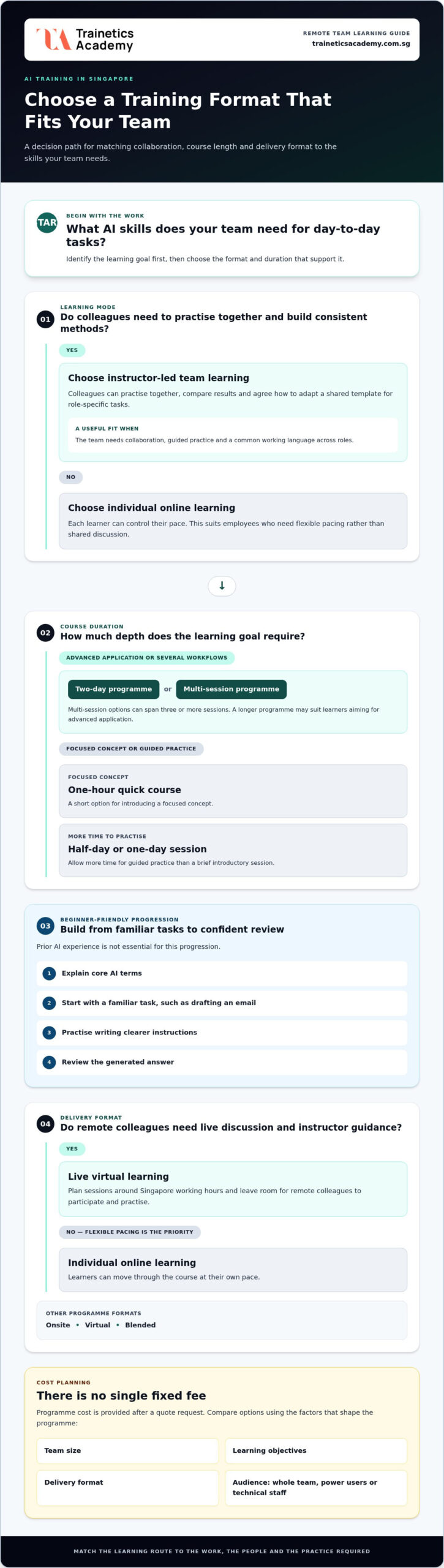
There’s no single fixed fee for AI training for remote teams in Singapore. The cost depends on the programme and is provided after a quote request. Factors include team size, learning objectives, delivery format, and whether the training is for the whole team, power users, or technical staff. Start by identifying the skills your team needs for its day-to-day work.
It’s reasonable to want a clear basis for comparing training options, especially when colleagues work across locations and need sessions that fit Singapore hours. A useful programme should do more than introduce AI tools: it should give employees practice with relevant tasks and help them build confidence applying AI in their roles.
This guide explains what shapes corporate AI training costs, how team-wide, power-user, and technical programmes differ, and what to consider when planning live online learning around Singapore schedules. You’ll also learn how an Artificial Intelligence Course can support practical skill-building, from foundational use to more specialised applications.
Key Takeaways
- Assess whether your team needs shared foundations, advanced workflows for power users, or technical depth before choosing a programme.
- Compare instructor-led team learning with individual online courses by considering collaboration, practice, and how skills will transfer into everyday tasks.
- Identify practical AI use cases that can support productivity and creative work across different roles.
- Plan live online sessions around Singapore working hours, with a format that gives remote colleagues time to participate and practise.
- Use Trainetics Academy’s Artificial Intelligence Course as a learning route when your team is ready to strengthen its AI capabilities.
Why Is Generative AI Training Important in Singapore?
Remote employees need more than access to a generative AI tool. They need to assess its outputs, apply them appropriately, and follow shared processes. For example, a marketing team might use AI to draft campaign options, then review every claim before publication. Training helps make that sequence deliberate. Employees learn to distinguish a useful first draft from a reliable final product and develop common practices they can apply across projects.
Privacy belongs in those foundations. Singapore’s Personal Data Protection Act is the Personal Data Protection Act 2012, according to Singapore Statutes Online. A practical training exercise can ask employees to classify information before entering it into an AI tool. A public product description differs from customer contact details or confidential business material. That distinction supports sound decisions without treating every prompt as risk-free. Teams can practise rewriting a request with fictional or anonymised details, then discuss what information should stay out.
Governance adds a repeatable structure to individual judgement. Singapore’s Model AI Governance Framework is in its Second Edition. Teams can use governance discussions to define who reviews AI-assisted work, which tasks need human approval, and how errors are reported. ISO/IEC 42001:2023 is an artificial intelligence management system standard, according to the International Organization for Standardization. It gives organisations a named management-system reference point, while training translates governance ideas into everyday decisions and team responsibilities.
Responsible AI principles become clearer through practice. A short review routine can help employees apply specific safeguards before relying on generated content:
- Check factual claims against the original source or trusted company material.
- Remove personal or confidential information from prompts unless the workflow permits its use.
- Review outputs for bias, tone, missing context, and unsuitable recommendations.
- Keep a human accountable for decisions that affect customers, colleagues, or business commitments.
For instance, a remote human resources team could use AI to organise interview questions, while employees assess their relevance and fairness before using them. A finance team might ask AI to explain a spreadsheet formula, then verify the calculation independently. These examples set a clear boundary: AI can assist with drafting, sorting, and explanation, but people remain accountable for decisions.
Training also gives teams a shared vocabulary for uncertainty. Employees can learn to spot a hallucinated detail, improve a prompt, and record corrections in approved templates or processes. That knowledge matters across marketing, operations, and customer support, where the same tool can create different risks. A short scenario-based exercise can show where review steps belong. The aim is a more consistent approach to responsible use, not simply faster output.
Team training compared with individual online courses
For a remote team, the choice is between shared, guided practice and self-paced individual learning. In Singapore, programmes vary by format, duration, and learning outcomes, including any completion documents they provide.
Beginner Requirements and Course Duration
Beginner-friendly courses should explain core AI terms before asking learners to write prompts or assess generated answers. Look for exercises that start with a familiar task, such as drafting an email, then build towards clearer instructions and output review. Prior AI experience isn’t essential for this progression. Practical workplace examples make the concepts accessible to employees with different levels of confidence.
Match duration to the skill goal. A one-hour quick course can introduce a focused concept, while a half-day or one-day session allows more time for guided practice. Learners aiming for advanced application may benefit from a longer programme rather than trying to master several workflows in one brief session.
Programme Formats and Certification
Singapore programmes include onsite, virtual, and blended delivery. Course lengths range from half-day sessions to one-day, two-day, or multi-session programmes, with multi-session options spanning three or more sessions. Choose live virtual learning when remote employees need shared discussion and instructor guidance. Individual online learning suits those who need flexible pacing.
Separate delivery format from certification when comparing courses. Review the stated learning outcomes and completion evidence, then match them to your organisation’s development goals. A course certificate and demonstrated workplace skills are different outcomes. Employees should leave able to apply a prompt or workflow, not only describe their attendance.
Team training is useful when employees need consistent methods. In a shared session, a marketing colleague and an operations colleague can practise the same prompt structure on role-specific tasks. They can compare results, discuss useful instructions, and agree how to adapt a template. This builds a common working language across the team that an individual course may not establish.
Individual courses offer a different strength: learners can pause, repeat a lesson, and practise at their own pace. This format can suit an employee exploring AI foundations before joining a group programme. Providers such as Mars Consultation Academy offer narrated modules, daily challenges, and certificate programmes that support this type of self-paced skill-building. A team can combine both approaches by assigning a self-paced introduction, then using an instructor-led session to work through real examples together.
For SkillsFuture course selection, check that the specific AI course appears in the SkillsFuture-funded directory. SkillsFuture course fee subsidies cover up to 70% of eligible AI course fees. Compare eligibility alongside practical fit, including the language of instruction, prompt exercises, schedule, and whether the course supports beginner or advanced skills.
Use this sequence to make a decision:
- Define the work task employees should practise.
- Choose individual study for flexible pacing or team training for shared application.
- Match course duration to the depth of practice required.
- Review funding eligibility and completion outcomes before enrolment.
Generative AI skills for productivity and creativity
Generative AI skills turn tool access into useful workplace application. In 2025, 73.8% of surveyed workers in Singapore used AI at work. For remote teams, practical literacy means selecting a suitable task, giving clear instructions, reviewing the output, and deciding what to do next. A team member can use AI to structure a project brief, then check its accuracy and adapt it for colleagues. That sequence develops judgement, not just familiarity with a prompt box.
Start with a defined task. For example, an operations employee could ask an AI tool to group feedback themes, then compare the summary with the original comments. A manager might request alternative explanations for a sales pattern, then assess them against verified business data. These uses can support decision-making, but they don’t transfer accountability to the tool. Employees still need to assess evidence, context, and consequences before acting on suggestions.
Creativity calls for a different application. A marketing team could generate several campaign concepts from a shared brief, then select and refine the strongest direction. AI can also help turn a technical explanation into a customer-friendly draft. Human input remains essential: employees bring audience insight, brand judgement, and factual review. A useful exercise asks workers to compare an initial prompt with a revised one, then explain which instruction improved the result.
Work itself may change as teams integrate AI into processes. More than two-thirds of AI-adopting firms in Singapore planned to prioritise workforce training and upskilling. Separately, 63% expected to redesign jobs around AI within one to two years. These findings make workflow analysis a practical training activity. Map a recurring task, identify where AI could assist, and define which steps still require employee judgement. A redesign should clarify responsibilities rather than simply add another tool.
In 2026, 18.9% of AI-adopting firms reported redesigned roles, while around 70.7% of AI-using firms reported improvements in worker productivity. Those figures point to two distinct training goals: adapting responsibilities and improving work output. Teams can track a chosen workflow through a simple before-and-after review, such as comparing the clarity of drafted reports or the time needed to organise meeting notes. The measure should fit the task, not a broad promise of productivity.
- Build fundamentals: practise prompt drafting, output review, and task selection.
- Apply AI tools: test one suitable workflow, such as summarising project notes.
- Set governance: define human review and responsibility before changing a process.
- Refine strategy: use results from the workflow exercise to guide further learning.
AI courses are most useful when exercises reflect employees’ real tasks. A remote team can work from a shared scenario, then adapt the method across roles. This turns individual experimentation into a repeatable skill and helps teams connect productivity, creativity, and responsible use.
Live online training at Singapore hours
Live online sessions let remote employees learn together without travelling to a classroom. In Singapore, a 60-90-minute lunch-and-learn can introduce one focused workflow, such as using ChatGPT to organise meeting notes. A facilitator can demonstrate the task, invite participants to try it, then discuss where human review belongs. This format suits teams seeking a concentrated learning session within a working day.
Schedule around the team’s actual work patterns, not simply the calendar. A Singapore-based group with colleagues in different locations, for example, can reserve a shared virtual session and use a common document for questions and practice. Share the learning goal and sample task beforehand. During the session, have employees adapt the example to their own workflows instead of watching a tool demonstration passively.
A half-day workshop lasting 3-4 hours allows more practice than a lunch-and-learn. Use the opening segment to introduce a relevant process, then move into guided exercises and group review. One exercise might ask participants to draft a customer response, improve the prompt, and compare the revised output. The facilitator can then lead discussion on accuracy, tone, and where automation would or wouldn’t fit.
Flexible part-time learning helps employees balance training with project deadlines. A team can split learning between live sessions and independent practice, with each employee applying one technique to a real task between meetings. For example, a support team could test AI-assisted categorisation on sample enquiries, then bring questions to the next facilitated session. This connects instruction to work without treating the tool as a substitute for judgement.
Asynchronous online learning adds flexibility when schedules don’t align. Employees can review a recorded demonstration or written exercise at a suitable time, then bring their results to a live discussion. Keep each activity tied to a clear outcome, such as writing a precise prompt or checking an AI-generated summary. A short practice task lets learners apply the material rather than simply consume it.
- Before: Share the session objective and a relevant practice task.
- During: Demonstrate one workflow, then let participants practise it.
- After: Ask employees to record one useful application and one open question.
Choose virtual, blended, or asynchronous elements according to your organisation’s needs. A fully live session supports immediate coaching; a blended format pairs real-time practice with independent learning. For example, a remote marketing team could practise generating campaign ideas together, then revise them individually. Clear goals, relevant examples, and time for questions make online training more useful for everyday work.
AI training programmes for whole teams, power users, and technical teams
How can AI training accommodate teams across time zones and different skill levels? Use a structured learning path: shared foundations for everyone, role-based practice for power users, and deeper technical work for specialists. Pair live collaboration with independent activities so employees can take part across schedules.
Whole-team programmes establish common AI skills and expectations. For example, a distributed customer support team can practise summarising sample enquiries and agree how staff should review the results. Shared exercises help colleagues use consistent language when discussing AI-assisted work. They also show which tasks may suit automation and which require employee judgement. This gives managers and team members a common starting point before specialisation.
Power-user training should focus on repeated, high-value tasks. A marketing specialist might refine prompts for campaign drafts, while an operations lead tests ways to organise recurring reports. Each learner can document the workflow, review output quality, and share a reusable template. This makes advanced practice useful to colleagues instead of keeping individual expertise within one role.
Technical teams need a different emphasis. Their programme can examine how AI fits existing processes, how to assess output quality, and where human review belongs. A product team, for instance, could map an AI-assisted feature from user need through testing and release. The goal is practical technical understanding, not simply a tour of tools such as Google products.
Build progression around demonstrated needs, not job titles alone. Start with a shared task that shows how employees currently work. Then group learners by the support they need: fundamentals, workflow design, or technical application. Someone comfortable with prompt writing may move on to advanced exercises, while a beginner practises clear instructions and output evaluation. This keeps training relevant without requiring every employee to follow identical material.
For colleagues across time zones, keep core learning materials accessible between live sessions. An employee can complete a guided exercise asynchronously, note a question, and bring it to a shared discussion. Use a common scenario, such as preparing a project update, then invite each regional group to adapt it. This balances schedule flexibility with a shared learning outcome.
A practical programme design can follow three stages:
- Align: Set a shared goal and introduce core concepts across the team.
- Specialise: Give power users and technical staff role-based exercises.
- Apply: Ask each group to document one suitable workflow and its review steps.
AI for Remote and Distributed Teams focuses on using AI to connect remote teams and improve output. This makes programme design about more than tool instruction: it connects individual practice with collaboration and team performance. Choose activities that produce a usable workflow, a clearer handoff, or a stronger basis for innovation.
Trainetics Academy: Artificial Intelligence Course
Trainetics Academy’s Artificial Intelligence Course offers a practical next step for teams building workplace AI skills. It can turn the concepts in this guide into structured learning, especially when employees need a shared foundation before applying AI to role-specific tasks. The course uses interactive learning and is delivered through physical and virtual platforms, allowing learners to engage with AI education in different settings.
Consider this course when your team wants to strengthen its AI knowledge and develop more confident application at work. Explore the Artificial Intelligence Course to see whether it fits your learning goals.
Visit Trainetics Academy’s website to explore the course.
Turn your team’s AI goals into a learning plan
Before setting a training budget, define the work your team wants to improve. Choose a recurring task, identify the roles involved, and agree on the practical skill employees should demonstrate afterwards. This gives decision-makers a clear basis for matching programme scope and delivery to business priorities.
For AI training for remote teams in Singapore, make the next step a focused discussion about connecting learning with everyday work. Consider which employees need foundational knowledge and where deeper expertise would help. Trainetics Academy offers an Artificial Intelligence Course to support your team’s development goals.
Contact Trainetics Academy about team training and take a confident step toward building practical AI capability.
Frequently Asked Questions
What does corporate AI training cost?
Corporate AI training costs depend on programme scope, with fees provided after a quote request. Key factors include participant numbers, learning objectives, session format, and the depth of practical exercises. A team seeking a focused introduction has different needs from one developing role-specific or technical skills. Define the work problem and desired learning outcomes first, so the proposed training can match your organisation’s needs.
What is AI training for organisations?
AI training for organisations helps employees understand and apply AI to workplace tasks. For example, a company could train its service team to draft clearer responses while managers learn to review AI-generated summaries. A structured programme connects learning to real processes and clarifies where human judgement remains essential. Organisations can start by identifying a recurring task, the employees involved, and the capability they want to develop.
What should AI training for employees cover?
Employee training should cover core AI concepts, prompt writing, output evaluation, and practical application. A useful exercise might ask staff to turn meeting notes into an action list, then check that the summary reflects the original discussion. Include guidance on reviewing accuracy and adapting outputs for the intended audience. Tailor practice to each role, so employees work with examples that resemble their responsibilities rather than abstract demonstrations.
Where do you deliver in Singapore?
Trainetics Academy offers learning through physical and virtual platforms in Singapore. Virtual delivery helps remote employees join from different locations, while physical sessions provide an in-person setting. Choose the format according to how participants need to practise and collaborate. A distributed team, for example, may prefer online learning for shared access, while an in-person group may benefit from working through exercises together in one room.
What AI training courses are available for remote teams in Singapore?
Trainetics Academy offers an Artificial Intelligence Course for learners and organisations building AI knowledge. AI training for remote teams in Singapore can give employees a shared starting point and connect lessons to their work. Before selecting a course, identify the roles involved and a practical task they want to improve. This preparation helps employees apply their learning to relevant workflows instead of treating AI as a separate topic.
Which Singapore providers offer live online AI training for teams?
Trainetics Academy is a Singapore training provider offering an Artificial Intelligence Course through virtual learning platforms. For AI training for remote teams in Singapore, identify the format employees need, such as shared instructor-led discussion or independent online study. Also define the workplace scenario participants should practise. A clear learning objective helps an organisation assess whether the course delivery suits its remote employees and their day-to-day responsibilities.
How much does corporate AI training cost in Singapore?
There is no single corporate AI training fee for every Singapore team. Costs depend on factors such as programme scope, participant numbers, delivery format, and learning objectives. Fees are provided after a quote request. To make the request useful, outline which employee groups need training, what tasks they want to practise, and whether the programme should focus on shared foundations or role-specific application.
Are SkillsFuture Credits or government grants available for AI training in Singapore?
Funding depends on the specific course and its eligibility. Singapore companies should use the SkillsFuture-funded course directory to check the individual AI course before making a selection. Eligible AI course fees may receive SkillsFuture course fee subsidies of up to 70%. Compare the course’s learning outcomes and funding status with your employees’ needs, then consider how the training will support practical skills at work.
Disclaimer
AI Content Disclaimer: Some articles on this website may be generated or assisted by AI-powered content creation tools. While we strive for accuracy and relevance, readers should independently verify information before relying on it. The content is provided for informational purposes only and does not constitute professional advice.