Government support can help make AI training for small businesses in Singapore more accessible: Singapore companies may use up to S$10,000 in SkillsFuture Enterprise Credit to support workforce training, according to SkillsFuture Singapore. The funding route and course determine what support applies.
Before committing staff time to AI training for small business in Singapore, it helps to understand the practical value and learning goals. Start with how AI works, where it may support everyday tasks, and how to assess its role in business decisions.
This guide covers what beginner AI courses may teach, how to think about funding, and where AI could fit into workflows such as customer service, planning and administration. It also outlines ways to move from foundational knowledge to practical use cases, helping you identify a useful next step for your team.
Key Takeaways
- Build foundational AI knowledge before choosing tools, so your team can assess what they do and where they fit.
- Compare funding routes against the course, employee eligibility and business needs to understand the support that may apply.
- Start with a specific workflow challenge, then evaluate whether AI can improve how your business handles it.
- Match learning pathways to each person’s role, from business decision-making to day-to-day operations.
- Develop practical skills in prompting, evaluating outputs and applying AI responsibly to make training useful beyond the classroom.
Beginner AI course content and foundations
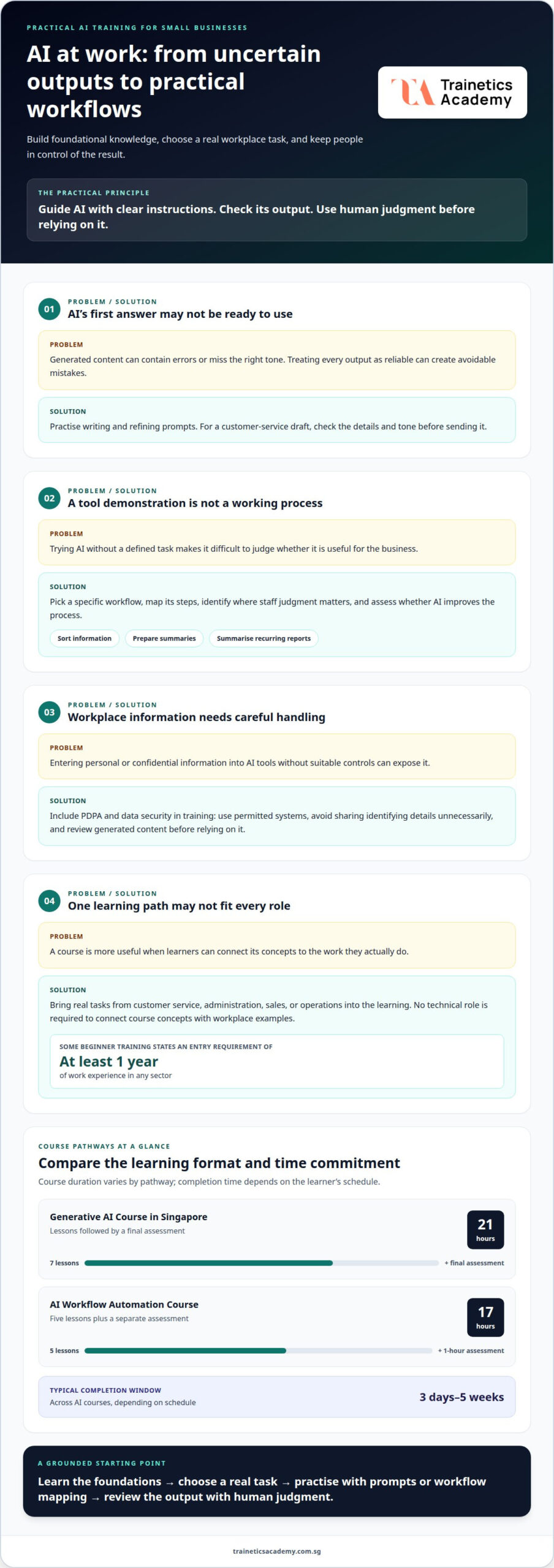
Beginner AI training should explain what artificial intelligence can do, where its limits lie, and how to use it thoughtfully at work. For a small business, the goal is practical: identify a suitable task, choose an AI approach, and evaluate the result instead of treating every output as reliable.
Foundational lessons often introduce generative AI, which creates content in response to instructions. Learners can practise writing prompts, refining requests and checking responses for accuracy. For example, a staff member might ask an AI tool to draft a customer-service reply, then verify its details and tone before sending it. These skills help employees guide AI rather than accept its first answer.
Course content may also cover workflow automation, where AI supports repeated tasks such as sorting information or preparing summaries. A useful exercise is to map a routine task, identify where human review is needed, and assess whether AI improves the process. Courses may also introduce responsible use, data handling, and the difference between generating content and making a business decision.
The stated entry requirement for some beginner training is at least 1 year of work experience in any sector. That makes the learning relevant to employees who can bring real tasks from customer service, administration, sales, or operations. No technical role is required to begin; learners need to connect course concepts with workplace examples.
Course duration varies by learning pathway. The Generative AI Course in Singapore runs for 21 hours across seven lessons, followed by a final assessment. The AI Workflow Automation Course runs for 17 hours across five lessons, plus a one-hour assessment. Learners typically complete AI courses within three days to five weeks, depending on their schedules.
The stated full fee for the Singapore AI for Beginners course is S$500 before funding. Its fee table lists 9% GST calculated on the full course fee.
Listed SSG support varies by eligibility: qualifying Singapore Citizens aged 21 to 39 and Permanent Residents receive 50% SWDA funding, while qualifying Singapore Citizens aged 40 and above receive 70%. SkillsFuture Credit is a separate funding route for eligible courses, not an automatic discount on every AI course. Compare the course’s eligibility, learner profile, and remaining fee before planning staff training.
Workplace AI can expose personal or confidential information if staff enter it into tools without suitable controls. In Singapore, include PDPA and data security in beginner training: use permitted systems, avoid sharing identifying details unnecessarily, and review AI-generated content before relying on it.
What government funding is available for companies?
Yes. Beginner-friendly generative AI courses can help Singapore SMEs build practical skills for workplace productivity and creative tasks. Begin by matching course content to a business need, such as drafting internal summaries or developing first drafts of marketing copy.
For Singapore companies, SkillsFuture Enterprise Credit can support workforce training. SkillsFuture Singapore states that companies may use up to S$10,000 in SkillsFuture Enterprise Credit to support workforce training. Employers can plan around this credit by identifying staff, selecting relevant training, and matching course costs to available support.
Eligible SMEs may also receive 70% SWDA funding for a course. An eligible SME is registered or incorporated in Singapore and has no more than 200 employees at group level, or group annual sales turnover of no more than S$100 million. These criteria help businesses assess whether the SME funding route may apply.
SkillsFuture Enterprise Credit can offset 90% of remaining course fees for employers. Businesses should check current funding terms and include any relevant deadlines in their training plans. The credit and course subsidy serve different roles: one supports eligible workforce training, while subsidies reduce eligible course fees.
Absentee payroll support can help address the cost of releasing employees for training. Eligible employees may receive S$4.50 per training hour. Employers can factor this support into scheduling, especially when several team members need time away from daily operations.
When planning generative AI training, connect the learning to specific workplace challenges. A customer-service team might practise drafting response options, then review them against company guidance. A small operations team could work on summarising reports or organising information. These exercises build digital skills and give staff a clear framework for evaluating AI outputs.
Foundational AI knowledge can also support innovation beyond individual tasks. Employees should understand how to write clear prompts, identify errors, and decide when human review is essential. Pairing these skills with existing digital processes helps a business assess where AI may contribute without treating generated content as a final business decision.
Before applying, map the process: define the training objective, identify participating employees, confirm the course’s funding route, and estimate the remaining fee. Then align training dates with staffing needs. This gives business owners a practical basis for planning SkillsFuture support while developing generative AI skills connected to workplace priorities.
Integrating AI into workflows, products, and business decisions
AI can create business value when it supports a defined workflow, product experience, or decision. Begin with a task that has a clear input and useful output, such as sorting enquiries or summarising recurring reports. Map each step, identify where staff judgment matters, and decide how to assess productivity. This prevents a tool demonstration from being mistaken for a working business process.
For operations, AI workflow automation can support repetitive information processing. An inventory team, for example, could use forecasting tools to review demand patterns and prepare replenishment suggestions. Staff still need to assess unusual orders, supplier delays, and seasonal changes. That review turns an AI-generated recommendation into one input for a sound operating decision.
Customer-facing products offer another route. A chatbot can respond to routine questions, while a recommendation engine can tailor product suggestions to customer behaviour. Real-time support across channels can make service more responsive. Businesses should define when a conversation moves to a staff member, especially when a customer’s request falls outside the chatbot’s intended role.
Build decision support around evidence, not output alone. Predictive analytics and forecasting tools can help teams examine trends and plan scenarios. For example, managers might compare forecast demand with current stock before setting purchasing priorities. They should also examine a forecast’s assumptions and consider how incomplete or outdated information could affect its recommendations.
AI agents can connect several actions within a real business workflow. Singapore businesses can build an AI agent for a real business workflow in a single First Build workshop. A practical development process is to choose one workflow, define the agent’s task, identify the information it needs, and set a human review point. Test the result against realistic cases before expanding its role.
Workforce upskilling is central to this process. Employees need to understand the workflow, assess AI outputs, and recognise when a person must take over. The AVPN AI Opportunity Fund, supported by Google.org and the Asian Development Bank, is another named initiative in the AI landscape. It is distinct from course-fee support: its existence does not establish that a particular company or training activity qualifies for funding.
To develop an implementation plan, assign a workflow owner and document the current process before introducing automation. Define what a useful result looks like, such as fewer manual hand-offs or more consistent information for planning. Review outcomes with the employees who use the process, then adjust the workflow. This creates a disciplined path from AI experimentation to measurable business practice.
AI training pathways for individuals and businesses in Singapore
Singapore learners can start with short introductions, then progress to role-based training or team projects. For businesses, the strongest learning pathway connects an operational need with the people responsible for addressing it.
Comparing AI Training Providers
AI training options in Singapore vary in format, practical focus, and intended learner. Compare whether a course teaches foundational concepts, applies AI tools to workplace tasks, or helps a team build a workflow solution. A short introductory lesson may suit initial exploration, while a business-focused programme may be more relevant to a team with a defined operational challenge.
The Singapore Business Federation works with private- and public-sector organisations to help businesses begin their AI journey with solutions suited to operational needs. Businesses can also explore support under IMDA’s AI x Digital Leaders initiative. Compare each pathway by its learning outcomes, workplace relevance, and fit with the team’s starting point.
Choosing the Right AI Training Course
Choose a course by identifying the learner, target task, and required level of practice. A business owner assessing AI strategy may need a different pathway from an employee handling daily customer enquiries. For a small team, write down one work challenge first, then compare course content with the skills needed to address it.
Check the delivery format and course structure against staff schedules. A quick AI learning resource can last 1 hour, while a longer course allows more time for guided practice. Individuals should also distinguish personal learning from company-wide upskilling, since each serves different objectives and may involve different funding routes.
For team learning, First Build recommends attending as a pair: one decision maker and one person who handles day-to-day work. That combination connects strategic priorities with practical workflow knowledge. Together, they can identify a suitable use case, explain current process steps, and assess whether an AI agent could support the work.
Individual learners can begin with an introductory course, then build toward practical applications relevant to their roles. Singapore Citizens must be at least 18 years old to qualify for the SkillsFuture AI Subscription initiative. Each eligible individual may redeem the complimentary subscription once during the three-year programme period, regardless of eligible AI course enrolments or completions.
Businesses can structure learning as a progression: introduce core AI concepts, practise with a relevant task, then review how the team applies what it has learned. For example, an employee might explore AI-supported report summaries before a manager considers broader use. This staged approach connects individual skills with business decisions.
The key is to match the learning pathway to its purpose. Choose an introductory resource for orientation, practical training for task-level capability, or a business-focused initiative when a team needs to align learning with operations. Singapore businesses should compare course outcomes and support options with their workforce needs.
What AI skills should Singapore small business owners and employees learn?
Start by defining the task. Owners should identify a business problem before selecting an AI tool, such as slow enquiry handling or repetitive report preparation. Employees can then map the current steps, inputs, and desired outputs. This gives training a practical target and helps the team judge whether an AI-assisted process addresses the actual problem.
Prompting is a foundational generative AI skill. Staff should state the task, provide relevant context, set constraints, and specify the required format. For example, a manager could request a concise summary of a meeting note, then ask separately for action items. Clear instructions make outputs easier to review and refine.
Evaluating outputs matters as much as writing prompts. Employees should compare generated claims with source documents, look for missing context, and correct inaccurate wording before use. A customer-service worker drafting a reply can check it against the customer’s actual request and company policies. Human review remains essential when accuracy or business judgment matters.
Business owners also need data literacy. They should understand what information an AI tool uses, how a forecast differs from a confirmed result, and which assumptions influence recommendations. When reviewing an inventory forecast, for example, a manager can compare suggested demand with recent orders and known supply delays before making a purchasing decision.
Workflow skills help teams move from isolated prompts to repeatable processes. Employees can document each step, identify repetitive tasks, and mark where approval or correction is needed. An operations team might use AI to sort incoming requests while a staff member handles exceptions. Mapping the process helps owners assess automation opportunities without losing oversight.
Customer-facing teams can benefit from skills in personalisation and service design. Staff can learn to review AI-generated response options, adapt the tone to different customer needs, and route complex issues to a person. A chatbot, for example, may handle common product questions while employees manage requests that need context or individual judgment.
Owners should develop decision-making skills alongside employees’ tool proficiency. Set a clear purpose, choose a workflow owner, and agree on what the team will review after a trial. Employees can record errors, useful outputs, and recurring adjustments. This creates a basis for improving the process and deciding whether broader adoption makes sense.
Finally, build responsible-use habits into everyday practice. Employees should follow company rules for approved tools, protect confidential business information, and avoid presenting generated content as verified fact. A simple review checklist can cover source accuracy, relevance, tone, and approval. These skills help Singapore small businesses apply AI thoughtfully to real workplace tasks.
Trainetics Academy: Artificial Intelligence Course
Trainetics Academy offers an Artificial Intelligence Course for learners building a practical understanding of AI. It may suit small business owners or employees seeking structured learning before applying AI concepts at work. Consider the course when your team has identified a skill gap, such as understanding AI tools or assessing where they may fit into a workflow.
Before starting, consider which roles need training and which business tasks your staff should understand better. This connects learning with your team’s goals and gives participants a clear focus.
Contact Trainetics Academy to discuss the Artificial Intelligence Course and your learning needs.
Turn AI learning into a workplace capability
Make AI learning part of how your team improves its work, not a one-off experiment. AI training for a small business in Singapore works best with a practical objective and clear ownership. Assign someone to coordinate learning, invite employees to identify tasks where AI could assist, and agree on how the team will review its use.
Build a learning rhythm that fits your operations. Employees can share useful prompts, discuss outputs that needed correction, and raise questions for further learning. As priorities evolve, revisit your team’s goals and focus development on relevant workplace challenges.
Strengthen your team’s understanding of AI with a structured next step. Contact Trainetics Academy to discuss your learning needs and move forward with purpose.
Frequently Asked Questions
Are there government subsidies available for AI training?
Yes. Funding may come through company workforce support or eligible course-level subsidies. SkillsFuture Singapore administers SkillsFuture Enterprise Credit, while eligible learners may use SkillsFuture Credit or UTAP for the Introduction AI Course. These routes serve different purposes, so distinguish employer support from individual funding when planning. Then match each employee’s intended course to its applicable eligibility conditions before setting the training budget.
Can I learn AI automation without any coding knowledge?
Yes, you can begin learning automation concepts without writing code. Start by describing a repeated task in plain language, such as sorting incoming requests, then identify the information and decisions involved. Beginner learning can introduce how AI tools support those steps and where staff review belongs. Understanding the process first helps you assess whether a no-code approach fits, rather than assuming every automation task requires software development.
Do I need a technical background or coding experience?
A technical background isn’t essential for learning foundational AI skills, though curiosity and workplace experience help connect concepts to real tasks. Some beginner courses require at least 1 year of work experience in any sector. A retail supervisor, for example, can bring practical knowledge of customer enquiries without knowing how to code. Focus on learning the terms, evaluating outputs, and deciding when human judgment should guide a task.
How can my company enrol employees for AI training?
Begin by identifying the employees who need training and the workplace capability they should develop. A Singapore business could select staff who handle customer enquiries, then define what they need to understand about AI. Trainetics Academy offers an Artificial Intelligence Course with physical and virtual learning platforms. Once your team’s priorities are clear, contact the academy to discuss the course and enrolment arrangements.
How long are the courses and can I study alongside a full-time job?
Course length depends on the learning pathway. The Generative AI Course in Singapore runs for 21 hours across seven lessons, followed by a final assessment. Learners typically complete AI courses within three days to five weeks, depending on their schedules. To plan around full-time work, compare lesson timing with busy periods, then reserve study time before enrolment. This makes it easier to coordinate learning with work responsibilities.
What can you learn here?
At Trainetics Academy, you can study through its Artificial Intelligence Course. AI learning can build a foundation for understanding AI concepts and considering their relevance at work. For example, an office administrator might explore how AI-generated summaries could support routine tasks, then practise reviewing them for accuracy. Bring a specific task you want to understand better to connect new concepts with your responsibilities.
What AI training courses are available for small businesses in Singapore?
Trainetics Academy offers an Artificial Intelligence Course for learners and organisations seeking AI education. Small businesses can start by identifying whether their priority is general understanding, employee readiness, or applying AI to a particular business task. That objective helps staff select a relevant learning focus and gives owners a clearer basis for discussing training needs with the academy, rather than choosing a course by its title alone.
How much does AI training for small businesses in Singapore cost?
The price depends on the case and is provided after a quote request. Relevant cost factors include the course, learning format, number of participants, and whether training is arranged for individuals or an organisation. Eligible funding may affect the amount a learner or employer ultimately pays, depending on the course and the applicant. Request a quote to understand the cost for your training needs.
Disclaimer
AI Content Disclaimer: Some articles on this website may be generated or assisted by AI-powered content creation tools. While we strive for accuracy and relevance, readers should independently verify information before relying on it. The content is provided for informational purposes only and does not constitute professional advice.