51% of AI-related job postings now exist outside of traditional IT sectors, according to 2026 employment placement data. You’re likely feeling the pressure of analysis paralysis as you decide where to invest your limited time. It’s a valid concern to ask, is it better to learn Python or prompt engineering first, especially if you’re intimidated by the coding learning curve or worried that prompts are just a temporary trend. We believe in building a professional identity rooted in scientific rigor and career longevity. This guide clarifies the optimal learning sequence to help you master Singapore’s modern tech landscape with confidence.
You’ll gain a strategic 6-month roadmap that secures immediate productivity gains at work while preparing you for advanced technical mastery. We’ll show you why starting with an Introduction AI Course, which is eligible for SkillsFuture Credits and UTAP funding, can be the catalyst for your professional transformation. Our sessions at 10 Anson Road, Level 22, International Plaza, Singapore 079903 are designed for those who value excellence and precision. By the end of this analysis, you’ll understand how to leverage both tools to set new professional benchmarks in your industry.
Key Takeaways
- Evaluate the 2026 tech landscape to determine whether it is better to learn Python or prompt engineering first based on your specific career trajectory.
- Understand why prompt engineering acts as a foundational “operating system” that allows you to deliver immediate professional value without a coding background.
- Identify the technical thresholds where Python becomes essential for building autonomous agents and automating complex, multi-step business workflows.
- Follow a structured 3-phase roadmap designed to transition you from a proficient AI communicator to a technical implementer in just six months.
- Learn how to select an AI course in Singapore that integrates practical industry applications with local regulatory frameworks like the PDPA.
The 2026 AI Skills Dilemma: Coding vs. Communication
Singaporean professionals often face a critical crossroads when choosing their next technical certification. The debate usually centers on a single point: is it better to learn Python or prompt engineering first to remain competitive in our local digital economy? Python is a versatile, high-level programming language that serves as the engine for data science and machine learning. In contrast, Prompt engineering is the sophisticated art of directing Large Language Models to produce specific, high-value outputs. This choice defines your professional identity in an era where technical mastery is no longer optional for leadership roles.
Modern workflows have shifted from the manual labor of writing every line of code to the strategic orchestration of intelligence. You’re no longer just a worker; you’re a conductor of digital systems. This transition requires you to identify your role early. Are you a builder who wants to construct the next generation of software infrastructure, or a user who needs to amplify their current operational productivity? In 2026, the ability to communicate with AI effectively has become as vital as the ability to program it.
To better understand the foundational choice between different technical skill sets, watch this discussion:
Why Python Remains the Backbone of AI
Python continues to provide the structural integrity for most AI applications. It’s the primary tool for data manipulation, statistical analysis, and deep learning integration. Professionals who master Python gain a level of career stability that purely prompt-based roles may lack. This is why a high-standard AI Course will typically incorporate basic scripting. At Trainetics Academy, we offer an Introduction AI Course eligible for SkillsFuture Credits and UTAP funding that bridges this gap. It allows you to build the “glue” that connects different AI agents. This ensures you aren’t just using tools, but creating custom solutions for your specific business needs at 10 Anson Road, Level 22, International Plaza, Singapore 079903.
The Rise of Prompt Engineering as a Professional Core
Prompt engineering has emerged as the essential interface for the 2026 workforce. It provides an immediate return on investment by allowing non-technical staff to perform complex tasks that previously required a developer. Research suggests that effective AI communication can save professionals more than 10 hours per week. This skill isn’t a passing fad; it’s a fundamental subset of modern tech literacy. While Python builds the engine, prompt engineering determines how well you can drive the vehicle toward your professional goals. It’s about achieving precision in communication to unlock the full potential of generative models.
Why You Should Learn Prompt Engineering First
For many professionals, the initial hurdle isn’t the difficulty of the material but the sequence of study. When deciding is it better to learn Python or prompt engineering first, the evidence for starting with prompts is compelling. Prompt engineering offers a near-zero barrier to entry. You can start delivering tangible business value on your first day without the frustration of syntax errors or debugging complex environments. This immediate feedback loop is essential for maintaining professional momentum. It transforms your daily workflow before you’ve even written a single line of script.
Adopting an “AI-native” mindset is about understanding the latent space and probabilistic nature of Large Language Models. You learn how these systems “think” and process instructions before you attempt to build them from scratch. This high-level conceptual understanding provides a strategic advantage. It shifts the focus from writing rote code to solving problems through structured logic. This shift is explored in depth when comparing Prompt Engineering vs Coding, where the focus moves toward high-level architectural thinking rather than granular manual labor.
In roles like marketing or human resources, the impact is instantaneous. A marketer can use advanced prompting to analyze 2026 consumer trends or draft hyper-personalized campaigns in seconds. An HR professional can automate initial resume screening or generate complex policy documents with precision. This isn’t just a theoretical benefit; it’s a measurable increase in operational capacity. Perhaps most importantly, mastering prompts allows you to use AI as a personal tutor for your future Python journey. You can ask an LLM to explain a specific Python function or debug a script you’ve written, creating a supportive environment where the AI acts as a mentor.
The 1 Day AI Course Singapore Advantage
Speed is a currency in Singapore’s competitive tech environment. A 1 day AI course Singapore provides the concentrated knowledge needed to bridge the gap between curiosity and competence. By focusing on rapid upskilling, you break the “learning wall” that often stops beginners. Localized training ensures you understand how to apply these tools within the specific context of Singapore’s regulatory and business frameworks, allowing you to set new benchmarks in your current role immediately.
Psychological Benefits of Starting with Prompts
Starting with natural language interaction significantly reduces “tech anxiety.” You build the foundational logic of “inputs and outputs” in a way that feels intuitive rather than intimidating. This psychological safety allows you to transition from a passive consumer to a power user of AI tools. It builds the confidence required to tackle more complex technical challenges later in your career. If you’re ready to start this journey, consider exploring the professional pathways offered at our academy to secure your future.
When Python Becomes Essential: The Second Step
While prompt engineering provides immediate utility, you will eventually encounter a technical ceiling. This occurs when your business requirements exceed the capabilities of a single chat window. If your objective is to build complex, multi-step workflows or autonomous agents that can act on your behalf, Python becomes the non-negotiable next step. It serves as the programmatic glue that connects disparate systems, allowing you to move from being an AI user to an AI architect. This shift is vital for those seeking leadership roles where technical oversight is required to manage automated departments.
The question of is it better to learn Python or prompt engineering first often resolves itself once you realize that Python enables customization that prompts alone cannot achieve. By learning to script, you can build your own AI wrappers and internal tools tailored to specific departmental needs. This transition ensures long-term career longevity in an era where basic AI literacy is becoming the baseline, not the differentiator. Mastering Python allows you to take full ownership of the AI stack, ensuring your solutions are scalable and robust enough for enterprise-level demands.
Python for AI Automation
Python is essential for connecting Large Language Models to your existing infrastructure, such as Excel spreadsheets, SQL databases, and web APIs. While a single prompt might summarize a document, a programmatic workflow can scrape hundreds of websites, analyze the sentiment of each, and update a dashboard in real-time. The Agentic Era is the convergence of high-level prompts and low-level scripts to create autonomous digital workers. This synergy allows you to move beyond simple chat interactions into the realm of true operational automation.
Data Privacy and Local Implementation
Singaporean firms, particularly in highly regulated sectors like finance and healthcare, increasingly prioritize secure, on-premise AI deployments. Managing these sensitive data pipelines requires technical expertise that prompts cannot handle alone. Proficiency in Python ensures you can implement AI solutions that comply with local standards, aligning with the benchmarks found in a comprehensive AI Course Singapore. Mastering these advanced technical requirements is the final step in securing your place in the 2026 workforce, allowing you to manage data with the precision that industry leaders expect.
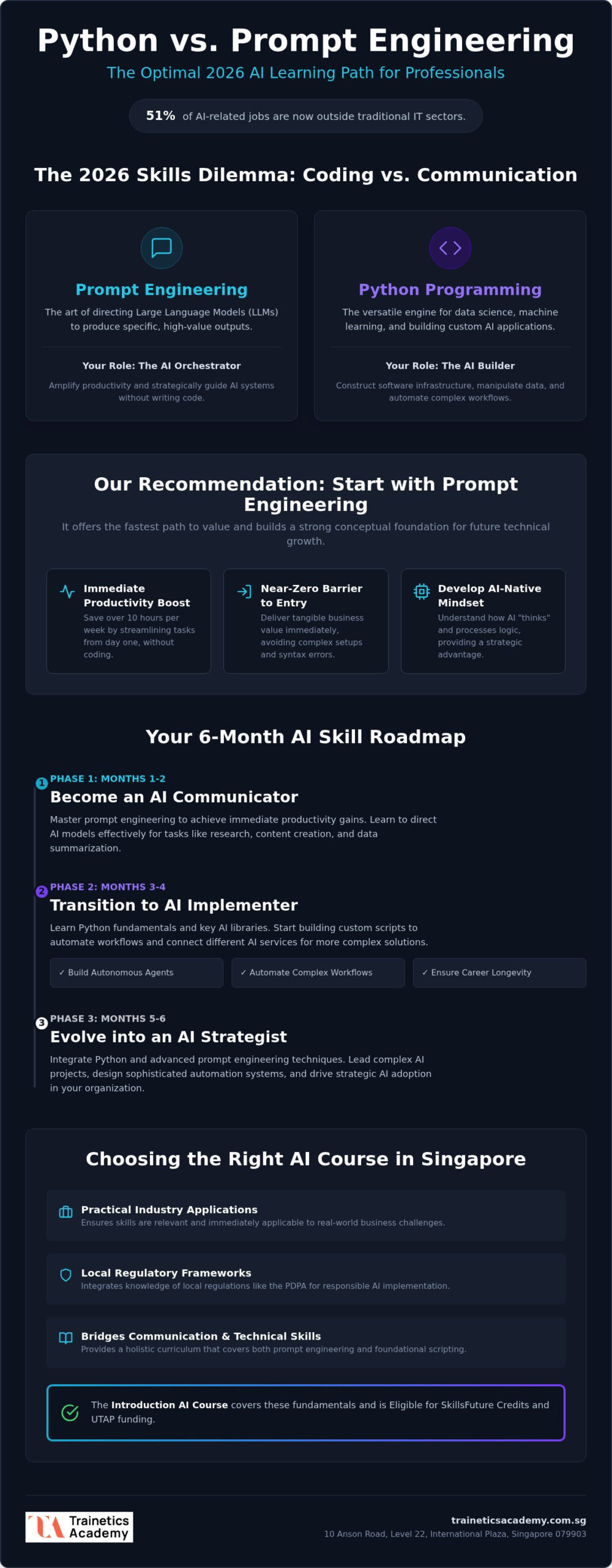
The Optimal 2026 Learning Roadmap: A 3-Phase Strategy
The most effective path to technical mastery in 2026 is not a linear choice but a strategic progression. When professionals ask is it better to learn Python or prompt engineering first, they’re often looking for the fastest route to career security. We recommend a phased approach that prioritizes immediate utility while building a rigorous technical foundation. This strategy ensures you don’t just learn tools; you develop a professional identity as an AI leader who understands both the “what” and the “how” of intelligent systems.
This roadmap relies on a recursive learning loop. Your proficiency in prompting will help you generate and debug code more effectively. Conversely, as you understand the logic of Python, your ability to structure complex prompts will improve significantly. This synergy is what separates a standard user from an industry innovator who sets new professional benchmarks.
Phase 1: The ‘Prompt-First’ Foundation
Your first month should focus exclusively on mastering generative AI workflows. You must move beyond simple queries and master advanced techniques such as zero-shot, few-shot, and chain-of-thought prompting. These methods allow you to guide an AI through complex reasoning steps, ensuring the output is precise and scientifically grounded. Achieving “superuser” status in your current role provides the psychological win needed to tackle harder technical subjects later. To begin this transformation, see our guide on Maximizing Your SkillsFuture Credit for AI courses. A concentrated 1 day AI course Singapore can often provide the jumpstart required for this phase.
Phase 2: Transitioning to Logic with Python
During months two and three, you should begin integrating Python syntax and logic into your skill set. Focus on the core building blocks: variables, loops, and functions. In 2026, the barrier to entry is lower because you can use AI to interpret complex scripts. Reading code is often easier than writing it from scratch; use your prompting skills to have the AI explain how a specific script works. This is why a high-quality AI course for beginners should emphasize the transition from natural language instructions to programmatic logic. It ensures you aren’t just memorizing syntax but understanding the underlying architecture of digital automation.
Phase 3: Building and Orchestrating Applications
The final phase, spanning months four to six, involves building AI-powered applications. This is where you use Python scripts to automate multi-step tasks that prompts alone cannot handle. You’ll learn to connect your AI models to external data sources and create custom internal tools. By the end of this six-month journey, you won’t just be asking if it is better to learn Python or prompt engineering first; you’ll be utilizing both as a unified toolkit. If you’re ready to accelerate this timeline, enroll in our comprehensive AI Course to secure your future in the Singapore tech landscape.
Choosing the Right AI Course in Singapore for Your Goals
Selecting an education partner in the current landscape requires a discerning eye for both technical depth and practical application. You must evaluate whether a curriculum effectively addresses the core strategic question: is it better to learn Python or prompt engineering first? A course that ignores the synergy between these two disciplines will leave you with a fragmented skill set. In a market where precision is paramount, you need a learning path that respects both the sophisticated art of communication and the rigorous science of implementation.
Local context is the primary differentiator for professionals seeking to advance within the region. Singaporean industries demand a high standard of excellence, particularly regarding data security and adherence to the PDPA. Professional readiness isn’t just about knowing the tools; it’s about understanding their ethical and legal application within our specific digital economy. Our focus remains on raising professional benchmarks, ensuring that your transition into an AI-driven role is both secure and scientifically grounded. We move beyond abstract theory to provide a professional identity that is respected across the tech sector.
Navigating the Singaporean AI Education Landscape
High-level professional training should ground technical skills in practical, regional frameworks. By leveraging available government support for lifelong learning, you can access elite-level education that empowers your career trajectory. Choosing a provider that understands the high standards of the local industry ensures your new competencies are immediately applicable. This strategic approach to upskilling allows you to set new benchmarks in your current role while preparing for the technical shifts of the coming years.
The Trainetics Academy Difference
We believe in fostering a professional identity rooted in excellence and continuous improvement. Our approach transitions you from a student to a visionary mentor capable of orchestrating the complex AI workflows described in our roadmap. This focus on professional readiness over abstract concepts ensures you can command the digital tools of the future with confidence and authority. If you’re ready to master the synergy of code and communication, join our next AI Course at Trainetics Academy and redefine your technical potential.
Secure Your Professional Identity in the AI Era
Mastering the 2026 tech landscape requires a disciplined approach to upskilling. You’ve seen that while Python provides the structural integrity for complex automation, prompt engineering offers the immediate operational leverage needed to excel today. The question of whether is it better to learn Python or prompt engineering first is ultimately about timing. Start with the interface to gain confidence; then move to the engine to build lasting career longevity. This symbiotic relationship between communication and code is the hallmark of a top-tier professional.
Trainetics Academy serves as your visionary mentor in this transition. We offer an expert-led, 1-day intensive format that prioritizes practical readiness over abstract theory. Our curriculum aims to raise professional benchmarks and ensures you’re prepared for the agentic era of artificial intelligence. Don’t let analysis paralysis stall your progress in Singapore’s competitive market. Take the first step toward technical mastery and international excellence by joining our community of elite practitioners who value precision and hard work.
Enroll in our SkillsFuture Eligible Introduction AI Course Today and accelerate your career at our International Plaza location. Your journey toward becoming an industry leader starts with a single, decisive action.
Frequently Asked Questions
Do I need a math background to learn Python for AI?
You don’t need a degree in mathematics to implement Python in a professional AI context. While the underlying science of machine learning involves calculus and linear algebra, most industry applications in 2026 rely on pre-built libraries and logical frameworks. Your success depends more on your ability to structure data and understand systemic logic than on solving complex equations manually. This allows you to focus on high-level architectural decisions rather than granular calculations.
Can I get a job with just Prompt Engineering skills in 2026?
You can certainly enter the workforce with a focus on AI communication, as many professional services now prioritize “AI literacy” for operational roles. Industries such as banking, human resources, and supply chain management require specialists who can refine model outputs for specific business needs. However, the question of is it better to learn Python or prompt engineering first is often about your long-term ceiling. While prompts get you in the door, technical skills ensure you stay in the room as an indispensable leader.
Is the Introduction AI Course at Trainetics Academy eligible for government support?
Our training programs are designed to align with Singapore’s national strategic focus on workforce upskilling. We provide various pathways for professionals to access our curriculum, ensuring that elite-level education remains a viable option for those committed to excellence. You should consult with our academic advisors regarding the specific financial frameworks and support available for your professional development journey, as we aim to facilitate a seamless transition into your new career identity.
How long does it take for a beginner to become proficient in Python?
A focused professional can typically reach a functional level of proficiency within three to six months. This timeline assumes you are targeting AI-specific applications rather than general software engineering. By concentrating on the “glue” code needed to connect different AI agents and data sources, you can begin automating complex workflows relatively quickly. This methodical approach builds the confidence required to move from basic scripting to advanced systems orchestration.
Will AI eventually write all the code, making Python obsolete?
AI will likely handle more rote coding tasks, but this makes the human architect even more essential. Python remains the primary language for directing these automated systems and ensuring their output meets rigorous professional benchmarks. Your role is evolving from a manual builder into a disciplined conductor. Proficiency in the language allows you to verify, debug, and secure AI-generated scripts, maintaining the high standards required in a corporate environment.
What is the best 1 day AI course Singapore offers for busy professionals?
The Introduction AI Course at Trainetics Academy is specifically tailored for those who value time and precision. We offer a concentrated, intensive format that distills complex technical concepts into actionable professional strategies. Our curriculum is designed to provide an immediate return on investment, allowing you to implement new efficiencies in your workflow the very next day. This focus on practical readiness makes it the premier choice for leaders who demand results over abstract theory.
Are there any subsidies for corporate AI training in Singapore?
Singapore maintains a robust ecosystem of support for professional development and corporate upskilling. These regional educational frameworks are designed to raise industry benchmarks across the board, ensuring the workforce remains ready for the demands of the digital economy. Organizations looking to integrate AI into their operations can often find support through various national initiatives. We recommend exploring these options to ground your team’s education in a relatable, practical context.
How do I start learning AI if I have zero technical experience?
Start by mastering the interface of AI through sophisticated communication techniques before diving into the underlying code. This sequence provides an immediate sense of accomplishment and helps you understand the probabilistic nature of Large Language Models. Once you are comfortable directing these systems, the transition to technical logic becomes a natural extension of your skills. This supportive learning path is designed to eliminate tech anxiety and replace it with a sense of security and professional ambition.
Disclaimer
AI Content Disclaimer: Some articles on this website may be generated or assisted by AI-powered content creation tools. While we strive for accuracy and relevance, readers should independently verify information before relying on it. The content is provided for informational purposes only and does not constitute professional advice.